The Battery Regulation: what actually applies to a robot fleet's packs
The worry is that every robot battery will need a passport and have to come out tool-free. Two numbers on the nameplate decide both — and for the mid-sized commercial pack the answer is not the expected one.
Since the Battery Regulation came into force, the same assumption keeps appearing in fleet conversations: that every robot battery now needs a passport, and that it has to be removable too. For the typical pack in a commercial service robot neither follows automatically. The Regulation does not decide by field of application but by two thresholds — five kilograms of mass and two kilowatt-hours of capacity. Between them sits a case the common reading misses.
Key Takeaways
- 1Regulation (EU) 2023/1542 entered into force on 17 August 2023 and sets out five battery categories.
- 2Under Article 3 a portable battery is sealed, weighs 5 kg or less and is not designed specifically for industrial use. A heavier robot pack therefore falls into the industrial battery category.
- 3Article 11 on removability and replaceability covers portable and LMT batteries and applies from 18 February 2027 — it does not reach industrial batteries.
- 4The digital battery passport applies from 18 February 2027 to electric vehicle, LMT and rechargeable industrial batteries above 2 kWh, accessible by QR code.
- 5A pack over 5 kg with 2 kWh or less is an industrial battery with no passport duty and no Article 11 removability duty.
Two numbers decide it, not the word “industrial”
Regulation (EU) 2023/1542 on batteries and waste batteries entered into force on 17 August 2023. Since then the same worry keeps surfacing in fleet conversations: that every robot battery now needs a battery passport and has to be removable by the user.
Neither holds straightforwardly for a typical commercial service robot. The obligations turn on two thresholds that have nothing to do with the field of application and everything to do with mass and capacity: five kilograms and two kilowatt-hours. Know those two numbers for the pack in front of you and you know the obligations.
How the Regulation classifies a robot pack
Article 3 sets out five battery categories: portable batteries, SLI batteries, batteries for light means of transport (LMT), electric vehicle batteries and industrial batteries.
A portable battery is defined as a sealed battery weighing 5 kg or less, not designed specifically for industrial use, and which is neither an electric vehicle battery nor an LMT battery nor an SLI battery. The five-kilogram mass threshold therefore sits inside the definition itself.
The classification for the ordinary fleet case follows from that: a battery pack in a commercial cleaning or transport robot that weighs more than five kilograms and is neither a vehicle, LMT nor SLI battery is not a portable battery. It lands in the industrial battery category — through the residual effect of the definitions, not because anyone regards the robot as “industrial”.
Article 11 does not reach industrial batteries
The obligation most often transferred wrongly is removability. Article 11 governs the removability and replaceability of batteries and, by its scope, applies to portable batteries and LMT batteries. It applies from 18 February 2027.
For portable batteries it requires that they be readily removable and replaceable by the end-user using commercially available tools, without the need for specialised tools — unless those are provided free of charge. For LMT batteries, which power e-bikes and e-scooters among others, removability by an independent professional applies, and it extends to the individual cells. A battery counts as readily replaceable where, after removal, it can be substituted by a compatible battery without negatively affecting the functioning, performance or safety of the product.
An industrial battery is not caught by Article 11. The idea that every robot pack will have to become tool-free swappable has no basis in this provision.
The battery passport starts above two kilowatt-hours
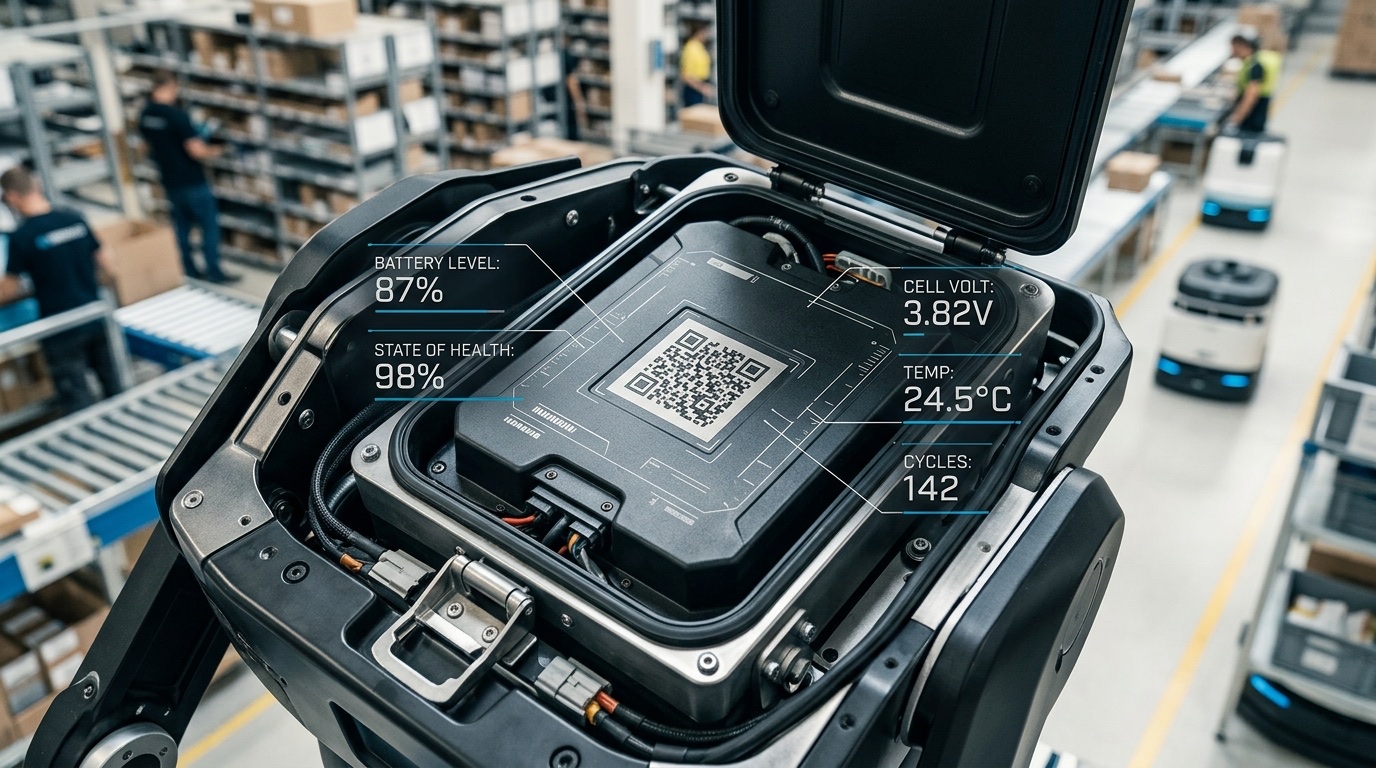
The second threshold is capacity. From 18 February 2027, electric vehicle batteries, LMT batteries and rechargeable industrial batteries with a capacity of more than 2 kWh placed on the EU market must carry a digital battery passport, accessible via a QR code.
The passport carries information specific to the battery and its sustainability requirements, and provides up-to-date data on handling instructions and state of health to recycling operators and to those repurposing batteries for a second life.
It is a yes-or-no line read off the nameplate. It does not scale with how many machines are in service or how often they charge.
The gap between five kilograms and two kilowatt-hours
The two thresholds together produce a case the common reading does not anticipate.
A pack weighing more than five kilograms is no longer a portable battery, so Article 11 and its removability duty do not bite. If its capacity is at the same time 2 kWh or below, the battery passport duty does not bite either, because that one requires more than 2 kWh.
Such a pack is an industrial battery with no passport and no Article 11 removability requirement. This is not a loophole but the result of how the categories are drawn: the Regulation aims its sharpest instruments at large storage and at consumer products, not at the mid-sized commercial pack in between.
For an operator that means the question is not whether the Regulation “applies to robots”. The question is what mass and what capacity are printed on the specific pack — and the answer can differ from one machine model to the next.
Carbon footprint: the same capacity line
The 2 kWh line appears a second time. Article 7 requires a carbon footprint declaration for electric vehicle batteries, for LMT batteries and for rechargeable industrial batteries with a capacity greater than 2 kWh. The footprint is calculated across the production process using life cycle assessment methodology.
So the same number separates two very different sets of obligations. A pack above the line pulls in both the passport and the footprint declaration; a pack below it pulls in neither. That is the line that carries real weight in a specification — not the category label.
What is left of this for fleet planning
The obligations sit primarily with the economic operator placing the battery on the market, not with the fleet operator. The operator meets the Regulation where it touches selection and the spare-parts route: through the category a pack falls into, and through whether a passport will exist for that model.
Two figures settle it: the mass of the pack and its capacity in kilowatt-hours. Both are on the nameplate. Everything else follows from those — and not from whether a machine is perceived as an industrial application.
FAQ
- Does every robot battery need a battery passport?
- No. The digital battery passport applies from 18 February 2027 to electric vehicle batteries, LMT batteries and rechargeable industrial batteries with a capacity of more than 2 kWh. If a pack's capacity is 2 kWh or below, no passport duty arises from that provision.
- Is a robot battery a portable or an industrial battery?
- Article 3 defines a portable battery as a sealed battery weighing 5 kg or less, not designed specifically for industrial use, and neither an electric vehicle, LMT nor SLI battery. A pack over five kilograms does not meet that definition and falls into the industrial battery category.
- Does the battery have to be removable by the operator?
- Article 11 on removability and replaceability applies to portable batteries and LMT batteries and takes effect from 18 February 2027. Portable batteries must be removable by the end-user with commercially available tools; LMT batteries by an independent professional. Industrial batteries are not covered by that provision.
- What information is needed to settle the classification?
- Two figures: the mass of the pack and its capacity in kilowatt-hours. Mass decides the boundary with portable batteries at five kilograms; capacity decides the battery passport and the carbon footprint declaration at two kilowatt-hours. Both appear on the nameplate.
- Does the carbon footprint declaration apply to robot batteries?
- Article 7 requires a carbon footprint declaration for electric vehicle batteries, LMT batteries and rechargeable industrial batteries with a capacity greater than 2 kWh. It is the same capacity threshold as the battery passport.
Related reading
Year three: what happens to a robot fleet at end of life
Battery ageing, OEM end-of-support, residual value and contract exit. What changes after go-live, and why the integration layer is what makes a hardware swap survivable.
28 August 2026robot fleet sizingRobot Fleet Sizing: Strategy for Scaling Success
Precise fleet sizing determines ROI and operational stability. Learn how werob translates workflows into exact hardware requirements.
6 June 2026eu machinery regulationEU Machinery Regulation 2023/1230: A Guide for Operators
From 20 January 2027, the new EU Machinery Regulation 2023/1230 sets new standards for robotics in Europe. Operators must act now to ensure the conformity of their fleets and avoid liability risks.
1 June 2026medical device regulation robotsMedical Device Regulation Robots: Compliance and Use in Care
The distinction between the Medical Device Regulation (MDR) and the Machinery Regulation determines liability when deploying robots. werob provides the legally secure path for operators of medical facilities.
12 June 2026robot fleet teleoperationTeleoperation: When robot fleets need a human in the loop
Even mature autonomous fleets run into real-world edge cases that require a human in the loop. This guide breaks down latency requirements, operator ratios, and regulatory requirements for teleoperation as an industry-standard fallback layer.
14 August 2026