Robot Fleet Sizing: Strategy for Scaling Success
Precise fleet sizing determines ROI and operational stability. Learn how werob translates workflows into exact hardware requirements.
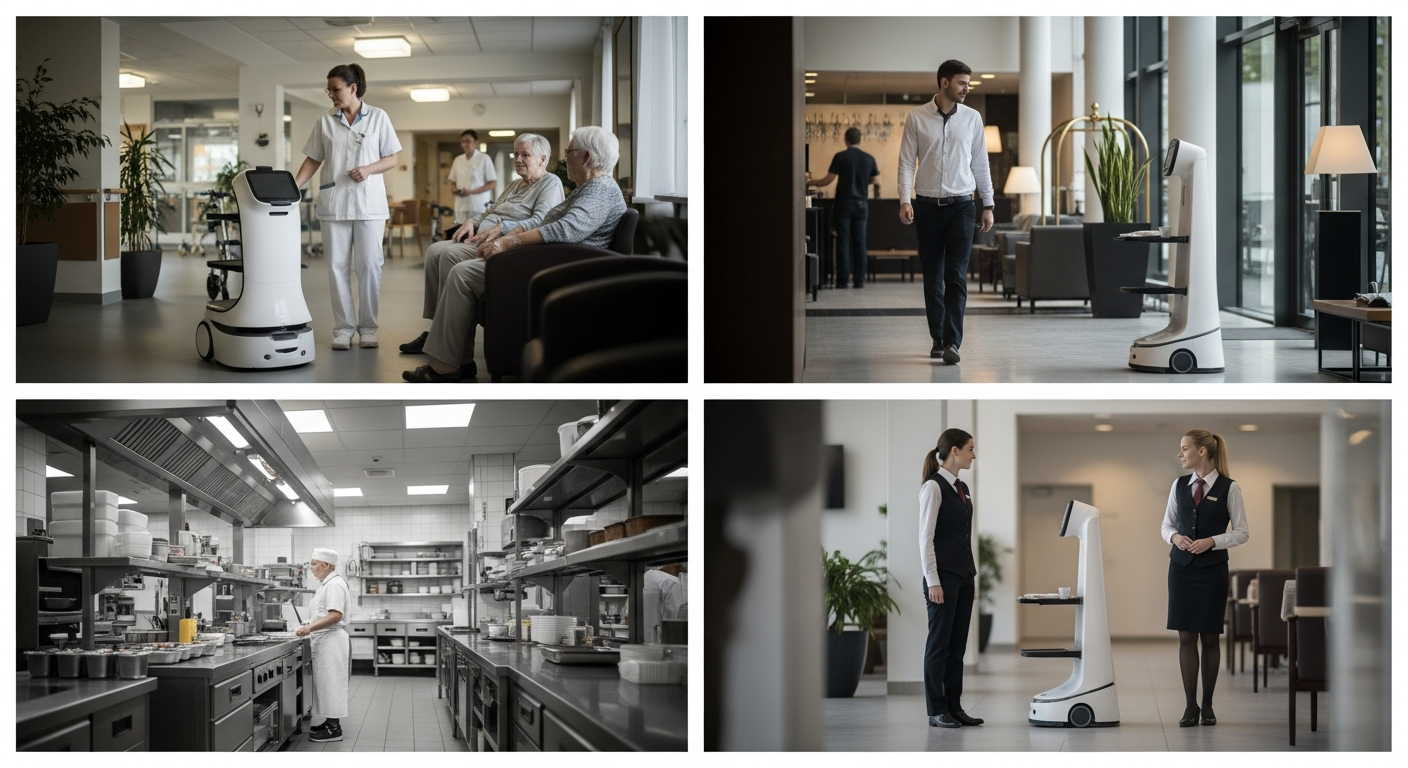
Ward 4. 3:15 a.m. The night watch is occupied with emergencies, while the autonomous transport robot completes the third medication round autonomously. Fleet sizing is not a theoretical value but the difference between operational relief and system standstill. If the number of units is not precisely matched to the peak loads, the workflow collapses in critical phases. werob comes in here to close the gap between process description and actual fleet strength. We regard the fleet not as a collection of hardware but as operational capacity that has to be scaled precisely to your shift schedules.
Key Takeaways
- 1Precise fleet sizing prevents operational bottlenecks and unnecessary investment costs through exact peak-load analysis.
- 2The werob Spec Engine delivers a deployable specification within 48 hours based on real process data.
- 3Hardware agnosticism enables access to more than 280 robot models and protects against supply bottlenecks of individual manufacturers.
The Mathematical Basis of Fleet Sizing
Determining the correct fleet size begins with a detailed throughput analysis. In logistics or care, it is not enough to know the average number of tasks per shift. What is decisive is the variance of the peak loads. A robot dimensioned for the average value will fail in 90 percent of deployments if these are concentrated in a two-hour time window. We calculate the fleet sizing based on the cycle time, which is composed of the travel time, the loading and unloading time, as well as the necessary buffer times for obstacle avoidance.
A decisive factor is the ratio of deployment time to charging time. Modern lithium-ion batteries do allow interim charging, but this must be strategically integrated into the workflow. When a robot is deployed in a care facility for transporting laundry carts, the fleet size must be chosen so that no supply gaps arise during the charging phases of individual units. werob analyzes these parameters in a hardware-agnostic manner and compares more than 280 different robot models from more than 44 OEM partners in order to find the most efficient combination for your site.
Spec Engine: From Process Description to Number of Units
The conventional path to fleet sizing in industry often takes three to six months and comprises numerous discovery workshops. werob shortens this process to 48 hours with the Spec Engine. Our engine is trained on data from more than 35,000 projects and translates your operational description directly into a technical specification. You specify how many medication rounds or room service trips occur per shift, and the system calculates the necessary fleet strength.
This speed is decisive for companies suffering from an acute staff shortage. Instead of discussing concepts for months, you receive a concrete quote within five days. The Spec Engine takes into account not only the pure number of robots but also the necessary infrastructure such as charging stations and network coverage. Through this automated approach, we reduce the risk of human estimation errors, which often lead to over- or under-dimensioning. The result is a precision in capacity planning that can be directly transferred into operational deployment.
Hardware Agnosticism as a Safety Factor in Planning
A common mistake in fleet sizing is vendor lock-in. Anyone who commits early to a single manufacturer is tied to its capacities and technical limits. werob pursues a hardware-agnostic approach. We rank more than 44 OEM partners against your specific requirements. If a manufacturer cannot deliver the required quantity promptly or the technical specifications are insufficient for a particular gradient in the building, our Supplier Match immediately suggests alternatives.
This flexibility is especially important when it comes to scaling. A fleet can consist of various robot types that are controlled centrally via the werob Cockpit. This way, more cost-effective models can be chosen for simple transport tasks, while specialized units are deployed for complex interactions. This differentiation considerably optimizes the total costs of the fleet. Because werob is not a reseller of a single manufacturer, the advice remains objective and purely oriented toward the operational result. You receive the hardware that best fits your workflow, not the one that happens to be in a dealer's warehouse.
Integration into the Operator Stack
A robot fleet is only as effective as its connection to the existing systems. Without integration, every robot remains an isolated island solution that has to be triggered manually. werob delivers pre-built connectors into the common operator stack. In care, this means a direct connection to PointClickCare or MatrixCare. In hospitality, we integrate into Opera PMS or Mews. These connectors ensure that tasks are automatically generated and distributed to the fleet.
Fleet sizing must reflect this depth of integration. A fully integrated robot achieves a considerably higher utilization than a manually operated device. As a result, in many cases the total number of required units can be reduced, which lowers the investment costs. When SAP EWM in logistics communicates directly with the robot fleet, waiting times at the transfer stations are eliminated. Our connectors ensure that the data flows and the robot fleet acts as an integral part of your digital infrastructure. This is a core aspect of our promise: in eight weeks from project start to productive deployment.
Regulation and the EU Machinery Regulation 2023/1230
When sizing a fleet, legal frameworks must be taken into account from the outset. A critical factor is the new EU Machinery Regulation 2023/1230, which is binding from 20 January 2027. This regulation imposes high requirements on conformity assessment, especially when robots from different manufacturers work in a common system. werob acts here as your compliance path. We ensure that the entire fleet complies with the European safety standards.
In addition, vertical regulations such as ISO 13482 for service robots in care or the BewachVO in the security area must be observed. An incorrectly sized fleet that leads to overly dense traffic in public areas can harbor safety risks and entail regulatory problems. werob integrates this compliance check directly into the Cockpit. The four-dimensional traffic-light system monitors not only the hardware and infrastructure but also the regulatory status of each individual unit. This way, you remain audit-capable at all times and minimize liability risks that could arise from operating autonomous systems.
Cost Relief in Care through Precise Planning
In the care sector, the cost pressure is immense. Precise fleet sizing enables significant savings here. For a typical medication round in a care facility, we have determined annual cost relief of a significant amount per site. This figure is based on the takeover of repetitive travel times by the robot fleet, which frees up the specialist staff for direct resident care. For the pure transport of laundry or meals, the relief amounts to around a considerable amount per year.
However, these results are only achievable if the fleet is precisely sized. Too few robots lead to the staff having to walk themselves again when a device is occupied. Too many robots cause unnecessary costs and get in each other's way. werob uses the data from our customers to validate these calculations. Our goal is an outcome-only model: you only pay once the robot is running and taking over the defined workflow. This shifts the risk of sizing from you to us as the systems integrator.
Scaling Effects in Hospitality and Gastronomy
In hospitality, automating room service offers enormous potential. A correctly sized fleet can realize cost relief of a considerable sum per site per year here. This is not only about delivering food and drinks but also about relieving floor cleaning through the transport of cleaning agents and waste. In the preparation of the bar and breakfast buffet, the savings potential amounts to a significant sum annually.
The challenge in hospitality is the extreme fluctuation in utilization. During breakfast time, the need for robot capacity is highest. Static planning would fail here. Through the live Cockpit, werob enables a dynamic assignment of tasks. Robots that are active in room service at night can support breakfast preparation in the morning. This multifunctional use reduces the number of required units and increases the ROI. Through integration into systems such as Opera PMS or Mews, the control takes place seamlessly in the background without the staff having to intervene.
The Cockpit: Live Management of Fleet Size
After commissioning, the phase of continuous optimization begins. The werob Cockpit offers real-time fleet management that goes far beyond simple status reports. It monitors the hardware health, the network infrastructure, and adherence to the operational specifications. When the data shows that a fleet is permanently operating at its capacity limit, the Cockpit delivers the basis for a decision on expansion. Conversely, underutilized units can be identified and repurposed for other tasks.
This monitoring is essential for long-term success. A robot that regularly stops due to faulty Wi-Fi coverage in a certain zone lowers the effectiveness of the entire fleet. The Cockpit detects such patterns immediately and enables targeted troubleshooting. Because werob already operationally looks after 200 robots in 11 European countries, these experience values flow directly into the further development of the platform. We offer you the operational layer that ensures your investment in robotics permanently delivers the promised results.
Outcome-only: werob's Commercial Model
An essential differentiator of werob is our commercial model. We dispense with classic list prices for hardware. Instead, our model is based on the result. You pay nothing before the robot is running in your operation and taking over the specified tasks. This outcome-only model forces us as an integrator to carry out the fleet sizing with absolute precision from the outset. A planning error would be directly to our detriment.
This model offers you maximum security. You do not have to invest high upfront capital in hardware whose benefit you have not yet been able to validate in detail. Together, we define the success criteria, be it the number of completed transports or the relief of the staff by a certain number of hours. Only once these goals have been reached does the model become commercially active. This is the fairest way to make the advantages of robotics accessible in industries such as care, hospitality, or logistics without burdening the operational budgets with incalculable risks.
FAQ
- How long does it take until the optimal fleet size is determined?
- With the werob Spec Engine, you receive a precise specification and the requirement for robot units for your specific workflow within 48 hours.
- Which data is needed for fleet sizing?
- We need information on your shift schedules, the tasks to be handled (e.g. number of transports), the building structure, and the existing IT systems.
- Can the fleet be expanded subsequently?
- Yes, the werob Cockpit monitors utilization live. As demand rises, additional units can be seamlessly integrated into the existing fleet.
- How is compliance with the EU Machinery Regulation ensured?
- werob acts as a systems integrator and takes over the compliance path in order to ensure that all deployed robots comply with Regulation 2023/1230.
- What cost saving is realistic in care?
- A correctly sized fleet can achieve annual cost relief of up to a significant amount per site on medication rounds in care.
- Do I have to buy the robots in advance?
- No, werob works according to an outcome-only model. You only pay once the robot fleet is running operationally and fulfilling the defined tasks.
Related reading
Fleet Sizing Humanoid Robots: Operational Planning Guide
Scaling from a single humanoid pilot to a live fleet requires precise unit density calculations. This guide details how to size humanoid fleets for senior living, hospitality, and logistics using the werob Spec Engine.
1 July 2026robot fleet managementRobot Fleet Management: Scaling Operations Beyond the Pilot
Moving from a single robot to a fleet requires more than hardware. It demands a centralized operating layer that connects workflows, compliance, and real-time performance data.
6 July 2026robotics fleet planningRobotics Fleet Planning: Strategies for Scalable Automation
Professional robotics fleet planning transfers isolated pilot projects into profitable operational processes. As a systems integrator, werob delivers the manufacturer-independent platform for the specification, selection, and live management of your robot fleet.
6 June 2026robot fleet end of lifeYear three: what happens to a robot fleet at end of life
Battery ageing, OEM end-of-support, residual value and contract exit. What changes after go-live, and why the integration layer is what makes a hardware swap survivable.
28 August 2026fleet management humanoid robotsFleet Management for Humanoid Robots: Operational Scaling
Managing humanoid robots requires more than a remote control. It demands a unified operating layer that handles compliance, stack integration, and live performance monitoring across diverse hardware.
1 July 2026