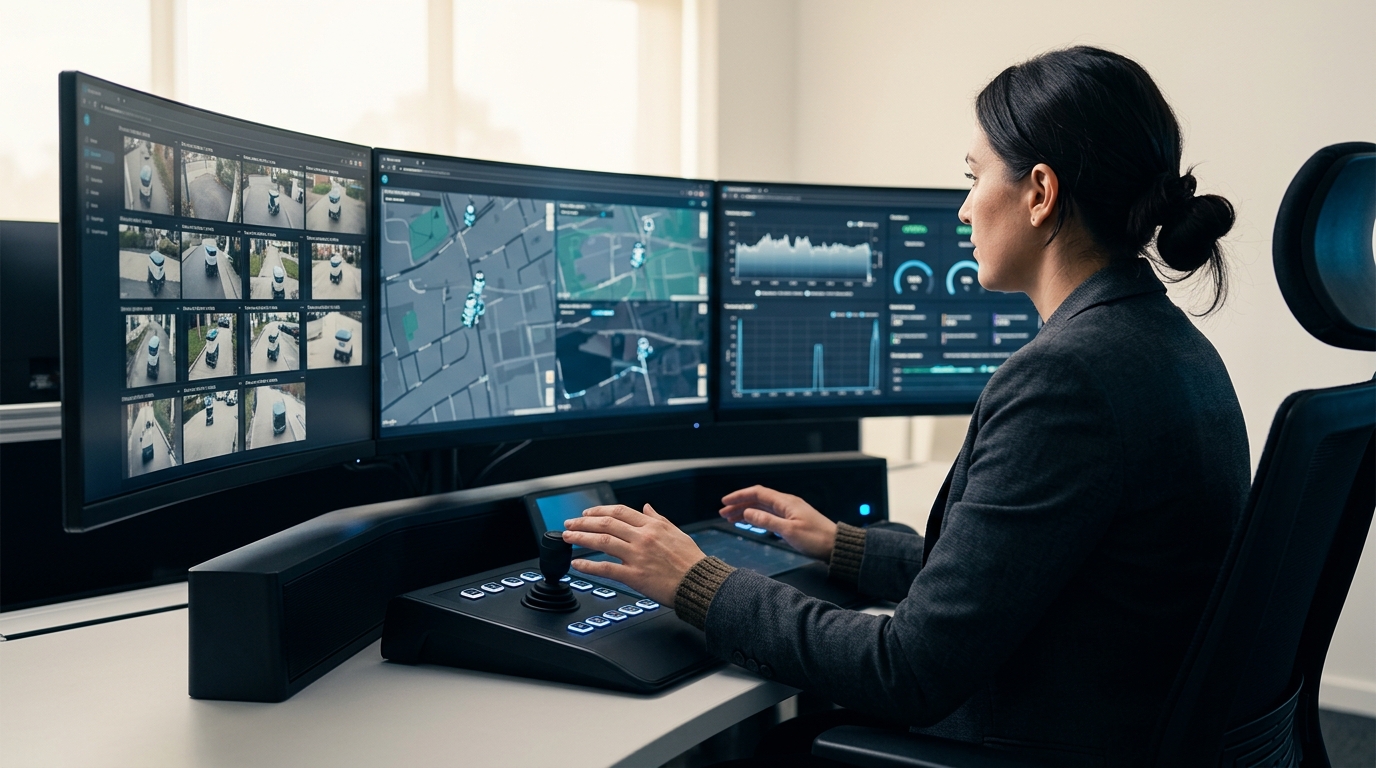
Teleoperation: When robot fleets need a human in the loop
Even mature autonomous fleets run into real-world edge cases that require a human in the loop. This guide breaks down latency requirements, operator ratios, and regulatory requirements for teleoperation as an industry-standard fallback layer.
Autonomous mobile robots and service robots achieve impressive reliability in structured environments. In real-world operational settings such as manufacturing halls, logistics centres, hotels, and healthcare facilities, however, purely autonomous algorithms regularly encounter their practical boundaries. Dynamic obstacles, temporary layout changes, unexpected reflections on cleaned floors, and abrupt lighting variations often cause navigation systems to lose localisation or initiate defensive safety stops.
Key Takeaways
- 1Autonomy limits: A relevant share of operative challenges are edge cases requiring a human fallback layer.
- 2Latency limits: Glass-to-glass latency should remain under 100 ms; latencies above 170 ms degrade remote control.
- 3Regulation: The EU Machinery Regulation 2023/1230, mandatory from 2027, governs remote access for robot cells.
- 4Cybersecurity: The IEC 62443 standard secures industrial remote control systems against unauthorized access.
- 5Scalability: With hardware-agnostic sourcing, deploying a live teleoperated fleet can take as little as eight weeks.
The 95 percent problem: Why autonomy alone is not enough
In operational practice, these edge cases account for a relevant share of day-to-day deployment challenges. When a robot halts in an edge case, it blocks travel aisles, delays downstream processes, and requires the physical intervention of on-site service personnel. For facility managers and operations leaders, every on-site rescue represents unplanned downtime costs and ties up valuable technical staff.
- Optical distortions: Low-angle sunlight or highly reflective flooring blinding lidar and optical camera sensors.
- Temporary bottlenecks: Pallets, cleaning carts, or groups of people fully blocking the calculated trajectory.
- Undefined transitions: Transitions between hall sectors, elevators, or outdoor zones overtaxing static environment maps.
- Sensor drift: Gradual odometry inaccuracies creating drift across simultaneous localisation and mapping (SLAM) coordinate frames.
Achieving economically viable and stable mobile robotics operations requires a standardised fallback pathway. Teleoperation bridges these residual exception cases across modern industrial deployments, enabling continuous mixed-traffic workflows alongside human staff without requiring physical safety fences.
Teleoperation as a concept: The human in the loop
Within modern robotics architectures, teleoperation serves as an established, industry-wide concept to ensure operational resilience across autonomous fleets. The approach follows a human-in-the-loop paradigm: robotic units operate fully autonomously during nominal conditions and request human assistance only when internal algorithmic confidence drops below a defined threshold.
When onboard systems detect an unresolvable navigation loop, a blocked path, or sensor degradation, the system transfers decision-making authority to a remote operations centre. A trained remote operator connects digitally to the live telemetry and vision streams, evaluates the environment, and guides the unit past the bottleneck before releasing control back to the autonomous navigation stack.
- Event detection: The robot detects an anomaly, comes to a controlled stop, and transmits a status code to the central fleet management system.
- Operator connection: The remote human in the loop accesses live multi-camera feeds and telemetry via a secure web interface.
- Trajectory correction: The operator navigates the unit past the hazard area or approves an alternate waypoint.
- Handback to autonomy: The onboard system validates its spatial coordinates and autonomously resumes the planned mission.
This structured intervention resolves immediate blockages within seconds while capturing high-value training data. Each resolved edge case can be logged and annotated, providing continuous datasets for retraining and refining fleet-wide autonomous navigation models.
Network and latency: Technical prerequisites
The technical viability of remote robotic control depends directly on the quality and determinism of the communication network. While standard diagnostic telemetry requires only minimal bandwidth, live teleoperation demands multichannel, high-resolution video streams transmitted with minimal delay.
Round-trip latency between the control station and the robot drivetrain determines physical safety. Empirical research demonstrates that constant latency below 170 ms remains manageable for remote human operators, whereas delays approaching 300 ms noticeably impair steering precision and reaction times. Sudden latency spikes induce oversteering and unstable braking, creating severe collision hazards in active environments.
| Network Parameter | Teleoperation Requirement | Operational Significance |
|---|---|---|
| Round-trip latency | Glass-to-glass below 100 ms | Prevents steering lag and overcorrection during directional changes. |
| Connection availability | Carrier-grade, near-continuous uptime | Guarantees uninterrupted command transmission during emergency manoeuvres. |
| Uplink bandwidth | 10 to 25 Mbit/s per active unit | Supports compressed real-time multi-camera video streams. |
| Jitter stability | Minimal and predictable variance | Ensures consistent video frame delivery without stuttering. |
To maintain these strict parameters across large manufacturing facilities or extensive corporate campuses, operators increasingly deploy private 5G campus networks. The 3GPP Ultra-Reliable Low-Latency Communication (URLLC) profile specifies 99.9999% reliability and latency of 1 ms or less, far tighter than the 30 ms to 100 ms end-to-end delay typically accepted on general IP networks.
Operator ratio and fleet management
A classic teleoperation model where each robot requires a dedicated, continuous human operator (a 1:1 ratio) is economically unsustainable. The economic leverage of autonomous fleets emerges through an asymmetric supervisory model, in which a single control station operator manages dozens of autonomous units (a 1:N ratio).
A professional fleet dashboard aggregates the operational status of all active units, relying on management by exception. Instead of continuously viewing dozens of live video feeds, the operator monitors global fleet health and engages only when an individual unit raises an escalation flag.
- Priority-based escalation queuing: Stalled units and navigation deadlocks are automatically ranked by operational urgency and business impact.
- Dynamic bandwidth allocation: High-throughput video streams are routed only to the specific unit currently undergoing active teleoperation.
- Deadman failsafe logic: If network connectivity drops during manual intervention, the robot automatically triggers a pre-configured safe stop.
- Integrated shift handovers: Documented event records facilitate seamless transitions between control station teams during 24/7 operations.
Under this architecture, supervision costs scale degressively with fleet size. In well-calibrated operational environments with low intervention rates, an experienced operator can supervise between 15 and 50 autonomous robots, reducing labor costs while preserving operational throughput.
Regulation: EU Machinery Regulation 2027 and ISO 13482
Deploying remote control capabilities across industrial and commercial facilities introduces specific compliance obligations. The EU Machinery Regulation 2023/1230 applies from 20 January 2027, when it repeals and replaces Directive 2006/42/EC. It takes a broader view of digital technologies than its predecessor, treating autonomous software behaviour, machine learning, and remote access interfaces as safety-relevant, and makes protection against manipulation of control functions part of machinery safety.
Under Regulation 2023/1230, remote interventions must maintain functional safety equivalency with on-site operation. Autonomous mobile robots and automated guided vehicles must incorporate deterministic safety stops, secure communication channels, and clear audit logging of all manual overrides to maintain CE conformity.
- Essential health and safety requirements: Maintaining protective stop functions and collision avoidance even during active remote teleoperation.
- Human-robot interaction boundaries: Complying with ISO 13482, which specifies safe design and protective measures for personal care robots, including mobile servant robots, and explicitly covers human-robot physical contact applications.
- Traceable intervention logs: Recording remote control sessions for legal liability verification and regulatory audit readiness.
- Cybersecurity alignment: Protecting wireless command channels against unauthorized remote override and signal manipulation.
Adhering to harmonized safety standards like ISO 13482 ensures that mobile service robots and collaborative units operate safely around humans, establishing verified physical separation distances and velocity restrictions during both autonomous execution and remote interventions.
Cybersecurity according to IEC 62443: Securing remote control
Establishing remote teleoperation channels inherently expands the cyber-attack surface of an automation deployment. If external command interfaces lack proper defenses, malicious actors could hijack vehicle controls or disrupt production lines, creating physical safety hazards for facility workers.
The IEC 62443 standard series provides the foundational framework for securing industrial automation and control systems (IACS) against unauthorized remote access.
- Zones and conduits architecture: Segmenting the robot fleet into isolated security zones, with all external remote access routed strictly through encrypted conduits.
- Role-based access control (RBAC): Enforcing multi-factor authentication (MFA) and strict permission levels between standard operators and maintenance engineers.
- Encrypted telemetry streams: Protecting video transmission and drive commands using robust end-to-end cryptographic protocols.
- Anomaly monitoring: Continuous inspection of network traffic to identify unauthorized command injections or denial-of-service attempts.
Implementing IEC 62443 Security Level 2 or 3 controls ensures that teleoperated fleets meet industrial defense standards, safeguarding operational continuity against cyber threats while fulfilling EU cybersecurity mandates.
From specification to deployment: The path to a live fleet
Building a resilient mobile robotics fleet requires early planning around edge cases and fallback management. Operators who treat human-in-the-loop intervention as an architectural pillar from day one avoid costly retrofits and unexpected downtime during scale-up.
Defining precise operational design domains, network bandwidth requirements, and regulatory boundaries simplifies hardware sourcing. Automated specification workflows, such as werob Spec Engine, translate shift requirements and regulatory criteria into deployable action plans within 48 hours.
- Requirements definition: Documenting environmental conditions, edge case frequencies, and network bandwidth.
- Hardware-agnostic sourcing: Selecting robot models and sensor suites that align with site layout and safety standards.
- Middleware integration: Establishing secure APIs, fleet dashboard connectivity, and failsafe logic.
- Commissioning and validation: Conducting simulated stress tests and teleoperation latency verification before production kickoff.
With standardized sourcing and structured specification, transitioning from initial planning to an active, human-in-the-loop supported fleet often takes just eight weeks, delivering predictable automation with guaranteed operational reliability.
FAQ
- What is teleoperation of a robot fleet?
- Teleoperation is the remote control of robots by a human operator. It typically serves as a fallback layer, stepping in when autonomous systems reach their limits due to edge cases, sensor failures, or unclear environmental conditions.
- Why is pure autonomy often not enough for robot fleets?
- Even highly advanced models struggle with unpredictable factors in real-world environments. A meaningful share of deployments involve edge cases that would bring operations to a standstill without a human in the loop.
- What latency is required for safe teleoperation?
- Safe control requires latency that is both low and consistent. The target for glass-to-glass latency is under 100 ms; significantly higher delays noticeably degrade control quality. 5G networks target reliability levels above 99.999 percent for this purpose.
- How many robots can a single operator supervise?
- Thanks to modern fleet management software, operators don't need to steer continuously. The operator ratio scales to 1:N, since a human is only alerted selectively -- for example on a hardware issue or when a task repeatedly fails.
- What regulatory requirements apply to remotely controlled robots?
- Key frameworks include the safety requirements of ISO 13482 and the new EU Machinery Regulation 2023/1230, mandatory from 20 January 2027, which also tightens regulation of cybersecurity and remote access for robot cells.
Related reading
NIS2 Robotics: Cybersecurity for Autonomous Fleets in Operation
The NIS2 Directive dramatically tightens requirements for cybersecurity of networked systems in critical sectors. Learn how werob, as a systems integrator, ensures compliance of your robot fleet and minimizes operational risks.
13 June 2026robot fleet charging infrastructureRobot fleet charging: Autonomous infrastructure
Charging infrastructure directly determines how large an AMR fleet needs to be and how available it stays in continuous operation. This guide breaks down charging-cycle planning, battery technologies, and redundancy concepts without committing to any one charging system.
14 August 2026Calculate the optimal fleet size for robotsCalculating the optimal fleet size for robots: Guide for operators
The precise calculation of the fleet size determines the ROI of your automation. Learn how to plan capacities, charging cycles and redundancies for stable 24/7 operation.
26 June 2026battery regulation robot fleetThe Battery Regulation: what actually applies to a robot fleet's packs
The worry is that every robot battery will need a passport and have to come out tool-free. Two numbers on the nameplate decide both — and for the mid-sized commercial pack the answer is not the expected one.
3 September 2026inspection robot process industry operator requirementsWhat six chemical operators ask of a round-walking robot — and what of that is not on the datasheet
In January 2023 BASF, Evonik, Currenta, Nobian, Covestro and Merck wrote down what an inspection robot has to be able to do in their plants. The paper is seven pages long, and the word certificate appears only at the margin. What it says instead decides operation after the pilot.
11 September 2026