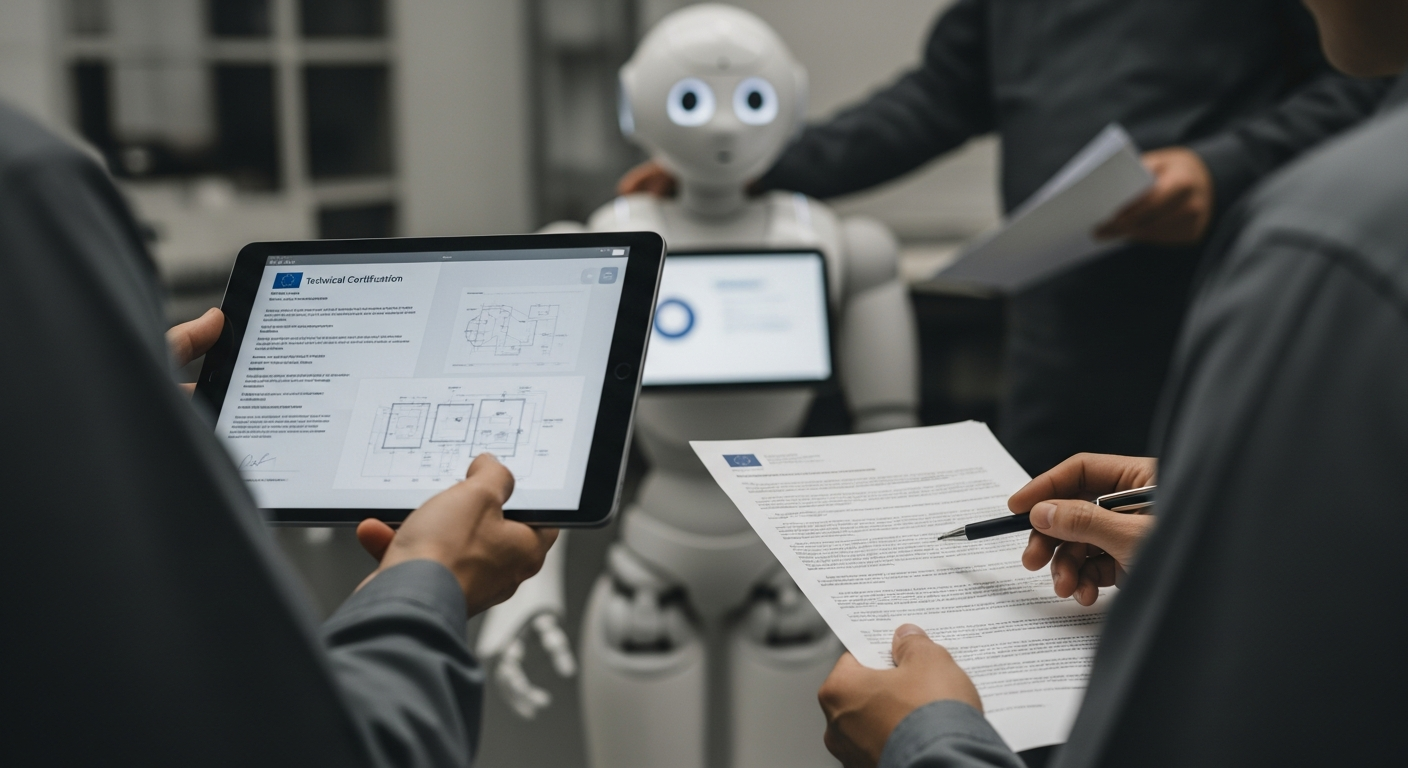
EU Machinery Regulation 2023/1230: A Guide for Operators
From 20 January 2027, the new EU Machinery Regulation 2023/1230 sets new standards for robotics in Europe. Operators must act now to ensure the conformity of their fleets and avoid liability risks.
Ward 2. 10:00 p.m. The medication cart rolls autonomously down the corridor. At Korian Germany's care facility, this is already lived reality. Yet while the technology works smoothly, the regulatory framework is changing fundamentally in the background. The new EU Machinery Regulation 2023/1230 is casting its shadow ahead. From 20 January 2027, gray areas in the use of service robots come to an end. Anyone investing in automation today must secure the conformity of their fleet not only technically but also from a regulatory standpoint. werob translates these complex requirements into operational processes so that your robots remain legally compliant on the floor even after the deadline.
Key Takeaways
- 1The EU Machinery Regulation 2023/1230 becomes binding on 20 January 2027 and mandatorily requires new conformity assessments for robot fleets.
- 2As a hardware-agnostic systems integrator, werob offers an integrated compliance path for more than 44 OEM partners.
- 3Through automation, annual cost relief of up to €112,000 per site can be realized.
The Deadline: 20 January 2027
The EU Machinery Regulation 2023/1230 is not a mere proposal but binding legislation that fully replaces the previous Machinery Directive 2006/42/EC on 20 January 2027. For operators in care, hospitality, and logistics, this means a significant tightening of documentation obligations. Unlike the old directive, the new regulation is directly applicable in all EU member states without requiring national transposition. This creates a uniform legal framework but simultaneously increases the pressure on companies that already use robots or plan to acquire them.
A critical aspect of the new regulation is the treatment of substantial modifications. As soon as a robot is deeply integrated into an existing workflow or significantly altered on the software side, the operator can legally become the manufacturer. This entails extensive liability consequences. werob acts here as a protective shield: we take on the role of systems integrator and ensure that the conformity assessment for the entire solution, consisting of hardware, software, and specific workflow, meets the requirements of the regulation. This is particularly relevant for fleets made up of various OEM components.
Cybersecurity and the EU AI Act
The EU Machinery Regulation 2023/1230 integrates explicit cybersecurity requirements for machinery for the first time. In a networked operating environment in which robots communicate via interfaces such as SAP EWM or Opera PMS, every device represents a potential gateway for cyberattacks. The regulation requires protection against corruption and unauthorized access, which is closely linked to the NIS2 Directive and the IEC 62443 standard. Operators must demonstrate that their robot fleet is secured against manipulation that could lead to physical hazards.
In addition, the requirements overlap with the EU AI Act. Since modern service robots are often based on machine-learning algorithms to avoid obstacles or prioritize tasks, they fall under the high-risk AI categories. werob integrates these compliance requirements directly into the live Cockpit. We not only monitor the hardware parameters but also ensure that the OEMs' software updates meet regulatory requirements. This protects you from unforeseen shutdowns by supervisory authorities such as the care home inspectorate or the employers' liability insurance associations.
The Challenge of Asian OEMs
A large share of currently available service robotics comes from manufacturers in Asia, such as Keenon or Pudu. While this hardware is often technically leading, many of these OEMs face the challenge of completing the specific European conformity assessment procedures in time for January 2027. Without a local partner who takes responsibility for integration and compliance with the EU Machinery Regulation, operators risk losing insurance coverage or facing official usage bans.
As a European systems integrator, werob specializes in closing this gap. We rank more than 44 OEM partners against your specific requirements, assessing not only performance but also the regulatory maturity of the manufacturers. We act as your local conformity assessor for Asian hardware. This ensures that you have access to the world's best technology without having to bear the legal risks of a direct import or an insufficiently documented integration. Our catalog comprises more than 280 rankable robot models, which we examine for their EU conformity.
Economics and Cost Relief
Compliance is not an end in itself but the basis for sustainable economic relief. A legally compliant robot typically pays for itself within the first 12 to 18 months. In the care sector, our customers, such as Korian Germany, already achieve double-digit cost relief in the first year. The following table shows verified savings potential per site per year:
| Industry / Area of Use | Specific Use Case | Cost Relief per Year |
|---|---|---|
| Care | Medication round | €92,000 |
| Care | Transport logistics | €71,000 |
| Hospitality | Room service | €112,000 |
| Hospitality | Bar & breakfast preparation | €54,000 |
| F&B / Gastronomy | Tray bot dishroom | €76,000 |
| Logistics | Yard patrol | €68,000 |
These figures are not estimates but are based on real operating data from our 200 robots in live use. By automating repetitive tasks, your specialist staff gain valuable time for value-adding activities, while werob guarantees compliance with all regulatory standards.
Seamless Integration into the Operator Stack
A robot that acts as an isolated island solution often causes more effort than benefit. The EU Machinery Regulation requires secure communication between all system components. For this, werob delivers pre-built connectors that enable direct integration into your existing software stack. Whether PointClickCare and MatrixCare in care, Opera PMS and Mews in hospitality, or SAP EWM in logistics: our interfaces are designed to transmit data securely and compliantly.
This integration is decisive for the auditability of your processes. In the event of an inspection by authorities, you must be able to demonstrate how commands are transmitted to the robot and how the system reacts to errors. werob documents these interactions completely in the Cockpit. In this way we meet not only the GDPR requirements when handling sensor data but also the strict requirements of ISO 13482 for personal care robots. You receive a turnkey solution that fits organically into your IT infrastructure.
The Live Cockpit for Fleet Control
The werob Cockpit is the central nervous system of your robot fleet. It offers a four-dimensional traffic-light system that monitors the status of your operation in real time: hardware, infrastructure, regulatory compliance, and specification. The regulatory layer is especially significant with regard to the EU Machinery Regulation 2023/1230. Here it is continuously checked whether the robot's current configuration still corresponds to the certified specification.
Should a component fail or a safety zone be violated due to structural changes at the site, the system raises the alarm immediately. This prevents robots from continuing to operate in a non-compliant state, which would have fatal legal consequences in the event of damage. The Cockpit also serves as digital proof of compliance with maintenance intervals and safety inspections. Operators in 11 European countries already use this tool to control their fleets efficiently and in a legally compliant manner. By 2028, we plan to increase the number of robots managed via the Cockpit to 2,000.
From Requirement to Spec in 48 Hours
Traditional consulting projects in robotics often take three to six months before the first robot sees the floor. werob breaks this cycle with the Spec Engine. Our AI-powered platform was trained on more than 35,000 projects and translates your operational requirements into a deployable robot specification within 48 hours. You simply describe to us the shift schedule, the task, and the spatial conditions, and we deliver the technical requirements document.
This process is not only fast but also precise. The Spec Engine takes the requirements of the EU Machinery Regulation 2023/1230 into account from the outset. Instead of treating compliance as a subsequent process step, it is integrated directly into the design of the robot mission. This considerably shortens the time to productive deployment: in just five days you receive a binding quote, and within eight weeks the robot is in use on your floor. This speed is a decisive competitive advantage in markets with an acute staff shortage.
Outcome-only: The Commercial Model
At werob, we believe in results, not promises. That is why our commercial model is based on the outcome-only principle. This means for you: you pay nothing before the robot is actually running and delivering the agreed performance on your floor. We dispense with complex upfront investments or opaque list prices. Our goal is to keep the barriers to entry into robotics as low as possible.
This model forces us to prioritize the highest quality and compliance from the start. Because we are only remunerated upon successful operation, we have an intrinsic interest in your fleet meeting the EU Machinery Regulation 2023/1230 and all other relevant standards such as the BewachVO or HACCP without gaps. We bear the technological and regulatory risk for you. This gives you the security to invest in a future-proof technology without burdening your budget with unforeseen follow-up costs.
The Path to Your Own Robot Fleet
At werob, the entry into the automated future takes place via a structured eight-stage onboarding process. It all begins with capturing your specific situation: Who are you, what does the shift look like, and which tasks should be automated? We analyze your infrastructure on site and match your preferences with our catalog of 44+ OEM partners. In doing so, we pay particular attention to compliance with ISO 13482 and the upcoming EU Machinery Regulation.
After the Spec Engine has determined the optimal configuration, integration into your software stack takes place via our connectors. The live Cockpit is set up, and your employees are trained. Within eight weeks we turn an operational challenge into an automated solution. Start now and secure your lead before the deadline in January 2027. Our experts accompany you at every step to ensure that your investment is protected over the long term and that the desired cost relief is realized.
FAQ
- What is the main difference between the old Machinery Directive and the new Regulation?
- The new Regulation 2023/1230 is directly applicable throughout the EU and introduces stricter requirements for cybersecurity, software integrity, and autonomous functions.
- Do existing robots have to be retrofitted by 2027?
- Robots put into operation before 20 January 2027 enjoy grandfathering protection, provided no substantial modifications are made. New installations after this date must mandatorily be compliant.
- How does werob support compliance with the Regulation?
- werob takes on the role of systems integrator, produces the necessary documentation, and continuously monitors compliance via the live Cockpit.
- What role does cybersecurity play in the new Regulation?
- The Regulation requires the protection of control systems against unauthorized access and manipulation in order to prevent physical hazards caused by cyberattacks.
- Does the Regulation also apply to robots from non-EU countries?
- Yes, all machinery placed on the EU market must comply with the Regulation. werob acts here as a bridge for Asian OEMs to ensure their conformity.
- What happens in the event of non-compliance with the EU Machinery Regulation?
- Heavy fines, sales and usage bans, and the loss of insurance coverage in the event of an accident may result.
Related reading
Digital Omnibus 2026: AI Act Changes for Robot Operators
Discover how the 2026 Digital Omnibus simplifies AI Act rules for robot operators, detailing new deadlines and redefined high-risk categories.
25 August 2026medical device regulation robotsMedical Device Regulation Robots: Compliance and Use in Care
The distinction between the Medical Device Regulation (MDR) and the Machinery Regulation determines liability when deploying robots. werob provides the legally secure path for operators of medical facilities.
12 June 2026product liability directive robot integratorThe Product Liability Directive: what an integrator owns after 9 December 2026
Conformity asks whether the machine may be placed on the market. Directive (EU) 2024/2853 asks a different question — who pays when someone is hurt — and for an integrator the answer turns on one word in Article 8(2).
4 September 2026iso 13482ISO 13482: Safety Standards for Service Robots in Practice
ISO 13482 is far more than a technical guideline. It is the regulatory foundation for the use of service robots in human environments such as care homes and hotels.
1 June 2026ce marking robotsCE Marking for Robots: Compliance and EU Regulation 2023/1230
The CE marking is mandatory for operating robots in the EU. With the new EU Machinery Regulation 2023/1230, the requirements for operators and integrators tighten massively from January 2027.
4 June 2026