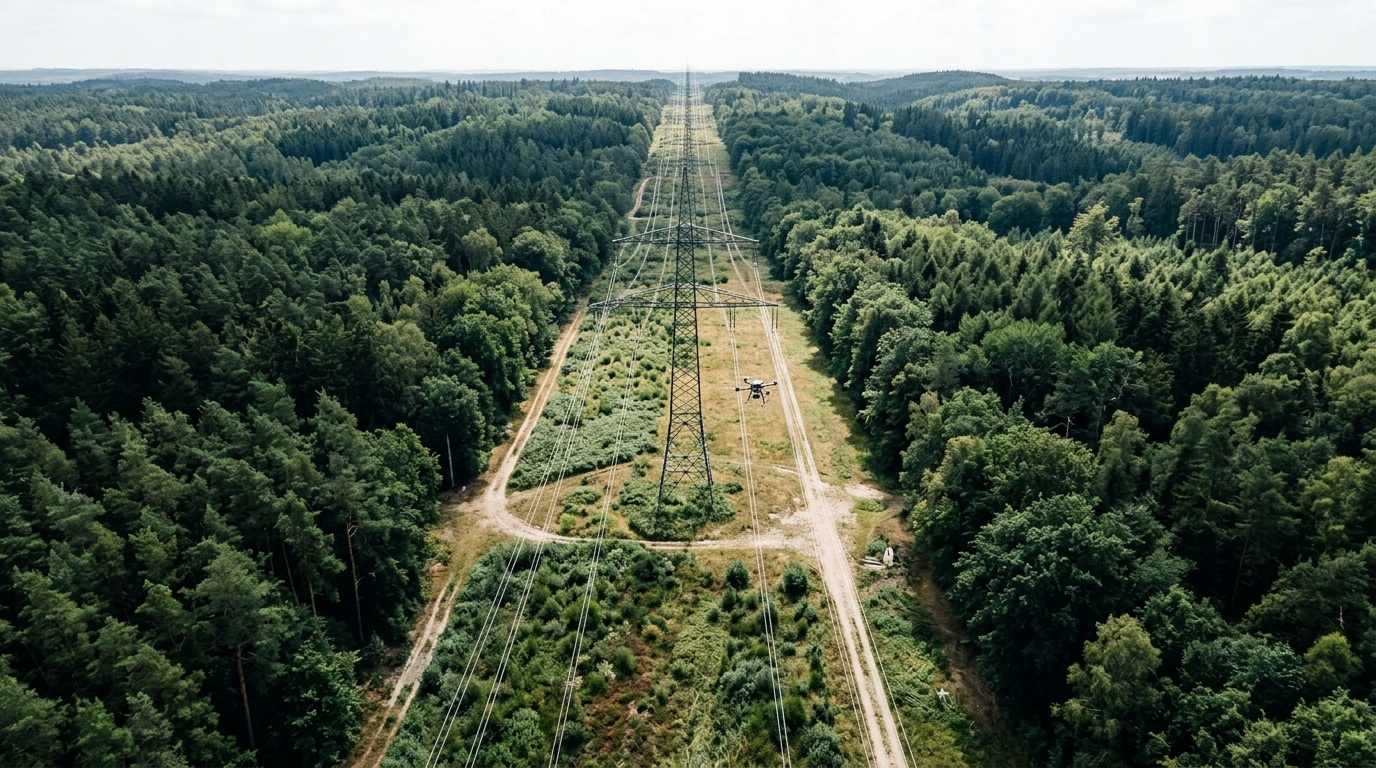
Vegetation Management on Power-Line Corridors: Why Clearing Is a Legal Obligation
Germany carries roughly 37,900 km of extra-high-voltage grid, every kilometre inside a protection strip set by law. Vegetation that grows into that strip is not a maintenance nicety — it is an outage and wildfire risk.
Germany operates roughly 37,900 km of extra-high-voltage transmission lines (BNetzA monitoring report 2025, as of 12/2024), and every corridor sits inside a protection strip that grid operators must keep clear of tall-growing vegetation under their duty of care (Verkehrssicherungspflicht) established by the Energiewirtschaftsgesetz (EnWG). The technical clearance distances sit in DIN VDE 0210 and DIN VDE 0211. Vegetation that breaches that clearance is not a cosmetic issue — it is a documented risk: flashover and outage on one side, a real wildfire risk beneath the corridor on the other.
Key Takeaways
- 1Germany carries roughly 37,900 km of extra-high-voltage grid (BNetzA, as of 12/2024), every kilometre inside a protection strip operators must keep clear of tall-growing vegetation under the EnWG.
- 2The technical clearance distances sit in DIN VDE 0210 and DIN VDE 0211; meeting them is part of the operator's duty of care, not optional.
- 3Corridor drone flights capture vegetation condition along the entire route in one pass, structured under EU drone regulation 2019/947 — a different task from the already-established thermal detection of hot joints.
The duty of care inside the protection strip
What uncontrolled growth actually triggers
Corridor flights instead of a foot patrol
Where this ends and thermography begins
FAQ
- Does an annual flight replace the entire inspection duty?
- The flight is a capture instrument, not a substitute for the duty of care itself. It gives the operator the basis on which to document and prioritise clearance work.
- What is the legal basis for the protection strip?
- The general duty follows from the operator's duty of care under the Energiewirtschaftsgesetz (EnWG); the technical minimum distances sit in DIN VDE 0210 and DIN VDE 0211.
- How often does a corridor need to be flown?
- That depends on how vegetation grows along the specific route, not a fixed calendar interval. wedrone sets the cadence together with the grid operator based on the growing season.
Related reading
Power Line and Infrastructure Inspection with Drones: Thermography, BVLOS Corridors and Data Products
Learn how drone thermography and BVLOS corridors optimize power line inspections under EU regulation 2019/947, from planning to routine operations.
8 July 2026ai act high-risk robotics classificationAI Act High-Risk Robotics Classification: Compliance for Operators
Classification as high-risk AI determines the legal admissibility of your robotics fleet. werob offers the compliance path for operators in care, logistics, and hospitality.
2 June 2026solar farm monitoring robotsSolar farm monitoring: robots and sensors for PV assets
Manual inspections across sprawling solar farms often cover only a fraction of the site and miss faults for months. This guide shows how autonomous robots take on thermography, panel cleaning, vegetation management, and perimeter protection, and how werob rolls it out in eight weeks.
14 August 2026