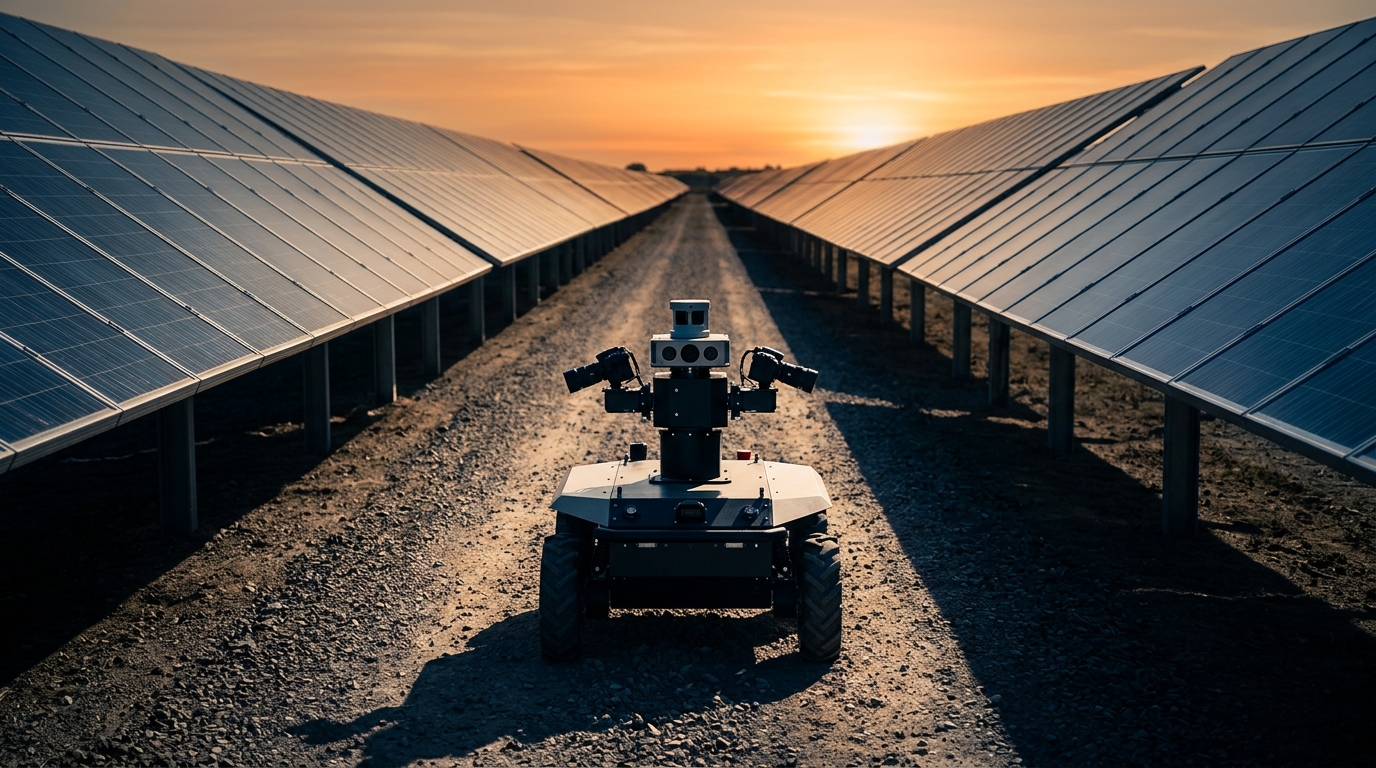
Solar farm monitoring: robots and sensors for PV assets
Manual inspections across sprawling solar farms often cover only a fraction of the site and miss faults for months. This guide shows how autonomous robots take on thermography, panel cleaning, vegetation management, and perimeter protection, and how werob rolls it out in eight weeks.
Utility-scale photovoltaic installations are expanding rapidly across the globe, with modern utility projects frequently generating several hundred megawatts of power across hundreds of hectares. Maintaining peak energy output across these massive installations requires continuous, meticulous inspection of every photovoltaic module, tracker mechanism, inverter, and balance-of-system component. However, relying on manual maintenance teams traversing vast fields on foot creates severe logistical and economic bottlenecks, exposing human workers to harsh environmental conditions and dangerous electrical hazards.
Key Takeaways
- 1Autonomous drone inspections are 75 percent faster and 45 percent cheaper than manual methods.
- 2Hardware faults cause huge losses; drones detect hotspots highly accurately via high-resolution thermography.
- 3Ground robots manage vegetation, inspect module rears, and secure the perimeter against theft.
- 4The Spec Engine converts requirements into ROS plans in 48 hours, enabling a hardware-agnostic go-live.
Thermographic fault detection from the air and on the ground
Thermal anomalies in utility-scale photovoltaic arrays not only degrade total power yield but also represent critical fire hazards and safety risks. Common hardware defects such as localized hotspots, micro-cracks, failed bypass diodes, and disconnected substrings generate distinct temperature gradients compared to healthy cells. Whereas conventional manual walk-throughs with handheld infrared cameras are labor-intensive and slow, autonomous aerial inspection systems streamline the inspection lifecycle: autonomous drone surveys are 75 percent faster and 45 percent cheaper than manual inspection procedures. Equipped with radiometric thermal imagers and high-resolution RGB sensors, drones scan multi-megawatt facilities within hours in full compliance with IEC 62446-3.
Ground robotics for underside and cable diagnostics
Despite the high speed and wide spatial coverage of unmanned aerial vehicles, aerial thermography faces physical line-of-sight limitations. Degradation on module backsheets, hidden junction boxes, and low-hanging cable harnesses remain obscured from an overhead perspective. Autonomous unmanned ground vehicles (UGVs) complement aerial diagnostics by navigating between panel rows at ground level, capturing close-range telemetry from beneath the racking structure.
- Thermal localization of overheated junction boxes and MC4 connectors positioned directly beneath the module tables.
- Optical and infrared detection of rodent bites, friction wear, and insulation breakdown on ground-level DC string cabling.
- Detailed visual and thermal inspection of module rear sides for backsheet delamination, cell hotspots, and mechanical stress cracks.
- Automated georeferencing of detected anomalies with direct export into enterprise O&M work-order ticketing systems.
By coupling aerial thermography overviews with granular ground-level diagnostics, plant operators establish an end-to-end digital twin of their electrical infrastructure. This multi-layered sensor strategy transforms maintenance from sporadic spot checks into an automated, predictive workflow that systematically eliminates yield loss.
Automated panel cleaning to prevent yield losses
Accumulations of dust, sand, agricultural particulate, and bird droppings (soiling) severely degrade the optical efficiency of photovoltaic modules. Depending on local geography, atmospheric conditions, and seasonal drought, unmanaged soiling results in continuous yield losses ranging from 25 to over 35 percent. Traditional manual washing using water trucks, manual brushes, and mobile elevated work platforms is labor-intensive, consumes vast volumes of water, and incurs substantial operating costs. Autonomous cleaning robots provide a standardized alternative, executing automated dry or low-moisture cleaning cycles with consistent surface pressure.
Coordinated UAV transport and operational safety
On large solar farms, ground-based cleaning robots encounter physical boundaries whenever panel tables are structurally separated by drainage ditches, access roads, or terrain elevation changes. To eliminate the need for manual transport by field staff, coordinated heavy-lift unmanned aerial vehicles (UAVs) serve as autonomous carriers. Utilizing model-predictive control algorithms, these aerial transport systems achieve a docking success rate of approximately 90 percent when deploying and retrieving cleaning robots directly on module tables.
- Complete elimination of fall risks by automating panel placement, edge navigation, and robot recovery on elevated tables and steep slopes.
- Surface-safe cleaning mechanics utilizing specialized microfiber brushes and vacuum systems that remove debris without causing micro-cracks or scratching anti-reflective coatings.
- Scalable multi-robot coordination allowing several cleaning units to operate concurrently across separate module strings to minimize cycle times.
- Water conservation in arid regions through waterless dry-brushing algorithms that eliminate the logistics of water transport.
Automating module cleaning removes maintenance crews from elevated, high-voltage surfaces and dramatically reduces workplace liability risks. Robotic fleets can be scheduled dynamically around weather events, wind forecasts, and real-time generation metrics to preserve peak module irradiance.
Autonomous vegetation management under PV arrays
Unchecked weed and grass growth under and around solar mounting structures represents a critical operational risk. When tall grasses, shrubs, or climbing weeds reach the lower edge of photovoltaic modules, they cast hard shadows across individual cell rows, reducing power output across entire series-connected strings. Low-profile autonomous mowing robots navigate beneath the racking structures, continuously maintaining vegetation height without colliding with support posts, tracker actuators, or low-hanging DC cables.
Low-profile ground units and fire prevention
Beyond preventing string shading, systematic vegetation control forms the core of wildfire mitigation on solar sites. During hot summer months and periods of severe drought, dense or dried-out brush transforms any potential electrical arc at connectors or combiner boxes into an immediate fire threat. Autonomous robotic mulchers and mowers prevent the accumulation of dry combustible biomass, eliminating the need for heavy, fuel-powered tractors that frequently cause soil compaction and accidental cable strikes.
- Preventive shading elimination through continuous short-cut mowing that prevents partial cell shading and localized thermal hotspots.
- Active wildfire mitigation by clearing dry combustible plant material near combiner boxes, cable trays, and transformer stations.
- Gentle ground operations using lightweight robotic chassis that prevent topsoil damage and navigate narrow row clearances safely.
- Automated obstacle detection and path replanning to navigate around structural foundations and terrain irregularities.
Integrating autonomous green care with sensor-driven inspections redefines solar farm operations. While standard industry practice entails manual inspections only once per year, operators utilizing autonomous drones and ground robots typically inspect assets weekly, reducing overall inspection time by 90 percent. This continuous stream of ground telemetry feeds directly into central facility management systems, allowing engineering teams to dispatch targeted interventions without manual scouting.
Perimeter protection and physical site security
Utility-scale photovoltaic farms are predominantly situated in remote, rural areas, making them prime targets for vandalism and organized theft of copper cabling, power inverters, and solar panels. Security breaches can easily result in equipment damages and component losses in the 140,000 euro range per incident. Traditional stationary CCTV cameras and fence-mounted intrusion sensors face distinct limitations on expansive sites, where long perimeters create blind spots and wildlife movement triggers frequent false alarms.
Mobile robotic patrols vs. static surveillance
Deploying autonomous perimeter monitoring systems bridges these security vulnerabilities through continuous, unpredictable mobile patrols. Autonomous ground robots traverse perimeter fences and internal service roads, operating around the clock regardless of weather conditions or lighting.
- Thermal night-vision and high-zoom pan-tilt-zoom cameras for rapid intrusion detection over long perimeter distances.
- On-device AI vision pipelines that distinguish human intruders and vehicles from wildlife to suppress false alarms.
- Automated deterrent triggers, including multi-directional spotlights, optical strobes, and two-way acoustic warning systems.
- Self-docking wireless recharging stations that ensure uninterrupted 24/7 patrol schedules across remote installations.
When a security robot detects a perimeter breach or anomalous activity, it immediately streams live georeferenced video and GPS coordinates to remote monitoring centers. This real-time visibility enables swift verification and targeted law enforcement dispatch before significant physical damage or component theft can occur.
Regulations, sensors, and the EU Machinery Regulation
Deploying fleets of autonomous mobile robots and unmanned aerial systems in industrial energy facilities requires strict adherence to evolving European safety and cybersecurity frameworks. Under the EU Machinery Regulation 2023/1230, which replaces the legacy Machinery Directive and becomes mandatory on 20 January 2027, digital technologies such as AI and robotics are treated as risk factors for the first time and cybersecurity becomes an integral part of machinery safety.
Safety standards and cybersecurity architectures
To achieve certified compliance, robotics deployments must align with harmonized standards such as ISO 13482 for personal care and mobile service robot safety, as well as IEC 62443 for operational technology (OT) cybersecurity. Operators must demonstrate that their autonomous fleets maintain robust fail-safe behaviors in the field and remain resilient against cyber tampering and software corruption.
- Functional safety control architectures that guarantee safe stop and obstacle avoidance behaviors under all environmental conditions.
- OT cybersecurity hardening per IEC 62443, ensuring end-to-end encrypted telemetry, secure firmware signing, and tamper-proof event logging.
- Comprehensive risk assessments covering machine autonomy, AI-driven navigation models, and remote fleet management interfaces.
- Audit-ready documentation and operational logs that verify continuous regulatory conformity across the equipment lifecycle.
Navigating these technical standards requires structured engineering processes. Ensuring that autonomous mobile systems meet both physical functional safety and digital cybersecurity requirements is essential for long-term legal certainty and operational insurance coverage.
From requirements to rollout: implementing robotic fleets
Transitioning from experimental robotic trials to standardized, enterprise-wide field operations requires a unified integration architecture. Solar asset owners, facility managers, and engineering teams must harmonize disparate hardware platforms, sensor suites, and operational data streams into a cohesive, auditable system.
Hardware-agnostic planning and unified operations
An end-to-end integration framework is what takes autonomous mobile robots from operational concept to live field execution. Through an AI-assisted Spec Engine, operators translate plain-language shift requirements and maintenance tasks into formally verified, ROS-compatible action graphs within 48 hours, enabling a fully compliant, hardware-agnostic go-live in as little as eight weeks.
- Spec Engine: Rapid translation of site maintenance workflows into formally verified, ROS-compatible deployment specifications.
- Supplier Match: Algorithmic matching across an OEM database of over 44 robot manufacturers based on regional service coverage, regulatory readiness, and hardware footprint.
- Connectors: Pre-configured API middleware integrating robotic telemetry directly with existing SCADA, CMMS, and enterprise ERP systems.
- Cockpit: Centralized operations dashboard providing real-time 4-dimensional traffic light monitoring across hardware health, site infrastructure, regulatory compliance, and specification fidelity.
By unifying planning, multi-vendor hardware matching, middleware connectivity, and continuous telemetry monitoring, the werob Platform enables solar farm operators to deploy scalable robotic fleets with complete regulatory and operational confidence.
FAQ
- What tasks do robots take on in solar farms?
- Autonomous systems handle thermographic inspection of solar modules, vegetation management under the arrays, automated panel cleaning, and continuous perimeter protection against theft and vandalism -- keeping site operations running smoothly.
- How do autonomous inspections lower O&M costs?
- Drones and ground robots drastically cut the labor required. Studies show drone-based inspections are 75 percent faster and 45 percent cheaper than manual checks.
- Why isn't a SCADA system enough for PV monitoring?
- SCADA systems often fail to detect yield losses at the cell or string level. Thermographic passes by autonomous robots precisely identify undetected hotspots, bypass-diode failures, and micro-cracks long before these defects show up in system-wide alerts.
- What safety standards apply to inspection robots?
- Beyond the baseline requirements of the EU Machinery Regulation 2023/1230, robotic systems in the energy sector must also meet strict cybersecurity standards such as IEC 62443. This prevents tampering with robot control systems and ensures sensitive image and sensor data stays protected.
- How quickly can an autonomous robotic system be deployed at a solar farm?
- With modern platform tooling, operator requirements can be translated into ROS-compatible deployment plans within 48 hours via the Spec Engine. Hardware-agnostic OEM selection through Supplier Match typically makes a full go-live achievable within eight weeks.
Related reading
Deploying Autonomous Perimeter Monitoring: A Buyer's Guide
Securing sprawling industrial perimeters against intrusion is costly and prone to human error. By deploying IP66-rated autonomous outdoor robots, facility leaders can ensure continuous fenceline monitoring that integrates seamlessly into existing VMS workflows.
13 August 2026scaling perimeter monitoring multi-siteScaling Perimeter Monitoring: What Breaks After the Pilot
Learn what breaks when scaling autonomous perimeter security robots across multiple sites, from alert fatigue and network gaps to complex SOC integration.
18 August 2026environmental monitoring with drones air quality ecosystemsEnvironmental monitoring with drones: air quality, ecosystems and climate resilience
Learn how wedrone simplifies environmental monitoring with drones, enabling air quality tracking and ecosystem compliance under EU regulation 2019/947.
7 July 2026drone dam inspectionMonitoring dams and reservoirs from the air: deformation and seepage over time
Learn how the wedrone platform standardizes multi-pass aerial monitoring to detect structural deformation and dam seepage over time with millimeter precision.
17 July 2026cleaning robot sensors lidar depth camera limits20 millimetres and a glass wall: what a cleaning robot's sensors are documented not to see
A catalogue scrubber-dryer robot drives on a 2D laser scanner, 3D depth cameras, an RGB camera and drop sensors. The datasheet gives one number to go with them: obstacles from 20 millimetres in height. What lies below that, what is made of glass and what is black is not in the datasheet, but it is in two measurement studies anyone can read.
14 September 2026