Hotel COO Automation: Strategies for Operational Excellence
Automation in the hotel industry is no longer an option, but an operational necessity to secure margins. Learn how COOs achieve annual savings of over 112,000 euros per location through precise specifications and seamless system integration.
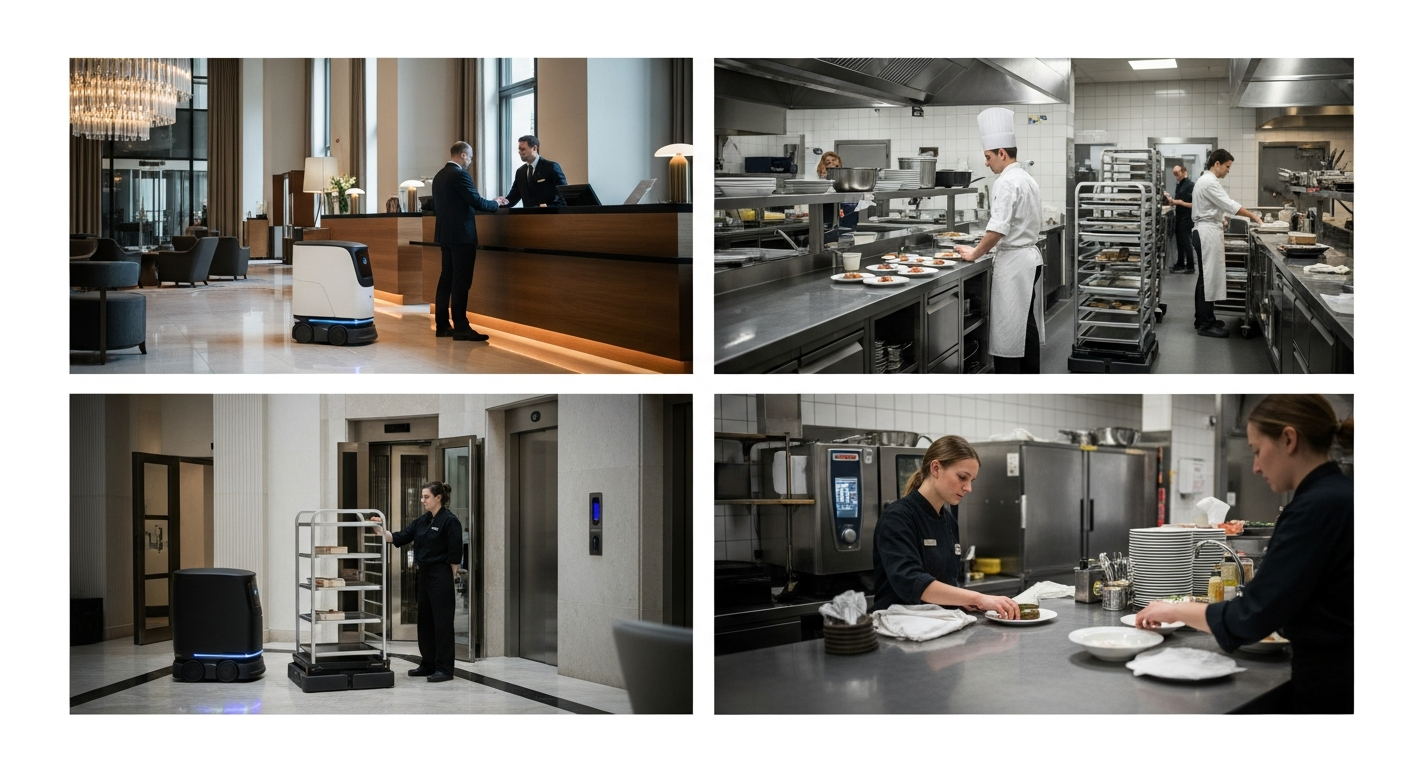
Floor 4. 6:30 a.m. While the first guests are waking up, the service robot is already making its fourth trip between the kitchen and the room service station. No staff stress, no delays due to lack of capacity in the morning. For the Chief Operating Officer (COO), this scene is the result of precise operational planning. In an industry suffering from a chronic shortage of skilled workers and rising labor costs, automation provides the necessary leverage to stabilize operations. werob acts as a system integrator, translating complex workflows into a usable robot specification in 48 hours and bringing it live into operation within eight weeks.
Key Takeaways
- 1Measurable ROI: Annual cost relief of €112,000 in room service and €54,000 in cash/breakfast per location.
- 2Fast implementation: Technical specifications in just 48 hours and live operation in 8 weeks.
- 3Regulatory security: Full compliance with the EU Machinery Regulation 2023/1230 (binding from January 20, 2027).
The operational reality: Why hotel COOs must act now
The hotel industry is facing a turning point. Rising operating costs and a turnover rate that regularly threatens operations are forcing COOs to reevaluate the efficiency of their locations. Automation is not an end in itself, but a tool to ensure service quality. Today, a chief operating officer must decide how repetitive tasks can be taken over by technology to free up remaining staff for value-added guest contacts.
Users also ask: What is the ROI of hotel robotics? The answer lies in reducing unproductive walking distances. In an average full-service hotel, up to 30 percent of service working time is spent purely on transport routes. By automating these routes, operating costs can be significantly reduced. werob offers a clear path for this: it only takes eight weeks from analyzing the workflow to productive use. Werob is not a manufacturer, but rather the integrator who selects the exact right hardware for the specific requirements of the hotel from a catalog of over 44 OEM partners.
The challenge for the COO is to avoid isolated solutions. A robot that does not communicate with the property management system (PMS) creates new manual effort instead of reducing it. Therefore, werob relies on prefabricated connectors that enable immediate communication between the robotics fleet and systems such as Opera PMS or Mews. This ensures that automation is seamlessly integrated into the existing digital infrastructure.
Cost reduction in room service: 112,000 euros per year
Room service is one of the most labor-intensive areas in the hotel industry. Employees often have to travel long distances to deliver small orders. This leads to long waiting times for the guest and inefficient use of human resources. By using specialized delivery robots, this process can be fully automated. The verified cost relief for room service amounts to 112,000 euros per location per year.
This figure is based on the assumption of transport tasks during day and night shifts. A robot needs no breaks and is ready for use 24 hours a day. Automation guarantees a consistent service speed, especially at night when staffing levels are thin. The COO benefits from a calculable size that works independently of short-term absences due to illness or termination.
The implementation is carried out via the werob Spec Engine. Within 48 hours, the specific room service process is translated into a technical specification. Factors such as elevator control, door passages and carpet condition are taken into account. The result is a precise requirements profile against which we test over 280 different robot models in order to find the optimal hardware solution. This hardware-agnostic approach ensures that the hotel is not tied to a single manufacturer, but rather receives the best technical solution for its architecture.
Efficiency in bar and breakfast: The 54,000 euro opportunity
In addition to room service, the bar and breakfast area offers significant automation potential. Preparing the breakfast buffet and removing dishes are repetitive tasks that take up skilled workers' valuable time. By using transport robots to support service staff, 54,000 euros in costs can be saved per location per year.
In practice, this means that service staff can concentrate on looking after guests while robots transport dirty dishes to the scullery or fetch fresh supplies from the warehouse. This reduces the physical strain on employees and increases the attractiveness of the workplace. A COO who relies on this technology is actively addressing the problem of employee retention.
Users also ask: Which interfaces are important for hotel robots? In the F&B sector, the connection to point-of-sale (POS) systems such as Toast or Lightspeed is crucial. werob supplies the necessary connectors so that orders can directly trigger a robot task. This deep integration into the operational stack distinguishes a professional system integration from a simple hardware purchase. The goal is a closed data cycle in which the robot acts as a physical extension of the digital management software.
Hardware agnostics: Why a single OEM increases risk
Many hotels make the mistake of committing to a specific robot manufacturer early on. This leads to vendor lock-in, which limits flexibility in the long term. werob follows a strictly hardware-agnostic approach. As a system integrator werob ranks over 44 OEM partners against the specific requirements of the customer. This guarantees that the best current technology is always used.
| Criteria | were system integration | Individual OEM reseller |
|---|---|---|
| Hardware selection | 44+ OEMs (agnostic) | Only one brand |
| Integration | Native connectors (Opera, Mews) | Most isolated solution |
| Compliance | EU 2023/1230 Path included | Often unclear with imports |
| Risk | Low due to diversification | High with manufacturer problems |
A COO must keep an eye on the long-term maintainability and scalability of his fleet. If a manufacturer discontinues support or loses touch technologically, the werob approach enables a seamless change of hardware, while the operational logic and integrations in the werob cockpit are retained. This protects the investments made in software and processes. werob currently operates over 200 robots in live operation in 11 European countries, which underlines the stability of this agnostic model.
The werob Spec Engine: A precise specification in 48 hours
The biggest bottleneck in automation projects is often the planning phase. Traditional consulting firms often require three to six months for discovery phases and feasibility studies. werob radically shortens this process. The Spec Engine, trained on over 35,000 projects, translates the verbal descriptions of hotel operations into a ready-to-use specification within 48 hours.
This process begins with a simple eight-step onboarding. The COO or operations manager describes the shifts, the tasks and the infrastructural conditions on site. The Spec Engine uses this to generate a precise action graph for robotics. This eliminates ambiguity and ensures that the offer, which is available within five days, is tailored precisely to operational needs.
Werob's speed is a decisive competitive advantage. In an industry where market conditions change rapidly, a hotel cannot wait months for a solution. The promise is clear: 48 hours to the spec, 5 days to the offer and 8 weeks until the robot is used productively on the floor. This focus on execution rather than lengthy theory makes werob the preferred partner for results-oriented COOs.
Seamless integration: Connectors for Opera PMS and Mews
A robot is only as good as its connection to the systems that control hotel operations. Without integration into the property management system, robotics remains a foreign body. werob solved this problem by developing prefabricated connectors. These enable two-way communication between the robot fleet and leading systems such as Opera PMS and Mews.
If a guest orders an additional towel or drink through the system, this order is automatically delegated to the available robot. The robot knows the room number, can call the elevator and notify the guest upon arrival. All of this happens without any manual intervention from reception staff. This automation of the communication chain is the key to scaling robotics deployments in large hotel chains.
Users also ask: How long does implementation take? Thanks to the prefabricated connectors, the integration time is massively reduced. While individual programming could take months, the werob stack enables commissioning within the eight-week window. This applies not only to PMS systems, but also to integration into the rest of the operator stack, such as SAP EWM for the logistics areas of larger resorts or Toast for the catering industry.
Regulatory security: The EU Machinery Regulation 2023/1230
For the COO, compliance is a critical issue that is often underestimated. From January 20, 2027, the new EU Machinery Regulation 2023/1230 will be binding. This regulation places significantly higher requirements on the conformity assessment of robot systems, especially when they are used in public areas such as hotel lobbies or corridors. Many Asian OEMs do not have the necessary local structures to meet these requirements independently.
werob acts as a compliance path here. By taking over the system integration, werob ensures that the entire solution complies with European safety standards. This includes not only the hardware, but also the software interfaces and interaction with people. Compliance with ISO 13482 for personal care robots and service robots is a standard part of werob's offering.
A violation of these regulatory requirements can lead to massive liability risks and operating bans. A COO who works with werob outsources this regulatory risk to an expert. werob continuously monitors the regulatory landscape and uses the cockpit to ensure that the fleet is operated in a compliant manner at all times. This offers management the necessary legal certainty for large-scale rollouts.
The live cockpit: fleet management at the push of a button
As soon as the robots are in use, the focus switches to stable operation. The werob Cockpit offers the COO and facility managers a central platform for monitoring the entire fleet across multiple locations. The system uses a four-dimensional traffic light system that displays the status of the hardware, infrastructure, regulations and specifications in real time.
If a problem occurs, for example a blocked elevator control or a sensor error, this is immediately signaled in the cockpit. Problems can often be resolved remotely before they impact hotel operations. This transparency is essential for trust in the technology. The COO receives monthly reports on the performance of the robots, the journeys made and the resulting cost reductions. This enables a data-based decision-making basis for further investments.
Users also ask: What does the EU Machinery Regulation 2023/1230 change? In addition to the safety aspects, the regulation also requires complete documentation of the machine control. The werob Cockpit automates this documentation and ensures that all relevant data for audits or inspections is available at all times. This turns fleet management from a technical task into a strategic control instrument for operational management.
Outcome-only: A commercial model with no upfront risk
A major obstacle to the introduction of robotics is often the high initial investment (CAPEX). werob breaks this pattern with a purely results-oriented commercial model: outcome-only. This means that the hotel only pays when the robot is in productive use and completes the defined tasks. There are no hidden list prices or expensive upfront consulting fees.
This model perfectly aligns the interests of werob and the hotel customer. werob has a direct interest in ensuring that the specification is precise, the hardware works reliably and the integration is seamless. For the COO, this means a massive reduction in financial risk. The costs for automation become operational expenses (OPEX), which can be directly financed through the savings achieved in personnel costs or through efficiency gains.
In summary, werob offers a turnkey process for hotel automation. From the initial analysis to the selection from 44+ OEMs to live operation and regulatory protection. With over 200 robots in use and a presence in 11 countries, werob is the partner for COOs who want to future-proof their operations. The path to automated operational excellence begins with a 48-hour specification phase that lays the foundation for measurable success.
FAQ
- What distinguishes werob from a robot manufacturer?
- werob is a hardware-agnostic system integrator. We do not manufacture our own robots, but select the best hardware for your specific workflow from over 44 OEM partners and integrate it into your tech stack.
- Which hotel systems can be connected?
- werob offers pre-built connectors for leading systems such as Opera PMS, Mews, Toast, Lightspeed and SAP EWM to ensure seamless communication between robotics and hotel management.
- How safe is it to use robots in public hotel areas?
- Safety is the top priority. All solutions integrated by werob comply with the relevant safety standards such as ISO 13482 and prepare operators for the upcoming EU Machinery Regulation 2023/1230.
- How much does implementation cost at werob?
- werob works according to an outcome-only model. You only pay when the solution is running productively. There are no upfront costs for the specification phase or consulting services.
- How many robots does werob already have in use?
- As of May 2026, werob operates over 200 robots in live operation in 11 European countries, including Germany, France, Italy and Great Britain.
- How long does it take from the first request to the robot running?
- Our process is optimized for speed: 48 hours to spec, 5 days to quote and 8 weeks to productive on-site deployment.
Related reading
Reducing Hotel Costs through Automation: Strategies for 2026
Rising labor costs and skilled labor shortages are forcing the hotel industry to increase efficiency. Learn how you can save up to EUR 112,000 per location through targeted automation in room service and preparation.
7 June 2026hotel automation labor costsHotel Automation Labor Costs: Strategies for Cost Relief
The hotel industry is facing a structural shortage of personnel. Automation is no longer a trend, but an economic necessity to reduce labor costs and ensure service quality.
7 June 2026robot integration pms hotelRobot Integration PMS Hotel: Efficiency through automation
The manual coordination of room service and cleaning ties up valuable human resources in the hotel industry. werob integrates robots directly into your property management system for automated processes without media breaks.
29 June 2026room service automationRoom service automation: increasing efficiency in hotel operations
Automating room service significantly reduces personnel costs per location per year. By integrating into PMS systems such as Opera or Mews, robots become a seamless part of the hotel infrastructure.
20 June 2026mews robot pmsMews Robot PMS Integration: Automation for the hotel industry
The direct integration of Mews PMS and robotics enables hotels to achieve significant cost relief and operational excellence. werob delivers the finished connectors for a quick rollout within eight weeks.
25 June 2026