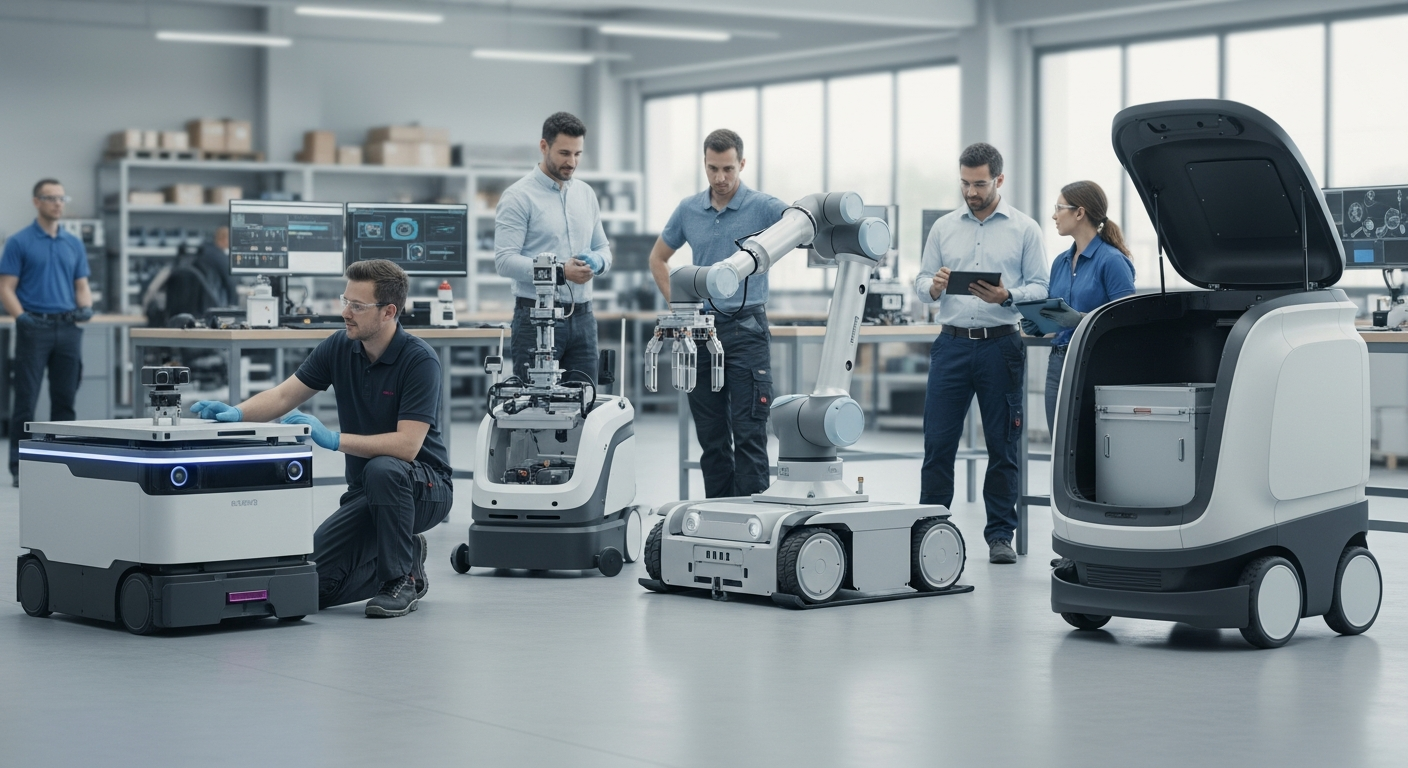
Delivery Robots for Companies: Integration Instead of Hardware Purchase
The introduction of delivery robots often fails due to hardware selection rather than workflow. werob translates your operational requirements into a precise specification in 48 hours and delivers the right fleet including integration.
Ward 4. 14:30. The shift change is approaching, but the material requirements for the next hour are already stored in the system. Instead of a care worker making the trip to the central storage, an autonomous delivery robot sets off. It navigates precisely through the corridors, uses the elevator on its own, and delivers the required consumables right on time. This is not a pilot project, but operational everyday life in facilities relying on system-integrated robotics. werob acts here as the decisive integrator, translating the operator's workflow into a ready-to-deploy specification and selecting the right hardware from a catalog of over 44 OEM partners.
Key Takeaways
- 1Workflow focus: a successful implementation begins with the precise specification of the workflow, not with the choice of hardware.
- 2Speed: through the werob Spec Engine, the path from requirement to deployment is shortened to just eight weeks.
- 3Cost efficiency: verified relief of up to EUR 112,000 per year ensures rapid return on investment.
The Operational Reality of Autonomous Delivery Robots
In modern business economics, the use of delivery robots is often misunderstood. It is not primarily about acquiring a machine, but about automating a logistics process. A delivery robot is only as efficient as the software layer that controls it. Many companies make the mistake of committing early to a specific manufacturer without considering the long-term integration needs. werob breaks this pattern by acting as a hardware-agnostic systems integrator. We first look at the workflow, then the specification, and finally the hardware.
An autonomous delivery robot must be able to understand dynamic environments. Whether in a hotel, a care home, or a logistics hall, the requirements for sensors and path planning are high. This is not only about avoiding obstacles, but about interacting with the infrastructure. This includes controlling elevators, opening automatic doors, and communicating with the in-house Wi-Fi. werob ensures that these components are taken into account already in the planning phase to avoid delays in live operation. With over 200 robots in live operation, werob has the necessary experience to depict these complex scenarios.
The Spec Engine: From Requirement to Precision
The traditional path to robotics introduction often takes three to six months and is characterized by lengthy discovery phases. werob has radically shortened this process through the Spec Engine. Within 48 hours, we translate your operational requirements into a technical specification. This engine has been trained on the basis of over 35,000 projects and immediately detects which hardware parameters are decisive for your specific deployment location. Do you need a payload of 40 kilograms, or is maneuverability in narrow corridors more important? The Spec Engine delivers the answer objectively and data-based.
Once the specification is in place, the Supplier Match takes place. werob ranks more than 44 OEM partners and over 280 different robot models against your profile. This prevents vendor lock-in and ensures that you always receive the technically best solution for your use case. While a manufacturer naturally favors its own products, werob remains neutral. Our goal is successful operation, not the sale of a specific brand. This process guarantees that within just five days you receive a binding offer precisely tailored to your operational needs.
Hardware Agnosticism as a Strategic Advantage
The landscape of robot manufacturers is fragmented. There are specialized providers for the service area such as Keenon or Pudu, industrial heavyweights such as MiR, and emerging humanoid developers such as Apptronik. For an operator, it is almost impossible to keep track of the technological maturity and compliance of all these systems. This is where the werob approach comes in. We continuously validate the hardware of our partners and ensure that it complies with European standards.
| Category | Example OEMs | Primary deployment area |
|---|---|---|
| Service robots | Keenon, Pudu, Bear Robotics | Hotel industry, gastronomy, care |
| Industrial AGVs | MiR, Robotnik, Clearpath | Logistics, manufacturing, facility management |
| Humanoid systems | Apptronik, Unitree, 1X | Complex manipulation, lab, care |
Through this hardware-agnostic approach, we can assemble fleets consisting of different models but controlled via a central interface. This is particularly important for companies with various locations or different task areas. A delivery robot in the kitchen of a hotel has different requirements than a system bringing towels to the rooms. werob integrates both worlds into a unified management system, the Cockpit.
Economics and Cost Relief per Location
The decision for delivery robots is primarily an economic one. In industries with high skilled labor shortages and rising wage costs, autonomous systems offer measurable relief. werob does not work with vague promises, but with verified figures from live operation. In care, the automation of transport tasks leads to cost relief averaging EUR 71,000 per location and year. This sum results from the reduction of unproductive walking times of specialist personnel, who can instead focus on direct resident care.
In the hotel industry, the effects are even clearer. A delivery robot in room service can realize cost relief of up to EUR 112,000 per year. Here, not only personnel costs are optimized, but also service speed and guest satisfaction are increased. In gastronomy, a tray bot in the dishwashing area relieves operations by around EUR 76,000 annually. These figures are not theoretical models, but results from projects such as at Korian Germany. werob's commercial model is consistently focused on success. As an outcome-only provider, you only pay when the robot is actually running in your operation and fulfilling the defined tasks.
Seamless Integration into the Existing Software Stack
An isolated robot is a foreign body in operation. True efficiency only arises through connection to the existing IT systems. werob delivers pre-built connectors for the most important industry solutions. In care, these are integrations into PointClickCare or MatrixCare. In the hotel industry, we connect the systems directly to Opera PMS or Mews. For logistics applications, connectors for SAP EWM are available. These integrations enable orders to be automatically generated as soon as an event is registered in the main system.
If, for example, a guest orders an extra pillow via the hotel system, this order is transmitted directly to the delivery robot. No manual intervention by an employee at a separate terminal is necessary. This deep integration reduces error sources and ensures smooth data flow. werob takes over the entire technical handling of these interfaces, so your IT department does not have to deal with the details of robot communication. This is an essential part of our promise to provide a fully functional system within eight weeks.
Regulatory Certainty and the EU Machinery Regulation
An often underestimated aspect when introducing delivery robots is legal certainty. From 20 January 2027, the new EU Machinery Regulation 2023/1230 becomes binding. Many robots currently on the market, especially from non-European manufacturers, do not yet fully meet these strict requirements. werob offers the necessary compliance path here. We carry out the required conformity assessments and ensure that the deployed systems meet all safety standards.
This includes not only physical safety according to standards such as ISO 13482 for service robots, but also aspects of cybersecurity according to IEC 62443 and data protection in accordance with GDPR. Since delivery robots are often equipped with cameras and sensors to navigate in public spaces, the protection of personal data is of the highest priority. werob ensures that all data processing processes are designed transparently and in legal compliance. For operators, this means significant risk minimization, as werob takes responsibility for the regulatory conformity of the overall solution.
The Live Cockpit: Real-Time Fleet Management
Once the delivery robots are in use, the phase of operational management begins. werob provides the Cockpit for this, a central platform for live fleet management. The heart is a four-dimensional traffic light system that monitors the status of hardware, infrastructure, regulation, and specification. If a robot stops due to a blocked path or a technical defect, this is immediately signaled in the Cockpit. Often, problems can be solved remotely before they noticeably disrupt operations.
The Cockpit also delivers valuable data for continuous optimization. You see at a glance which routes are used most frequently, how high the utilization of individual devices is, and where in the process efficiency potential still lies. This transparency is the foundation for data-driven scaling of your robot fleet. werob supports you in turning the insights gained into operational improvements. With experience from 11 European countries, werob offers infrastructure that is also designed for international rollouts.
The Commercial Model: Outcome-only Instead of Investment Risk
The introduction of new technologies is traditionally associated with high upfront investments (CAPEX). werob changes this paradigm through a purely results-oriented model. Our outcome-only approach means that no costs arise for you before the robot is productively working in your operation. We bear the risk of implementation and technical integration. This enables companies of any size to benefit from the advantages of robotics without burdening their balance sheet with high one-off payments.
This model creates a natural alliance between werob and the operator. Since we are only compensated on successful operation, our incentive system is directly linked to your operational efficiency. We are not interested in selling you as many robots as possible, but exactly the number and types that optimally support your workflow. This partnership approach is one of the reasons why werob is today the largest systems integrator for robotics in Europe. Our goal for 2028 is the operation of 2,000 robots, which we will achieve through consistent standardization and customer orientation.
FAQ
- What distinguishes werob from a robot manufacturer?
- werob is a systems integrator and not a manufacturer. We are hardware-agnostic and choose the best solution for your specific workflow from over 44 OEM partners. We provide the software layer, the integration, and the operation, instead of just selling a single device.
- How long does it take until a delivery robot is ready for use?
- Our promise is: 48 hours to specification, five days to offer, and eight weeks to productive deployment of the robot in your operation.
- Which software systems can be connected?
- werob offers pre-built connectors for market-leading systems such as SAP EWM, Opera PMS, Mews, PointClickCare, MatrixCare, and Toast. Further integrations are possible via our API layer.
- Is the use of delivery robots legally safe?
- Yes, werob ensures the compliance path for the EU Machinery Regulation 2023/1230, which becomes binding from January 2027. We take over the conformity assessment and ensure compliance with ISO 13482 and GDPR.
- What does implementation at werob cost?
- werob works on an outcome-only model. This means you only pay when the system is operationally running. There are no high upfront investments without a guaranteed result.
- How is the fleet monitored during operation?
- Via the werob Cockpit, you have access to the status of your fleet at any time. A four-dimensional traffic light system monitors hardware, infrastructure, regulation, and adherence to specification in real time.
Related reading
Bear Servi Provider Germany: Integration instead of Hardware Purchase
The search for a Bear Servi provider in Germany often leads to pure hardware dealers. werob takes a different path: as a hardware-agnostic systems integrator, we embed the Bear Servi into your existing workflow and secure regulatory compliance.
3 June 2026legged delivery robotsLegged delivery robots: what actually delivers in 2026
Seven years of announcements and not one commercial route. What Boston Dynamics, RIVR, Ford and Continental actually achieved in delivery, and what it means for your planning.
6 August 2026hardware markup oem robotHardware markup OEM robots: system integration instead of vendor lock-in
The choice of robot hardware is secondary to process integration. werob explains how hardware markup for OEM robots paves the way from requirement to productive fleet in eight weeks.
23 June 2026robots instead of employeesRobots instead of employees: operational efficiency through integration
The use of robotics is not a question of hardware, but rather of seamless integration into existing workflows. werob translates operational requirements into usable specifications in 48 hours and realizes measurable cost reductions without upfront investment.
2 July 2026last mile handoverThe last fifteen metres: why the handover is the bottleneck
Between the kerb and the flat door sits the part of delivery that no datasheet describes. Intercom, door release, stairwell, parcel box and proof, and why that is an integration item.
6 August 2026