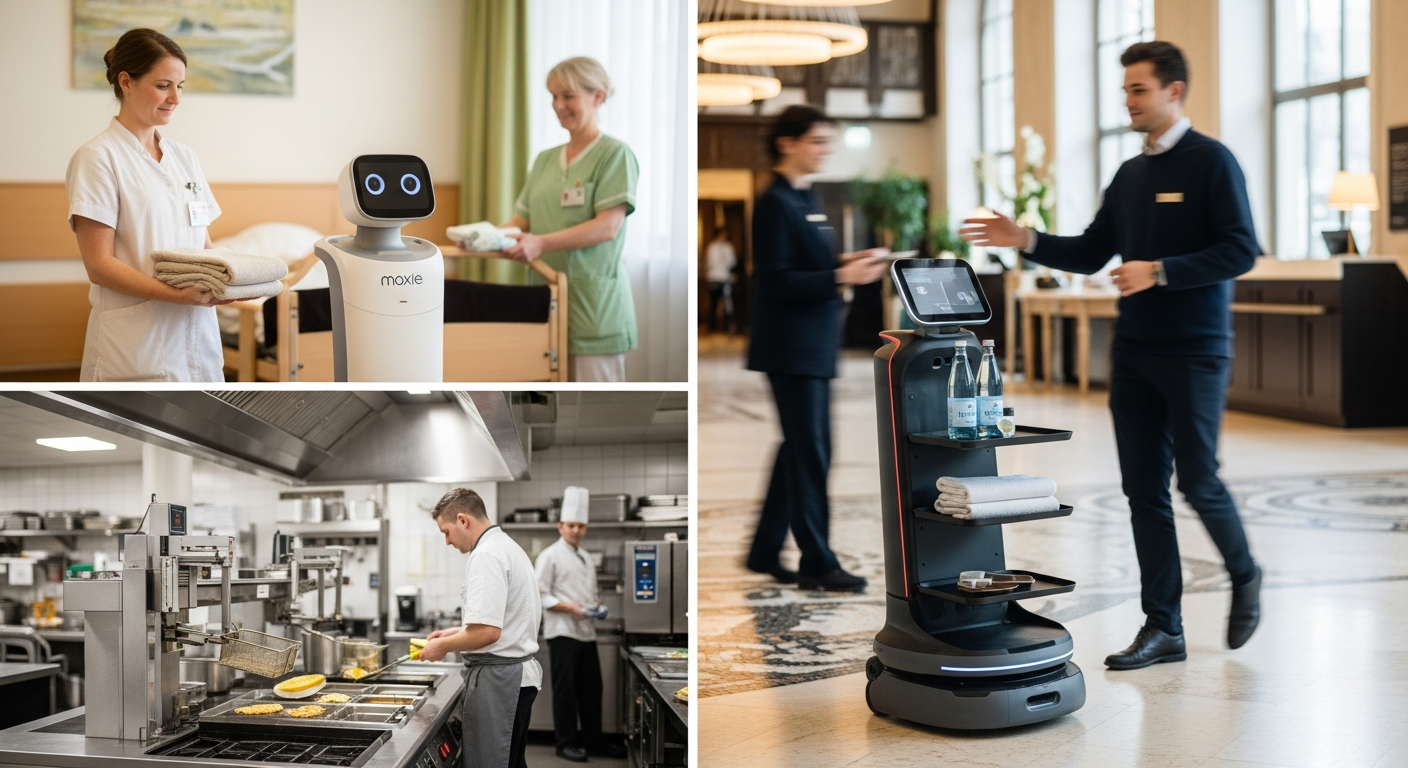
Robots instead of employees: operational efficiency through integration
The use of robotics is not a question of hardware, but rather of seamless integration into existing workflows. werob translates operational requirements into usable specifications in 48 hours and realizes measurable cost reductions without upfront investment.
Station 2. 10:00 p.m. The medicine trolley starts moving silently and heads to the programmed rooms. While the nursing staff gains time to speak directly to residents, the machine takes over the logistical routine. This is not a future scenario, but rather everyday operations at over 200 locations in eleven European countries. werob does not act as a manufacturer, but rather as the decisive operational level that translates the workflow of a nursing home, hotel or logistics center into a precise robot specification. Within 48 hours, a procedural description becomes a technical requirements profile that is matched against over 44 OEM partners.
Key Takeaways
- 1Cost reduction of up to 112,000 euros per location and year through targeted automation of repetitive tasks.
- 2Hardware-agnostic approach with access to 44+ OEMs and 280 robot models prevents vendor lock-in.
- 3Complete integration into existing software stacks such as SAP, Opera or PointClickCare within eight weeks.
From the shortage of skilled workers to the technological infrastructure
The European market is facing an unprecedented challenge: there is a shortage of tens of thousands of skilled workers in nursing, the hotel industry and logistics. The strategy of using robots instead of employees is not aimed at displacing staff, but rather at regaining valuable working time for core tasks. As a leading system integrator, werob has specialized in closing this gap. With over 200 robots in live operation and a presence in countries such as Germany, France and Sweden, the platform proves that robotics is now a scalable infrastructure component.
A key mistake many companies make is trying to evaluate robotics through individual hardware manufacturers. werob breaks this vendor lock-in. As a hardware-agnostic partner, the werob Spec Engine evaluates over 280 different robot models from 44+ OEMs. The aim is to translate the operator's specific task - be it the medication round in nursing or room service in the hotel - into a technical equivalent. At werob, this process only takes 48 hours, while classic consulting approaches often require months for the discovery phase.
The operational reality shows that the success of automation does not depend on the robot itself, but on its integration into the existing ecosystem. werob provides the necessary operational level for this. This includes not only the selection of hardware, but also regulatory protection and the technical connection to the operator's existing software stack. This is the only way to turn a machine into a reliable employee replacement for unwanted, repetitive tasks.
The werob Spec Engine: Ready for use in 48 hours
The biggest hurdle in introducing robotics is translating human work instructions into machine-readable logic. werob uses the Spec Engine for this, a model that was trained on data from over 35,000 projects. The operator describes his workflow in his own words. Within two days, werob delivers a detailed specification that covers all relevant parameters such as load capacity, battery life, navigation capability and safety requirements.
After the specification comes the supplier match. Since Werob is not a reseller of a single manufacturer, the ranking of the hardware is purely performance-based. Whether a robot from Keenon, Pudu, Boston Dynamics or Apptronik is used is determined solely by the accuracy of the fit to the defined task. This neutral approach ensures that operators always receive the most technologically and economically sensible solution. The ranking takes into account not only the technical data, but also the ability to deliver and conformity with European standards.
This process massively shortens the time until the first productive use. While traditional procurement channels often take six months or longer, werob promises an offer within five days and a robot in live use within eight weeks. This speed is crucial for companies that are suffering from acute staff shortages and need immediate relief. The Spec Engine is the heart of this acceleration and eliminates lengthy pilot phases without a clear target image.
Economic efficiency and measurable cost relief
Robotics has to pay off. werob works with validated key figures that reflect the actual cost reduction per location and year. In nursing, the automation of the medication round leads to a relief of 92,000 euros annually. Simply transporting laundry or waste saves a further 71,000 euros. These sums are not theoretical projections, but are based on real operational data from customers like Korian Germany.
The potential is even clearer in the hotel industry. A robot in room service saves the budget by 112,000 euros per year, while assistance with bar and breakfast preparation saves 54,000 euros. These figures make it clear that using robots instead of employees in routine areas is one of the most effective measures for optimizing margins. In the Food & Beverage (F&B) area, a tray bot in the dishwashing chamber generates a relief of 76,000 euros, while the automated kitchen floor cleaning costs 44,000 euros.
| Area | Use case | Annual relief (€) |
|---|---|---|
| Care | Medicine round | 92,000 |
| Care | Transport logistics | 71,000 |
| Hotel industry | Room service | 112,000< /td> |
| Hospitality | Bar/Breakfast | 54,000 |
| F&B | Tray Bot | 76,000 |
| Logistics | Yard Patrol | 68,000 |
That werob's commercial model underlines this focus on cost-effectiveness. As an outcome-only provider, werob bears the implementation risk. The operator only pays when the system runs as specified. There are no hidden list prices or high upfront investments for hardware that ends up sitting unused in the corner. This approach makes robotics equally accessible and calculable for medium-sized companies and large chains.
Seamless integration into the operator stack
A robot that acts in isolation creates additional effort instead of relief. The real strength of werob lies in the prefabricated connectors. These software interfaces integrate the robot fleet directly into the existing management systems. In care, this means integration into PointClickCare or MatrixCare. In the hotel sector, systems such as Opera PMS or Mews are directly connected to trigger tasks automatically as soon as a guest places an order.
Werob offers connections to SAP EWM for logistics and industry, while interfaces to Toast or Lightspeed are available in the catering sector. This integration ensures that the robot becomes part of the digital workflow. He receives his orders directly from the system that the employees use anyway. No additional training is required for complex robot software. The employees interact with their usual interfaces, while werob takes over the coordination of the hardware in the background.
The werob cockpit serves as a central monitoring unit. It provides a four-dimensional traffic light system that shows the status of hardware, infrastructure (such as Wi-Fi and elevators), regulatory and specification compliance in real time. If a robot is blocked or a technical problem occurs, this will be reported immediately. This live fleet management is the prerequisite for stable 24/7 operations without human supervision on site.
Regulation as a success factor: EU Machinery Regulation 2023/1230
Legal security is often an underestimated risk when using robots instead of employees. From January 20, 2027, the new EU Machinery Regulation 2023/1230 will be binding. It places significantly higher demands on conformity assessment, especially for robots that operate close to people. werob offers the necessary compliance path here. As a system integrator, werob assumes responsibility for compliance with these standards and ensures that all systems used are future-proof.
This also includes specific industry specifications such as ISO 13482 for service robots in the care sector or the security regulations (BewachVO) for security robots. HACCP standards must also be adhered to in the catering industry. werob integrates these regulatory requirements as early as the spec phase. A robot that does not meet European safety standards will not even be included in the selection process. This protects operators from costly shutdowns by authorities or liability risks in the event of damage.
Werob also addresses topics such as the EU AI Act and the GDPR. Since robots are equipped with sensors and cameras, it is essential to handle the information collected in accordance with data protection regulations. werob ensures that data processing takes place locally or in secured European clouds and that all cybersecurity requirements according to IEC 62443 are met. At werob, compliance is not an optional extra, but an integral part of the operational level.
Humanoid Robots: The Next Level of Automation
While specialized service robots are already taking on standard tasks today, humanoid robots are increasingly coming into focus. werob is already running pilot projects, such as in a nursing facility in Hamburg, where the first humanoid model successfully supports tasks in the twelfth week of operation. Partners such as Apptronik, Figure AI or Unitree are developing hardware that is able to move in environments designed for humans - without the need for ramps or special doors.
The advantage of humanoid systems lies in their versatility. A robot can help with breakfast service in the morning, take on logistics tasks at lunchtime and patrol at night. werob currently lists over 280 different types of robots, including the latest humanoid developments. The challenge here lies less in the mechanics and more in the control of complex movement sequences. werob uses advanced action graphs to ensure that the robot carries out its tasks precisely and safely.
Despite the technological fascination, werob remains true to its principle: the use must deliver a measurable result. Humanoid robots are only recommended if they offer an economic advantage over specialized systems in the customer's specific environment. Thanks to werob's hardware-agnostic platform, operators can be sure that they are not investing in hype, but in technology that is made fully operational by the werob cockpit and the existing connectors.
Eight steps to productive robot use
The path to automation with werob is standardized and transparent. It all starts with an 8-step intake process. The operator provides information about his identity, the shift schedules, the type of tasks and the existing infrastructure on site. Preferences regarding hardware or specific regulatory requirements are also queried. This structured process ensures that no important details are overlooked and that the Spec Engine can work precisely.
After submitting the data, werob creates the specification within 48 hours. The offer will follow within five days. Once the decision has been made, the eight-week implementation phase begins. During this time, the connectors are configured, the hardware is prepared and the regulatory checks are completed. At the end of these eight weeks, there is a robot that is productively integrated into the operation and reduces costs from day one.
This process is designed to keep the operational burden on the customer as low as possible. Since Werob controls the entire integration, there is no need to dedicate your own IT resources to robot programming. The goal is a turnkey system that works according to the outcome-only principle. Success is measured by the achievement of the defined performance indicators, which can be viewed at any time in the werob cockpit.
Security and monitoring in live operations
A robot in public spaces or in sensitive areas such as care requires constant monitoring. The werob Cockpit takes on this task centrally for all locations. It not only monitors whether the robot is driving, but also analyzes in-depth telemetry data. If Wi-Fi coverage becomes weak in an area or an elevator connector reports a delay, the system detects this before it comes to a standstill.
The safety of human-machine interaction is the top priority. All robots used by werob have multi-level safety systems that detect obstacles in real time and avoid collisions. Compliance with ISO 13482 ensures that the robots can operate safely even in the immediate vicinity of residents or guests. The cockpit also documents all security events seamlessly, which is crucial for liability and home supervision in Germany.
In addition, the cockpit enables continuous optimization of the fleet. By analyzing travel routes and task times, bottlenecks can be identified and processes can be adjusted. For example, if a transport robot in logistics has to regularly wait at a certain point, werob provides the database to make yard patrols or shelf stocking more efficient. The cockpit is therefore not just a control instrument, but a tool for permanently increasing efficiency.
The future of work: humans and machines working together
The decision to use robots instead of employees is a strategic commitment to future viability. Companies that invest in automated infrastructure today will secure a competitive advantage in a market with a shrinking workforce. werob sees itself as a partner who moderates this transition and secures it technologically. werob plans to expand the fleet to 2,000 robots by 2028 in order to sustainably relieve the burden on the European economy.
People remain the focus of value-adding activities. The robot takes over the lifting, carrying and searching, while the employee makes decisions, advises and cares. This division of tasks leads to higher employee satisfaction because physically demanding and monotonous work is eliminated. Customers like Korian are already showing that acceptance of robotics is high when it works reliably and makes everyday work noticeably easier.
werob offers the platform to make this vision a reality. With the combination of Spec Engine, Supplier Match, Connectors and Cockpit, werob delivers the only consistent solution for operational robotics in Europe. The path from the initial idea to the running system is short, risk-free and economically highly attractive. Start now and transform your workflows in eight weeks.
FAQ
- How long does it take for a robot to be ready for use?
- At werob, the process from the first specification to live operation takes eight weeks. The technical specifications are created within 48 hours; you will receive a concrete offer after five days.
- What are the upfront costs?
- werob works according to an outcome-only model. This means you don't have to make any upfront hardware or integration investments. Costs only arise when the system is running in your company as specified.
- Is the solution compatible with my existing software?
- Yes, werob offers ready-made connectors for market-leading systems such as SAP EWM, Opera PMS, Mews, Toast, MatrixCare and PointClickCare. Seamless integration into your digital workflows is therefore guaranteed.
- Do the robots meet German safety standards?
- Absolutely. werob ensures conformity with the EU Machinery Regulation 2023/1230 and takes into account specific standards such as ISO 13482, BewachVO and HACCP. All systems are certified for use in public and sensitive areas.
- What happens in the event of technical disruptions?
- All robots are monitored in real time via the werob cockpit. A four-dimensional traffic light system immediately reports malfunctions in hardware, infrastructure or software, minimizing downtime.
- Can werob also deliver humanoid robots?
- Yes, werob has access to leading humanoid platforms such as Apptronik or Unitree. We are already integrating these systems in pilot projects and evaluating their use based on your specific specifications.
Related reading
Robotics platform for operations: integration instead of hardware
A modern robotics platform is much more than a control unit for individual machines. It acts as an operational layer that combines hardware agnostics, regulatory compliance and deep software integration in one system to realize measurable cost reductions.
5 July 2026delivery robotsDelivery Robots for Companies: Integration Instead of Hardware Purchase
The introduction of delivery robots often fails due to hardware selection rather than workflow. werob translates your operational requirements into a precise specification in 48 hours and delivers the right fleet including integration.
11 June 2026mir agv provider germanyMiR AGV Providers Germany: System Integration Instead of Hardware Purchase
Those searching for a MiR AGV provider in Germany often find only hardware dealers. werob takes a different approach: We integrate Mobile Industrial Robots (MiR) as part of a manufacturer-independent fleet directly into your operational stack.
12 June 2026use robots in operationUsing robots in business: The guide for system integration
Anyone who wants to use robots in business often fails due to the complexity of integration and regulatory hurdles. werob solves this through a hardware-agnostic platform that translates operational processes into technical specifications in 48 hours.
28 June 2026nlp robot letterNLP Robot Brief: Automate operational workflows in 48 hours
The manual creation of specifications for robotics projects often takes months. werob uses NLP-supported briefings to translate operational requirements into precise specifications in 48 hours and find the right robot from over 44 manufacturers.
25 June 2026