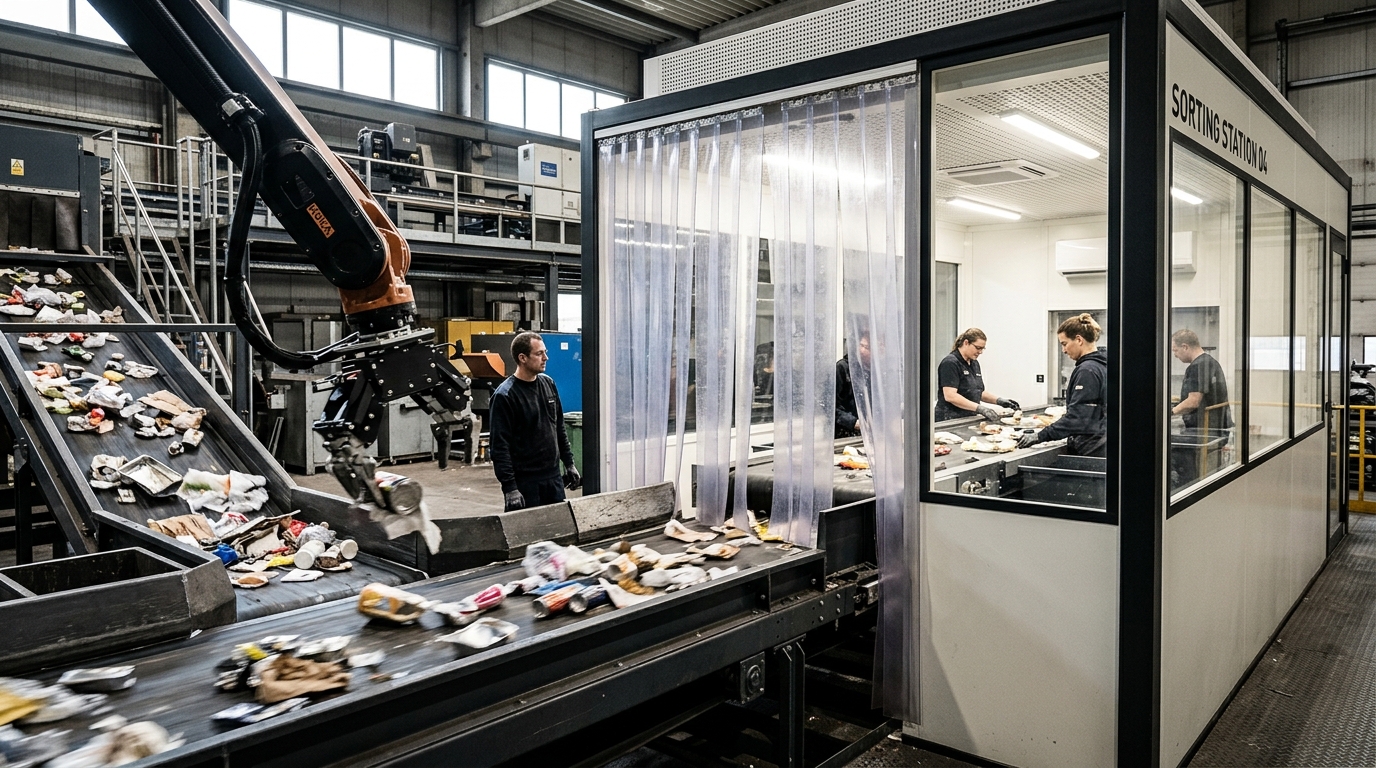
TRBA 214: what a sorting cabin requires before a picking arm is priced
Most rule sets describe the conditions under which a machine is permitted. TRBA 214 describes an activity that is meant to shrink — and section 4.6 puts a figure on the workstation an operator keeps.
In almost every robotics project the regulation runs one way: a rule set describes the conditions under which a machine may enter a place. In waste sorting it runs the other way. TRBA 214 describes an activity that is meant to shrink, names machine sorting equipment as the route, and elsewhere puts a precise figure on the workstation an operator keeps. This piece reads the rule in the original — July 2018 edition, first amendment 2021 — and sets against it which machine actually exists for that position on the belt today, and which does not.
Key Takeaways
- 1TRBA 214 section 4.2(3): „Eine manuelle Sortierung von Abfällen ist zu vermeiden. Sofern dies nicht vollständig möglich ist, muss der Anteil manueller Sortiertätigkeiten minimiert werden.“ — manual sorting of waste is to be avoided and, where that is not fully possible, the share of manual sorting must be minimised. Section 4.5.1(1) names machine sorting equipment as the example route.
- 2Activities within the scope of TRBA 214 are assigned no protection level at all (section 3(4), „Nicht-Schutzstufentätigkeiten“, § 6 BioStoffV). That does not lower the bar — the duties sit in section 4 and carry numbers.
- 3Permanent workstations may only be set up in cabins and control stands under section 4.4 or in sorting cabins under section 4.6 (section 4.2(1)).
- 4Section 4.6.2(5): low-turbulence supply air from above through large-area inlet elements, above every occupied sorting position, with an area of not less than 1 m² at a supply air flow of about 1,000 m³ per sorting station per hour. Paragraph 6 requires slight overpressure inside the cabin.
- 5The technical control value is 5 × 10⁴ colony-forming units per m³ of breathing air as a sum value for mesophilic moulds (section 5.2(1)). Above 1 × 10⁵ CFU/m³ the risk assessment must be repeated (section 5.5(2)).
- 6Respiratory protection is not an escape route: section 4.12(4) states that burdensome respiratory protection „darf nicht als Dauermaßnahme vorgesehen werden“ — it may not be planned as a permanent measure — and from filter class P3 upwards, mandatory occupational medical care under section 6.1 is a precondition for the activity.
The rule that describes its own replacement
The Technical Rules for Biological Agents are determined by the Committee for Biological Agents (ABAS) and announced by the Federal Ministry of Labour and Social Affairs in the Gemeinsames Ministerialblatt. TRBA 214 „Anlagen zur Behandlung und Verwertung von Abfällen“ stands in the July 2018 edition (GMBl 2018 no. 30 of 3 July 2018), amended by the first amendment 2021 (GMBl no. 41 of 13 July 2021). Every section number in this piece comes from that edition; older online mirrors number differently.
Within its scope the TRBA gives concrete form to the requirements of the Biological Agents Ordinance. An employer who complies with it may assume the corresponding requirements of the ordinance are met; an employer who chooses another solution must achieve at least the same level of safety and health protection with it.
Section 1(1) draws the scope widely: the TRBA applies to handling biological agents in activities in plants for the treatment or the material or energy recovery of waste, and additionally to sorting analyses and manual sorting of waste outside waste treatment plants. Sorting plant, mechanical-biological treatment, composting and the waste bunker all sit inside one rule set.
The sentence this piece turns on is in section 4.2(3) and runs two lines: „Eine manuelle Sortierung von Abfällen ist zu vermeiden. Sofern dies nicht vollständig möglich ist, muss der Anteil manueller Sortiertätigkeiten minimiert werden.“ Manual sorting of waste is to be avoided; where that is not fully possible, the share of manual sorting work must be minimised.
That inverts the usual reading direction. A rule set normally describes the conditions under which a machine may occupy a workstation. This one describes a workstation that is meant to shrink. Section 4.5.1(1) even names the route: „Die Störstoffauslese ist so zu gestalten, dass die manuelle Sortierung minimiert ist, z.B. durch den Einsatz von maschinellen Sortiereinrichtungen.“ — contaminant picking is to be designed so that manual sorting is minimised, for example by using machine sorting equipment. And section 4.5.3(1) removes one sub-task entirely: manual opening of bags is to be excluded.
No protection level — and why that makes nothing easier
One widespread misreading is worth clearing up first, because it turns up regularly in tenders and specifications. Activities in waste treatment plants are assigned no protection level. Section 3(4) says so expressly: „Tätigkeiten im Geltungsbereich dieser TRBA müssen keiner Schutzstufe zugeordnet werden und werden darum auch als Nicht-Schutzstufentätigkeiten bezeichnet (§ 6 BioStoffV).“
Reading a lower bar into that gets the rule backwards. The duties here do not flow from a classification but from the risk assessment and from the technical measures in section 4 — and those carry harder numbers than any protection level would. Section 3(6) also explains why no classification is possible: the spectrum of biological agents present in waste varies with the type, origin and processing of the waste, exposure conditions fluctuate strongly over time and differ greatly from place to place.
For the built form, section 4.2(1) sets the base rule: permanent workstations may only be set up in cabins and control stands under section 4.4 or in sorting cabins under section 4.6. A permanent hand-sorting position at an open belt is therefore ruled out before ventilation, measurements or personal protective equipment are discussed at all. The question is not whether a sorting cabin is needed, but only how many positions inside it stay occupied.
What a sorting cabin structurally is
Section 4.6.1(1) requires, for hand sorting, a working room closed off from other operating areas and climate-controlled. The structural separation has to ensure that no air loaded with biological agents can flow into the sorting cabin.
The detail of that separation sits in paragraph 4 and is where a retrofit gets expensive: the cabin doors must be self-closing, and the pass-through openings for the sorting belts and the discharge areas have to be included in the separation — the rule names closable discharge chutes and lamellae at the pass-through openings for picking belts. A belt running through a wall is an opening, and every opening has to be dealt with.
Paragraph 3 requires easily cleanable surfaces and materials that prevent the accumulation of settled dust, naming wet-cleanable floor coverings and the integration of cabling and lighting into the walls. Paragraph 7 requires the sorting run to be designed without hard-to-clean gaps, for instance under the sorting belt, and cavities to be sealed. Paragraph 6 excludes transfer points of sorting and conveyor belts inside the cabin, or requires them to be encapsulated.
For a robotics project, paragraph 5 is the most important sentence in the whole section: „Maschinelle Sortiereinrichtungen sind außerhalb der Sortierkabine zu installieren.“ Machine sorting equipment is to be installed outside the sorting cabin. Under this rule a sorting robot therefore does not work inside the cabin. It sits over the belt before or after it — and the cabin it replaces either goes or stays. An intermediate state in which the picking arm stands beside the sorter in the same room is not contemplated.
The ventilation, and the number attached to it
Section 4.6.2(1) sets the job of the ventilation system: it must minimise employees' exposure to airborne biological agents at the workstation, ensure compliance with the technical control value, and provide balanced climatic conditions. Paragraph 2 requires the sorting station to be laid out so that the breathing zone of the sorting personnel is reached by the supply air stream throughout all movements of the work sequence.
Paragraph 5 carries the figure a cabin project is measured against: fresh air is fed into the cabin from above with low turbulence through large-area inlet elements — for example above every occupied sorting position with an area of not less than 1 m² at a supply air flow of about 1,000 m³ per sorting station per hour. The elements are mounted as low as possible, around 2.5 m above the floor, so that a stable quasi-laminar displacement flow fills the breathing zone; to stabilise it the rule names air curtains or plastic strip curtains on at least three sides.
Paragraph 6 sets the pressure regime, and does so the opposite way round to intuition: the exhaust system is to be matched to the supply air flow so that slight overpressure prevails in the cabin, and supply and exhaust may only be operable together. The overpressure keeps loaded air out; a cabin under negative pressure would draw it in. Paragraph 4 additionally requires the operating state of the system to be clearly recognisable to employees, acoustically or optically, with tampering technically excluded.
The rest of the section covers what holds the figure in practice. Paragraph 9 requires even belt loading, including at every start-up of the belt, to minimise raised dust. Paragraph 10 requires dust ingress into the cabin to be avoided, for instance by enclosing and extracting at the belt section before it enters the cabin. Paragraph 11 requires cleaning equipment, naming a class H industrial vacuum.
Section 4.6.3 turns this into continuing duties. Paragraph 3: the ventilation systems are to be inspected as required and at least annually by a competent person, with a record kept of the result. Paragraph 4: the sorting cabin and the sorting belt, including the lamella curtains, are to be given a low-dust cleaning every working day. Paragraph 5: during breaks and downtime the ventilation must keep running, or sufficient lead time must be provided before work resumes. Paragraph 2 requires proof of effectiveness on commissioning and after modifications.
The technical control value and its measurement regime
Section 5.1(1) ties back to § 8(6) BioStoffV: the employer has to check the function and effectiveness of technical protective measures regularly, and at permanent workstations to do so by determining the concentration of biological agents, irrespective of how long anyone stays there. Paragraph 2 bounds the value: it is meant to help the employer judge whether the protective measures are working, and is expressly not to be used as a limit value in permitting procedures.
Section 5.2(1) sets it: the TKW is fixed at 5 × 10⁴ colony-forming units (CFU) per m³ of breathing air as a sum value for mesophilic moulds. It applies to checking the effectiveness of protective measures at workstations in sorting cabins, cabins, driver's cabs and control stands — and not in areas fully separated from the plant area in ventilation terms, such as control rooms and crane cabs reached through unloaded areas.
Section 5.3 describes how the measurement is taken, and the detail shows the sorting position itself is meant rather than the room: sampling takes place at the workstation under normal operating conditions at breathing height, for standing workstations at 1.6 m measured from the floor. In sorting cabins measurements may be taken at unoccupied sorting positions opposite a sorter, with the sampling head positioned at the edge of the sorting belt, in the middle of the workstation. The minimum number of individual measurements is tabulated: for a 10-minute sampling duration at least five individual measurements with the median as the result, for one hour at least two with the arithmetic mean.
Section 5.5 governs the consequences. Where the result exceeds the TKW, the existing technical and organisational protective measures are to be optimised. Where it is greater than 1 × 10⁵ CFU/m³, the employer must in addition repeat the risk assessment; if that shows the measures taken are insufficient, they must be adjusted without delay. Effectiveness must then be checked again.
This is where a hand-sorting position becomes a recurring obligation rather than a one-off capital item: as long as a position is occupied there is a measured value that can be exceeded, and a chain that then starts.
Respiratory protection is expressly not a permanent solution
The obvious workaround — skip the cabin, issue masks — is closed off by the rule itself. Section 4.12(1) sets the baseline equipment: safety shoes of protection category S2 to DIN EN ISO 20345, suitable hand protection to DIN EN 388, and body-covering workwear to DIN EN ISO 13688.
Paragraph 2 makes respiratory protection conditional on the technical measures: it is to be provided where the hazard from airborne biological agents cannot be reduced by structural, technical and organisational measures — the occasions named include failure or malfunction of technical protective measures and maintenance and cleaning work with experience of high exposure. Paragraph 3 sets the level: at minimum a half mask with a class P2 particle filter to DIN EN 143 or an FFP2 filtering half mask to DIN EN 149; for work in heavily loaded areas, „for example in the area of the waste bunker“, at least P3 or FFP3.
Paragraph 4 then draws the line that closes the exit: filters and filtering half masks are to be changed every working day, filtering devices are unsuitable for people with beards along the sealing lines, and — the decisive sentence — the use of burdensome respiratory protection is to be limited to what is strictly necessary and may not be planned as a permanent measure. Wearing-time limits apply.
Section 6 attaches a personnel consequence to that. Under section 6.1, grounds for mandatory occupational medical care under the annex to the ArbMedVV can arise for activities requiring group 2 respiratory protective devices — filtering devices with class P3 particle filters are named. The section ends with a sentence that leaves no room: „Die Pflichtvorsorge ist Tätigkeitsvoraussetzung.“ Mandatory care is a precondition for the activity. Under section 6.2, offered care comes into consideration for raised exposure to moulds and bacteria, expressly „for example where the technical control value is exceeded“, and for activities requiring FFP2.
In short: PPE moves the obligation, it does not discharge it. And from P3 upwards, an occupational medical examination decides whether a person may be deployed at that position at all.
Which machine exists for this today — and which does not
The rule names machine sorting equipment but no manufacturer and no product. The market does, and it is narrower than the number of vendors suggests.
The only picking arm with a named German reference is the ZenRobotics Heavy Picker, a Terex brand since 2022. At IMRO Maschinenbau in Uffenheim a plant for incinerator bottom ash is being built in which ZenRobotics robotics is combined with IMRO's processing lines to recover metals including aluminium, copper and stainless steel; it was announced on 23 October 2025 with the intention of being fully operational before the end of 2025. The performance figures come from the manufacturer and should be read as such: up to 2,300 picks per hour per arm, objects up to 40 kg and up to 1.5 m, „up to 99 % purity“ in recovered material. How well a per-attempt rate holds across a full shift is a separate question — see the piece on success rates and shift plans.
Recycleye entered the German market in May 2022 through Veolia Germany's U-Start programme; no named German site has been published since. In April 2026 CP Group took a majority stake in Recycleye. Machinex supplies European installations with SamurAI and the SamurAI Optima introduced in 2025, including at Veolia sites in France, but with no German reference. AMP renamed itself in February 2024 and moved from the picking arm to supplying whole facilities, and is therefore no longer a vendor for this position.
Two areas expressly do not belong here, and it is more honest to say so than to blur the boundary.
Sensor-based sorting is a different business. NIR, X-ray and magnetic separators come from STEINERT in Cologne and from TOMRA, and are assembled into lines by plant builders such as STADLER in Altshausen — the battery sorting plant commissioned in 2026 at Ginsheim-Gustavsburg for Saubermacher contains 35 STEINERT NIR units and no picking arm. Under section 4.6.1(5) that equipment always sat outside the cabin anyway. It is not what a manufacturer-independent integrator contributes, and werob does not sell it.
In the waste-to-energy plant there is no machine for this purpose, there is software. TRBA 214 reaches into the waste bunker — section 4.12(3) names it as a heavily loaded area with a P3 requirement. What the market offers there is computer vision as an advisory layer: Jaipur Robotics of Zurich sells „Jaipur Intelligence“, a SaaS platform that detects objects in the bunker, maps calorific value and alerts crane operators. That is a software product from a company founded in 2024 at pre-seed stage, not a robot and not something an integrator installs. Presenting it otherwise sells a category that does not exist.
What that means for a plant, in the arithmetic
The reflex at this point is to divide the cabin cost by the number of sorting positions and book a saving per position replaced. The rule does not support that, and knowing so matters more to a defensible calculation than any manufacturer figure.
Only one quantity scales with headcount: the supply air flow under section 4.6.2(5) is specified „per sorting station“ and the inlet elements sit „above every occupied sorting position“. Handing three of four positions to a picking arm reduces the cabin's design air rate accordingly.
Everything else attaches to the room, not to the position. The structural separation under section 4.6.1, the at-least-annual inspection of the ventilation by a competent person under section 4.6.3(3), the daily low-dust cleaning of cabin, belt and lamella curtains under paragraph 4, the continued operation of the ventilation during breaks under paragraph 5 and the measurement duty under section 5 all persist as long as one position is occupied. The saving at the last position is therefore binary, not linear: only when no permanent workstation remains inside the cabin do the room, the inspection, the cleaning duty and the measurement regime fall away.
A realistic first project is usually shaped so that a picking arm takes the volume fractions and one quality-control position remains. Then the cabin remains too, and the benefit sits in the air rate, in the smaller number of exposed people, and in the question under section 6.1 of whether P3 still has to be worn at that position — not in a deleted structure. Saying this in advance saves explaining it afterwards.
The second number that decides such a purchase is not in occupational safety law but in waste law: the sorting and recycling quotas under § 6 of the Commercial Waste Ordinance, determined monthly and filed with the authority. Which machine actually moves that number, and which does not, is in the piece on the sorting quota.
FAQ
- Does TRBA 214 mandate a sorting robot?
- No. Section 4.2(3) provides that manual sorting of waste is to be avoided and, where that is not fully possible, the share of manual sorting work must be minimised. Section 4.5.1(1) names the use of machine sorting equipment as an example of how contaminant picking is to be designed. No particular product, manufacturer or pick rate is prescribed anywhere.
- Which protection level applies to workstations in a sorting plant?
- None. Section 3(4) records that activities within the scope of this TRBA need not be assigned to any protection level and are therefore described as non-protection-level activities (§ 6 BioStoffV). The requirements instead follow from the risk assessment and from the structural, technical and organisational measures set out in section 4.
- How much supply air does a hand-sorting position need?
- Section 4.6.2(5) names large-area inlet elements feeding from above, above every occupied sorting position with an area of not less than 1 m², at a supply air flow of about 1,000 m³ per sorting station per hour, mounted as low as possible at around 2.5 m above the floor. Paragraph 6 requires the exhaust system to be matched so that slight overpressure prevails in the cabin, and allows supply and exhaust to be operated only together.
- What is the technical control value and what happens if it is exceeded?
- Under section 5.2(1) the TKW is fixed at 5 × 10⁴ colony-forming units per m³ of breathing air as a sum value for mesophilic moulds, and applies among other places to workstations in sorting cabins. Where the result exceeds it, the technical and organisational protective measures are to be optimised under section 5.5(1). Above 1 × 10⁵ CFU/m³ the risk assessment must additionally be repeated (paragraph 2). Under section 5.1(2) the TKW is expressly not a limit value for permitting procedures.
- Is FFP3 enough instead of a sorting cabin?
- No. Section 4.2(1) permits permanent workstations only in cabins and control stands under section 4.4 or in sorting cabins under section 4.6. Section 4.12(4) further provides that the use of burdensome respiratory protection is to be limited to what is strictly necessary and may not be planned as a permanent measure. From filter class P3 upwards, mandatory occupational medical care comes into consideration under section 6.1, and that care is a precondition for the activity.
- Does TRBA 214 also apply to waste-to-energy plants?
- Yes, as a matter of scope. Section 1(1) covers plants for the treatment or the material or energy recovery of waste, and section 4.12(3) expressly names the waste bunker as a heavily loaded area requiring at least P3. There is, however, no picking arm on the market for that location; what is offered there is computer vision software as an advisory layer for the crane operator, for instance from Jaipur Robotics — a software product, not a machine an integrator installs.
Related reading
85 percent, documented monthly: which machine actually moves the sorting quota
The sorting quota and the recycling quota have different denominators. Miss that and you buy a picking arm that lifts one number while diluting the other — and the ordinance's annex also says which components an integrator does not supply.
7 September 2026robot success rateReading robot success rates honestly: what 45.7 percent floor pickup means for a shift plan
Google published per-task success rates alongside its new models. They are strong research results and they are not shift ready for every task. Telling those apart is a numeracy problem, not a robotics problem.
30 July 2026sorting robot quality control packaging wasteThe last picking station: what a sorting robot changes at the end of the line — and what it does not
In 2022 a waste company in Swisttal put a picking robot not at the start of its packaging-waste plant but at the end, where the PET stream is almost pure and every missed pick is expensive. The operator itself says what the robot replaces and what still happens by hand.
11 September 2026