85 percent, documented monthly: which machine actually moves the sorting quota
The sorting quota and the recycling quota have different denominators. Miss that and you buy a picking arm that lifts one number while diluting the other — and the ordinance's annex also says which components an integrator does not supply.
In a pre-treatment plant for commercial municipal waste, the figure an automation decision can be measured against already exists: it is determined monthly, documented, and filed with the authority once a year. Anyone considering a sorting robot therefore does not need to invent a business case — they need to read two definitions in § 2 of the German Commercial Waste Ordinance closely. The two have different denominators, and that determines whether a machine lifts both quotas or plays one off against the other.
Key Takeaways
- 1§ 6(3) GewAbfV requires operators of pre-treatment plants to run them so that a sorting quota of at least 85 percent by mass is achieved as a calendar-year average. Under paragraph 5, a recycling quota of at least 30 percent by mass has applied since 1 January 2019.
- 2The denominators differ: under § 2 no. 7 the sorting quota measures the mass output for recovery against the total mass fed into the plant; under § 2 no. 8 the recycling quota measures the mass sent to recycling against the mass previously output for recovery.
- 3Under § 6(4) the sorting quota must be determined for every month and documented without delay. Where it falls more than ten percentage points below the annual quota in two months of the current calendar year, the competent authority must be notified without delay.
- 4Under § 6(6) the recycling quota must be determined for each calendar year, documented without delay, and submitted to the competent authority by 31 March of the following year.
- 5The annex to § 6(1) sentence 1 prescribes five components. Two of them carry statutory performance figures: metal extraction units with at least 95 percent recovery and plastic extraction units with at least 85 percent recovery. That is sensor and magnetic separation equipment, not a picking arm.
- 6The picking arm sits in component 3 of the annex: „Aggregate zur maschinell unterstützten manuellen Sortierung“ — machine-assisted manual sorting units, precisely the activity whose share TRBA 214 section 4.2(3) wants minimised.
Two quotas, two denominators
The German ordinance on the management of commercial municipal waste and certain construction and demolition waste — Gewerbeabfallverordnung, GewAbfV, in its 2017 version — defines in § 2 two figures that are routinely named in one breath on site and that have nothing to do with each other arithmetically.
§ 2 no. 7, sorting quota (Sortierquote): the quotient of the mass of waste output for recovery through the sorting of mixtures under § 4(1) sentence 1 and § 9(1) sentence 1 no. 1 and of mixed construction and demolition waste under § 9(3) sentence 1, and the total mass of those mixtures fed into a pre-treatment plant, multiplied by 100 percent.
§ 2 no. 8, recycling quota (Recyclingquote): the quotient of the mass of waste sent to recycling and the total mass of waste output for recovery through the sorting, multiplied by 100 percent.
The denominator of the sorting quota is the plant's input. The denominator of the recycling quota is what the sorting quota carries in its numerator: the mass output for recovery. The second quota therefore does not measure the plant against its input at all; it measures the quality of the output against its quantity.
That chaining is why a machine which pulls more mass out of the stream does not automatically improve both figures. It is also why a plant comfortably meeting one of the two quotas can fail the other without anything having changed in throughput.
What § 6 requires — and when the authority hears about it
The duties sit in § 6, „Anforderungen an Vorbehandlungsanlagen“, and for a rule of this kind they run on an unusually short clock.
Paragraph 3 sets the first figure: operators of pre-treatment plants must operate their plants so that a sorting quota of at least 85 percent by mass is achieved as an average across the calendar year.
Paragraph 4 turns that into a monthly rhythm and a trigger: operators must determine the sorting quota for every month in order to establish the annual figure, and document it without delay after determination. As soon as the monthly sorting quota falls more than ten percentage points below the annual sorting quota under paragraph 3 in two months of the current calendar year, operators must notify the competent authority without delay under sentence 3. That notification requires details of the causes of the shortfall, the measures required, and the implementation steps and time needed.
Paragraph 5 sets the second figure: operators of pre-treatment plants have had to meet a recycling quota of at least 30 percent by mass since 1 January 2019 at the latest. Paragraph 6 gives it a deadline: it must be determined for each calendar year, documented without delay, and the documentation submitted to the competent authority by 31 March of the following year.
Paragraph 7 describes where the remainder goes: waste sorted out and not sent to recycling is to be given priority for proper, harmless and high-quality other recovery, in particular energy recovery. Under paragraph 8, hazardous waste must be sorted out.
For an investment decision that is a rare starting position. The figure already exists, it is collected monthly, it has a defined escalation point towards the authority and an annual filing date. It does not have to be constructed to carry a business case.
The annex: five components, and who supplies them
§ 6(1) sentence 1 requires operators to equip their plants with at least the components named in the annex, in order to ensure proper, harmless and high-quality recycling, in particular of the waste fractions paper, cardboard and board, plastic, metal and wood. Sentences 2 and 3 allow the components to be distributed across several plants operated in series, but then require, where different operators are involved, contracts ensuring further treatment and compliance with both quotas.
The annex to § 6(1) sentence 1 names five components:
1. stationary or mobile shredding units;
2. units for separating different materials;
3. units for machine-assisted manual sorting;
4. metal extraction units with at least 95 percent recovery;
5. plastic extraction units with at least 85 percent recovery.
Items 4 and 5 are the real finding. Here the ordinance prescribes not merely a category of equipment but a machine performance in percent. There are not many places in German waste law where a unit has to meet a statutorily fixed recovery rate.
Sensor sorting is a different business — and the ordinance says so itself
Who supplies components 4 and 5 is unambiguous in this market, and it is not the robotics integrator. Metal and plastic extraction at the required rates means magnetic separators, eddy current separators and sensor-based sorting — NIR and X-ray.
In Germany that equipment comes from STEINERT in Cologne, one of the world's leading houses for sensor-based sorting and magnetic separation, and from TOMRA, whose recycling sorting division is based in Germany. They are assembled into lines by plant builders such as STADLER Anlagenbau in Altshausen. The battery sorting plant commissioned in 2026 at Ginsheim-Gustavsburg for Saubermacher, one of the most advanced of its kind in Europe, combines STADLER equipment with 35 STEINERT NIR sorting units — and contains no picking arm.
That is not an aside but the boundary of what is on offer here. werob is a manufacturer-independent systems integrator for robotics and does not sell sensor sorting. An integrator who implies they can supply components 4 and 5 is selling a chapter that established German houses have occupied for decades. The ordinance's annex already draws the line itself: it separates the units carrying a statutory recovery rate from the component in which a manual sorting activity is machine-assisted.
The energy side does not belong here either. § 6(7) routes the non-recycled share into other recovery, in particular energy recovery — that is, into the 164 thermal waste treatment plants the Federal Statistical Office records for 2024 with an input of 25,523.5 thousand tonnes. What is offered there in the way of digitalisation is computer vision software for the bunker crane, such as the „Jaipur Intelligence“ SaaS platform from Jaipur Robotics, a Zurich company founded in 2024. That is software, not an integrable unit, and it moves neither quota in this ordinance, because it sits in a different class of plant.
The component a picking arm sits in
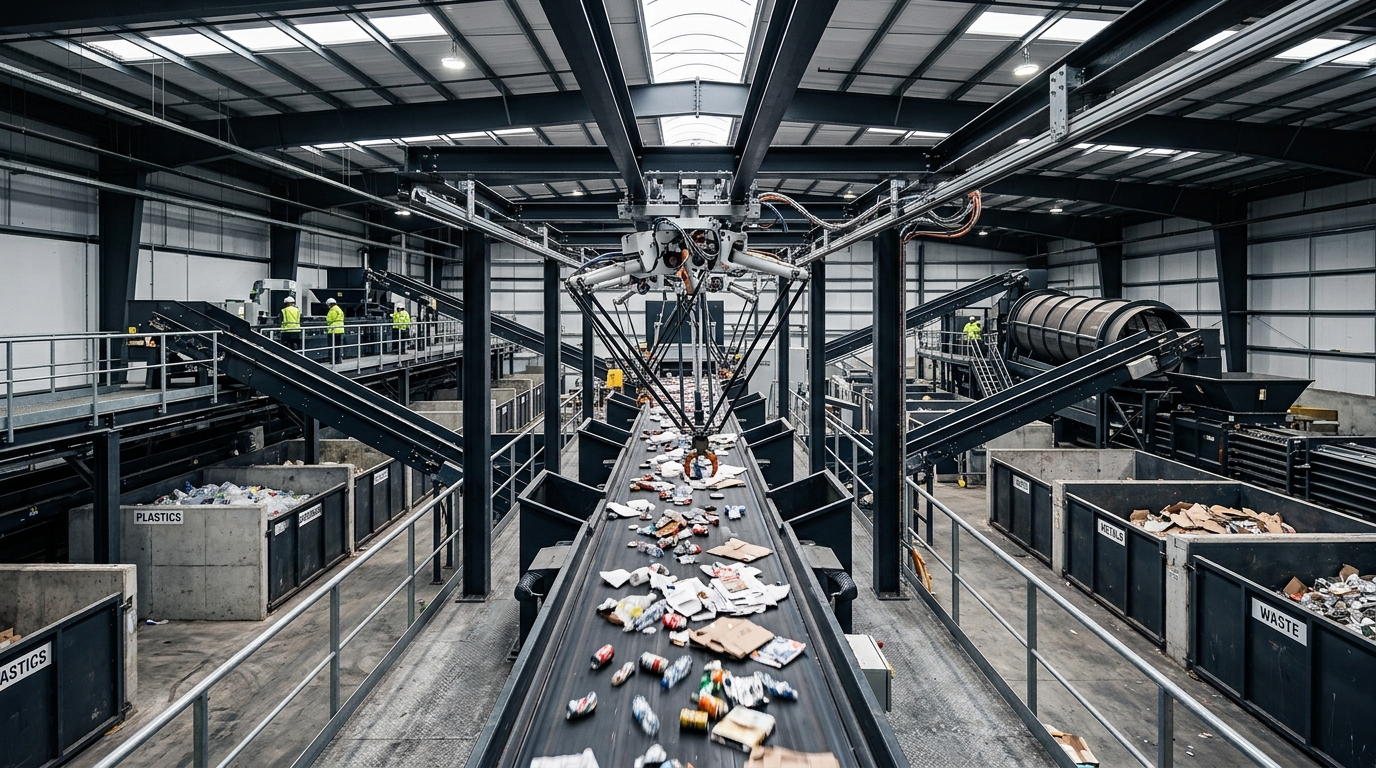
That leaves component 3: units for machine-assisted manual sorting. This is the picking position at the belt, and it is where a sorting robot sits.
The wording is worth pausing on. The ordinance prescribes machine-assisted manual sorting as a mandatory component — it therefore presupposes a human sorting operation that a machine supports. The Technical Rule for Biological Agents that applies to the same plant says the opposite about the activity itself, in section 4.2(3): manual sorting of waste is to be avoided, and where that is not fully possible, the share of manual sorting work must be minimised.
That is not a contradiction, but it is a tension a plant has to hold: waste law requires the component, occupational safety law wants the share of the activity inside it kept small. A picking arm over the picking belt satisfies both at once — the component remains present, the manual share falls. What that means in detail for occupational safety, which ventilation, measurement and medical-care duties attach to an occupied sorting position, and where the saving becomes binary rather than linear, is set out in the piece on TRBA 214 and the sorting cabin.
The ordinance itself prescribes no performance for component 3. There is no pick rate, no accuracy and no availability to be met — unlike the 95 and 85 percent attaching to components 4 and 5. An operator who wants to base a procurement on a statutory requirement will not find one for the picking arm.
Why a picking arm can move the two quotas in opposite directions
This is where the two denominators pay out. A picking arm pulls material out of the stream and places it in a fraction. What that does to the quotas depends entirely on where the fraction subsequently goes.
If the picked mass goes to recycling, it rises in the numerator of the sorting quota (mass output against input) and in the numerator of the recycling quota (mass sent to recycling) — and equally in the denominator of the recycling quota. Both quotas move up, the recycling quota more slowly because its denominator grows with it.
If the picked mass instead goes to other recovery, in particular energy recovery under § 6(7) — as a refuse-derived fuel fraction, say — it rises in the numerator of the sorting quota and in the denominator of the recycling quota, but not in the latter's numerator. The sorting quota rises; the recycling quota falls.
This is not a technicality but the most common configuration in a pre-treatment plant. A picking arm is easiest to train on the clearly recognisable, bulky contaminants, and a share of those are calorific rather than recyclable. A machine optimised for tonnage lifts the 85 percent figure and pushes down on the 30 percent figure. A machine optimised for clean recyclable fractions lifts both, but more slowly.
For a specification that yields a very concrete question, to be answered before any hardware is selected: which of the two quotas is the binding one in this plant? A plant sitting at 87 percent sorting and 31 percent recycling needs a different target definition for the gripper than one at 84 and 38 percent. The ordinance delivers the figures for that every month, free of charge.
What a vendor reference tells you about a quota — and what it does not
Sorting-robot vendors advertise pick rates and purities. Neither quantity appears anywhere in § 6 GewAbfV. A quota is a mass balance across a calendar year; a pick rate is an instantaneous performance at a belt. Between the two sit belt loading, availability, fraction assignment and where the material subsequently goes — and none of those is in a datasheet.
What is useful in a reference is therefore not the number but the waste stream. The only named German reference for a picking arm at present is the IMRO Maschinenbau facility in Uffenheim, announced on 23 October 2025, in which ZenRobotics robotics — a Terex Corporation brand since August 2022 — is combined with IMRO processing lines. What it recovers is aluminium, copper and stainless steel from incinerator bottom ash. For the quota question that is the most favourable case imaginable: the picked fraction goes unambiguously to recycling and therefore lifts both quotas at once. A plant whose gripper pulls calorific contaminants cannot rely on this reference.
The manufacturer's figures for the Heavy Picker — up to 2,300 picks per hour per arm, objects up to 40 kg and 1.5 m, „up to 99 % purity“ — describe the machine, not the balance. They should be read as manufacturer claims and do not substitute for a twelve-month mass view.
The rest of the German reference base is thin. Recycleye entered the market in May 2022 through Veolia Germany’s U-Start programme; no named German site has been published since, and in April 2026 CP Group took a majority stake. Machinex supplies SamurAI and the SamurAI Optima introduced in 2025 to European sites including Veolia plants in France, with no German reference. AMP renamed itself in February 2024 and moved from the picking arm to whole facilities, and can no longer be listed as a picking-arm vendor.
For the size of the population: the Federal Statistical Office records 940 sorting plants in Germany for 2024 with an input of 23,122.6 thousand tonnes, within a total of 12,920 waste disposal facilities. Not every one of them is a pre-treatment plant within the meaning of this ordinance — and only a small share has a picking arm today.
What is already settled before a procurement
Three things are fixed before a quotation is requested, and all three come from the ordinance itself rather than from a vendor deck.
First: the figure exists. Under § 6(4) the sorting quota is determined and documented monthly in any case. A sorting robot is therefore one of the few robotics purchases whose effect can be measured against a number that is already kept and already addressed to an authority — rather than against a metric constructed for the occasion.
Second: there is a defined escalation point. Two months more than ten percentage points below the annual quota trigger notification of the authority without delay, with causes, measures, implementation steps and time needed. An operator who has hit that point in recent years knows the occasion for an investment more precisely than any payback calculation could describe it.
Third: the target is decided by the denominators, not by the pick rate. Before hardware is selected, it needs settling which of the two quotas is the binding one and where the picked fraction subsequently goes. A specification that leaves this open can be met by a picking arm doing 2,300 picks an hour and still move the wrong number.
And one boundary stands. The components carrying a statutory recovery rate — 95 percent metal, 85 percent plastic — are sensor sorting, and they come from the established German and European plant builders. A robotics integrator adds the picking position; it does not replace the line.
FAQ
- Which plants does § 6 GewAbfV apply to?
- Operators of pre-treatment plants (Vorbehandlungsanlagen). By the definition of the sorting quota in § 2 no. 7, it covers the sorting of mixtures under § 4(1) sentence 1 and § 9(1) sentence 1 no. 1 and of mixed construction and demolition waste under § 9(3) sentence 1. Under § 6(1) sentences 2 and 3 the prescribed components may be distributed across several plants operated in series, but where different operators are involved only with contracts ensuring further treatment and compliance with both quotas.
- How do the sorting quota and the recycling quota differ?
- In the denominator. Under § 2 no. 7 the sorting quota sets the mass output for recovery against the total mass of the mixtures fed into the plant. Under § 2 no. 8 the recycling quota sets the mass sent to recycling against the total mass of waste output for recovery through the sorting. The numerator of the first quota is the denominator of the second.
- When must the authority be notified?
- Under § 6(4), as soon as the monthly sorting quota falls more than ten percentage points below the annual sorting quota under paragraph 3 in two months of the current calendar year. The notification must be made without delay and must state the causes, the measures required, and the implementation steps and time needed. Separately, the recycling quota must be submitted under paragraph 6 by 31 March of the following year.
- Does the Commercial Waste Ordinance mandate a sorting robot?
- No. Item 3 of the annex to § 6(1) sentence 1 requires units for machine-assisted manual sorting, without specifying a design, a pick rate or an accuracy. Statutory performance figures exist only for two other components: metal extraction with at least 95 percent and plastic extraction with at least 85 percent recovery.
- Can a sorting robot make the recycling quota worse?
- Yes, arithmetically. Where picked mass is routed to other recovery, in particular energy recovery, under § 6(7), it raises the numerator of the sorting quota and at the same time the denominator of the recycling quota, but not the latter's numerator. The sorting quota then rises while the recycling quota falls. Which fraction a gripper is meant to pull therefore has to be settled before hardware selection.
- Does software in a waste-to-energy plant move either quota?
- No. § 6 GewAbfV addresses pre-treatment plants, not thermal waste treatment plants; under § 6(7) energy recovery is the destination for the non-recycled share, not the place where the quotas are measured. What is on the market for waste-to-energy plants is computer vision platforms supporting the crane operator, for instance from Jaipur Robotics — software, not a unit within the meaning of the annex to § 6.
Related reading
TRBA 214: what a sorting cabin requires before a picking arm is priced
Most rule sets describe the conditions under which a machine is permitted. TRBA 214 describes an activity that is meant to shrink — and section 4.6 puts a figure on the workstation an operator keeps.
7 September 2026sorting robot quality control packaging wasteThe last picking station: what a sorting robot changes at the end of the line — and what it does not
In 2022 a waste company in Swisttal put a picking robot not at the start of its packaging-waste plant but at the end, where the PET stream is almost pure and every missed pick is expensive. The operator itself says what the robot replaces and what still happens by hand.
11 September 2026robotics integrator man-days saved90 percent fewer man-days than a traditional robotics build
A traditional in-house robotics rollout ties up internal man-days that never show up on a quote — vendor comparison, integration, rework. werob cuts exactly that effort by 90 percent.
11 September 2026