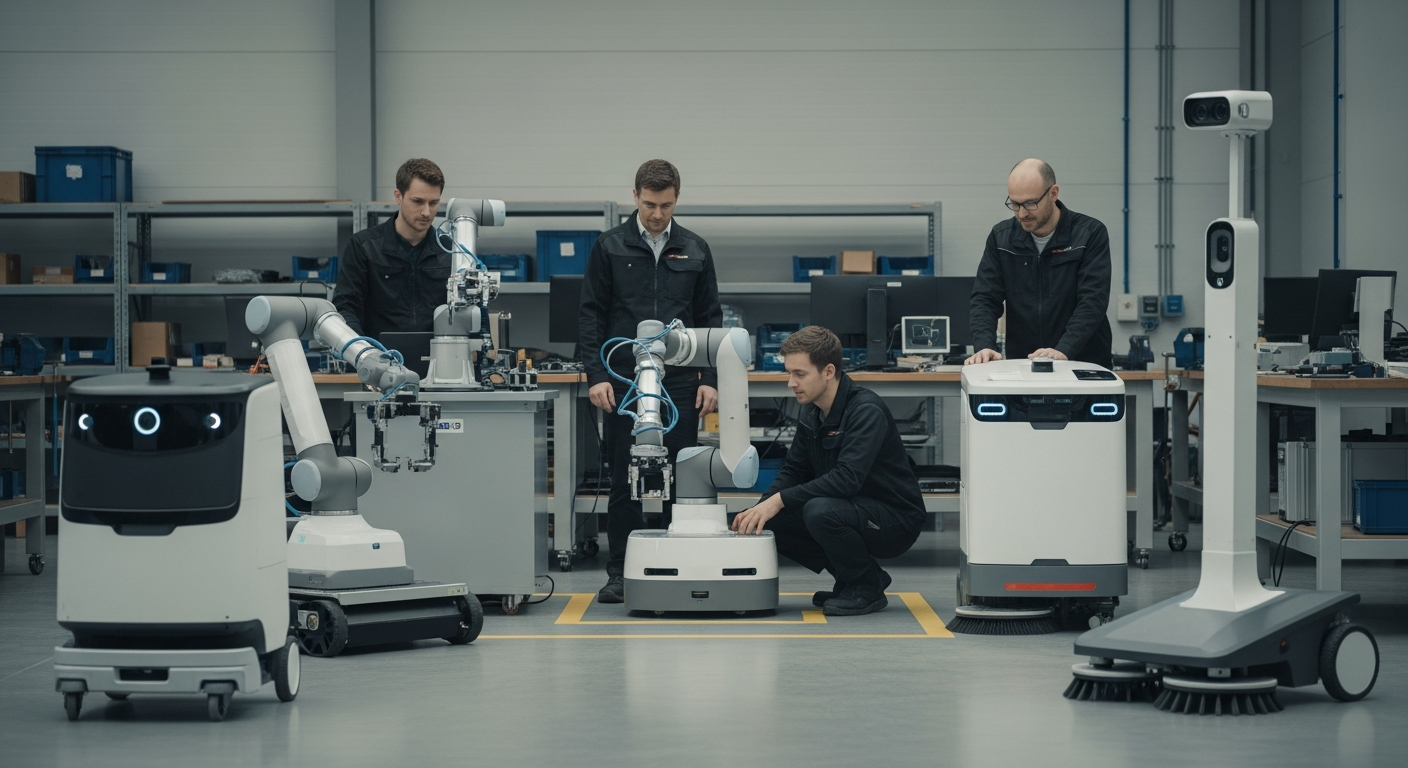
Serving robots: increasing efficiency through system integration
Serving robots reduce the operational load in the catering and hotel industries. werob delivers a ready-to-use fleet including full stack integration in eight weeks.
Brasserie at the market. 7:45 p.m. The main course for table 14 is ready. Instead of walking the 40 meters to the station itself, the waitress puts the plates on the robot's tray. This navigates autonomously through the guest room, avoids guests with centimeter precision and stops at the target position. The staff stays with the guest during this time, advises on the wine selection and actively increases sales per table. This scene is not a pilot project, but rather everyday operations in over 200 locations across Europe. The success of this installation is not based on the choice of a specific robot model, but on the precise translation of the workflow into a technical specification.
Key Takeaways
- 1Hardware agnostics is crucial: werob selects the best solution for your specific workflow from 44+ OEMs.
- 2Significant cost reduction: A tray bot in the wash chamber can save significant costs per year and location.
- 3Fast implementation: In just 48 hours to the specification and in eight weeks to productive use of the robot.
The serving robot market: More than just hardware
The market for serving robots has grown rapidly in recent years. Numerous manufacturers, especially from Asia, are entering the European market with ever new models. However, there is a central challenge for operators of restaurant chains, hotels or canteens: the hardware alone does not solve an operational problem. A robot that is not seamlessly integrated into the existing IT infrastructure and daily workflows quickly becomes an obstacle instead of a relief.
werob follows a consistently hardware-agnostic approach here. As a system integrator, we evaluate 44 different OEM partners and their 280 robot models. werob translates an operator's workflow into a usable specification. We don't just look at the load capacity or battery life, but at the entire operating level. These include the Spec Engine, the Supplier Match, the connectors in the operator stack and the live cockpit for fleet management.
Robotics offers a necessary answer to the shortage of skilled workers and rising operating costs. But only those who master integration can achieve real economic effects. werob ensures that the selected hardware fits exactly to the spatial conditions and the process requirements on site, without tying the operator to a single manufacturer.
Economic efficiency: Significant cost reduction per location
The introduction of serving robots is often misunderstood as an innovation project. In fact, it is a purely business decision. In the catering industry, significant wage costs are incurred due to unproductive walking distances between the kitchen, dining room and washing up area. A serving robot that is used as a tray bot in the washing chamber achieves significant cost savings per location and year. In the hotel industry, use of room service can even lead to significant relief.
These figures are based on the reduction of personnel costs in areas where there is no direct added value for the guest. If a robot takes over the heavy trays, the existing staff can be used more efficiently. This saves costs and improves working conditions as the physical strain is reduced. werob uses an outcome-only commercial model: you only pay when the robot is in productive use. There are no hidden list prices or upfront investments in hardware that later sits unused in the corner.
Scaling across multiple locations increases these effects. A restaurant chain with ten locations can achieve significant annual relief. werob provides the necessary transparency and ensures that amortization occurs in the first year. The decision to use robotics turns from a technical gimmick into a tough competitive advantage in a low-margin environment.
The werob Spec Engine: To the specification in 48 hours
Traditional consulting projects to introduce automation often take three to six months. werob breaks up this slow process. With our Spec Engine, we translate your operational requirements into a usable robot specification within 48 hours. This engine was trained on the basis of over 35,000 projects and immediately recognizes which hardware parameters are crucial for your specific workflow.
The process begins with a simple intake: who are you, what does the shift look like, which tasks should be taken over and what is the infrastructure on site. The Spec Engine uses this to generate an action graph that defines exactly how the robot must act. Whether it's navigating narrow hallways or interacting with automatic doors, all details are captured in the specification. This not only saves time, but also drastically minimizes the risk of bad purchases.
After the specification is in place, the supplier match follows. Here the requirements are checked against our catalog of 44+ OEMs. The result is a ranking of the most suitable robots. This data-driven approach ensures you always get the best hardware for your use case, regardless of brand preferences or sales pressure from individual manufacturers. You will receive a concrete offer within just five days and the robot will be in use at your location within eight weeks.
OEM comparison: Leading serving robots at a glance
In order to make the right choice, it is essential to compare the leading manufacturers. werob works with the world's best OEMs to offer the right solution for every requirement. The following table gives an overview of common models and their main areas of application.
| Criteria | Keenon T9 | Pudu BellaBot | Bear Robotics Servi |
|---|---|---|---|
| Primary use | Narrow aisles, F&B | Interactive service | High-end catering |
| Load capacity | Up to 40 kg | Up to 40 kg | Up to 30 kg |
| Navigation | Lidar & Vision | Lidar & SLAM | Lidar & cameras |
| Special feature | Very compact | Cat design, speech | Very precise sensor technology |
| werob Integration | Complete | Complete | Complete |
While the Keenon T9's compact design makes it ideal for restaurants with close seating, the Pudu BellaBot's design ensures a high level of acceptance among guests, especially in family-oriented businesses. Bear Robotics, on the other hand, impresses with its extremely robust workmanship and precise navigation in demanding environments. werob does not evaluate these models in isolation, but always in the context of your specific infrastructure. A robot that shines in a test environment may fail in a real restaurant with changing lighting conditions and dynamic obstacles. Our Supplier Match takes these operational realities into account.
Integration into the operator stack: Seamless connectivity
Werob's connectors are a crucial part of our platform. We offer pre-built integrations into the industry's common systems. These include POS systems such as Toast and Lightspeed, property management systems such as Opera PMS and Mews, and enterprise solutions such as SAP EWM. These connectors allow the robot to receive commands directly from the existing workflow.
When a waiter completes an order in Toast, the Spec Engine can automatically order the robot to the kitchen. As soon as the kitchen marks the food as ready, the robot knows which table to go to. In the hotel industry, a robot can deliver room service orders autonomously via the Mews integration, including controlling elevators and notifying the guest via the room phone or an app. This deep integration makes the difference between a manually controlled machine and an autonomous system.
Connecting to the existing stack eliminates the need for staff to operate additional equipment. Robotics fits organically into the existing IT landscape. This not only increases efficiency, but also ensures a clean database in the werob cockpit. Here you can see in real time how many deliveries have been carried out, how high the utilization is, and where bottlenecks may exist in the process.
Regulatory and compliance: The EU Machinery Regulation 2023/1230
An often underestimated aspect when using robotics is legal security. From January 20, 2027, the new EU Machinery Regulation 2023/1230 will be binding. This regulation imposes significantly higher requirements on the safety and compliance of machines, especially when used in areas with human interaction. Many robots that are now imported directly from Asia do not meet these strict criteria without appropriate adjustments and certifications.
werob acts as your compliance path here. We ensure that all systems we use comply with current and future regulatory requirements. This includes not only the CE marking, but also specific standards such as ISO 13482 for personal care robots or compliance with the GDPR when processing sensor data. For operators, this means legal certainty and protection against liability risks.
Specific regulations such as the BewachVO or IEC 62443 for cybersecurity also apply, particularly in the area of security and facility services. werob integrates these requirements in the spec phase. Our cockpit continuously monitors the status of the fleet, including regulatory parameters. If a robot needs a security update or a certification expires, this will be immediately visible in the 4-dimensional traffic light system. With werob you are investing in a future-proof solution that can be operated legally and safely even after 2027.
The werob Cockpit: Live fleet management for professionals
Operating a robot fleet requires continuous monitoring and optimization. The werob Cockpit is the central control unit for all your autonomous systems, regardless of manufacturer. It provides a 4-dimensional traffic light system that shows the status of hardware, infrastructure, regulatory and specification in real time. The cockpit shows whether all robots are ready for use or whether there are problems with the WiFi, a blocked charging station or an expired certification.
The cockpit provides detailed reports on the performance of your fleet. You can evaluate the number of trips, the distance traveled and the resulting cost savings per location. This data is essential to demonstrate the ROI of your investment and further optimize processes. For example, if a robot is constantly blocked on a certain day of the week, the cockpit provides the database to adjust the route or shift planning.
Another advantage of the cockpit is remote maintenance and error diagnosis. Many problems can be solved without a technician having to be on site. This reduces downtimes and ensures the continuous availability of the systems. werob operates this cockpit as part of the platform level, so that you can fully concentrate on your core business while we take over the technical supervision of the robots.
Ready for use in eight weeks: The path to success
Fast implementation ensures operational advantages. While others are still thinking about strategies, werob customers are already productive. 48 hours to specification, five days to quote and eight weeks to robot in use. This tight schedule is only possible because we rely on standardized processes and ready-made connectors.
The path to live operation follows eight clear steps. After the initial intake and the creation of the specification, the supplier match takes place. Once the hardware is selected, we prepare the integration into your software stack. At the same time, we check the on-site infrastructure, such as WiFi coverage and the condition of the floors. After delivery, the Action Graphs are configured and your staff is trained. The conclusion is the go-live phase, in which we closely monitor operations via the cockpit.
This structured approach minimizes interruptions to your ongoing operations. Since we are hardware-agnostic, we can react flexibly and offer alternatives even if individual manufacturers experience delivery bottlenecks. werob is your partner for the entire term, from the initial idea to daily fleet management. Start now and sustainably relieve your team by using modern serving robotics.
Robotics as a strategic component
Serving robots are much more than a trend. They are a technological necessity to meet the increasing demands in the service industry. But the key to success lies not in the robot itself, but in the system integration. werob offers you the platform to integrate robotics into your company easily, quickly and legally. With our expertise as the largest system integrator in Europe and a portfolio of over 44 OEM partners, we will find the solution that exactly fits your requirements.
The combination of the Spec Engine, the Supplier Match, the Connectors and the Cockpit creates an operating level that guarantees maximum efficiency and transparency. Thanks to the outcome-only model, you bear no financial risk before the actual go-live. Significantly reduce your operating costs while increasing the quality of service for your guests. The future of the catering and hotel industry is autonomous; werob is your pathfinder there.
FAQ
- How much does it cost to implement a serving robot at werob?
- werob uses an outcome-only commercial model. This means you only pay when the system is running productively. There are no classic list prices for the hardware because, as a system integrator, we calculate the overall solution including integration and operation.
- What requirements does my location have to meet?
- What is important is stable WiFi coverage, flat floor surfaces without high thresholds and enough space for the charging stations. As part of our 48-hour spec, we review these requirements in detail for your location.
- Can serving robots also use elevators?
- Yes, thanks to our connectors and integration into the building control system, many of the robots we maneuver can autonomously call and use elevators, which is particularly essential in hotel room service.
- How do guests react to the robots?
- The experience from over 200 live locations shows a very high level of acceptance. Robots are often perceived as helpful support as staff have more time to personally care for guests.
- What happens if a robot is defective?
- We monitor the fleet in real time via the werob cockpit. Many errors can be corrected remotely. In the event of hardware defects, our service network intervenes to keep downtimes as low as possible.
- Is the use of the robots compliant with data protection regulations?
- Yes, werob ensures that all systems work in accordance with GDPR. Sensor data for navigation is processed locally and is not used to identify people unless this is explicitly part of the specification.
Related reading
Transport robots: efficiency and cost reduction in operation
Transport robots take over repetitive routes in care, hotels and logistics. werob integrates these systems into your existing software stack in a hardware-agnostic manner in eight weeks.
20 June 2026pudu cc1 pro cleaning providerPudu CC1 Pro Cleaning Provider: Integration Instead of Hardware Purchase
The Pudu CC1 Pro is one of the most versatile cleaning robots on the market, but without deep system integration it remains an isolated tool. werob translates your operational requirements into a ready-to-deploy fleet including full compliance in eight weeks.
14 June 2026robot integration pms hotelRobot Integration PMS Hotel: Efficiency through automation
The manual coordination of room service and cleaning ties up valuable human resources in the hotel industry. werob integrates robots directly into your property management system for automated processes without media breaks.
29 June 2026lightspeed pos robot integrationLightspeed POS Robot Integration: Efficiency in F&B Operations
The seamless connection between the cash register system and service robotics determines the profitability in the catering industry. werob delivers the ready-made connectors for Lightspeed to transform manual processes into automated workflows.
24 June 2026opera pms robot integration apiOpera PMS Robot Integration API: Automating Hotel Operations
Integrating your robotics fleet with the Opera PMS API is the difference between a standalone gadget and a functional operational system. This guide explains how werob connects 44+ OEMs to your existing hotel stack in eight weeks.
4 July 2026