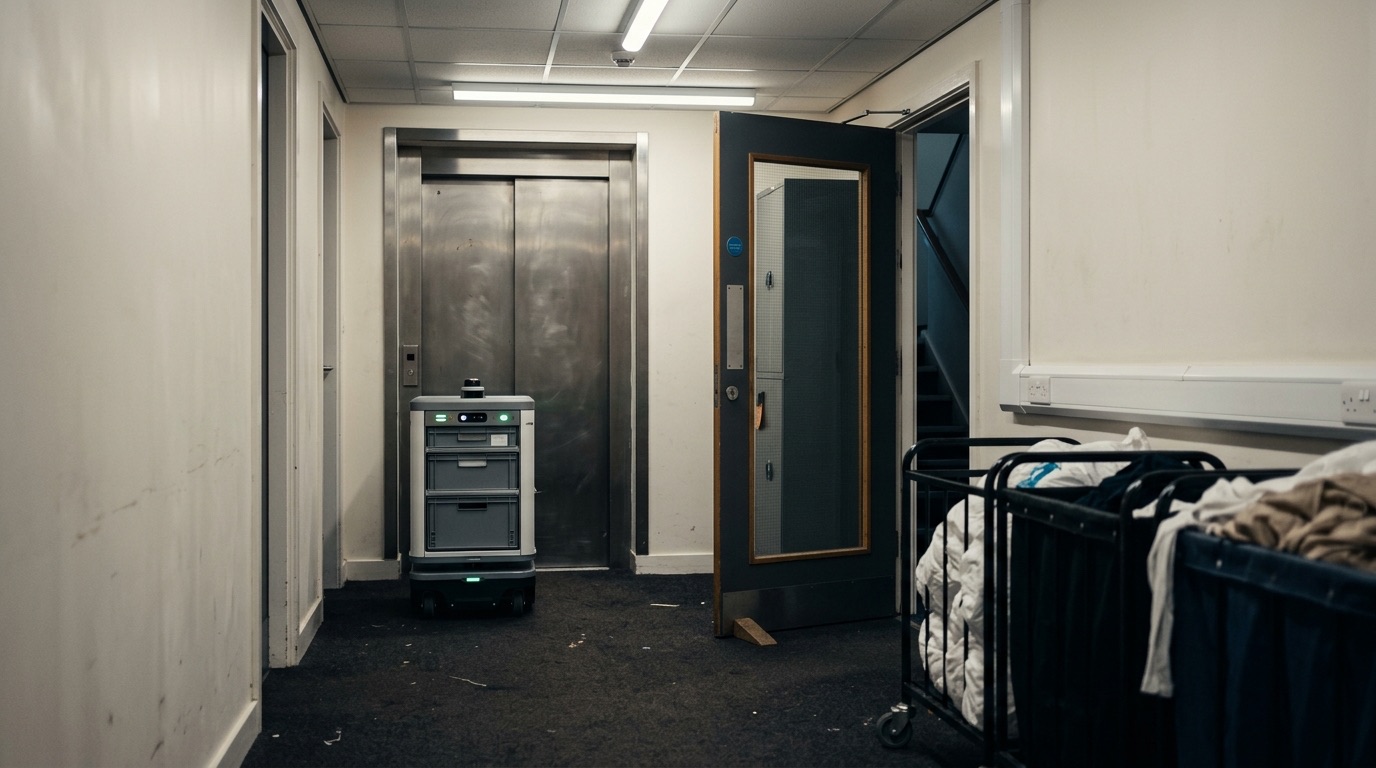
Manicured demos, messy buildings: why a business primer on physical AI names integration, not the model, as the barrier
A 25-page primer written for executives, not engineers, spends its last third on a single point: the videos are real, the labs are tidy, and the hard part is fitting the machine into an untidy operation. The author reaches that conclusion by way of tractors, power stations and a logistics writer. An operator can use it as a reading guide for the next vendor pitch.
Most of what an operator sees of physical AI arrives as a clip: a hand turning a cube, a humanoid folding a shirt, a legged machine crossing a rubble field. In March 2026 Aaron Frank, formerly principal faculty at Singularity University, published a 25-page primer on the subject written for business readers rather than engineers. Its first two thirds explain where those clips come from. Its last third makes an argument that an operator in a hotel, a clinic or a plant will recognise from their own floor: the technology on the screen is the easier half, and getting it to hold up inside a real operation, with its lifts, shift changes and forty-year-old door controllers, is the half that decides the project. This article reads that argument, keeps the report's claims separate from ours, and draws out what it changes about the questions to put to a vendor.
Key Takeaways
- 1Frank's report describes the viral robot videos of the past year as products of ‘highly manicured research environments’ and makes real-world integration, not the underlying AI, the core barrier to deployment. That is the report's claim, stated in its own introduction, and it is a claim about the field, not about any one supplier.
- 2The report leans on an a16z essay for the term distribution shift: the gap between a curated research setting and the site a robot is expected to work in. Its illustration is a picking robot with a 95 percent success rate, a fine lab result that turns into hundreds of failures a day in a logistics facility.
- 3The same report expects remote human operators to remain a standing component of deployed physical AI for some time, and notes that the intervention doubles as training data. For an operator that turns remote assistance from a support detail into a contract clause.
- 4Frank quotes Dylan Bourgeois, who writes on logistics automation, to the effect that the hard problem was never the automation but the integration: dozens of systems with different taxonomies, speeds and interfaces that have to be kept in step. That is a description of a building, not of a robot.
- 5The historical section of the report is the part an operator should take least literally and think about most: tractors and electric power each took decades to change how work was done, because the surrounding infrastructure had to be rebuilt first. The open question the report leaves is which of those surrounding pieces are still missing for service robots.
What the report is, and what it is not
The document is called A Business Leader's Introduction to Physical AI, is dated March 2026, runs to 25 pages and carries an estimated reading time of 25 minutes. Its author, Aaron Frank, describes himself as a researcher and advisor who spent more than a decade in Silicon Valley and most recently taught as principal faculty at Singularity University. The report is not a study and does not present measurements of its own; it is a synthesis of published sources and interviews the author conducted, and it reads as an orientation for executives who have started hearing the phrase physical AI in board meetings. That matters for how it should be used. Its value to an operator lies in how it orders the field and in the handful of sources it puts in one place, not in any number it generates.
Its structure is five parts: a chapter on the AI side and the idea of spatial intelligence, one on the hardware realities, one on simulation as the new infrastructure for training robots, one on the deployment gap, and a closing historical section. The first three explain why the past two years have looked so different from the decade before them. The last two are the ones this article is about, because they are where the report stops describing what laboratories can do and starts describing what organisations have to do.
The core claim, in the report's own framing
Frank states his central argument in the introduction rather than saving it for the end. He grants that the moment is real: the breakthroughs he describes are genuine and the change in what robots can be trained to do is not marketing. He then observes that many of the most-watched robot videos of the past year reflect what he calls ‘highly manicured research environments’, and from that draws the report's core proposition, that a significant barrier to deploying these machines will be how their integration into messy real-world environments is handled, a task which, in his words, history shows can be far harder than building the technology itself.
Two things about that framing are worth keeping precise. First, it is a claim about the field, based on the sources he cites and the people he spoke to; it is not a finding about any particular manufacturer, and the report names no supplier as failing at deployment. Second, it is not a claim that the AI does not matter. The report's chapters on reinforcement learning in simulation and on vision-language-action models are enthusiastic and, on their subject, well sourced. The argument is one of proportion: of the two halves of a robot project, the half the videos show is the half that is moving fastest, and the half they do not show is the half that has always taken longest.
Distribution shift: the lab result that is useless in production
For the mechanism behind the gap, the report borrows a term from an essay by the venture investor Oliver Hsu at a16z: distribution shift. Hsu's definition, as Frank relays it, is the difference between the curated controllability of a research environment and the real world the robot is expected to work in. The example is deliberately mundane. A robot trained in simulation to handle boxes meets boxes that are slightly deformed, in a warehouse with unusual lighting, seen through cameras mounted at a slightly different angle from the training data. None of those is a dramatic failure. Together they move the machine off the distribution it was trained on.
The consequence is given as arithmetic, and it is the one number in this part of the report worth remembering. A picking robot that succeeds 95 percent of the time is, in a research setting, a striking result. In a logistics facility the same rate produces, in the report's words, potentially hundreds of failures a day, which would make the system functionally useless for the company running it. The report does not develop that arithmetic further, and this article does not need to: what a per-attempt rate does to an exception queue across a shift has been worked through on this site before, on Google's published per-task figures. The point the primer adds is about where the shortfall comes from. It is not that the model is weak. It is that the site is not the lab, and no site ever will be.
The remote hand: teleoperation as a standing component
One consequence the report draws is that teleoperation, a remote human stepping in when a robot meets an unexpected situation, is likely to remain a critical part of successfully deployed physical AI for some time. Frank makes two observations about it that go beyond the usual support-desk picture. The first is that the intervention does double duty: the remote operator keeps the machine in service, and the recorded intervention becomes training data that improves the model for the next occurrence. The second is geographic. He cites reporting, from a congressional hearing and a subsequent Forbes piece, that Waymo's vehicles in San Francisco have relied on remote assistance staff based in the Philippines, and uses it to raise a question of offshoring physically embedded work that he says gets far less attention than automation-driven job loss.
For an operator in Germany the labour-market politics are someone else's problem; the operational reading is not. If remote assistance is a standing component rather than a launch-phase courtesy, then it is part of the delivered system and belongs in the contract: who is on the other end of the link, where they sit, what they see when they take over, and what happens to the footage afterwards. When the robot works a hotel corridor or a ward, what they see is guests and patients. This site has covered when a fleet needs a human in the loop, and the physical-AI solution page sets out the data-rights questions; the primer's contribution is to say plainly that the hand in the loop is not going away, which is a reason to price it rather than assume it out.
Dozens of systems, none of them the robot
The part of the report that reads most like an integrator's week is an interview Frank conducted with Dylan Bourgeois, who writes on logistics automation. Bourgeois's observation is that even in today's highly automated logistics sites, the people who run them struggle to say why throughput was different on a given day, because the environment is made of dozens of interrelated systems, each with its own taxonomy, speed, interface and set of assumptions. Keeping them in step, he says, is less like controlling a machine and more like conducting an orchestra. The line Frank pulls out as a quotation is that the warehouse of the future will be defined not by the sophistication of its robots but by how well it manages the unglamorous work of making dozens of systems play nicely together. Elsewhere in the report the same author is quoted more bluntly: the hard problem was never the automation, it was always the integration.
Nothing in that passage is specific to warehouses. A hotel's version of the orchestra is the property management system, the lift controller, the fire alarm panel, the door access system and the housekeeping roster, each keeping its own time. A clinic adds the pharmacy system and the ward's shift pattern. This site has already written about what a robot can only learn once it is inside a particular building, and about lifts, fire doors and WLAN as the items that set the commissioning schedule; there is no need to restate that here. What the primer contributes is a name for the general case and an independent voice saying that the general case, not the robot, is what decides whether a deployment holds.
Rubber tyres: what the historical section is for
The closing chapter of the report is the one an operator should take least literally and think about most. Frank recalls that in 1900 the tractor was on magazine covers and at the centre of trade shows, and that it nevertheless took roughly half a century before it was widely adopted on American farms. He recalls that Edison's first power station ran in 1881 and that nearly forty years later very little of American industry was electrified, because factories built around belts and pulleys could do nothing useful with electricity until the factory itself was redesigned around individually powered machines. His explanation for both is the same: the technology was missing complementary pieces. Early tractors ran on metal wheels and got stuck in mud; rubber tyres did not arrive until the 1930s. His question to a company thinking about physical AI is what the rubber-tyre equivalents are for these machines, and his conclusion is that the world-changing effect of electricity came not from the invention but from redesigning industry to absorb it, so that the technology was the easiest part and systems engineering and operational design the real challenge.
Historical analogies prove nothing, and the report does not pretend otherwise. But the question it leaves is a good one to put to any pitch. The rubber tyres of a service robot are dull: a lift interface that does not need a bespoke board, a door standard that fire safety officers accept, a way of describing a floor plan that survives a vendor change, a charging arrangement that does not depend on one manufacturer's dock. Where those exist, a deployment is an integration job of known size. Where they do not, an operator who buys early is funding their development, and should know that is what the money is for. Which of them exist for a given building and a given task is a question this article cannot answer in general, and the report does not try to; it is the question a site survey exists to answer.
What follows for the integrator's role
It is tempting for a systems integrator to read a report like this as an endorsement, and the chapter title, The Deployment Gap: Long Live the Integrators, invites exactly that. Some care is needed. The report is describing a role, not vouching for anyone who holds it. Its argument supports one narrow proposition about that role: that the work of fitting a learned system into an existing operation is separate from the work of building the learned system, and that the first is where projects succeed or fail. werob's position on this site has been the same since the physical-AI solution page was written: manufacturer-independent integrator, not model developer. The models come from the manufacturers. The specification of what a site actually requires, the selection across manufacturers, the connection to the building's systems and the operation afterwards are the work, and they are the work the report describes as the hard part.
What the report does not do, and what this article will not do on its back, is say anything about how any particular integrator, werob included, performs that work. Frank's sources are about the field. They do not measure anyone's deployments, and they say nothing about any tool, method or data a given integrator uses. An operator who wants evidence about a specific integrator should ask that integrator for references and numbers from live sites, and should treat a report like this one as background on why those numbers matter, not as a substitute for them.
Limits: what is documented here and what is not
Everything attributed to the report comes from the 25-page PDF of A Business Leader's Introduction to Physical AI by Aaron Frank, dated March 2026, read in September 2026. Its claims have been paraphrased; the only phrase reproduced verbatim is ‘highly manicured research environments’, and the Bourgeois lines are quoted as the report quotes them. The 95-percent picking example and the definition of distribution shift are attributed by the report to an essay by Oliver Hsu at a16z; this article has not read that essay independently. The Waymo remote-assistance reporting is cited by the report to a Forbes article of 17 February 2026 by Brad Templeton, which this article likewise has not verified independently. The tractor and electrification history is the report's account, itself drawn from an Economist piece and a Matthew Ball essay, and is presented here as the report's argument, not as established economic history. No figure on this page is werob's own, and nothing here describes werob's methods, tools or results; the report says nothing about them and neither does this article.
FAQ
- What does Aaron Frank's report say is the biggest barrier to deploying physical AI?
- In the report's own words, a significant barrier will be how the integration of these machines into messy real-world environments is handled, a task it describes as historically harder than building the technology. It supports that with an a16z essay on distribution shift, an interview with a logistics automation writer on keeping dozens of systems in step, and a historical section on tractors and electrification.
- What is distribution shift in robotics?
- As the report relays it from Oliver Hsu's a16z essay, distribution shift is the difference between the controlled research setting a robot was trained in and the site it is expected to work in: deformed boxes, unusual lighting, cameras at a slightly different angle. The example given is a picking robot at 95 percent success, a strong lab result that would produce hundreds of failures a day in a logistics facility.
- Does the report say the AI is not the important part?
- No. It calls the recent breakthroughs genuine and spends most of its length explaining them. Its argument is about proportion: the part of a robot project that appears in videos is moving fastest, and the part that does not appear, fitting the machine into an existing operation, is the part that has always taken longest and decides whether the project holds.
- Why does the report treat remote teleoperation as permanent rather than temporary?
- Because, it argues, unexpected situations will keep occurring outside the training distribution, and a remote human both keeps the machine working and generates the training data for the next occurrence. For an operator that means remote assistance belongs in the contract: who provides it, from where, what they see, and what happens to the recordings.
- Does the report say anything about werob or about how integrators work?
- No. It describes the integrator's role as the one where the hard problem sits and gives the chapter a title to that effect, but it names no integrator, measures no deployments and says nothing about any integrator's tools or methods. This article makes no claim about werob's own performance on its basis.
Related reading
Using robots in business: The guide for system integration
Anyone who wants to use robots in business often fails due to the complexity of integration and regulatory hurdles. werob solves this through a hardware-agnostic platform that translates operational processes into technical specifications in 48 hours.
28 June 2026adaptive robot reliability physical aiPhysical AI: why adaptive robots fail less often than scripted ones
A rigid, pre-scripted system stalls the moment reality deviates from the plan — a moved cart, a closed door, a skipped step. Physical AI is the difference between a robot that stops there and one that keeps working.
11 September 2026Genetec robot event integrationGenetec Robot Event Integration: Scaling Autonomous Security
The integration of autonomous robots into existing security systems often fails due to proprietary interfaces. werob solves this problem with preconfigured connectors that translate robot events directly into the Genetec Security Center, thus enabling significant cost reductions per location.
23 June 2026optimus tesla germany deploymentOptimus Tesla Germany Deployment: Strategy for Operators
Tesla Optimus marks the transition from research to operational application. For German companies, however, success is determined not by the hardware itself, but by integration into existing processes and compliance with EU Machinery Regulation.
13 June 2026last mile handoverThe last fifteen metres: why the handover is the bottleneck
Between the kerb and the flat door sits the part of delivery that no datasheet describes. Intercom, door release, stairwell, parcel box and proof, and why that is an integration item.
6 August 2026