Logistics Security Robot Provider: Integration Instead of Hardware Purchase
The choice of the right logistics security robot provider determines the long-term compliance and economic viability of your plant security. As a hardware-agnostic integrator, werob offers the direct path from operational requirement to live fleet in eight weeks.
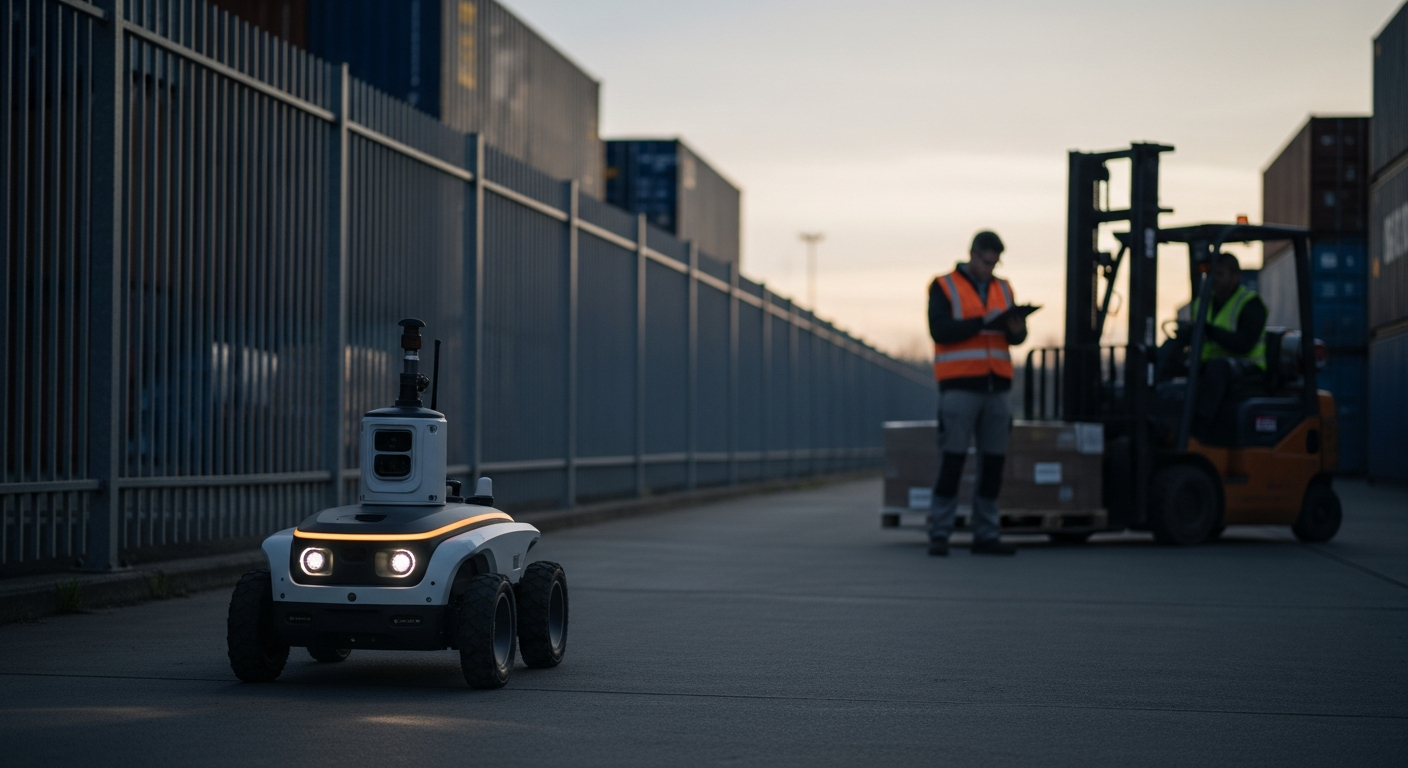
Tuesday, 02:15. Outdoor warehouse Hamburg-South. The autonomous patrol has been running for four hours without interruption. Every detection is documented in real time and fed directly into the security service's Genetec system. While a single security guard previously had to physically check 18 hectares, he now monitors the Live Cockpit in which two robots are patrolling. This operational reality is no longer a pilot project, but the standard in modern logistics centers. The decisive factor here is not the robot itself, but the seamless integration into the existing security infrastructure and compliance with regulatory requirements such as the BewachVO.
Key Takeaways
- 1The choice of provider should be based on integration capability into systems such as Genetec and SAP EWM, not just on the hardware.
- 2An autonomous yard patrol enables verified cost relief of EUR 68,000 per year on average.
- 3The EU Machinery Regulation 2023/1230 makes a certified compliance path mandatory from January 2027.
Why Choosing a Provider Goes Beyond Hardware
When looking for a logistics security robot provider, many companies mistakenly focus first on the physical device. In the operational practice of logistics and plant security, however, hardware is only one component of a complex security architecture. A robot that does not communicate with the Video Management System (VMS) or whose data is not legally archived poses more of a risk than relief.
werob acts as the decisive operational layer here. We are not a manufacturer, but the systems integrator that bridges the gap between 44+ OEM partners and your specific stack. The goal is not the ownership of a robot, but the achievement of a measurable outcome. In logistics, this specifically means cost relief of about EUR 68,000 per year for a yard patrol. This saving results from the reduction of personnel costs while simultaneously increasing the control frequency and documentation quality.
A professional provider must be able to translate the security service's requirements into a technical specification that takes into account both the terrain conditions and the regulatory framework. werob uses the Spec Engine for this, which has been trained on data from over 35,000 projects, to create a ready-to-deploy specification within 48 hours.
Economics and Verified Cost Relief
Investment in autonomous security systems must be justified by clear key figures. In the logistics security industry, we at werob see consistent results that go beyond vague adjectives. An automated yard patrol leads on average to cost relief of EUR 68,000 per location and year. For retail patrols in large-area retail, this value is about EUR 58,000.
These figures are based on the replacement or supplementation of night watches and the automation of routine checks that were previously performed manually. werob's commercial model is consistently focused on success: outcome-only means that you only pay when the robot is productively in use. There are no hidden list prices or lengthy discovery phases without results.
In addition to direct cost savings, there is the avoidance of follow-up costs from security incidents. Through integration into SAP EWM, the movement data of the robots can be matched with logistics processes, which massively increases transparency on the site. A logistics yard in scaled operation can thus realize total savings of up to EUR 136,000 per year, when multiple units act in coordination.
Regulation as a Decisive Filter for Providers
A critical aspect when selecting a logistics security robot provider is compliance with European standards. Particularly relevant is the EU Machinery Regulation 2023/1230, which becomes binding from 20 January 2027. Many Asian OEMs currently do not have the necessary conformity assessments for the European market. werob acts as a compliance path here and ensures that every deployed solution meets the strict requirements.
In the area of security, specific requirements such as the BewachVO (Security Service Regulation) and IEC 62443 for industrial cybersecurity are added. A robot acting as part of critical infrastructure must be protected against unauthorized access and may not create security gaps in the corporate network. werob checks all 280 rankable robot models in the catalog against these regulatory standards.
Compliance with GDPR is mandatory for camera-based systems in public or semi-public spaces. Professional integrators ensure that data processing takes place locally or flows into the Cockpit via encrypted channels, without violating the privacy of employees or passers-by. This regulatory umbrella is a core component of the werob offering.
Integration into the Security Stack: Genetec and SAP EWM
An autonomous robot is only as valuable as its connection to the control center. werob delivers pre-built connectors that enable immediate integration into market-leading systems. For security applications, the connection to Genetec is the industry standard. Through this, robot feeds are treated like stationary cameras and alarms are fed directly into the existing alarm matrix of the security service.
In logistics, the link with the Warehouse Management System, especially SAP EWM, is of strategic importance. If a robot detects an irregularity at a gate during its patrol, this incident can be directly matched with the loading data stored in SAP. This depth of integration distinguishes a professional systems integrator from a pure hardware reseller.
The werob Cockpit serves here as a superordinate control layer. It offers a four-dimensional traffic light system that monitors the status of hardware, infrastructure, regulation, and specification in real time. If a robot fails due to a network problem or regulatory inconsistency, this is immediately signaled before a security gap arises.
Hardware Agnosticism: The Best OEMs Compared
Since werob operates hardware-agnostically, over 44 OEM partners are ranked against the customer's specific requirements. Frequently deployed systems in security and logistics include specialized platforms such as ANYbotics, Boston Dynamics (Spot), or Robotnik. Each of these platforms has specific strengths, whether in off-road capability, battery life, or sensor payload.
A comparison of providers shows that there is no single perfect robot. While a four-legged robot like Spot is ideal for rough terrain and stairs in industrial facilities, wheel-based systems from providers such as Clearpath or Taurob are better suited for the efficient monitoring of expansive, level logistics areas. werob takes over the ranking of these options based on the 48-hour specification.
Through this approach, companies avoid vendor lock-in. Should a manufacturer change its software strategy or no longer meet the EU's compliance requirements, the operational layer can be migrated to another OEM via the werob platform without all integration work becoming obsolete. This secures the investment in the long term.
Comparison Table: Integrator vs. OEM Direct Purchase
| Criterion | OEM direct purchase | werob systems integration |
|---|---|---|
| Hardware selection | Limited to one portfolio | 44+ OEMs, 280+ models |
| Specification duration | 3-6 months discovery | 48 hours via Spec Engine |
| Stack integration | Mostly proprietary/closed | Native connectors (Genetec, SAP) |
| Compliance (EU 2023/1230) | Customer's own responsibility | Integrated compliance path |
| Commercial model | Purchase/leasing (CapEx) | Outcome-only (OpEx-focused) |
| Fleet management | Manufacturer-specific | Central Live Cockpit |
The Path to Robot Deployment in Eight Weeks
The speed of implementation is an essential competitive advantage. While traditional consulting houses often need months for the creation of discovery decks, werob follows a strict eight-week plan. It all begins with the 48-hour workflow in which shift schedules, terrain structure, and security goals are translated into a technical specification.
Within five days, a concrete offer is available based on the Supplier Match. Here, the best-suited robots for the specific task are ranked. After commissioning, the configuration of the connectors and the preparation of the infrastructure take place. Since werob relies on pre-built modules, time-intensive individual programming is largely eliminated.
In week eight, the first robot goes into live operation. This process is designed to minimize operational disruptions. The security service is not burdened by lengthy technology introductions, but receives a ready-to-use tool that fits seamlessly into daily routines. The goal is the immediate relief of personnel from monotonous and dangerous tasks.
Future-Proofing through the werob Cockpit
After commissioning, the phase of continuous fleet management begins. The werob Cockpit enables central monitoring of all active units across various locations. This is particularly important for logistics companies with several branches, as a uniform security standard can be guaranteed in this way.
The Cockpit monitors not only the position and battery status, but also compliance with regulatory parameters. If, for example, legal requirements for data storage change, this can be centrally controlled via the platform. The four-dimensional traffic light ensures that the Head of Security has full control over the operational readiness of their autonomous fleet at all times.
With a view to 2028 and the goal of 2,000 robots in live operation, werob is constantly developing the platform further. New OEM partners and improved connectors are continuously added to the catalog. Companies that rely on werob today do not just buy a solution for today, but secure access to the leading operational layer for robotics in Europe.
FAQ
- What distinguishes werob from a traditional robot manufacturer?
- werob is a systems integrator and not a manufacturer. We offer a hardware-agnostic platform that compares over 44 different OEM partners and integrates the robots directly into your existing software infrastructure.
- How high are the savings from security robots in logistics?
- An automated yard patrol relieves a location by EUR 68,000 per year on average. For large-area logistics yards, total savings can be over EUR 136,000.
- Which IT systems can be connected to the robots?
- werob offers ready-made connectors for security and logistics stacks such as Genetec and SAP EWM, as well as for systems in other industries such as Opera PMS or PointClickCare.
- Is the use of security robots legally permissible?
- Yes, provided the requirements of the BewachVO, the GDPR, and the EU Machinery Regulation are met. werob ensures that all deployed solutions comply with these regulatory requirements.
- How long does it take until a robot is ready for use?
- From the first conversation to productive deployment on your site usually takes only eight weeks at werob. The technical specification is available after 48 hours.
- What does the outcome-only business model mean?
- Outcome-only means that no costs arise for you before the robot has been successfully integrated into your operation and runs as specified. There are no upfront investments in lengthy consulting phases.
Related reading
Ciborius Alternative: Scaling Robotics Security with werob
Plant security and property protection face structural change. While classic security service providers often rely on personnel, werob, as a hardware-agnostic systems integrator, offers a scalable alternative through autonomous robot fleets.
4 June 2026patrol robotsPatrol Robots: Efficiency and Compliance in Facility Security
Autonomous patrol robots close the gap between labor shortages and rising security requirements in logistics. werob integrates these systems directly into your existing security stack within eight weeks.
13 June 2026mir agv provider germanyMiR AGV Providers Germany: System Integration Instead of Hardware Purchase
Those searching for a MiR AGV provider in Germany often find only hardware dealers. werob takes a different approach: We integrate Mobile Industrial Robots (MiR) as part of a manufacturer-independent fleet directly into your operational stack.
12 June 2026scaling perimeter monitoring multi-siteScaling Perimeter Monitoring: What Breaks After the Pilot
Learn what breaks when scaling autonomous perimeter security robots across multiple sites, from alert fatigue and network gaps to complex SOC integration.
18 August 2026unitree b2 securityUnitree B2 Security: Integrating Quadruped Robotics into Operations
The Unitree B2 represents a shift in industrial security from static cameras to mobile, autonomous sensing. As a systems integrator, werob translates this hardware capability into a compliant, integrated security workflow.
7 August 2026