MiR AGV Providers Germany: System Integration Instead of Hardware Purchase
Those searching for a MiR AGV provider in Germany often find only hardware dealers. werob takes a different approach: We integrate Mobile Industrial Robots (MiR) as part of a manufacturer-independent fleet directly into your operational stack.
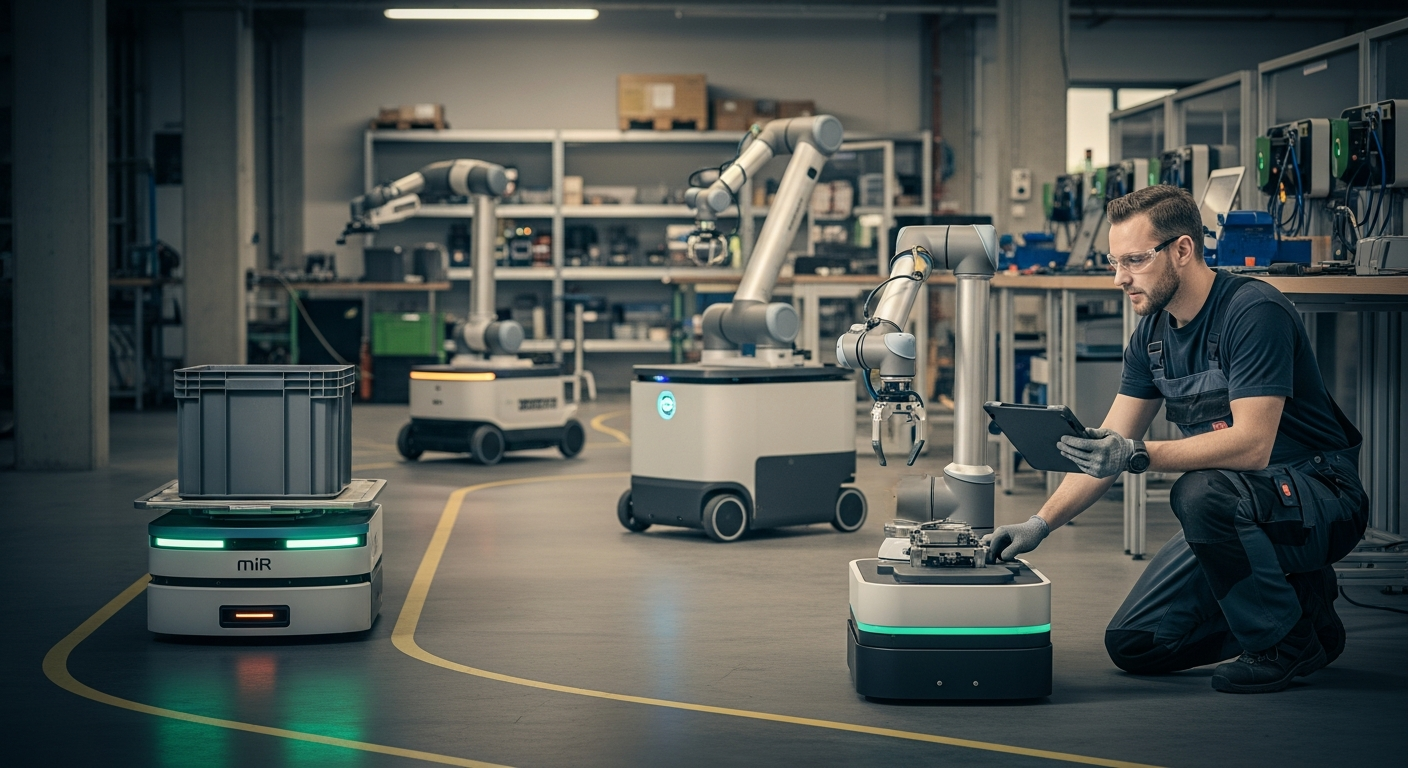
Logistics center, 3:15 AM. Shift change in order picking. While the workforce rotates, a MiR AGV moves silently between the high-bay warehouse and the shipping station. There is no delay, no search effort. The robot follows a precise action graph created 48 hours after the first specification. In Germany, companies often search for a MiR AGV provider to bridge staff shortages. But hardware alone does not solve process problems. Success depends on integration into the software stack and compliance with regulatory requirements. werob translates these requirements into a deployment-ready solution that goes beyond mere purchasing.
Key Takeaways
- 1werob is not a pure hardware vendor, but a hardware-agnostic system integrator that objectively evaluates over 44 OEM partners.
- 2The Spec Engine shortens the path from requirement to deployment-ready robot to just eight weeks, including 48-hour specification.
- 3Pre-built connectors enable seamless integration into existing systems like SAP EWM, Opera PMS, or MatrixCare.
The Market for MiR AGV Providers in Germany
The search for a MiR AGV provider in Germany usually leads to traditional resellers. These companies sell hardware but often leave the operator struggling with complex integration. An Automated Guided Vehicle (AGV) like the models from Mobile Industrial Robots is a highly precise tool that unfolds its full potential only when it seamlessly communicates with existing infrastructure. werob does not see itself as a mere vendor, but as a system integrator that closes the gap between the OEM and daily operations.
In the German industrial landscape, demand for autonomous transport systems has increased dramatically. It is no longer just about replacing forklifts, but about fully automating material flows. A MiR AGV provider must today offer more than just a datasheet. They must understand how the robot interacts with fire doors, elevators, and warehouse management systems. werob uses a Spec Engine for this purpose, based on data from over 35,000 projects, to create a deployment-ready specification within 48 hours.
An essential aspect when choosing a provider is long-term viability. While a reseller is often only available for maintenance contracts after the sale, werob offers a live cockpit for fleet management. This is particularly important because many companies in Germany do not want to rely on a single manufacturer. werob ranks over 44 OEM partners, including MiR, to find the exact hardware that matches the respective workflow. This hardware-agnostic approach prevents vendor lock-in and secures the investment for the future.
Hardware Agnosticism: Why MiR is Only Part of the Solution
Mobile Industrial Robots (MiR) offers excellent hardware for internal transport. But in a complex operating environment, hardware is often responsible for only 30 percent of project success. The remaining 70 percent is accounted for by integration, software integration, and regulatory approval. As a hardware-agnostic system integrator, werob evaluates over 280 different robot models against the customer's specific requirements. If a MiR system is the best choice for the load requirement and aisle width, it is selected.
The advantage of this approach lies in objectivity. A specialized MiR AGV provider will always try to sell a MiR model, even if a different system might be more efficient for a specific sub-task. werob, on the other hand, uses the Supplier Match to objectively compare 44+ OEMs. This ensures that the operator receives the technically and economically most sensible solution. In logistics, for example, this could mean that MiR is used for pallet transport, while a specialized outdoor robot is deployed for yard patrols.
The economic relief provided by such systems is concretely measurable. In logistics, for example, an automated yard patrol results in cost relief of €68,000 per location per year. Similar effects are seen in transport in healthcare with €71,000 in savings. These figures are not estimates, but based on live operation of over 200 robots that werob already operates in 11 European countries. When choosing a provider, you should always ask about proven cost relief in real-world operations.
The Spec Engine: Deployment-Ready in 48 Hours
The traditional path to introducing AGVs in Germany often takes three to six months. Discovery decks are created, endless meetings held, and feasibility studies conducted. werob breaks this slow process open. With the Spec Engine, the operator's workflow is translated into a technical specification within 48 hours. This is possible because the system has been trained on an enormous database and already knows the requirements of various industries such as logistics, healthcare, and hospitality in detail.
A MiR AGV provider that merely supplies hardware cannot offer this speed advantage. werob's Spec Engine not only defines the robot type, but also creates a complete action graph. This graph describes exactly what the robot needs to do, when, and where. Infrastructure hurdles such as WLAN coverage or floor conditions are already considered in the planning phase. The result is a quote within five days and a deployment-ready robot in just eight weeks.
This speed is a decisive competitive advantage. In industries with high cost pressure, every month that a process remains unautomated counts as lost savings. Through rapid specification, companies in Germany can scale their automation efforts without getting stuck in months-long planning phases. werob assumes full responsibility for technical feasibility, which minimizes risk for the operator.
Integration into the Operator Stack: SAP EWM and More
An autonomous robot that does not communicate with the warehouse management system (WMS) or ERP system is an island solution. It requires manual intervention, which partially negates the automation advantage. werob offers pre-built connectors into the operator's stack. For logistics, connecting to SAP EWM is particularly crucial. A MiR AGV provider should be able to provide these interfaces without months of custom programming.
In addition to SAP EWM, werob supports integrations into systems such as PointClickCare, MatrixCare, Opera PMS, Mews, Toast, and Genetec. These connectors ensure that the robot receives its tasks directly from the leading system. When a transport order is generated in SAP EWM, the MiR robot immediately knows which pallet it needs to move from where to where. This happens in real-time and without human intervention. The error rate approaches zero, while throughput times are optimized.
This depth of integration is what sets werob apart from a pure hardware dealer. We do not build bridges that have to be torn down after the project, but use standardized interfaces that remain stable even with manufacturer software updates. For the operator, this means high reliability and easy scalability of the robot fleet across multiple locations.
Regulatory Compliance: EU Machinery Regulation 2023/1230 in Focus
An often underestimated topic when choosing a MiR AGV provider in Germany is compliance. As of January 20, 2027, the new EU Machinery Regulation 2023/1230 will become binding. This regulation sets significantly higher requirements for the safety and documentation of autonomous systems. Whoever invests in hardware today must ensure that it can still be operated legally after 2027. werob has already firmly integrated the compliance path for this regulation into its platform.
Especially with Asian OEMs, but also with European manufacturers like MiR, a comprehensive conformity assessment is essential. werob acts as a regulatory shield for the operator here. We ensure that all deployed systems comply with necessary ISO standards, such as ISO 13482 for service robots. In Germany, there are also specific requirements such as the Security Services Ordinance (BewachVO) for security robots or nursing home regulations in healthcare.
Without proper regulatory documentation, companies risk losing insurance coverage in case of damage or even fleet shutdown by authorities. A system integrator like werob reviews these aspects already in the spec phase. This gives management the assurance that automation is not only efficient, but also legally compliant. In a time when liability risks for AI-based systems are increasing, this is an indispensable part of every robotics project.
Economics: Outcome-Only Instead of List Prices
werob's business model differs fundamentally from that of a classic MiR AGV provider. While resellers often rely on list prices and high upfront investments, werob pursues an outcome-only model. This means: The customer pays only when the robot is actually running and fulfilling the defined workflow. This shifts risk from the operator to the integrator and ensures maximum alignment with project success.
The cost savings are significant. A hotel can save €112,000 per location annually through automated room service. In gastronomy, a tray-bot in the dishwashing area relieves the budget by €76,000 per year. These savings enable companies to amortize their robotics investment in the shortest time. werob provides the necessary transparency through the live cockpit, which captures and evaluates all fleet performance data in real-time.
By eliminating complex price lists and hidden consulting costs, werob makes robotics accessible to many companies for the first time. The goal of werob is to have over 2,000 robots in live operation by 2028. This scaling effect benefits customers, as werob's large number of projects provides unparalleled cost optimization experience. When searching for a MiR AGV provider today, you should consider total cost of ownership (TCO) over the lifecycle, not just the hardware acquisition price.
Comparison: MiR Reseller vs. werob System Integrator
To make the decision for the right partner easier, a look at core competencies helps. A pure hardware provider specializes in moving boxes and performing basic maintenance. werob, on the other hand, moves workflows. The following table illustrates the differences in approach.
| Criterion | Classic MiR Reseller | werob System Integrator |
|---|---|---|
| Hardware Selection | MiR Only (Single-Vendor) | 44+ OEMs (Hardware-Agnostic) |
| Planning Duration | 3-6 Months Discovery | 48 Hours Spec Engine |
| Integration | Often via Third Parties | Pre-built Connectors (SAP, Mews, etc.) |
| Compliance | Hardware Certificate Only | Full EU 2023/1230 Compliance Path |
| Payment Model | Purchase or Leasing (CAPEX) | Outcome-Only (OPEX-Focused) |
| Operations | Reactive Support | Live Cockpit & Fleet Management |
This comparison shows that werob operates on a level above pure hardware. For companies seeking a scalable and future-proof solution, system integration is the only way to master the complexity of modern robotics.
The Live Cockpit: Full Control Over Your Fleet
Once the robots are deployed, fleet management begins. A MiR AGV provider who disappears after installation leaves the operator alone with problems. werob provides the live cockpit, a central management tool based on a four-dimensional traffic light system. This system continuously monitors hardware, infrastructure, regulatory compliance, and adherence to specification.
If, for example, a robot stops due to a WLAN disruption, the cockpit shows this immediately. Often problems can be resolved remotely before they significantly impact operations. The cockpit also provides valuable data for continuous process optimization. How many kilometers has the robot traveled? How many transport orders were successfully completed? This data is the foundation for demonstrating cost relief, such as the €54,000 savings in bar and breakfast preparation in hotels.
Furthermore, the cockpit enables simple scaling. New robots can be integrated into the existing system within days. Since werob works hardware-agnostically, the same cockpit can manage MiR robots alongside systems from Keenon and Pudu or even humanoid robots from Apptronik. This central control layer is the heart of a modern, automated operation and provides transparency that is not achievable with conventional methods.
FAQ
- What sets werob apart from a regular MiR AGV provider?
- werob is hardware-agnostic and offers a complete operational platform including Spec Engine, Supplier Match, and Live Cockpit, rather than just selling hardware.
- How long does it take for a MiR AGV to be deployment-ready?
- With werob, you receive a specification in 48 hours, a quote in 5 days, and a deployment-ready robot typically within 8 weeks.
- Is werob compatible with SAP EWM?
- Yes, werob offers pre-built connectors for SAP EWM as well as for many other systems such as Mews, Toast, or PointClickCare.
- What does integrating a MiR AGV cost at werob?
- werob works on an outcome-only model. You pay only when the system is running. There are no classic list prices for integration.
- How safe is operation with regard to the new EU Machinery Regulation?
- werob offers an integrated compliance path for EU Machinery Regulation 2023/1230, which becomes binding in January 2027.
- Can werob also integrate robots from other manufacturers?
- Yes, werob ranks over 44 OEM partners and can manage over 280 different robot models from different manufacturers in a single fleet.
Related reading
Robotics provider Berlin: system integration instead of hardware purchase
The search for a robotics provider in Berlin often ends with hardware manufacturers with a limited portfolio. As a system integrator, werob offers access to over 44 OEMs and integrates robots directly into existing software stacks such as SAP EWM or Opera PMS.
3 July 2026robotics provider ViennaRobotics provider Vienna: system integration for operations
The search for a robotics provider in Vienna often leads to hardware sellers without integration expertise. werob closes this gap as a manufacturer-independent system integrator for care, hotels and logistics.
3 July 2026keenon m2 provider careKeenon M2 Provider Care: Integration Instead of Pure Hardware Purchase
The Keenon M2 is considered a specialized delivery robot for the healthcare sector. As an agnostic systems integrator, werob integrates this hardware directly into your operational care stack and secures compliance with EU standards.
10 June 2026pudu cc1 pro cleaning providerPudu CC1 Pro Cleaning Provider: Integration Instead of Hardware Purchase
The Pudu CC1 Pro is one of the most versatile cleaning robots on the market, but without deep system integration it remains an isolated tool. werob translates your operational requirements into a ready-to-deploy fleet including full compliance in eight weeks.
14 June 2026Robot service provider CologneRobot service provider Cologne: System integration for operators
Companies in Cologne are not looking for robots, but for operational relief. As a system integrator, werob translates your workflows into a precise specification in 48 hours and brings the hardware to the site in eight weeks.
28 June 2026