Robot cell dimensioning tool: Planning in 48 hours
The precise dimensioning of a robot cell is the prerequisite for economical automation. werob replaces months-long planning cycles with an AI-powered spec engine and delivers a ready-to-use specification in 48 hours.
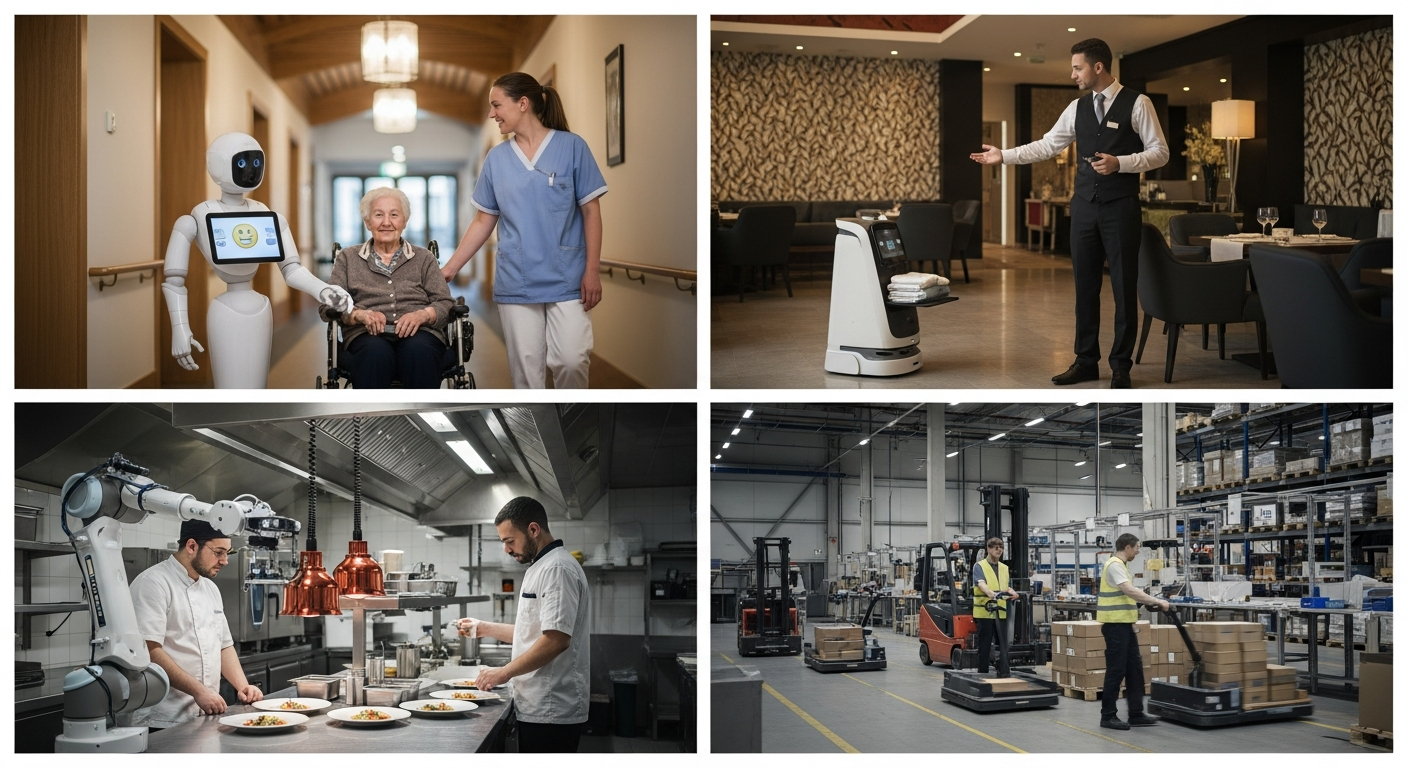
Logistics center, 3:15 a.m. The shift manager observes the autonomous palletizing on ramp 4. Where forklifts used to block the flow of traffic, a precisely dimensioned robot cell now operates. The planning of this area was not done over months of discovery workshops, but was based on a data-driven specification that was available within two days. werob has industrialized this process. Instead of committing to a single manufacturer, the cell was planned to be hardware-agnostic. The result is a solution that fits exactly into the existing space and communicates directly with SAP EWM. In eight weeks, an operational bottleneck became an automated throughput point.
Key Takeaways
- 1The Spec Engine creates a usable specification for your robot cell in 48 hours.
- 2Hardware agnostics allows comparison of 44+ OEM partners for the optimal solution.
- 3Prefabricated connectors integrate robots directly into SAP, Mews or PointClickCare.
The challenge of manual sizing
In classic industrial automation, the phase from the initial idea to the finished specification often takes three to six months. Engineering firms create extensive discovery decks that, while theoretically sound, often neglect the operational reality on site. A tool for sizing a robot cell must do more than just create CAD drawings. It must understand a site's specific workflow, cycle times and physical barriers.
Mistakes at this early stage are costly. An undersized cell leads to safety risks and frequent emergency stops, while an oversized solution wastes valuable space and degrades ROI. werob uses a spec engine that was trained on data from over 35,000 projects. This engine translates human descriptions of workflows into precise technical requirements. In care, a correctly sized round of medication leads to a cost reduction of 92,000 euros per year. This precision is only possible through data-driven planning that goes beyond traditional spreadsheets.
Hardware agnostics as a strategic advantage
A key mistake when using traditional sizing tools is being tied to a single manufacturer. If a tool is provided by an OEM, it will always prefer that manufacturer's hardware, even if it is not optimal for the specific space. werob takes a hardware-agnostic approach. The Supplier Match algorithm ranks over 44 OEM partners and 280 different robot models against the created specification.
This process ensures that the sizing of the cell is based on the best available technology. The Spec Engine decides whether a humanoid robot from Apptronik or a specialized service robot from Keenon is used. In the hotel industry, for example, this enables an annual cost reduction of 112,000 euros for room service. By comparing different kinematics and sensor layouts, space requirements are minimized while operational speed is maximized. Operators receive a ranking that objectively compares technical suitability and economic efficiency.
Integration into the digital operator stack
Physical sizing is only half the battle. A robot cell must be digitally integrated into the existing infrastructure. werob supplies prefabricated connectors for this. These enable seamless connection to systems such as SAP EWM, Opera PMS, Mews or PointClickCare. A sizing tool must therefore also take into account the data load and communication latency.
If a robot takes over a yard patrol in a logistics center, which means a relief of 68,000 euros per year, it must communicate in real time with the security management system. The dimensioning of the cell here also includes the WLAN coverage and the placement of gateways. werob ensures that the robot does not act as an isolated machine, but as an integrated part of the digital ecosystem. This shortens the time until productive use to eight weeks, as no individual interfaces need to be programmed.
Regulatory and EU Machinery Regulation 2023/1230
An often overlooked aspect when sizing robot cells is legal compliance. From January 20, 2027, the EU Machinery Regulation 2023/1230 will be binding for all operators in Europe. This regulation places high demands on the risk assessment and safety of autonomous systems. werob offers a built-in compliance path here.
Every dimensioning created by the Spec Engine already takes into account the necessary safety distances and protection mechanisms required for certification. This is particularly critical in industries such as nursing or catering, where robots work in close proximity to people. In the F&B industry, where a tray bot in the washroom saves 76,000 euros per year, the travel paths must be dimensioned to meet all HACCP standards. werob takes responsibility for this regulatory level so that operators do not run any legal risk.
Economic efficiency through outcome-only commerce
Investing in robotics often fails due to unclear cost structures and long payback periods. werob breaks this model with an outcome-only approach. Operators do not pay for planning or hardware purchases according to list prices, but only when the system is live and fulfills the defined workflow. The dimensioning of the cell thus becomes a common target.
Precise planning avoids unnecessary costs. In a golf club, automated ball collection results in a reduction of 38,000 euros per year. Since we cover the entire chain from specification to matching to operation in the cockpit, the usual margin markups of several intermediaries are eliminated. The focus is on the measurable result at the location. This model creates trust and enables companies to start automation projects without high upfront risk.
Live fleet management in the cockpit
As soon as the robot cell is dimensioned and installed, the operating phase begins. The werob Cockpit offers live fleet management with a four-dimensional traffic light system. It monitors hardware health, network infrastructure, regulatory compliance and original specification adherence. If the operational conditions change, for example due to new shelves in a warehouse, the system detects the deviation from the original dimensions.
In the retail security industry, where a patrol saves 58,000 euros in costs, this permanent monitoring is essential. The cockpit provides data for audits and helps to continuously optimize the efficiency of the cell. It is the central tool for the Director of Operations to track the status of all robots in different locations in real time. This turns a one-time planning into a permanently efficient automation solution.
From onboarding to live operation in eight weeks
The path to an automated robot cell follows a strict schedule at werob. After the first intake discussion, the Spec Engine only needs 48 hours for the technical specification. The operator will receive a binding offer within five days. Delivery and commissioning usually takes place within eight weeks. This speed is unique in the market for system integration.
One example is Korian Germany, where this rapid implementation resulted in significant cost reductions in the first year. The process includes eight steps, from analysis of the shift plan to final integration into the software stack. This standardization minimizes the burden on on-site personnel and ensures a high level of acceptance of the new technology. Dimensioning is the critical first step that determines the success of the entire project.
Future security through scalable systems
The requirements for companies are constantly changing. A robot cell that is perfectly dimensioned today may have to take on new tasks tomorrow. The werob system is designed for scalability. Because the platform is hardware-agnostic, robots can be replaced if necessary or the fleet can be expanded with new models without having to replan the entire infrastructure.
Werob plans to operate 2,000 robots across Europe by 2028. This scaling is only possible because the sizing and integration has been automated through software. For operators, this means investment protection. You are not tied to the life cycle of a single manufacturer, but use a platform that grows with technological progress. Whether humanoid robots in care or autonomous mowers on the golf course, the werob platform offers the framework for a future-proof automation strategy.
FAQ
- What is a tool for sizing a robot cell?
- It is a software solution that translates operational workflows into technical parameters such as space requirements, range and cycle time in order to select the appropriate hardware.
- How long does planning with werob take?
- The specification takes 48 hours to create, an offer is available in five days and the robot is ready for use in eight weeks.
- Is werob a robot manufacturer?
- No, werob is a hardware-agnostic system integrator that selects and operates the best robots from various OEMs for the customer.
- What role does the EU Machinery Regulation 2023/1230 play?
- It will be mandatory from January 2027. werob ensures that all dimensioned cells already meet these future safety standards.
- What does the outcome-only model mean?
- Customers only pay when the robot runs successfully in live operation. There are no upfront planning costs or hardware list prices.
- Can the robots be integrated into existing software?
- Yes, werob offers direct interfaces to systems such as SAP EWM, Opera PMS, MatrixCare and many other industry solutions.
Related reading
Robot specification tool: Go live in 48 hours
A professional robot specification tool shortens the planning phase from months to hours. werob uses an AI-powered engine to translate workflows directly into technical requirements and rank 44+ OEMs.
2 July 2026robot rollout planning toolRobot Rollout Planning Tool: From Spec to Floor in Eight Weeks
Most robotics projects fail during the planning phase due to vendor lock-in and regulatory gaps. werob provides a technical framework to translate workflows into deployable specifications within 48 hours.
6 July 2026Robot supplier selection toolRobot supplier selection tool: To the specification in 48 hours
Selecting the right robot supplier determines the ROI of your automation strategy. Learn how werob tests 44+ OEMs against your operational needs and delivers a ready-to-use fleet in eight weeks.
1 July 2026robot tender toolRobot tender tool: Efficiency in system integration
Forget months of consultation cycles and hundreds of pages of specifications. A modern robot tender tool translates operational workflows directly into technical specifications and delivers ready-to-use hardware within eight weeks.
27 June 2026robot cell simulation europeRobot Cell Simulation Europe: From Spec to Live in 8 Weeks
Moving from a manual workflow to a robotic cell requires more than a purchase order. It requires a validated simulation that accounts for infrastructure, regulatory compliance, and stack integration. werob provides the operating layer to move from spec to live operation in eight weeks.
5 July 2026