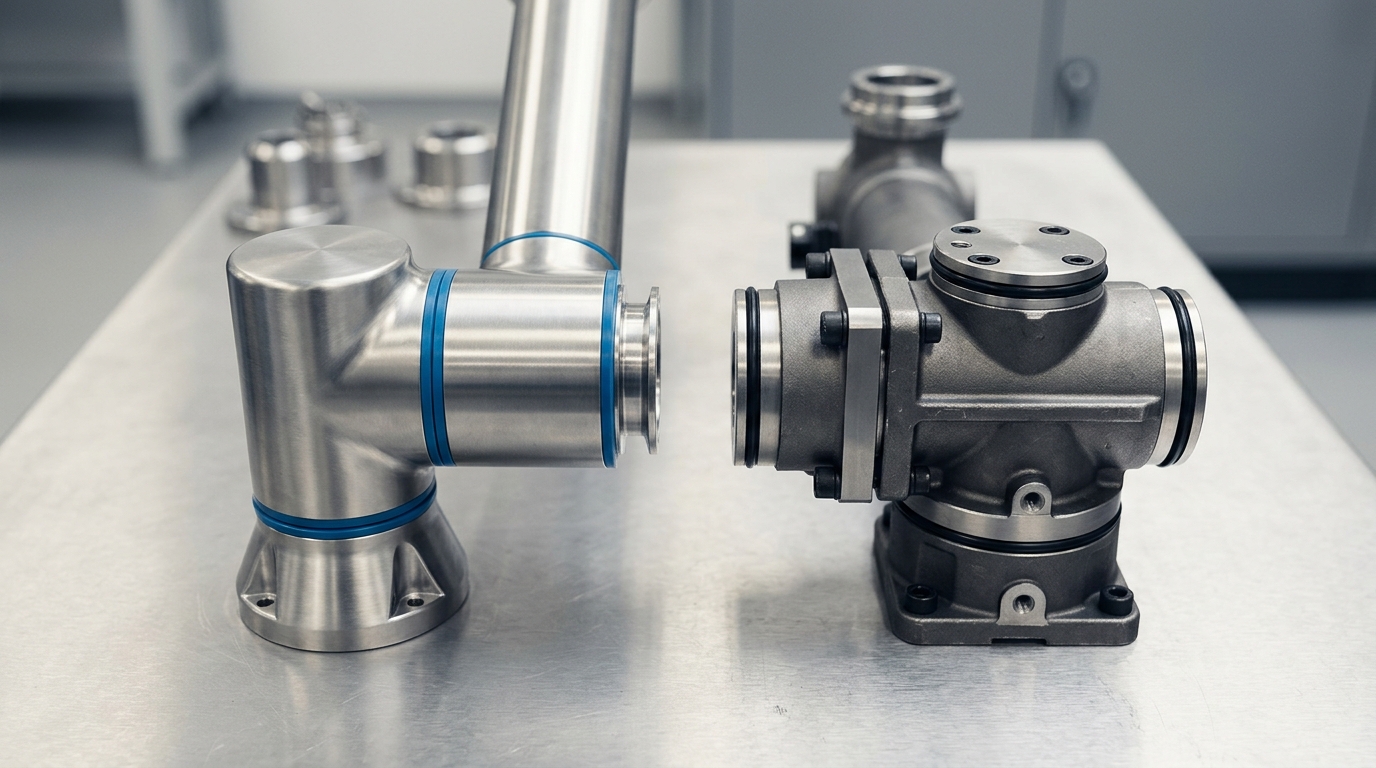
Food contact compliant robot: commercial kitchen filters
Discover how a food contact compliant robot cuts the commercial kitchen shortlist through materials law, IP69K washdown ratings, and hygienic design.
Before evaluating a commercial kitchen robot's capabilities, operators must apply three critical filters: component-level food-contact compliance, EHEDG hygienic design, and IP69K washdown ratings. These baseline legal and sanitary requirements eliminate most models upfront.
Key Takeaways
- 1A robotic arm is not approved as a whole for food contact; only specific components must comply with Regulation (EC) 1935/2004.
- 2Wet production areas require IP69K ingress protection to withstand 100 bar, 80-degree Celsius washdown routines.
- 3Standard grippers fail in commercial kitchens due to exposed fasteners; compliant end effectors require EHEDG hygienic design.
- 4Regulation (EU) 2023/1230 introduces stricter safety and compliance rules for autonomous machinery from 20 January 2027.
Regulation (EC) 1935/2004 and component compliance
A commercial robotic manipulator is never certified as a single, monolithic food-contact unit under European Union law. Regulation (EC) No 1935/2004 applies to materials and articles intended to be brought into contact with food, or which can reasonably be expected to transfer their constituents to food, and it sets out the general principles of safety and inertness for every food contact material placed on the EU market[1]. In practice, compliance applies strictly at the component level: only the specific surfaces, end effectors, suction cups, and protective sleeves that touch raw or cooked ingredients fall within the scope of food-contact materials legislation. Catering operators and facility directors reviewing food and beverage robotics solutions must distinguish between a robot marketed broadly for catering environments and a verified food contact compliant robot installation.
Under Article 16 of Regulation (EC) No 1935/2004, materials covered by specific harmonisation measures, such as plastics governed by Commission Regulation (EU) No 10/2011, must be accompanied by a written declaration stating that they comply. The European Commission describes this as the Declaration of Compliance (DoC), which is based on supporting documentation that must be provided to enforcement authorities on request. That supporting documentation is where migration behaviour sits: Regulation (EU) No 10/2011 works with specific migration limits per substance and an overall migration limit, tested with food simulants under standardised time and temperature conditions. A general declaration of CE conformity under machinery safety legislation does not cover food-contact migration.
- Verification of specific food types: confirming whether the component is tested for aqueous, acidic, alcoholic, or fatty foods.
- Defined temperature and contact thresholds: matching the operating envelope with the maximum contact temperature and duration stated in the migration test report.
- Traceability down to the batch level: ensuring every food-contact polymer, elastomer, or coated surface carries batch-traceable documentation pursuant to Article 17 of Regulation (EC) No 1935/2004.
The legal burden of proof rests entirely on the food business operator who places the automated processing line into service. If an official food safety inspector requests documentation for an automated ingredient portioning or plating cell, the operator must produce the component-level Declarations of Compliance along with evidence of good manufacturing practice under Regulation (EC) No 2023/2006. Robotic kinematic arms built with painted cast aluminium or uncertified anodised housings cannot legally touch unsealed food directly, regardless of how advanced their motion planning software may be.
Food-grade grippers and the end effector problem
The end effector represents the primary physical boundary between the robotic kinematic chain and the food product. Standard industrial grippers fail almost immediately in commercial kitchen environments because unsealed mechanical joints, exposed threaded fasteners, and internal cavities retain organic debris and moisture that routine washdown cannot reach. Furthermore, conventional pneumatics and servo-electric actuators rely on standard industrial greases that pose acute chemical contamination risks if seals degrade under dynamic load.
To qualify as a food-grade gripper, the tooling must satisfy strict mechanical and metallurgical requirements. Structural components directly facing food zones are commonly built from austenitic stainless steel or from engineering thermoplastics such as polyetheretherketone (PEEK) and polyoxymethylene (POM-C); where those polymers touch food, their constituent substances must appear on the Union list of authorised substances established by Commission Regulation (EU) No 10/2011 and be covered by a Declaration of Compliance[2]. Materials in the product area must be physiologically safe, must not release impermissible constituents into the food, and must hold their surface quality across their service life. Lubricants inside enclosed gearboxes or dynamic seals should carry NSF H1 registration, so that incidental technical contact remains physiologically harmless.
- Elimination of blind holes and exposed threads: all fasteners must be hygienically sealed or positioned entirely outside the food contact zone.
- Dynamic sealing integrity: dual-lip elastomeric seals (FDA/EU-compliant EPDM, FKM, or PTFE) engineered to retain lubrication while preventing wash fluid ingress.
- Structural resilience under acceleration: maintaining hygienic seal integrity under continuous dynamic accelerations reaching up to 15G during high-speed pick-and-place cycles.
Vacuum and suction tooling introduce unique hygiene complications in food processing cells. In traditional pneumatic pick-and-place setups, ambient air drawn through suction cups pulls aerosolised fats, moisture, and particulate matter into internal vacuum lines. When the vacuum cycles off, contaminated air and trapped moisture can be blown back across open food surfaces. Hygienic pneumatic systems require dedicated exhaust routing away from open food zones, easily dismantled silicone or polyurethane suction cups, and in-line sanitisation ports that allow complete chemical flushes between production runs.
EHEDG hygienic design in practice
Hygienic design in food robotics is governed by the guidelines of the European Hygienic Engineering & Design Group (EHEDG). The publication of EHEDG Guideline 62 Part 1 established formal hygienic design criteria specifically for robotic systems in open food processing environments[3]. The guideline provides engineering methodologies to eliminate microbiological harborage sites, facilitate wet and dry sanitation, and ensure mechanical equipment does not compromise product integrity.
A fundamental rule of EHEDG hygienic design is the total elimination of horizontal ledges, open crevices, and dead spaces. All exterior surfaces of the manipulator and tooling must feature minimum slope angles (typically at least 3 degrees) to ensure liquids drain freely away under gravity rather than pooling. Internal corners and transitions must incorporate continuous radii (minimum 3 mm to 6 mm) rather than sharp 90-degree internal steps, allowing spray detergents to reach every contact surface without manual scrubbing.
Material surface roughness represents another critical technical parameter. Metallic surfaces in food contact and splash zones must exhibit an average surface roughness (Ra) of 0.8 micrometres or smoother, achieved via mechanical polishing or electropolishing. Rougher surface profiles allow micro-cracks where bacterial biofilms (such as Listeria monocytogenes and Salmonella) can anchor themselves, resisting standard automated cleaning protocols. All exterior elastomer seals and surface coatings must demonstrate chemical resistance to aggressive alkaline detergents (pH 12 to 14) and acidic descalers (pH 1 to 2) used in institutional hygiene regimes.
Ingress protection and the IP69K threshold
The physical environment of a commercial kitchen wet zone dictates an aggressive ingress protection specification. Mobile logistics robots and standard articulated arms designed for light assembly frequently carry IP54 or IP65 ratings, which protect only against light dust ingress and low-pressure water splashes. In a commercial catering facility where production areas, combi-steamer zones, and hot station automation cells undergo daily washdowns, low IP ratings inevitably lead to catastrophic electrical failures, seal breakdown, and trapped moisture.
The benchmark standard for open food processing washdown environments is IP69K, the highest ingress protection rating defined in ISO 20653, a rating that originated in the German automotive standard DIN 40050-9[4]. In the water portion of the test the equipment is placed on a rotating turntable and sprayed for 30 seconds per surface from a distance of 10 to 15 cm, with water at 80 degrees Celsius and a pressure between 80 and 100 bar, from four nozzle angles of 0, 30, 60 and 90 degrees[5]. Equipment that achieves this rating can withstand direct high-pressure, high-temperature jet cleaning without water penetrating the internal electronics or motor enclosures.
| Ingress Protection Rating | Applicable Standard | Water Exposure Test Parameter | Commercial Kitchen Washdown Suitability |
|---|---|---|---|
| IP54 | IEC 60529 | Splashing water from any angle at 10 L/min (0.1 bar) | Unsuitable: dry front-of-house logistics only |
| IP65 | IEC 60529 | Water jets from 6.3 mm nozzle at 12.5 L/min (0.3 bar) | Unsuitable: moisture ingress during routine washdowns |
| IP67 | IEC 60529 | Temporary static immersion up to 1 metre depth for 30 min | Marginal: lacks resistance to dynamic high-pressure washdowns |
| IP69K | ISO 20653 / DIN 40050-9 | Close-range jets at 80 to 100 bar and 80 °C, 30 s per surface | Fully compliant: engineered for aggressive high-pressure sanitation |
Thermal cycling introduces a secondary failure mode known as internal condensation. During daily operations, internal servo motors and electronics generate operating temperatures between 40 and 60 degrees Celsius. When cold washdown water strikes the external housing, the rapid temperature drop creates an internal vacuum, drawing humid air past compromised joint seals. High-grade washdown manipulators incorporate positive internal air pressurisation or hermetically sealed stainless chambers to neutralise this suction effect.
Cleanability as a hidden operational cost
Cleanability (Reinigbarkeit) directly dictates the operating expenditure and net labour balance of a commercial kitchen automation cell. When evaluating robotic automation, engineering teams frequently model cycle times, throughput increases, and gross labour reduction during prep shifts, while sanitation time stays outside the business case. However, if a complex six-axis cell requires extensive manual teardown, delicate masking of unsealed connectors, and intricate manual scrubbing of joint crevices at the end of each shift, the time spent cleaning can diminish or entirely neutralise the operational hours saved.
The financial viability of a foodservice robot installation depends directly on the ratio of automated production time to manual sanitation time. A manipulator engineered according to strict hygienic principles allows Clean-in-Place (CIP) or rapid Clean-out-of-Place (COP) procedures, where tooling snaps off without hand tools and the entire arm is hosed down with foaming sanitiser in minutes. Conversely, a non-hygienic arm with textile protective covers (robot jackets) introduces recurring laundry costs, daily tear-off routines, and the continuous risk of fungal growth underneath damp fabric.
- Tool-less mechanical disassembly: end effectors, suction pads, and guide rails that disconnect within seconds for immersion sanitisation.
- Absence of external cabling looms: all pneumatic and electrical wiring routed internally through the robot base and wrist to prevent grease accumulation.
- Compatibility with standard dosing chemistry: material warranties guaranteeing resistance to chlorine, peracetic acid, and quaternary ammonium compounds.
Kitchen operations managers must calculate sanitation labour into their total cost of ownership models. Requiring certified technical staff to oversee robotic cleaning routines drives up hourly operating costs compared to allowing standard kitchen cleaning personnel to execute standard wet washdowns. Cleanability must therefore be treated as a hard technical specification line item during system selection rather than a secondary maintenance detail.
HACCP: the robot as a hazard analysis step
A robot is never a plug-and-play compliance solution that guarantees food safety by its mere presence; rather, it is a mechanical process step that must be formally integrated into the facility's Hazard Analysis and Critical Control Points (HACCP) plan. Under Article 5 of Regulation (EC) No 852/2004 the obligation to put in place, implement and maintain a permanent procedure based on the HACCP principles sits with the food business operator, not with an equipment supplier[6]. Introducing robotic automation into a commercial kitchen or institutional catering facility alters the physical, biological, and chemical risk profile of the preparation workflow.
The hazard analysis must systematically examine each mechanical interaction between the automated system and open food. Moving joints and rotating linkages present friction zones where polymer wear debris or micro-plastics could detach into food trays. Similarly, dynamic seals subjected to continuous wear must be monitored to prevent lubricant leakage from reaching food surfaces. These mechanical interfaces must be documented with explicit preventive maintenance intervals and inspection routines inside the HACCP master log.
- Physical hazard controls: integration of magnetic or optical sensors to detect missing gripper components, damaged suction cups, or fastener detachment.
- Chemical hazard verification: mandatory documentation logs proving exclusive use of NSF H1 food-grade lubricants and validated rinse cycles after chemical sanitation.
- Allergen cross-contact management: automated wash cycles and dedicated end-effector tool changers to eliminate cross-contact between distinct meal preparations.
When configured correctly, an automated robotic cell provides superior auditability compared to manual workflows. Sensor telemetry can continuously record end-effector washdown cycles, surface temperatures, and tooling swap verifications directly into an audit-logged facility management system. The robot thereby transforms from a potential hygiene vulnerability into an auditable Critical Control Point (CCP) verification tool.
Sequencing filters and Machinery Regulation 2023/1230
The regulatory landscape for autonomous robotics in European commercial kitchens tightens with Regulation (EU) 2023/1230 (the Machinery Regulation), which repeals and replaces Machinery Directive 2006/42/EC and applies from 20 January 2027[7]. Manufacturers placing machinery on the market must then design and construct it in accordance with the essential health and safety requirements of Annex III to the regulation, and draw up an EU declaration of conformity before affixing the CE marking. Understanding commercial kitchen automation economics requires evaluating these legal and physical constraints long before kinematic capabilities are discussed.
Facility directors and project planners who start their selection process by comparing payload capacities, reaches, or software interfaces inevitably waste resources on hardware that cannot legally operate in a food facility. Sourcing must follow a rigid sequence of qualification filters that eliminate non-viable platforms at the outset.
- Filter 1 - Food-contact materials law: verifying component-level Declarations of Compliance under Regulation (EC) No 1935/2004 and positive list materials.
- Filter 2 - Ingress protection and hygienic construction: demanding IP69K washdown certification and EHEDG Guideline 62 geometric compliance.
- Filter 3 - Cleanability and shift economics: auditing tear-down times, internal cable routing, and chemical resistance to ensure sanitation labour does not negate productivity.
- Filter 4 - Machinery safety and CE conformity: assessing collaborative safety zones, emergency stop architectures, and Machinery Regulation 2023/1230 requirements.
- Filter 5 - Kinematic capability and cycle time: evaluating payload, reach, tool speeds, and recipe-handling flexibility only after the first four filters are satisfied.
As a manufacturer-independent robotics systems integrator, werob applies this exact engineering sequence across every professional kitchen project. By deploying the werob Platform, engineering teams leverage the Spec Engine and Supplier Match to filter the entire global robotics market against food-contact regulations, washdown ratings, and integration requirements. This vendor-neutral methodology ensures that operators invest exclusively in robotic systems that are legally compliant, hygienically sound, and financially viable on the commercial kitchen floor.
FAQ
- What makes a food contact compliant robot legal to use?
- The robot itself is not universally approved. Specific parts that touch the food, like the end effector or gripper, must carry a Declaration of Compliance under Regulation (EC) 1935/2004, proving they do not migrate harmful substances into the product.
- Why is IP69K necessary for commercial kitchen robotics?
- Kitchens that undergo aggressive daily sanitation protocols require robots rated IP69K, which ensures the machinery can survive direct high-pressure water jets at 100 bar and 80 degrees Celsius without ingress or electrical failure.
- How does EHEDG hygienic design apply to food robots?
- EHEDG Guideline 62 dictates that robotic systems must feature drainable surfaces, avoid horizontal ledges, eliminate dead spaces where microbes can harbour, and withstand professional cleaning chemicals.
- Do food robots come pre-certified for HACCP?
- No. A robot is integrated as a step inside your existing HACCP hazard analysis. Operators must document the new critical control points it introduces, such as physical contamination risks or allergen cross-contact, and establish monitoring routines.
- When does the Machinery Regulation 2023/1230 apply?
- Regulation (EU) 2023/1230 applies from 20 January 2027. It introduces stricter safety requirements for machinery, particularly addressing new digital technologies, autonomous operations, and human-robot collaboration in processing environments.
Related reading
QSR kitchen robotics: which tasks pay off and which do not
A sober framework for QSR and mid-market operators: which kitchen tasks are worth automating, which are not, and why a narrow robot loses its case the moment the task stops being narrow.
25 July 2026cooking automation fry station qsrRobots at the hot station: what cooking automation in QSR delivers today
How robotic fry stations address turnover and worker safety at the QSR hot line, why they stay narrow and task-specific, and where the honest limits are.
24 July 2026kitchen robotsKitchen Robots: Efficiency and Compliance in Gastronomy
Automating the gastronomy kitchen is no longer a future scenario, but an economic necessity. Learn how werob, as a systems integrator, integrates hardware-agnostic solutions into existing stacks.
10 June 2026