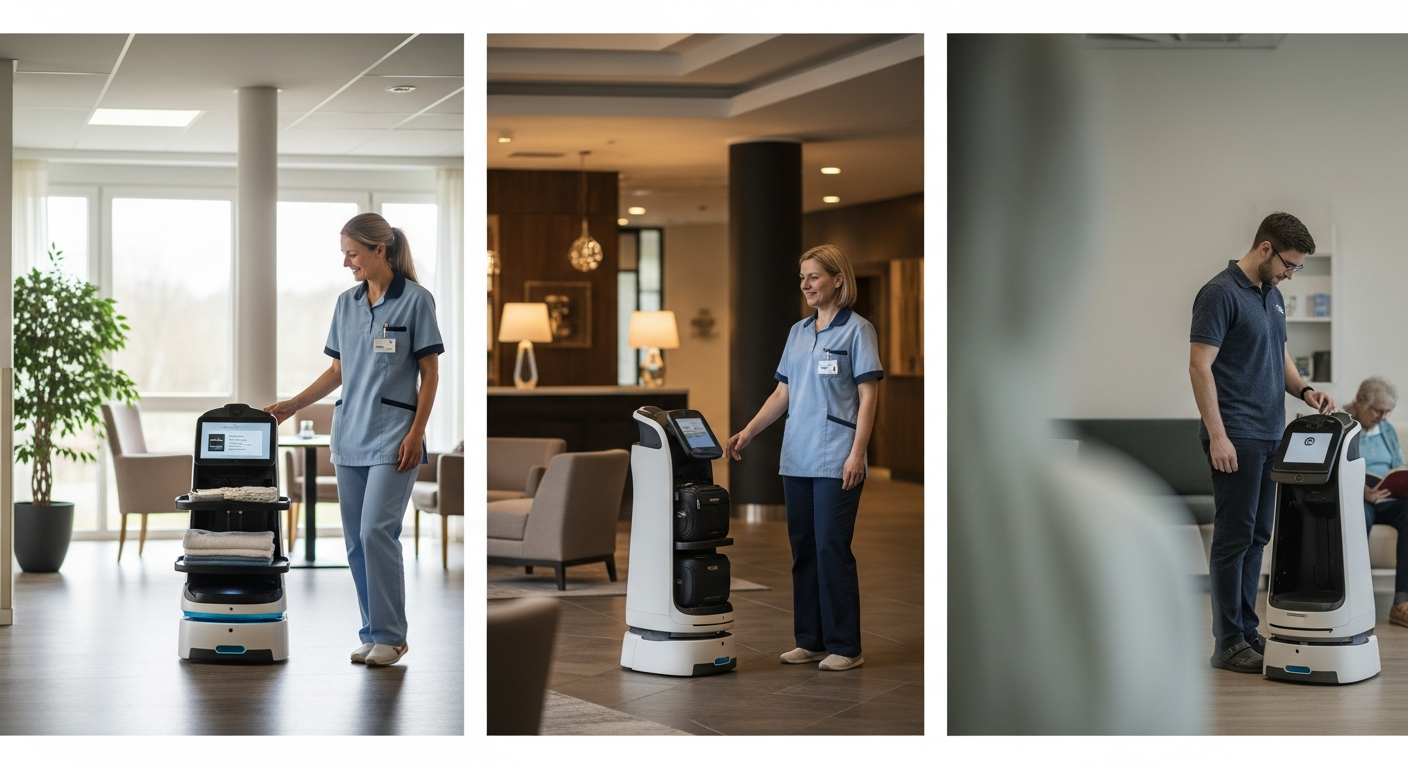
Facility manager robot deployment: efficiency in 8 weeks
Robotics in facility management is no longer an experiment, but an operational necessity to control costs. werob translates your workflows into a usable specification in 48 hours and brings robots into live operation in eight weeks.
Logistics center. 3:15 a.m. The security service is understaffed, but external surveillance is running smoothly. An autonomous robot patrols the fence area while the facility manager monitors the live data in the cockpit. This is not a future scenario, but rather everyday operational life at over 200 active installations in Europe. werob does not deliver hardware promises, but rather measurable results. We translate complex processes into automated processes that go live within eight weeks. As a system integrator, werob ranks over 44 OEM partners to meet your specific requirements in order to find the optimal robot for your object.
Key Takeaways
- 1Cost relief of up to 68,000 euros per year and location through automated patrols and cleaning.
- 2Full legal certainty through compliance with the EU Machinery Regulation 2023/1230 from January 2027.
- 3Fast implementation: To the specification in just 48 hours and to productive live operation in 8 weeks.
The new role of the facility manager in automation
Facility managers today are faced with the challenge of dealing with rising wage costs and massive staff shortages while maintaining consistent service quality. The use of robots is the logical answer here. It's not about exchanging people, but rather about relieving the burden of repetitive, physically difficult or dangerous tasks. werob acts as your central partner, bridging the gap between your operational requirements and the technological implementation.
A modern facility manager no longer manages cleaning staff, but rather controls a hybrid fleet. This consists of specialized robots for floor cleaning, autonomous monitoring units and human specialists for complex special tasks. werob supports you in seamlessly integrating this fleet into your existing stack. With connectors to systems such as SAP EWM or Genetec, the robot becomes a digital employee that reports and documents its tasks autonomously. This creates transparency that was previously not possible with manual processes.
Spec Engine: From workflow to specification in 48 hours
The biggest bottleneck in the introduction of robotics in facility management has so far been the planning phase. Traditional consulting firms often require three to six months to complete a discovery phase. werob breaks this cycle with the Spec Engine. Within just 48 hours, we translate your verbal descriptions of shifts, floors and tasks into a precise, usable robot specification.
Our Spec Engine has been trained on over 35,000 projects. She immediately recognizes which hardware requirements are necessary for an outdoor yard patrol or floor cleaning in an F&B chain. You don't get a vague concept paper, but rather a detailed action graph for the robot. This process eliminates the risk of bad purchases and ensures that the chosen solution fits your infrastructure exactly. Whether it's overcoming thresholds, using elevators or integrating into fire protection systems, the Spec Engine covers all operational details.
Hardware agnostics: 44 plus OEMs for your success
A common mistake in facility management is the so-called vendor lock-in. Anyone who commits to a single robot manufacturer early on loses the flexibility to react to market changes. werob is not a manufacturer and not an individual reseller. We are hardware agnostic. We have over 44 OEM partners in our catalog, including market leaders such as Boston Dynamics, Keenon, Pudu and Apptronik.
Through our Supplier Match, we rank over 280 different robot models to meet your specific requirements. If a manufacturer delivers a software update that no longer meets your needs, or if a new model works more efficiently, werob makes it easy to switch or add to your fleet. We evaluate the hardware on four dimensions: performance, infrastructure compatibility, regulatory and specification fidelity. This ensures that you always use the best technology for your location without having to be tied to a single manufacturer's roadmap.
Economic efficiency: Verified cost reductions per location
Hard numbers count in facility management. werob does not provide estimates, but rather bases its calculations on verified data from over 200 live companies. The cost reductions are significant and often lead to a positive balance in the first year. For a yard patrol in logistics, the annual cost relief is 68,000 euros per location. In the area of retail patrol for security service providers we reach 58,000 euros.
The savings are also measurable in the area of cleaning. Automated kitchen floor cleaning in F&B establishments saves the budget by 44,000 euros per year. These sums result from reducing overtime, avoiding absenteeism and increasing operational efficiency. Since we follow an outcome-only model, you only pay when the robot actually runs. There are no hidden list prices or upfront investments in hardware that ends up sitting unused in the corner. Our goal is to provide maximum relief for your operational budget from the first day of live operation.
Integration into the operator stack: SAP EWM and Genetec
A robot that acts as an isolated standalone solution creates more work in facility management than it saves. The true efficiency comes from integration into the existing software stack. werob offers prefabricated connectors that connect the robot directly to your management systems. In logistics, this means a direct connection with SAP EWM. The robot receives its driving orders directly from the warehouse management system and reports the execution in real time.
For security service providers, we integrate the fleet into platforms such as Genetec. Camera streams from the robots are integrated directly into the control center, and sensor data immediately triggers alarms in the existing security system in the event of irregularities. This seamless integration ensures that your employees don't have to learn new tools. They work in their usual environment while the robots provide the data in the background. werob takes care of the entire technical translation between the different protocols and ensures stable, bidirectional communication.
Regulatory information: EU Machinery Regulation 2023/1230 is mandatory
Legal security is a critical issue for facility managers. From January 20, 2027, the EU Machinery Regulation 2023/1230 will be binding. Many Asian OEMs currently do not have the necessary conformity assessments for the European market. werob acts as your compliance path here. We ensure that every robot we use meets strict European security standards.
This includes not only hardware, but also software security in accordance with IEC 62443 and data protection in accordance with GDPR. This legal certainty is particularly indispensable in public spaces or in sensitive areas such as nursing homes (ISO 13482). werob takes responsibility for regulatory compliance and documents all safety-relevant aspects in the live cockpit. This means you can always provide information during audits or inspections by home inspectors or professional associations. We protect you from the legal risks associated with importing and operating uncertified robotics hardware.
The werob Cockpit: Live fleet management with a traffic light system
Once the robots are in use, facility managers need full transparency about the status of the fleet. The werob Cockpit offers a four-dimensional traffic light system that monitors the status of the hardware, infrastructure, regulations and specifications in real time. You can see at a glance whether a robot is stopped due to a blocked lane or whether maintenance is due.
This central management tool makes it possible to control hundreds of robots across different locations with minimal personnel effort. The cockpit provides detailed reports on the hours worked and the area performance achieved. This data serves as an objective basis for billing services and optimizing deployment plans. If a robot deviates from the defined specification, the system immediately raises an alarm. This guarantees a consistently high quality of service, which would be difficult to control manually.
Outcome-only: The commercial model for operators
Traditional procurement models for robotics often involve high investment risks. werob eliminates this risk through a purely results-oriented commercial model. You pay nothing until the robot is running productively at your location. This outcome-only model ensures that our interests are perfectly synchronized with your operational goals.
We only make money if the solution works and delivers the promised added value. There are no complicated leasing contracts for hardware that becomes obsolete after two years. Instead, we offer you the flexibility to make your automation scalable. If you want to equip additional locations, we use the existing spec engine to speed up the rollout. This model is particularly attractive for facility management companies that need to protect their margins and cannot bear high upfront costs. With werob you convert fixed costs into variable, performance-related costs.
Robot in action in eight weeks
Speed is a crucial competitive advantage. While other companies are still in the planning phase, werob customers are already in live operation. Our process is designed for maximum efficiency: 48 hours to the specification, five days to the binding offer and eight weeks to the first robot on the site. This tight schedule is possible because we rely on standardized processes and prefabricated connectors.
We accompany you through all eight steps of the onboarding process, from the first recording of your shift schedules to the final acceptance on site. Our experience from over 200 live installations in 11 European countries guarantees that we identify and avoid typical stumbling blocks at an early stage. Whether in Germany, France or Poland, werob delivers consistent quality and ensures that your automation strategy becomes reality quickly and safely. Get started today and let us translate your first workflow into a specification.
FAQ
- How much does it cost to integrate a robot at werob?
- werob works according to an outcome-only model. This means you only pay when the robot is successfully in use at your location. There are no flat-rate list prices as the costs are calculated individually based on the results achieved and the hardware configuration chosen.
- Which robot manufacturers does werob support?
- We are hardware agnostic and work with over 44 OEM partners. These include Boston Dynamics, Keenon, Pudu, Apptronik and Unitree. In total, we can arrange over 280 different robot models for your specific requirements.
- How long does it take for a robot to be ready for use?
- Our promise is: 48 hours to the finished specification, five days to the offer and eight weeks to the productive use of the robot at your location.
- Can werob be integrated into existing software systems?
- Yes, werob offers ready-made connectors for common systems such as SAP EWM, Genetec, Opera PMS, Mews and Toast. Seamless integration into your existing IT stack is a core component of our platform.
- Is the use of robots legally safe?
- Yes, werob ensures compliance with all relevant standards, including the EU Machinery Regulation 2023/1230, ISO 13482 and the GDPR. We act as your compliance path for secure operations in Europe.
- In which countries does werob operate?
- As of May 2026, werob is active in 11 European countries, including Germany, Austria, Switzerland, France, Italy, Spain, Netherlands, Denmark, Sweden, Poland and Great Britain.
Related reading
Robot Integrator: To an operational fleet in eight weeks
A robot integrator closes the gap between hardware manufacturers and everyday operations. Find out how werob specifies workflows in 48 hours and brings productive units to the floor within eight weeks.
30 June 2026system integrator roboticsSystem integrator robotics: Scaling in eight weeks
A robotics systems integrator bridges the gap between OEM hardware and operational reality. werob translates workflows into usable specifications in 48 hours and integrates fleets into existing IT stacks.
5 July 2026robot deployment partner germanyChoosing a Robot Deployment Partner in Germany
Navigating the German robotics landscape requires more than hardware selection. It demands a systems integrator capable of bridging the gap between operational workflows and strict EU regulatory compliance.
5 July 2026robot deployment partner franceRobot Deployment Partner France: Scaling Operations in 8 Weeks
Deploying robotics in France requires more than just purchasing hardware. It demands a systems integrator that can navigate the EU Machinery Regulation 2023/1230 while integrating directly into existing tech stacks like Mews and Opera PMS.
5 July 2026robot deployment spec automationRobot Deployment Spec Automation for Scalable Operations
Traditional robotics procurement takes months of discovery. werob uses a Spec Engine trained on 35,000 projects to deliver deployable specs in 48 hours.
5 July 2026