Automation against a shortage of skilled workers: Operational strategies 2026
The shortage of skilled workers endangers the operational viability of entire industries. werob shows how robot fleets create operational relief within eight weeks and free skilled workers from repetitive tasks.
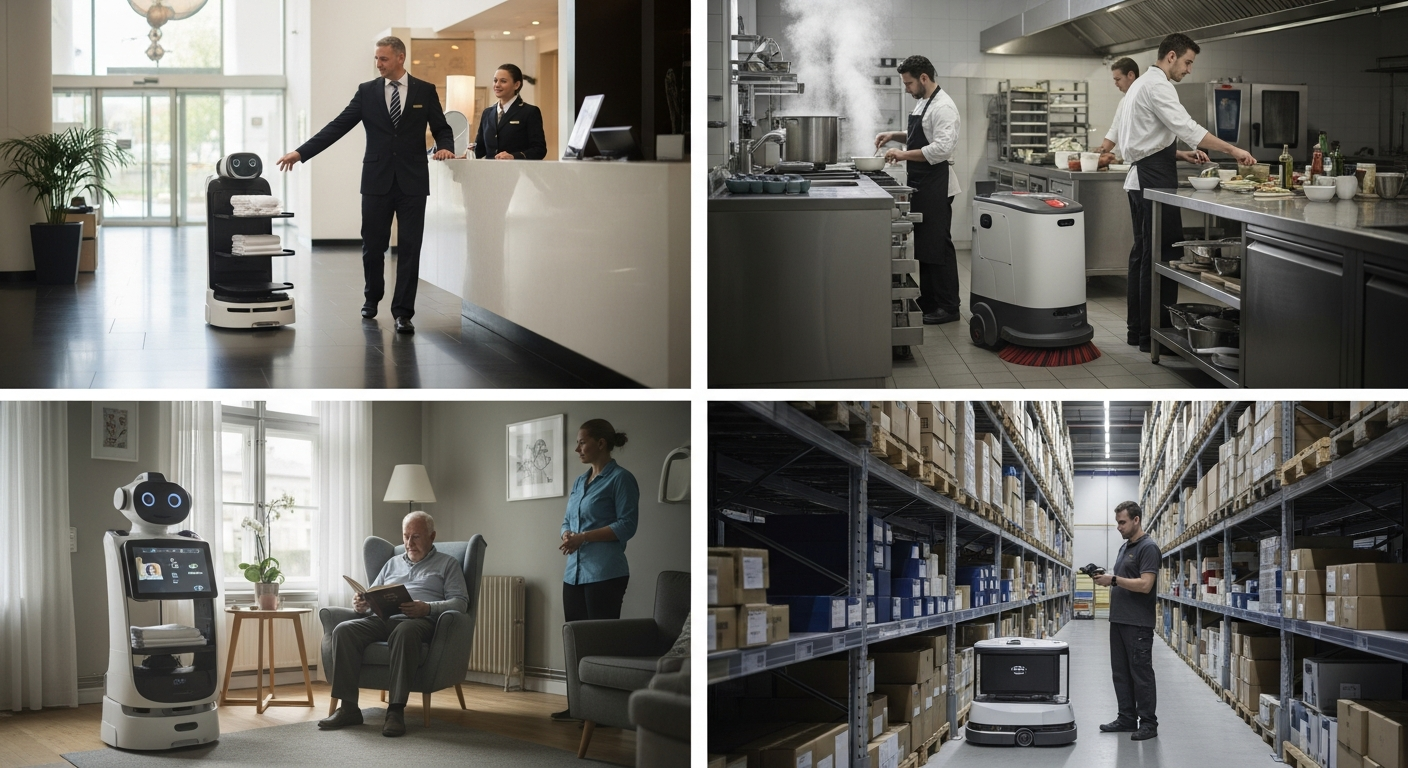
Station 2. 10:00 p.m. The night watch is responsible for 40 residents alone. While the nurse completes documentation, an autonomous transport robot delivers the medication carts for the next morning. This is not a vision of the future, but rather everyday operational life in facilities like Korian Germany. This is not about replacing people, but rather about regaining time for core tasks. werob translates these workflows into technical specifications in 48 hours and brings the hardware into live operation in eight weeks. As a system integrator, werob closes the gap between theoretical automation and real operational added value.
Key Takeaways
- 1Automation is the only scalable answer to the structural skills shortage in operational industries.
- 2werob shortens the path from requirement to live operation to eight weeks thanks to the AI-supported Spec Engine.
- 3Hardware agnostics protects against vendor lock-in and provides access to over 280 specialized robot models.
The reality of the shortage of skilled workers in operational companies
The shortage of skilled workers is no longer an abstract problem of the future, but an immediate threat to the operational ability of European companies. In nursing, the hotel industry and logistics, the lack of qualified personnel leads to a massive overload of the remaining employees. This results in a dangerous downward spiral of increasing fluctuation, declining service quality and skyrocketing costs for temporary employment. The traditional search for personnel is reaching its limits as demographic change structurally reduces the number of available workers.
Companies therefore have to fundamentally rethink their operational processes. It's about deploying valuable human resources where empathy, judgment and complex decision-making are needed. Repetitive, physically demanding or monotonous tasks such as transporting laundry, cleaning floors or delivering medication can now be reliably carried out by robots. werob acts as the decisive system integrator, who doesn't just sell hardware, but translates the entire workflow into an automated solution.
The challenge often lies not in the availability of the technology, but in its integration. Many operators fail due to the complexity of choosing from over 280 available robot models and connecting to existing IT systems. werob solves this problem through a structured process that delivers a ready-to-use specification within 48 hours. This turns automation from a lengthy project into a quickly implemented operational measure against the personnel shortage.
The werob Spec Engine: From workflow to solution in 48 hours
One of the biggest obstacles to the introduction of robotics is the lengthy planning phase. Classic consulting approaches often require three to six months to define requirements and create feasibility studies. At a time when stations are forced to close due to staff shortages, this period is unacceptable. werob has radically shortened this process with the Spec Engine. Based on data from over 35,000 projects, werob translates an operator's natural descriptions into a precise technical specification.
This process begins with a simple recording of the current situation: which shifts are understaffed. What routes do employees take every day? What infrastructure is available? werob delivers a finished action graph model for robot use within just 48 hours. This speed is crucial to immediately address operational pressure in companies. The Spec Engine not only takes into account the technical requirements, but also the regulatory framework and the necessary interfaces to the existing software stack.
This data-driven approach minimizes the risk of wrong decisions. Instead of relying on the marketing promise of a single manufacturer, werob uses objective criteria to find the best solution for the specific use case. This is the first step of the four-stage werob platform, which is designed to bring robot fleets into live operation quickly and safely. For the operator, this means maximum transparency and planning security from day one.
Hardware agnostics as a strategic advantage
The robotics market is highly fragmented. There are specialized manufacturers of cleaning robots, transport robots and, increasingly, humanoid systems. It is almost impossible for an operator to keep track of the performance and reliability of over 44 OEM partners. A vendor lock-in, i.e. being tied to a single manufacturer, also represents a significant business risk. If a manufacturer discontinues support or the hardware does not perform as promised, the entire automation project is at risk of collapse.
werob therefore follows a strictly hardware-agnostic approach. As a system integrator, we rank over 280 different robot models against the customer's individual specifications. Whether a system from Keenon, Pudu, Boston Dynamics or Apptronik is used is decided solely by operational suitability and cost-effectiveness. werob is not a reseller of a single manufacturer, but rather the operator's advocate in the complex OEM market. This independence guarantees that the technologically best and most cost-efficient solution is always chosen.
In addition, this approach ensures scalability. As a company grows or needs change, robots from different manufacturers can easily be combined in the same fleet. The werob Cockpit acts as a higher-level control level that manages all systems across manufacturers. This is particularly important for large operators in the care or hotel industry who manage different locations with varying structural conditions. The hardware becomes an interchangeable component, while the intelligence and process control remain in the werob platform.
Economic efficiency and measurable cost relief
Automation has to pay off. In the current economic situation, investments can only be justified if they deliver a clear and quick return on investment (ROI). werob relies on an outcome-only model here: the customer only pays when the robot is actually in use and fulfills the defined tasks. This eliminates the financial risk of the implementation phase and ensures that the interests of the integrator and operator are perfectly aligned.
The potential savings are significant and are based on verified data from live operation of over 200 robots in 11 European countries. In care, a robot for medication rounds saves the site an average of €92,000 per year. In the hotel industry, the automation of room service results in cost savings of €112,000 annually. These numbers are not estimates, but operational reality for existing customers.
| Industry / use case | Verified cost relief per year/location |
|---|---|
| Care: medication round | 92,000 € |
| Care: transport tasks | 71,000 € |
| Hotel: Room service | 112,000 € |
| Hotel: Bar & breakfast preparation | 54,000 € |
| F&B: Kitchen floor cleaning | 44,000 € |
| Logistics: Court patrol | €68,000 |
These reliefs arise primarily from the reduction of unproductive travel times and the stabilization of duty rosters. If a robot takes over the transport of dirty laundry or food, specialists gain up to two hours per shift to work directly on guests or residents. This not only increases efficiency, but also massively improves working conditions, which in turn reduces the fluctuation rate and reduces the costs of new recruitment.
Integration into the operator stack: The role of connectors
A robot that acts as an isolated solution often creates more work than it saves. True efficiency only comes from seamless integration into the company's existing IT infrastructure. If the care robot does not know which resident is in which room, or the logistics robot does not have access to the warehouse management system, the potential remains unused. werob solves this integration hurdle with prefabricated connectors.
These connectors enable direct communication between the robot fleet and leading industry systems. In care, these are integrations in PointClickCare and MatrixCare. In the hotel industry, systems such as Opera PMS and Mews are connected, while in the catering industry, Toast and Lightspeed are supported. werob offers connections to SAP EWM for logistics. This profound integration ensures that orders are generated automatically and status reports are fed back in real time to the employees' usual interfaces.
By using these standardized interfaces, we drastically shorten the implementation time. Instead of spending months programming individual software solutions, werob uses proven modules. This also ensures data integrity and meets the highest security standards. The employee does not have to learn new software, but rather operates the robot indirectly using the systems he is already familiar with. This increases acceptance among the workforce and ensures that automation immediately becomes part of the daily workflow.
Regulatory safety: EU Machinery Regulation 2023/1230
The legal framework for the use of robots in public or semi-public spaces is becoming increasingly complex. The new EU Machinery Regulation 2023/1230, which will be binding for all operators in the European Union from January 20, 2027, is particularly critical. This regulation places significantly higher requirements on the safety and conformity assessment of machines, especially if they are controlled with artificial intelligence or work in close proximity to people.
Many Asian OEMs currently do not have the necessary certifications or documentation to meet these strict European requirements. Werob offers a crucial compliance path here. As a system integrator werob takes responsibility for the regulatory compliance of the overall solution. This includes not only compliance with the Machinery Ordinance, but also specific standards such as ISO 13482 for service robots in the area of personal care or the BewachVO for security robots.
Without a partner like werob, operators risk that their expensive systems will have to be shut down from 2027 or that there will be no insurance coverage in the event of damage. werob already integrates the regulatory check into the Spec Engine and the cockpit. The four-dimensional traffic light system in live management continuously monitors the status of the hardware, infrastructure, specifications and regulations. werob thus offers the legally safest way to anchor automation in the company in a long-term and legally secure manner.
Practical case studies: Korian and humanoid systems
The theory of automation only proves itself in tough operational practice. An outstanding example is the collaboration with Korian Germany. Robotic fleets have been implemented in Korian's care facilities to relieve staff of logistical tasks. The result was a double-digit cost reduction in the first year of operation. The employees reported a noticeable physical relief as heavy transport trolleys can now be moved autonomously. This shows that automation contributes directly to employee satisfaction.
Another pioneering project is taking place in a nursing facility in Hamburg. The first humanoid robot system is being used here in pilot operation. In the twelfth week of operation, it is already clear how humanoid robots can take on tasks that were previously reserved for human forces, such as assisting with mobilization or simple interaction tasks. These systems, from partners such as Apptronik or Unitree, mark the next level of automation to combat the shortage of skilled workers.
These practical examples demonstrate the scalability of the werob platform. From simple transport tasks to complex humanoid interactions, werob covers the entire spectrum. In all cases, the speed of implementation was crucial for success. By promising to get from first contact to the running robot within eight weeks, the facilities were able to respond quickly to acute staff shortages. The experiences from these projects are continuously incorporated into the optimization of the Spec Engine, from which every new customer benefits.
The path to implementation in eight weeks
Werob's process is designed for maximum speed and minimum stress for the operator. It is divided into eight clear steps that ensure that the solution exactly fits your needs. First, the shifts and tasks that should be automated are identified. werob uses the Spec Engine to create a detailed specification within 48 hours. In the second step, the supplier match takes place, in which the appropriate robots are selected from the catalog of 44+ OEMs.
After the selection, the technical integration follows into the existing software stack via the werob connectors. At the same time, regulatory conformity is ensured in accordance with the EU Machinery Regulation 2023/1230. The operator will receive a binding offer based on the outcome-only model within five days. As soon as the decision has been made, the implementation phase begins on site. Thanks to the preparatory work in the Spec Engine and the use of prefabricated connectors, it usually only takes eight weeks until the first robots go live.
After the go-live, the werob Cockpit takes over fleet management. Here all performance data is monitored and adjustments are made to the specification if necessary. The operator has full insight into the performance and the cost reduction achieved at all times. This structured approach takes away companies' fear of complex technology projects and enables them to combat the shortage of skilled workers proactively and with measurable success. werob remains the permanent operating partner who keeps the systems up to date and compliant.
Outlook: The future of automation until 2028
The development of robotics is accelerating rapidly. While specialized service robots are primarily used for transport and cleaning today, the next generation of humanoid robots will massively expand the range of applications. werob is already preparing to manage over 2,000 robots in live operation by 2028. This scaling is necessary to meet increasing demand across Europe. With a presence in 11 countries, werob is the leading system integrator, which provides operational support for this transformation.
A central factor for the future will be the further development of AI-controlled action graphs. Robots are becoming increasingly autonomous and capable of operating safely in unstructured environments. werob uses the data from the live cockpit to continuously refine the Spec Engine algorithms. This means that future implementations can be even more precise and faster. The integration of AI is always viewed from the perspective of regulatory security and data protection in order to meet the requirements of the EU AI Act.
For companies, this means that now is the right time to get started with automation. The technological maturity is present, the regulatory paths are paved by advertising and the economic necessity is unavoidable due to the shortage of skilled workers. Anyone who lays the foundation for an automated fleet today will secure a decisive competitive advantage and the long-term operational viability of their company. werob is ready to accompany you on this path as a hardware-agnostic partner in record time.
FAQ
- How quickly can a robot be in use with us?
- With werob it usually takes eight weeks from the first specification to live operation. The specification itself is available after just 48 hours.
- What costs arise before commissioning?
- Thanks to werob's outcome-only model, you pay nothing until the robot actually runs in your company and fulfills the defined tasks.
- Is the solution compatible with our existing software?
- Yes, werob offers pre-built connectors for systems such as PointClickCare, MatrixCare, Opera PMS, Mews, Toast and SAP EWM.
- What happens if there are technical problems with the hardware?
- The werob cockpit monitors the fleet in real time. As a system integrator, we coordinate support with the 44+ OEM partners and ensure operational readiness.
- Do the robots meet the new EU safety guidelines?
- Yes, werob offers an integrated compliance path for the EU Machinery Regulation 2023/1230, which is binding from January 2027.
- Can different types of robots be combined?
- Absolutely. werob is hardware-agnostic and manages cross-manufacturer fleets centrally via a single platform.
Related reading
Robot Integrator: To an operational fleet in eight weeks
A robot integrator closes the gap between hardware manufacturers and everyday operations. Find out how werob specifies workflows in 48 hours and brings productive units to the floor within eight weeks.
30 June 2026construction robots skilled labour shortageConstruction Robots Against the Skilled-Labour Shortage: Which Tasks Pay Off in 2026
Discover which construction robots pay off in 2026 as general contractors in the DACH region deploy automated layout, rebar, and drilling systems.
17 July 2026system integrator roboticsSystem integrator robotics: Scaling in eight weeks
A robotics systems integrator bridges the gap between OEM hardware and operational reality. werob translates workflows into usable specifications in 48 hours and integrates fleets into existing IT stacks.
5 July 2026service robots against the labour shortage how facilityService robots against the labour shortage: how facility operators automate cleaning
Discover how facility operators use independent service robotics and flexible rentals to beat the cleaning labor shortage and stabilize workflows.
6 July 2026Staff shortage in catering robotsShortage of staff in the catering industry: Robots as an operational solution
The shortage of staff in the catering industry endangers the operational viability of entire chains. As a system integrator, werob offers hardware-agnostic solutions that go live within eight weeks and massively reduce the workload on the workforce.
26 June 2026