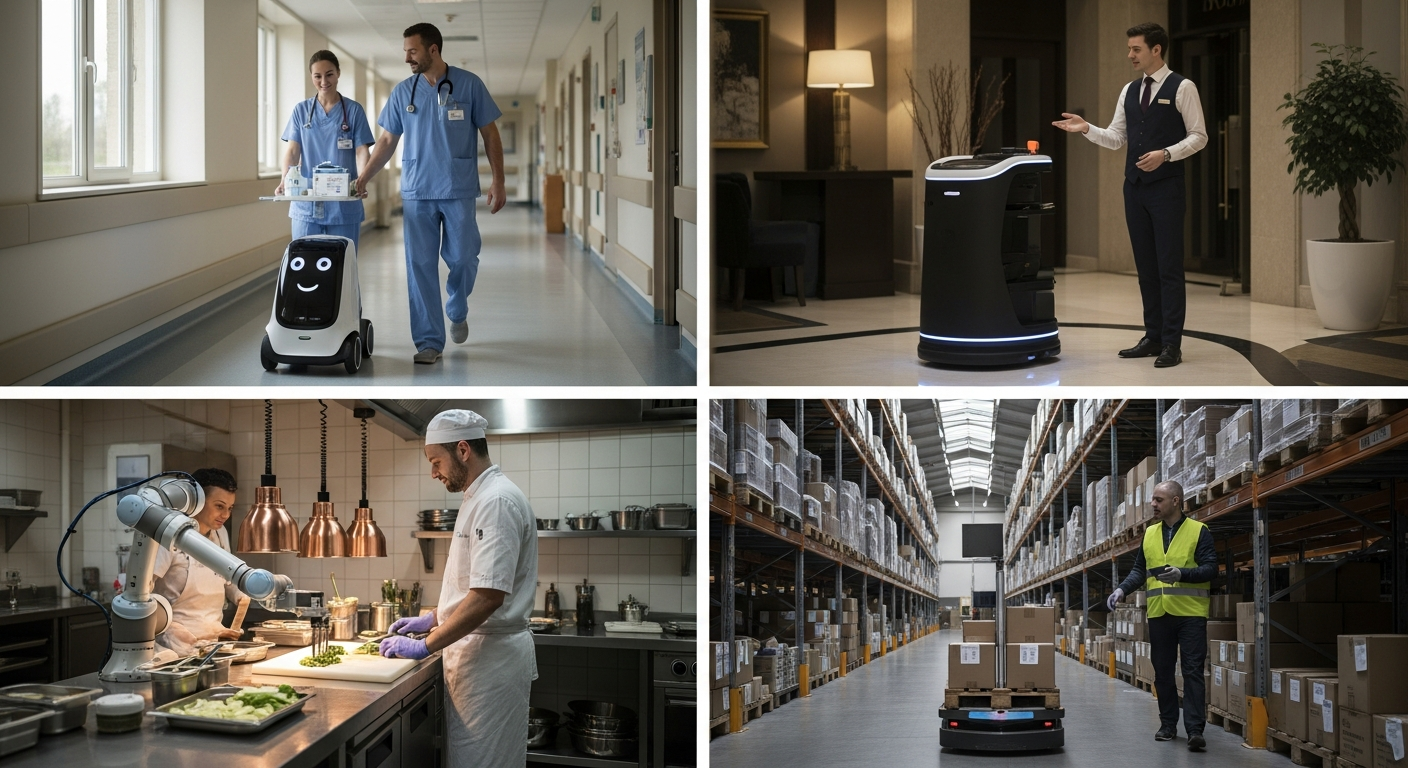
Robot tender tool: Efficiency in system integration
Forget months of consultation cycles and hundreds of pages of specifications. A modern robot tender tool translates operational workflows directly into technical specifications and delivers ready-to-use hardware within eight weeks.
Tuesday, 9:00 a.m., regional management conference room. A stack of 150 pages of specifications lies on the table. Three months of preparation for a fleet of transport robots. This is the status quo of the classic industrial tender. Meanwhile, a humanoid robot whose specification was finalized in 48 hours is already in its twelfth week of operation in a Hamburg care facility. werob is not a robot manufacturer and not a classic consultancy. As a system integrator, werob translates an operator's workflow into a usable specification, ranks 44+ OEM partners and delivers pre-built connectors into the operator stack. With 200 robots in live operation in 11 European countries, werob proves that speed and operational precision are not a contradiction.
Key Takeaways
- 1The werob Spec Engine shortens the process from requirement to specification to 48 hours instead of the usual 3 to 6 months.
- 2Hardware agnostics enables access to 44+ OEMs and 280 robot models without vendor lock-in.
- 3Integrated compliance for the EU Machinery Regulation 2023/1230 secures operations beyond 2027.
The end of the 6 month Discovery deck
In traditional procurement of robotics solutions, companies often spend three to six months creating specifications. These documents are often outdated before the first hardware hits the ground. A modern robot tender tool breaks this paradigm. The werob Spec Engine uses data from over 35,000 projects to translate your operational requirements, such as shift schedules, floor layouts and specific tasks, into a technical action graph. This process does not take months, but only 48 hours.
The decisive advantage lies in the operational specificity. Instead of vague terms such as process optimization, the tool defines exact requirements for load capacity, battery life, navigation ability in narrow corridors and the necessary sensors for interaction with people. This is particularly critical in industries such as nursing or hotels, where the environment is highly dynamic. werob acts as a translator between the language of the operations manager and the technical specifications of the manufacturer. The result is a precise document that serves as the basis for subsequent supplier matching without the operator having to become a robotics expert himself.
Hardware agnostics instead of vendor lock-in
A major mistake in classic tenders is the early decision on a manufacturer. An effective robot tendering tool must be hardware-agnostic. werob maintains a catalog of over 44 OEM partners and can check 280 different robot models against the specification created. These include well-known manufacturers such as Boston Dynamics, Keenon, Pudu, Apptronik and Unitree. The tool does not evaluate based on brand name, but rather based on how well it fits the operational requirements.
Using this ranking process, operators avoid vendor lock-in. If a manufacturer does not optimally meet the requirements for the medication round in a nursing home, the system automatically suggests alternatives that are technically superior or economically more attractive. This competition among OEMs ensures the operator has the best solution on the market. Since werob is not a reseller of a single manufacturer, the recommendation remains neutral and purely results-oriented. This is the only way to remain flexible in the long term in a rapidly developing market like robotics.
The EU Machinery Regulation 2023/1230 as a filter
An often overlooked but critical aspect when selecting robotics hardware is regulatory compliance. The new EU Machinery Regulation 2023/1230 will be binding from January 20, 2027. Many Asian OEMs currently do not have the necessary conformity assessments for the European market. A professional robot tender tool integrates these regulatory requirements directly into the selection process. werob acts as a compliance path.
Every robot that is specified and matched via the werob platform goes through a test with regard to the applicable standards such as ISO 13482 for personal assistance robots or the BewachVO for security robots. This protects the operator from legal risks and costly shutdowns by the home inspectorate or professional associations. At a time when liability issues regarding autonomous hardware are becoming more complex, the tool offers the necessary security that the fleet used not only functions technically, but is also operated in a legally compliant manner. This is a core differentiator compared to purchasing directly from the manufacturer or a simple reseller.
Integration into the operator stack
A robot is only as good as its connection to the existing IT infrastructure. An isolated system creates additional manual effort and reduces ROI. werob therefore supplies prefabricated connectors for the most common systems in the target industries. These include PointClickCare and MatrixCare for care, Opera PMS and Mews for the hotel industry, and SAP EWM for logistics. Integrations into cash register systems such as Toast or Lightspeed are also available as standard.
The robot tender tool checks in the planning phase whether the selected hardware is compatible with these interfaces. For example, a transport robot in a hotel needs to know when a guest has checked out via the PMS in order to prioritize the room service order. In logistics, the robot must communicate directly with the warehouse management system to receive driving orders without human intervention. These deep integrations are the reason why werob can implement the rollout within eight weeks, while individual projects often fail due to the IT interface.
Economic efficiency: From spec to ROI
The decision in favor of robotics is ultimately made by reducing costs. werob uses verified data from the live operation of 200 robots to calculate realistic savings potential. In care, the automation of the medication round leads to an annual cost reduction of 92,000 euros per location. In the hotel industry, a room service robot can save up to 112,000 euros per year. These numbers are not estimates, but operational reality for customers like Korian Germany.
The robot tender tool compares these savings with the operating costs. Since we follow an outcome-only model, the operator only pays when the robot actually runs and delivers the specified performance. There are no hidden list prices or high upfront investments for consulting services. This commercial approach shifts risk from the operator to the integrator and ensures that only solutions that provide measurable economic value are implemented. A tray bot in the dishwashing chamber of a restaurant, for example, saves staff by 76,000 euros annually, which enables amortization in the shortest possible time.
The 8-week path: From tool to live operation
Geschwindigkeit ist in der heutigen Marktumgebung ein entscheidender Wettbewerbsvorteil. The process at werob is designed for maximum efficiency: 48 hours until the finished specification, five days until the binding offer and eight weeks until the robot is in live use. This tight schedule is made possible by the four levels of the werob platform. After the Spec Engine and the Supplier Match comes the implementation via the connectors and finally the monitoring in the live cockpit.
The cockpit offers a four-dimensional traffic light system that monitors hardware, infrastructure, regulations and compliance with the original specification in real time. This allows operations directors to keep track of their fleet at all times, regardless of whether it is a single location or a Europe-wide distribution. werob already operates in 11 countries, including Germany, France, Italy and the United Kingdom. This international presence allows large chains to implement their automation strategy across borders with a single partner who has already integrated the local regulatory specifics into the tender tool.
Comparison: Classic tender vs. werob Spec Engine
To illustrate the advantages of a modern robot tendering tool, a direct comparison with the conventional process helps. While classic tenders are often slowed down by bureaucratic hurdles and a lack of technical depth, werob relies on data-driven automation.
| Criteria | Classic tender | werob Spec Engine |
|---|---|---|
| Time required to produce the spec | 3 to 6 months | 48 Hours |
| Hardware selection | Limited to well-known brands | 44+ OEMs ranked agnostically |
| IT integration | Individual programming | Prefabricated connectors (SAP, Opera etc.) |
| Compliance check | Manual by legal department | Integrated (EU 2023/1230 compliant) |
| Cost model | High upfront investment / advice | Outcome-only (payment upon operation) |
This comparison shows It is clear that the werob approach is not only faster, but also less risky. Focusing on the outcome rather than the process allows companies to reap the benefits of robotics immediately rather than getting stuck in lengthy planning phases.
Future security through the werob cockpit
After the successful tender and implementation, the actual operational phase begins. A robot tendering tool should not end with selection. The werob Cockpit takes over fleet management and ensures that the hardware delivers the promised performance in the long term. With the goal of having over 2,000 robots in use by 2028, werob is continually investing in the platform's monitoring and optimization functions.
The cockpit proactively detects deviations from the specification. For example, if a robot can no longer complete its tasks in the allotted time due to changes in the building's WiFi infrastructure, the system raises an alarm. This transparency is essential for facility managers and CTOs to guarantee fleet availability. Through continuous data collection, insights from live operations flow directly back into the Spec Engine, making future tenders even more precise. werob therefore offers a closed cycle from the first idea to long-term, profitable operation.
Conclusion for decision-makers
The implementation of robotics today is no longer a question of technology, but rather a question of system integration. A robot tendering tool like the werob Spec Engine eliminates the complexity and risks previously associated with automation. By combining speed, hardware agnostics and deep software integrations, werob offers the most efficient path to a productive robot fleet. Companies that act now will not only secure significant cost savings, but also the necessary compliance for the upcoming regulatory requirements in Europe. Start your specification in 48 hours and experience how robotics sustainably improves your everyday operations.
FAQ
- What is a Robot Tender Tool?
- It is a software solution that translates operational workflows into technical robotics specifications and automatically identifies the appropriate manufacturers on the market.
- How quickly does werob deliver an offer?
- After the Spec Engine has defined the requirements within 48 hours, you will receive a binding offer within five working days.
- What costs arise before live operation?
- At werob, the outcome-only model applies. This means you only pay once the robot has been successfully integrated into your business and is running.
- Is werob tied to specific robot manufacturers?
- No, werob is hardware-agnostic and ranks over 44 different OEMs purely based on their technical and economic suitability for your project.
- Does the tool support integration with SAP?
- Yes, werob offers ready-made connectors for SAP EWM as well as for many other systems such as Opera PMS, Mews, Toast and MatrixCare.
- What happens if there are regulatory changes?
- werob continuously monitors legislation, such as the EU Machinery Regulation 2023/1230, and ensures that all proposed robots meet current standards.
Related reading
Robot specification tool: Go live in 48 hours
A professional robot specification tool shortens the planning phase from months to hours. werob uses an AI-powered engine to translate workflows directly into technical requirements and rank 44+ OEMs.
2 July 2026robot tender softwareRobot tender software: Efficiency in 48 hours
Conventional tendering processes for robotics often take months and result in rigid manufacturer lock-ins. werob optimizes classic advice with a software-supported spec engine that translates workflows into precise requirements in 48 hours.
27 June 2026robot rollout planning toolRobot Rollout Planning Tool: From Spec to Floor in Eight Weeks
Most robotics projects fail during the planning phase due to vendor lock-in and regulatory gaps. werob provides a technical framework to translate workflows into deployable specifications within 48 hours.
6 July 2026Robot supplier selection toolRobot supplier selection tool: To the specification in 48 hours
Selecting the right robot supplier determines the ROI of your automation strategy. Learn how werob tests 44+ OEMs against your operational needs and delivers a ready-to-use fleet in eight weeks.
1 July 2026Robot cell sizing toolRobot cell dimensioning tool: Planning in 48 hours
The precise dimensioning of a robot cell is the prerequisite for economical automation. werob replaces months-long planning cycles with an AI-powered spec engine and delivers a ready-to-use specification in 48 hours.
2 July 2026