Shortage of staff care robot solution: Efficiency through integration
The shortage of personnel in nursing requires immediate operational relief instead of lengthy consultation cycles. werob translates care workflows into usable robot specifications in 48 hours and integrates them directly into the existing IT stack.
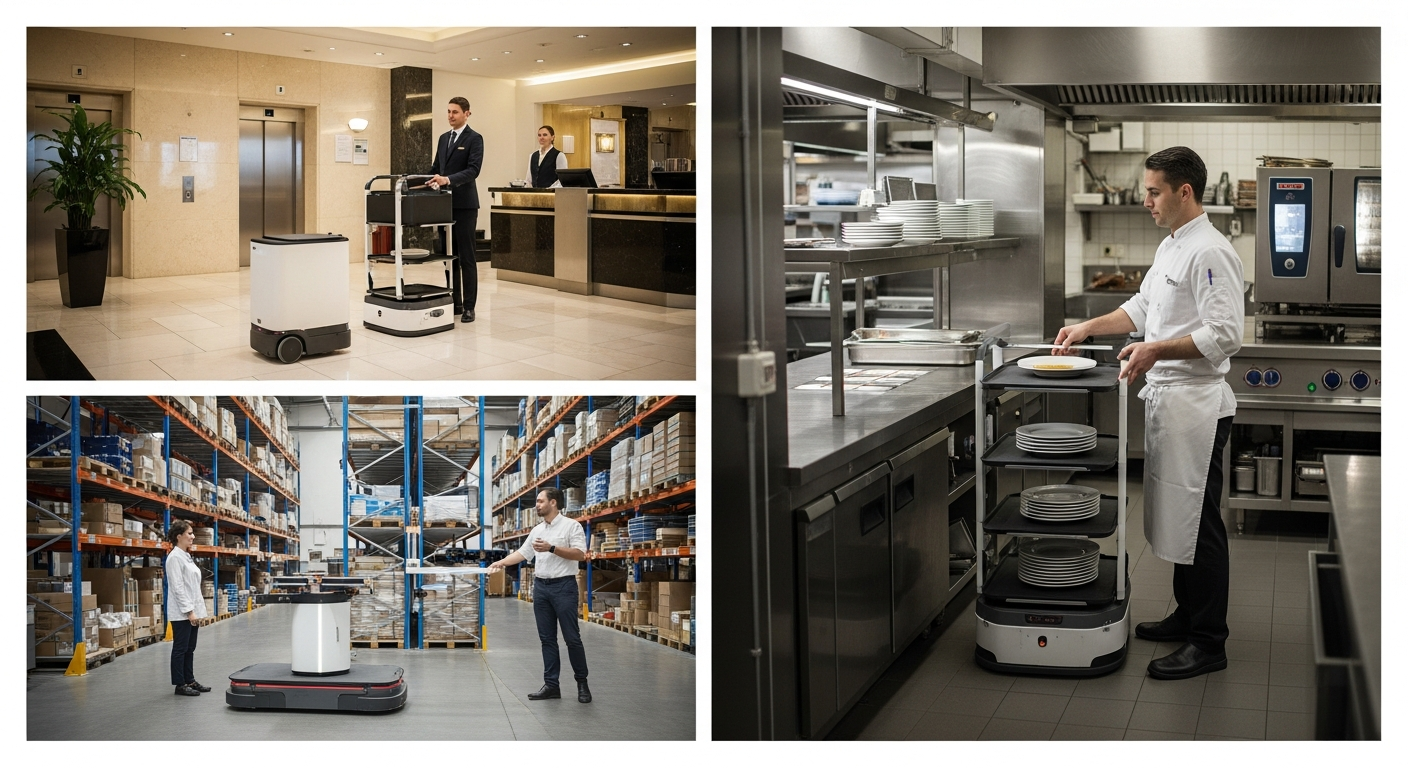
Station 3. 3:15 a.m. The night watch is solely responsible for 40 residents. While the nurse completes medical documentation, an autonomous transport robot delivers the clean laundry to the handover points for the early shift. There is no interruption for logistics operations. In this scene, robotics becomes visible not as a replacement for human attention, but as a level of operational relief. werob enables exactly this situation through rapid system integration, which goes from the first conversation to live operation within eight weeks. As a hardware-agnostic system integrator, werob ensures that the technology follows the workflow and not the other way around.
Key Takeaways
- 1The werob Spec Engine translates care workflows into a ready-to-use robot specification in just 48 hours.
- 2By automating medication rounds and transport, significant costs can be saved per location.
- 3werob is hardware-agnostic and selects the objectively best solution for your needs from over 44 OEM partners.
The crisis as a driver for surgical robotics in care
The shortage of skilled workers in long-term inpatient care is no longer a theoretical future scenario, but the daily reality of operators. When positions remain unfilled for months, the quality of care drops and the burden on remaining staff increases exponentially. werob starts here. We do not view robotics as an isolated gadget, but rather as an integral part of the business organization. The goal is to regain net nursing time by automating non-nursing activities.
Statistics show that nursing staff spend up to 30 percent of their working time on logistical tasks. This includes transporting meals, fetching medication from the pharmacy or distributing laundry. werob identifies these time wasters using the Spec Engine within 48 hours. By automating these processes, existing staff are massively relieved. A drug round supported by robotics results in significant annual cost relief per site. These figures are based on real operational data from over 200 robots that werob already supports operationally in 11 European countries.
Spec Engine: From workflow to solution in 48 hours
The biggest hurdle when introducing robotics in care is often the planning phase. Traditional consulting firms require three to six months for discovery decks and feasibility studies. werob shortens this process radically. Trained on data from over 35,000 projects, our Spec Engine translates the human description of a workflow into a precise technical specification. They describe the shift, the floor and the task to us. We deliver the appropriate robot specification within 48 hours.
This process takes into account not only the hardware requirements, but also the infrastructural conditions on site. Do elevators need to be controlled? How wide are the hallways? What floor coverings are available? The Spec Engine ensures that the chosen solution works from day one. Through this data-driven approach, we eliminate the risk of bad purchases and ensure that the robotic solution is tailored precisely to the needs of the nursing service manager and the residents. This leads to a clear roadmap and a binding offer within five days.
Hardware agnostics: Why a single manufacturer is not enough
werob is not a robot manufacturer and is not an exclusive reseller of a single OEM. This independence is our greatest advantage for the operator. The robotics market is fragmented and developing rapidly. A manufacturer that builds the best service robot for the catering industry today may not be the right partner for the specific requirements of a dementia ward. werob ranks over 44 OEM partners and more than 280 different robot models to meet your specific requirements.
Our catalog includes leading names such as Keenon, Pudu, Bear Robotics or, for specialized tasks, humanoid systems from partners such as Apptronik or Unitree. Using the supplier match process, we find the hardware that fits best in terms of technology and regulation. We prevent the so-called vendor lock-in. If your needs change or a better model comes onto the market, the werob platform enables a seamless change or expansion of the fleet without having to rebuild the entire infrastructure. This secures your investment in the long term.
Integration into the operator stack: PointClickCare and MatrixCare
A robot that acts as an isolated unit often creates more work than it saves. True efficiency comes from integration into the care facility's existing software landscape. werob offers prefabricated connectors for the most important systems on the market. These include PointClickCare and MatrixCare. Through these integrations, the robot knows, for example, exactly when a medication order was triggered and which room it needs to be delivered to.
This connectivity also extends to the building infrastructure. Our systems communicate directly with automatic doors and elevator controls. The robot moves autonomously over several floors without the intervention of an employee. This seamless integration into the facility's digital workflow is a core differentiator of werob. We do not deliver hardware islands, but rather an integrated operating level. The staff operates the robot using the usual interfaces, which increases acceptance and reduces training time to a minimum.
Cost relief and ROI: concrete figures for management
Investments in robotics must be economically justified. werob provides a transparent basis for this. In care, we see two primary levers for cost reduction. The automation of the medication round leads to significant annual relief for each location. The time saved by the specialist staff can be invested directly in patient care. The second area is logistics, where the transport of laundry, meals, or consumables saves additional sums per year and site. These savings are not theoretical projections but are based on real deployment data from werob projects at customers such as Korian Germany.
Regulatory information: EU Machinery Regulation 2023/1230 as a mandatory path
The legal framework for the use of robots in care is becoming more stringent. The new EU Machinery Regulation 2023/1230, which is binding from January 20, 2027, is particularly important. Many Asian OEMs currently do not have the necessary conformity assessments for the European market. werob acts as your compliance path here. We ensure that all of the systems we integrate meet the strict requirements of the regulation as well as specific standards such as ISO 13482 for personal care robots.
In addition, we take into account local requirements such as those of home supervision in Germany. A robot in the public space of a care facility must meet the highest safety standards in order not to endanger residents and visitors. werob takes care of all regulatory documentation and ensures that your company remains auditable at all times. This also includes data protection in accordance with GDPR, as robots are equipped with sensors and cameras. With werob, you outsource the regulatory risk to an expert who monitors the entire life cycle of the fleet.
The live cockpit: transparency and fleet management
As soon as the robots are in use, the werob cockpit takes over the monitoring. It is a central fleet management system that works with a four-dimensional traffic light system. We monitor hardware health, network infrastructure, regulatory compliance and performance against the original specification. If a deviation occurs, this is immediately visible in the cockpit and can often be remedied remotely.
For the nursing service management, the cockpit offers valuable insights into the actual use and the efficiency gains achieved. How many kilometers did the robot travel today? How many deliveries were successfully completed. This data enables complete source traceability and continuous improvement of processes. The cockpit is the operational level that ensures that the robotics solution does not become orphaned after the initial euphoria, but rather provides lasting added value. werob operates this system for all 200 robots in live operation and uses the knowledge gained to continually improve the algorithms.
For productive use in eight weeks
Time is the critical factor in solving the staff shortage. While other projects often take years, werob promises to have the robot in use within eight weeks. This tight schedule is only possible because we have standardized the entire process from specification to matching to integration. After the 48-hour spec phase and offer on day five, the rollout phase begins. We use our pre-built connectors to quickly integrate the hardware into your stack.
In the eighth week, the robot rolls onto your station. Our team accompanies the commissioning on site, trains the staff and ensures that acceptance is high. We know that robotics in care only works if employees perceive them as real help. That's why we attach great importance to intuitive operation and clear communication. The quick rollout allows you to immediately reduce costs and noticeably reduce the pressure on your team. Start now and let us analyze your workflow in 48 hours.
FAQ
- How quickly can a robot be ready for use in my care facility?
- At werob, it usually takes eight weeks from the first specification to the productive use of the robot on the station. The specification itself is available after just 48 hours.
- What costs arise before commissioning?
- werob is oriented towards operational success. Billing only occurs when the system is in productive use. There are no upfront costs for the planning phase.
- Are the robots safe for use in dementia wards?
- Yes, werob selects hardware that is ISO 13482 certified for use in human proximity. We also ensure compliance with the EU Machinery Regulation 2023/1230.
- Can the robot communicate with our care software?
- Yes, werob offers direct connectors for systems like PointClickCare and MatrixCare to ensure seamless integration into your existing workflows.
- What happens if a robot has a technical malfunction?
- All robots are monitored live via the werob cockpit. Our 4-dimensional traffic light system detects disruptions immediately, and many problems can be resolved remotely by our team.
- Do I have to make any structural changes to my facility?
- In most cases, no major structural measures are necessary. werob integrates digital interfaces for elevators and doors so that the robot can move autonomously.
Related reading
Shortage of staff in the catering industry: Robots as an operational solution
The shortage of staff in the catering industry endangers the operational viability of entire chains. As a system integrator, werob offers hardware-agnostic solutions that go live within eight weeks and massively reduce the workload on the workforce.
26 June 2026raas care robotRaaS care robots: Efficiency through system integration
Robotics as a Service (RaaS) transforms care from an investment-intensive hurdle into a scalable operating model. As a system integrator, werob provides the necessary infrastructure to productively integrate robots into everyday station life within eight weeks.
26 June 2026amortization robot carePayback of robots in care: ROI analysis for operators
The payback of robots in care does not depend on the hardware, but on the integration into the workflow. Find out how you can save up to 92,000 euros per year through automated medication rounds and transport routes.
21 June 2026care robot acceptanceCare robot deployments: why acceptance decides success
Discover why care robot deployments fail over staff acceptance rather than technical limits, and how operators can design successful robotic pilot projects.
27 August 2026Robot pilot project care inquiriesRequest robot pilot project care: Live operation in 8 weeks
A robot pilot project in care must not be an end in itself. Anyone who inquires today is looking for operational relief and legally secure processes. werob translates your requirements into a usable specification in 48 hours.
1 July 2026