NLP Robot Brief: Automate operational workflows in 48 hours
The manual creation of specifications for robotics projects often takes months. werob uses NLP-supported briefings to translate operational requirements into precise specifications in 48 hours and find the right robot from over 44 manufacturers.
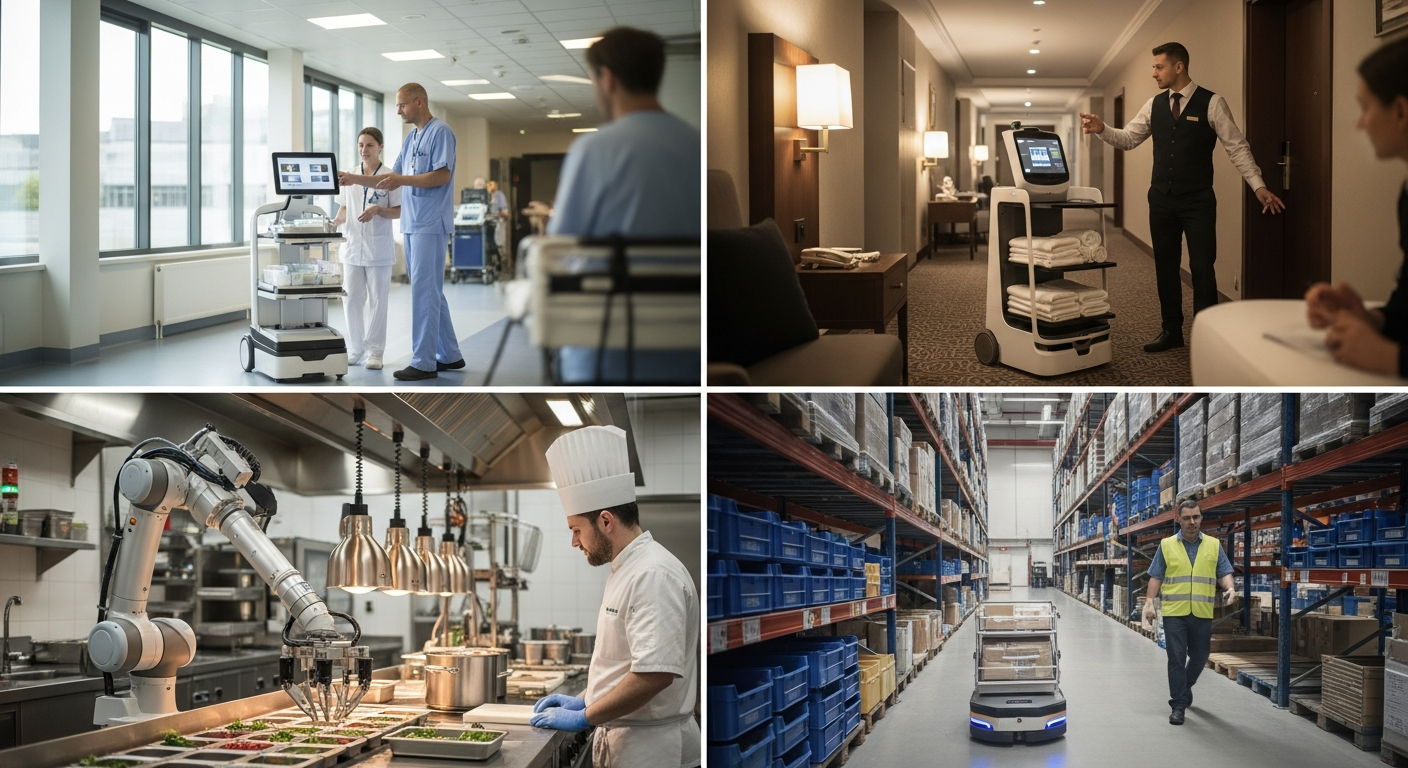
Station 2. 10:00 p.m. The night watch describes the upcoming round of medication and the necessary transport routes for the next eight hours. In the traditional world of automation, this report would now flow into a weeks-long consulting project to create a specification. At werob, this operational description forms the basis for the NLP robot letter. The Spec Engine analyzes the requirements, identifies obstacles and translates the workflow directly into a technical specification. A finished concept is available within 48 hours. No discovery deck, no lengthy workshops, just operational precision for immediate use.
Key Takeaways
- 1The werob Spec Engine translates operational descriptions into technical robot specifications in 48 hours.
- 2Hardware agnostics guarantees access to over 44 OEM partners and prevents vendor lock-in.
- 3Ready-made connectors enable integration into systems such as SAP EWM, Opera PMS and PointClickCare.
From spoken word to technical specification
The biggest hurdle in introducing robotics into companies is not the hardware, but the translation of operational reality into a technical language. An NLP robot brief uses natural language processing to bridge the gap between the shift manager on the floor and the engineer in the lab. Instead of querying technical parameters such as load capacity or navigation algorithms, the system concentrates on the task. Who does what, when and where. The werob Spec Engine was trained on over 35,000 projects in order to derive complex requirements from these simple descriptions.
This process eliminates the sources of error in classic specifications. Consultants often do not adequately understand the fine nuances of a nursing home or hotel business. An NLP-powered approach, on the other hand, captures the operational essence directly from the people who carry out the process on a daily basis. The result is a specification that is not only technically correct, but also ensures employee acceptance. If the robot does exactly what the workforce has defined as relief, the success rate of the implementation increases massively. werob guarantees this transition from description to finished specification within just 48 hours.
Why classic discovery phases in robotics fail
In traditional system integration, companies often spend three to six months in the so-called discovery phase. During this time, meetings are held, process diagrams are drawn and theoretical models are created. For operations, this means a massive loss of time and high opportunity costs. While the competition is already automating, your own company is waiting for the next strategy paper. An NLP robot letter breaks this pattern. It replaces lengthy consultation cycles with data-driven analysis in real time.
The costs of these delays can be measured in concrete terms. In a nursing home, a delayed implementation of the medication round corresponds to a lost cost relief of 92,000 euros per year. In the hotel industry, every month without room service robots costs around 9,300 euros in potential increases in efficiency. werob comes into play here and delivers a binding offer based on the NLP briefing within five days. The goal is not to document problems, but to provide a solution in eight weeks. This speed advantage is the key factor for ROI in highly competitive markets.
Hardware agnostics through Supplier Match
An essential part of the NLP Robot Brief is the independence from individual manufacturers. werob is not an OEM reseller, but a system integrator. This means that the specification is tested against a catalog of over 44 OEM partners and 280 different robot models. Whether a humanoid robot from Apptronik, a service robot from Keenon or a logistics system from ANYbotics is the best choice depends solely on compliance with the specification. This supplier match process ensures that customers do not get into a vendor lock-in.
The Spec Engine evaluates the hardware according to objective criteria derived from the NLP briefing. If the requirement requires HACCP conformity for the food sector, all models without the relevant certification are automatically rejected. If the floor conditions or door widths in the hotel pose specific requirements, the system filters out the appropriate solutions. This hardware-agnostic approach guarantees that the most technologically and economically sensible solution is always used. This gives customers access to the world's best innovations without having to become experts in robotics hardware themselves.
Integration into the existing software stack
A robot that works in isolation is only worth half as much as an integrated system. The NLP Robot Brief therefore takes the existing IT infrastructure into account right from the start. werob offers prefabricated connectors for the most important industry solutions. These include PointClickCare and MatrixCare for care, Opera PMS and Mews for the hotel industry, and SAP EWM for logistics. These integrations ensure that the robot receives its commands directly from the existing system and reports its status in real time.
In a restaurant, for example, this means that the robot is informed via Toast or Lightspeed when an order is ready for delivery. In logistics, the system communicates directly with SAP EWM to accept transport orders without manual intervention. This seamless connection is the key to scaling. An NLP briefing that ignores the existing interfaces leads to isolated solutions that cause more work than they save in everyday operations. werob ensures that the robot fleet becomes an integral part of the digital value chain.
Regulatory safety and EU Machinery Regulation 2023/1230
The regulatory landscape for robotics in Europe is changing drastically. The EU Machinery Regulation 2023/1230, which is binding from January 20, 2027, is particularly important. Many Asian manufacturers do not have the necessary conformity assessments for the European market. werob acts as a compliance path here. Every specification resulting from an NLP robot letter is automatically checked against the applicable standards such as ISO 13482 for personal assistance robots.
This means legal certainty for operators. Using robots without complying with the Machinery Ordinance can lead to high fines and liability risks. werob assumes responsibility for compliance with these standards. The cockpit continuously monitors the regulatory status of the fleet in live operation. If regulations change or certificates expire, this is immediately signaled via the four-dimensional traffic light system. This regulatory depth is a unique selling point that goes far beyond the mere purchase of hardware and enables long-term operation in regulated environments such as care or security.
Economic efficiency: concrete cost relief instead of adjectives
The success of a robotics project is ultimately measured by the cost reduction per location and year. werob works with verified numbers that come directly from the live operation of over 200 robots. In nursing, the automation of the medication round leads to an annual relief of 92,000 euros. Transporting laundry or waste saves another 71,000 euros. In the hotel industry, the potential for room service is 112,000 euros, while the preparation of bar and breakfast costs 54,000 euros.
These figures are not estimates, but rather the results of a precise workflow analysis by the NLP robot Brief. werob's commercial model is consistently geared towards these results. Under the outcome-only principle, customers only pay when the robot actually runs on the surface and delivers the promised performance. There are no hidden list prices or upfront planning fees. This focus on actual benefits fundamentally distinguishes werob from classic consultants or hardware sellers. The goal is a measurable increase in the operating margin from the first day of live operation.
The 8-week path to live operations
Speed is a core promise of werob. The process from the first NLP robot letter to productive use usually only takes eight weeks. This tight schedule is only possible because werob controls the entire integration value chain. After 48 hours of creating the specification, a binding offer will follow within five days. Once the decision has been made, the physical implementation and software integration phase begins.
During these eight weeks, the connectors to the operator stack are activated and the hardware is preconfigured. Since we already provide operational support for over 200 robots in 11 European countries, the processes are well-established. There are no surprises in terms of infrastructure or regulations, as these have already been queried and assessed in the NLP briefing. This standardized onboarding process minimizes the risk for the operator and ensures a quick return on investment. werob is the partner that brings robotics from theory into practice while others are still working on the strategy.
Live fleet management in the werob cockpit
As soon as the robots are in use, the werob cockpit takes over the monitoring. This is the fourth level of the platform and serves as the central control element for the operator. The cockpit uses a four-dimensional traffic light system to display the status of the fleet in real time. Hardware condition, infrastructure stability, regulatory compliance and adherence to the original specification are monitored. If a robot deviates from its planned workflow, this is detected immediately.
This live management is crucial for lasting success. An NLP robot letter defines the target state, the cockpit guarantees the current state. Operators have full insight into the performance of their fleet at all times, regardless of whether they operate one robot at one location or hundreds of robots in eleven countries. The data from the cockpit flows back into the Spec Engine to make future briefings even more precise. This creates a learning system that continuously increases the efficiency of robotics deployments and ensures operational excellence.
Future security through humanoid robotics
The NLP Robot Brief is already prepared for the next generation of automation: humanoid robots. werob has already successfully completed the first pilot project with a humanoid robot in a Hamburg care facility into its twelfth week of operation. These systems offer a whole new level of flexibility because they are designed for environments built for people. The Spec Engine can process requirements for humanoid systems just as precisely as for specialized service robots.
Through partnerships with leading developers such as Boston Dynamics, Apptronik or Figure AI, werob ensures that customers always have access to the most modern technology. An NLP-supported briefing makes it possible to define complex movement sequences and interactions that were previously impossible to automate. Whether it is about supporting the mobilization of residents in care or complex logistics tasks, the integration takes place via the same proven platform. werob is paving the way for this new era of robotics in Europe and offers companies the necessary structure to use these innovations safely and profitably.
FAQ
- What is the advantage of an NLP robot letter compared to a specification sheet?
- An NLP robot letter saves months of time because it translates operational requirements directly into technical parameters. It is based on real workflows instead of theoretical assumptions and is created in just 48 hours.
- What cost savings are realistic in care?
- In care, werob enables verified cost relief of 92,000 euros per year for the medication round and 71,000 euros for transport tasks per location.
- Does werob support integration into SAP EWM?
- Yes, werob offers direct connectors for SAP EWM as well as other systems such as Opera PMS, Mews, Toast and MatrixCare to ensure seamless process automation.
- How is werob dealing with the new EU machinery regulation?
- werob offers an integrated compliance path for the EU Machinery Regulation 2023/1230, which is binding from January 2027. We carry out the necessary conformity assessments for our OEM partners.
- Do I have to buy the robots or is there a rental model?
- werob works according to an outcome-only model. This means that commercial billing only starts once the system is live and successfully in operation. Details are created individually based on the spec.
- In which countries does werob operate?
- As of May 2026, werob operates over 200 robots in 11 European countries, including Germany, Austria, Switzerland, France, Italy, Spain, Netherlands, Denmark, Sweden, Poland and Great Britain.
Related reading
Robot letter on specification: In 48 hours to the deployment plan
The gap between a vague idea and a deployment-ready robot is often months long. werob closes this gap in 48 hours through an automated Spec Engine.
28 June 2026robot brief to spec aiRobot Brief to Spec AI: Accelerating Robotics Deployment
Traditional robotics procurement takes months of discovery and consulting. werob uses an AI-driven Spec Engine to translate operational workflows into technical specifications in 48 hours, moving from brief to live operation in eight weeks.
4 July 2026robots instead of employeesRobots instead of employees: operational efficiency through integration
The use of robotics is not a question of hardware, but rather of seamless integration into existing workflows. werob translates operational requirements into usable specifications in 48 hours and realizes measurable cost reductions without upfront investment.
2 July 2026robot tender softwareRobot tender software: Efficiency in 48 hours
Conventional tendering processes for robotics often take months and result in rigid manufacturer lock-ins. werob optimizes classic advice with a software-supported spec engine that translates workflows into precise requirements in 48 hours.
27 June 2026robot specification toolRobot specification tool: Go live in 48 hours
A professional robot specification tool shortens the planning phase from months to hours. werob uses an AI-powered engine to translate workflows directly into technical requirements and rank 44+ OEMs.
2 July 2026