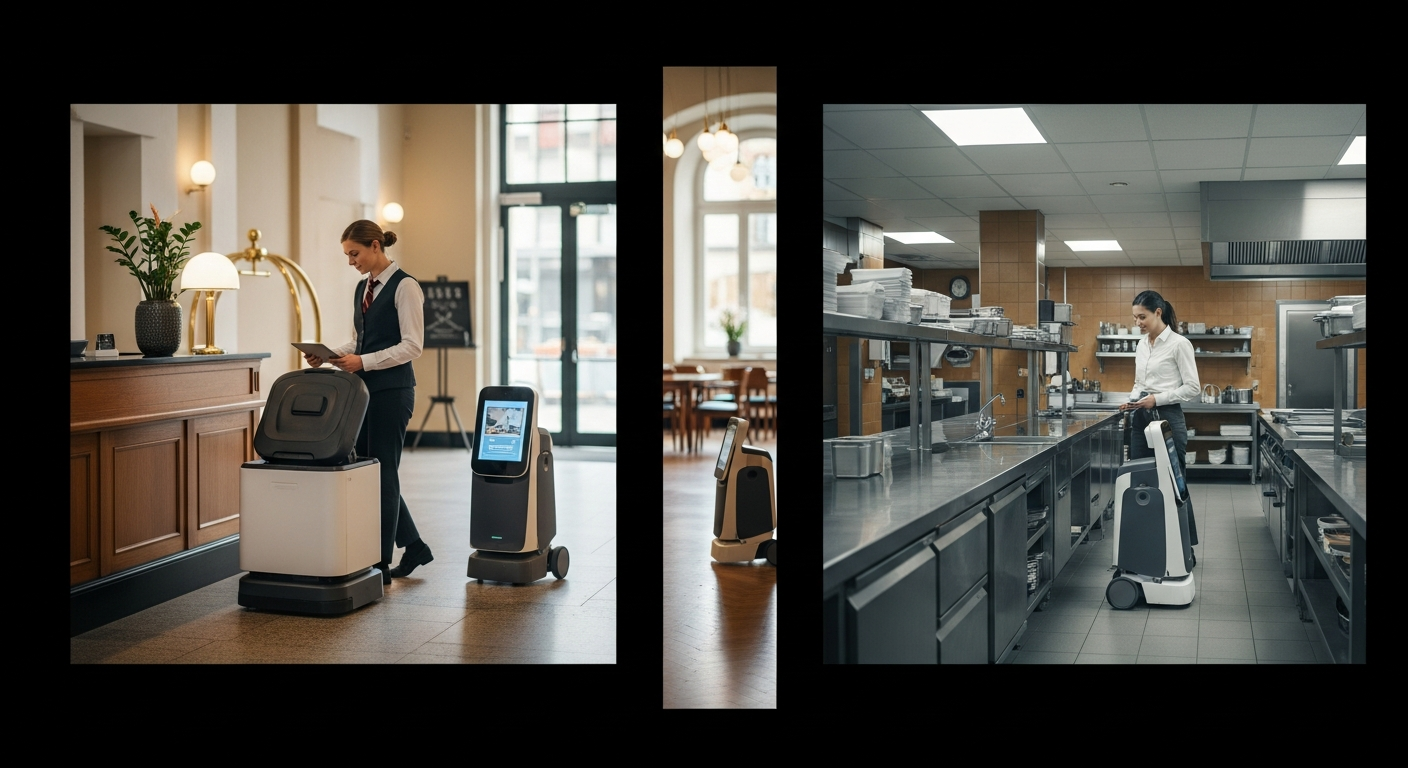
Mews Robot PMS Integration: Automation for the hotel industry
The direct integration of Mews PMS and robotics enables hotels to achieve significant cost relief and operational excellence. werob delivers the finished connectors for a quick rollout within eight weeks.
Floor 4. 11:15 p.m. A guest orders an additional set of towels through the Mews Guest Journey Portal. The system registers the request, validates the room status and assigns the order to an autonomous service robot while the staff concentrates on guest service. The robot leaves its charging station, navigates to the elevator, communicates with the floor control and delivers the goods precisely to the room door. This scene is not a pilot project, but rather an operational standard in hotels that use werob as a system integrator. While conventional approaches often fail due to the lack of communication between the software stack and hardware, werob translates these workflows into a usable specification.
Key Takeaways
- 1Significant annual cost reductions in room service can be achieved through the Mews integration.
- 2werob delivers a ready-to-use specification within 48 hours and brings robots into live operation in eight weeks.
- 3The hardware-agnostic platform provides access to 44+ OEMs and ensures compliance with EU Machinery Regulation 2023/1230.
Werob as a system integrator for Mews environments
werob is not a robot manufacturer or a classic consulting company. As a system integrator, werob occupies the interface between hotel operations and the robotics hardware. In the hotel industry, the property management system (PMS) is the central component of all processes. When this core element does not communicate with the physical automation, isolated solutions emerge that cause more work than they save. werob solves this problem with a hardware-agnostic platform, which currently includes over 44 OEM partners and 280 different robot models.
The decisive advantage for hotel operators lies in speed and precision. While classic discovery phases in the industry often last three to six months, werob uses a spec engine that has been trained on over 35,000 projects. Within 48 hours, a verbal description of the workflow becomes a technical specification. This speed is necessary to effectively address the shortage of skilled workers in the hotel industry. werob acts as the operating level that ensures that the selected hardware exactly matches the requirements of the Mews PMS.
A key aspect of werob positioning is independence. Since werob is not tied to a single manufacturer, the robots are ranked purely based on performance data and compatibility with the Mews stack. This prevents vendor lock-in and ensures that the hotel always receives the most efficient solution for the respective use case, be it in room service, cleaning or the breakfast area.
The werob connector for Mews PMS
The technical integration of robots into an existing hotel ecosystem often fails due to the complexity of the interfaces. werob offers ready-made connectors that enable direct communication with Mews. These connectors are not individual tinkering solutions, but rather standardized software components that ensure data exchange in real time. When a guest makes a request in the Mews system or an employee changes a status, this trigger is immediately translated into a robot order.
This integration covers various dimensions of hotel operations. In room service, this means that the robot knows which rooms are occupied and what priority a delivery has. In cleaning, the system can send cleaning robots specifically to the free floors based on the check-out status in Mews. The werob Connector acts as a translator between the Mews cloud structure and the local navigation of the robot hardware. This reduces the error rate when transmitting orders to a minimum.
Another advantage of werob connectors is scalability. Hotel chains that use Mews at multiple locations can roll out the logic, once defined, to all locations via the werob Cockpit. The integration is designed to support future updates to Mews or new robot models. This means the investment remains future-proof, as the entire software infrastructure does not have to be rebuilt every time the hardware is changed.
Economic advantages and cost relief
Automation in the hotel industry must be measured by hard numbers. werob provides validated data from the live operation of over 200 robots in eleven European countries. For a standard hotel, the use of an integrated robot solution in room service results in significant annual cost reductions per location. This sum results from taking on repetitive errands that previously tied up expensive specialist staff, especially at night or at peak times.
Another area with high savings potential is the preparation of the bar and breakfast. Here, automation enables significant annual relief. Through integration with Mews, these tasks can be precisely planned, so that staff can concentrate on direct guest contact. In the F&B department, the use of tray robots in the dishwashing chamber leads to further significant relief, while automated kitchen floor cleaning accounts for a significant amount per year.
These figures are not theoretical estimates, but operational reality for customers such as large hotel resorts. werob's commercial model is consistently geared towards the success of the customer: outcome-only. This means that hotel operators only pay when the robot is actually in use and completes the defined tasks. This eliminates the financial risk of bad purchases or lengthy implementation phases without any benefit.
Hardware agnostics and OEM ranking
The robotics market is confusing and growing rapidly. It is challenging for a hotel operator to keep track of the performance of manufacturers such as Keenon, Pudu, Bear Robotics or specialized humanoid developers such as Apptronik. werob solves this problem with Supplier Match. Over 44 OEM partners are ranked against the specification created in 48 hours. Not only technical data such as load capacity or battery life are taken into account, but also the real performance in similar hotel environments.
Werob's hardware agnostics ensures that the optimal machine is selected for each application. A robot that is ideal for transporting heavy laundry carts in service hallways may not necessarily be the best choice for discreet room service in guest areas. With access to a catalog of 280 shunting-capable robots, werob can put together a fleet that is perfectly coordinated and controlled centrally via the cockpit.
This approach also protects hotel operators from technological obsolescence. Should a manufacturer discontinue support or a new, more efficient model comes onto the market, the werob platform allows for easy hardware replacement while the process logic and Mews integration remain in place. werob takes over all communication with the OEMs and ensures that the devices meet European standards.
Regulatory security and EU compliance
An often underestimated aspect when introducing robotics is the regulatory framework. From January 20, 2027, the new EU Machinery Regulation 2023/1230 will be binding. This regulation places high demands on conformity assessment, especially for robots that work in direct contact with people, as is the case in hotels. werob offers the necessary compliance path here. As a system integrator werob ensures that all systems used meet the strict security requirements.
In addition to the machine regulations, ISO 13482 for personal assistance robots and the GDPR also play a central role in the hotel industry. Robots are equipped with numerous sensors and cameras in order to be able to navigate safely. werob configures the systems so that guest data protection is maintained at all times and no sensitive data is stored or transmitted without authorization. This is particularly important for the acceptance of the technology by guests and employees.
For hotels that use robots in the F&B area, HACCP standards are also added. werob specifically selects hardware that is certified for contact with food and can be easily cleaned. By assuming regulatory responsibility, werob relieves the burden on the hotel operators' legal and compliance departments and ensures legally compliant operation of the entire fleet.
From specification to live operation in eight weeks
Time is a critical factor in the hotel industry. werob radically accelerated the implementation process. The path begins with an 8-step onboarding intake in which the hotel operator describes their requirements, shift schedules and infrastructure. The Spec Engine delivers a detailed specification within 48 hours. Just five days later, a concrete offer is available that is based on the outcome-only model.
The actual implementation up to the first robot in live use usually only takes eight weeks. During this time, werob prepares the connectors for the Mews PMS, configures the hardware and carries out the necessary tests on site. This also includes integration into the building infrastructure, such as the control of elevators and automatic doors. werob uses proven interfaces for this, which enable the robots to change floors smoothly.
After the go-live, the werob cockpit takes over the monitoring. Hotel managers can see in real time how many tasks have been completed, what the fleet charging status is and whether there are any operational bottlenecks anywhere. This live fleet management is crucial for continuously improving operations. werob remains the partner for the operation even after installation and ensures that the systems always remain up to date with the latest technology and regulations.
The advertising cockpit for hotel fleet management
The werob Cockpit is the central control unit for hotel operations. It provides a four-dimensional traffic light system that monitors the status of hardware, infrastructure, regulatory and specification. For a hotel manager, this means maximum transparency without technical overhead. If a robot cannot complete its task due to a blocked lane or a technical defect, the cockpit reports this immediately before the guest notices a delay.
The data from the cockpit flows directly into the analysis of operational efficiency. It is possible to understand exactly which shifts benefit most from automation and where additional robots may be needed. This data-driven decision-making is a significant advantage over manual processes, where actual staff utilization is often difficult to measure. The cockpit also makes it possible to directly compare the performance of the various OEM partners, with every action remaining traceable down to the protocol level thanks to complete source traceability.
Another important aspect of the cockpit is remote maintenance and update management. Software optimizations for Mews integration or security patches are installed centrally without a technician having to be on site. This minimizes downtime and ensures that the robot fleet always operates at maximum efficiency. werob's goal is to control over 2,000 robots via this platform by 2028, which underlines the scalability and robustness of the system.
Comparison: Manual processes vs. Mews robot integration
To illustrate the added value of an integrated solution, it is worth making a direct comparison of the workflows. In a traditional hotel operation without robotics integration, many steps are error-prone and tie up valuable human resources. The following table shows the differences in operational processing.
| Feature | Manual process | werob + Mews Integration |
|---|---|---|
| Order placement | By telephone or by note | Automatically via Mews API |
| Staff retention | Employee leaves post to run errands | Staff remains available for guest service |
| Night shift | Limited service or high costs | Full service 24/7 |
| Documentation | Often incomplete or manual | Seamless digital logbook in the cockpit |
| Reaction time | Depending on workload | Immediate execution after system trigger |
This comparison makes it clear that integration goes far beyond simply replacing a human activity. It is a process optimization that increases data quality and stabilizes the quality of service for the guest. While an employee can be distracted by unforeseen events, the integrated robot works through its task list precisely and comprehensibly. This leads to higher guest satisfaction as waiting times are minimized.
Outcome-only commerce: security for hotel operators
Werob's commercial model is fundamentally different from classic investment models. Instead of charging large sums of money upfront for hardware and advice, werob relies on a purely results-oriented model. Hotel operators only pay when the robot solution is operational and delivers the promised benefits. This is a strong promise that can only be made by a system integrator who is confident in the quality of its specifications and connectors.
This model includes not only the provision of the hardware, but the entire life cycle of the solution. Maintenance, software updates, compliance checks and continuous optimization via the cockpit are part of the package. For the hotel, this means calculable costs that are directly offset by the savings achieved. If a robot in room service saves significant costs per year, the investment is profitable from the start.
werob assumes the entire risk of technology selection and integration. If a component does not function as expected, it is werob's responsibility to resolve this within the framework of the outcome-only model. This approach creates a true partnership between the integrator and the hotel operation as both share the same goal: a smoothly functioning, automated environment that addresses skills shortages and increases operating margins.
FAQ
- Is werob a manufacturer of hotel robots?
- No, werob is a system integrator. The company does not produce its own hardware, but rather integrates the best robots from over 44 OEM partners into hotel operators' existing software stack, such as Mews PMS.
- What are the advantages of integration into the Mews PMS?
- The integration enables an automated workflow. Guest service requests are transferred directly from the PMS to the robot fleet, while employees are freed up for more valuable tasks. This saves time, reduces errors and reduces the workload on staff.
- What does werob’s outcome-only model mean?
- Outcome-only means that hotel operators do not have to make any upfront investments in hardware or consulting. Costs are only incurred when the robot solution runs successfully in live operation and fulfills the defined tasks.
- How safe are robots in public hotel areas?
- Safety is the top priority. werob ensures that all robots used meet ISO 13482 and are prepared for the upcoming EU Machinery Regulation 2023/1230. In addition, modern sensors ensure safe navigation around guests and obstacles.
- Can the robots drive elevators independently?
- Yes, werob integrates the robot fleet into the building infrastructure. The robots communicate with the elevator control via special interfaces in order to move between floors independently.
- How long does it take for a robot to be ready for use in a hotel?
- At werob, it usually takes eight weeks from the first specification to live operation. The technical specification is available after just 48 hours and a binding offer after five days.
Related reading
Robot Integration PMS Hotel: Efficiency through automation
The manual coordination of room service and cleaning ties up valuable human resources in the hotel industry. werob integrates robots directly into your property management system for automated processes without media breaks.
29 June 2026hotel coo automationHotel COO Automation: Strategies for Operational Excellence
Automation in the hotel industry is no longer an option, but an operational necessity to secure margins. Learn how COOs achieve annual savings of over 112,000 euros per location through precise specifications and seamless system integration.
24 June 2026bear servi hotel industry GermanyBear Servi in the German hotel industry: Integration and ROI
The use of Bear Servi in the German hotel industry requires seamless integration into existing systems such as Opera PMS or Mews. werob translates your operational processes into a usable specification in 48 hours and ensures operations.
6 July 2026opera pms robot integration apiOpera PMS Robot Integration API: Automating Hotel Operations
Integrating your robotics fleet with the Opera PMS API is the difference between a standalone gadget and a functional operational system. This guide explains how werob connects 44+ OEMs to your existing hotel stack in eight weeks.
4 July 2026hotel cost reduction roboticsHotel Cost Reduction Robotics: Operationalizing ROI in 8 Weeks
Move from discovery decks to live operations. werob delivers a deployable robot specification in 48 hours and a live fleet in eight weeks, offsetting up to €112,000 in annual room service costs.
2 July 2026