Humanoid Robot Price 2026: Costs and ROI for Operators
The price of humanoid robots in 2026 will no longer be defined by hardware list prices, but by the depth of integration and regulatory compliance. Find out how werob paves the way from specification to productive use in eight weeks.
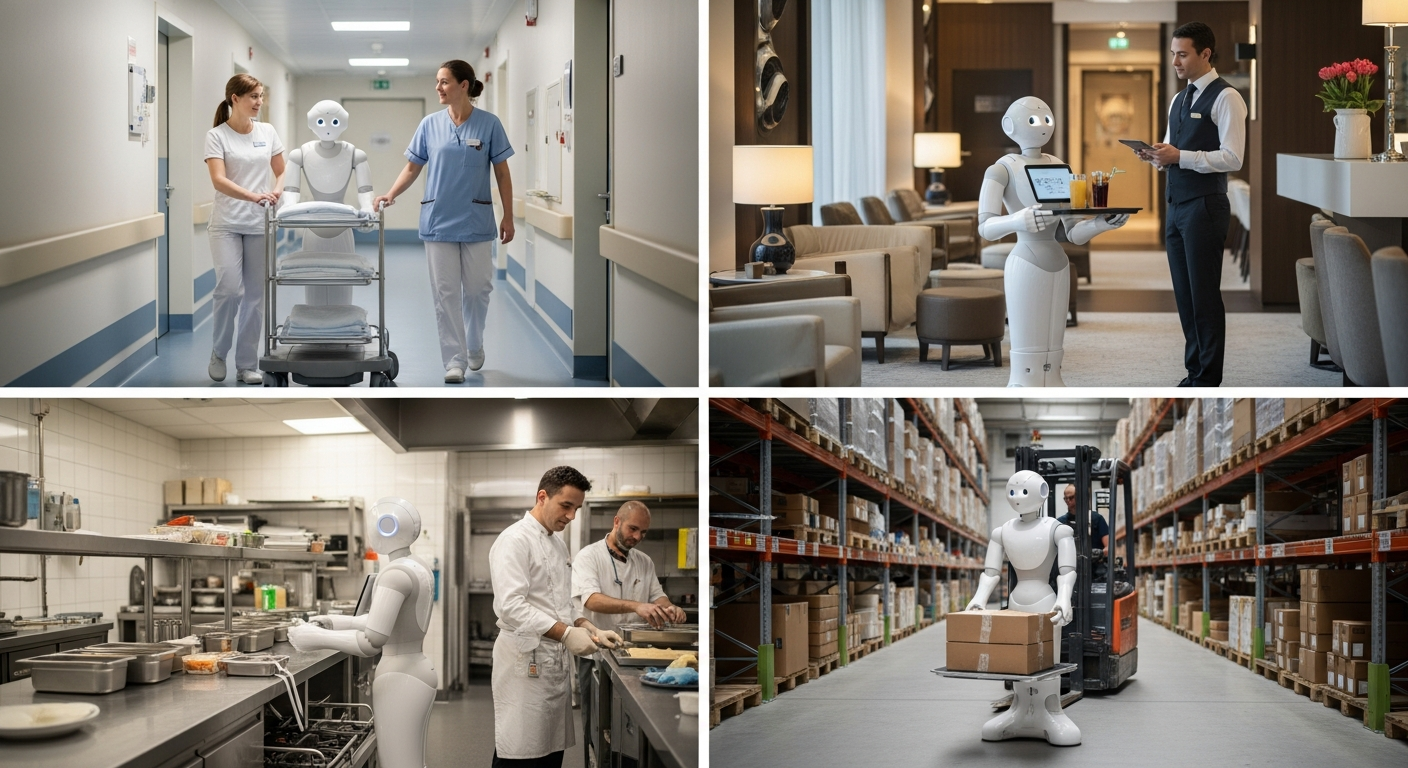
Hamburg, senior residence. 3:15 a.m. Night watch on station 4. A humanoid robot of the latest generation completes the patrol, detects an obstacle in the hallway and reports the situation to the central cockpit. It is the twelfth week of live operation. What was once considered a futuristic experiment will be an operational reality in May 2026. The question of the price of a humanoid robot has changed fundamentally. It is no longer about the purchase price of a single machine, but about the costs per hour of work relieved and the seamless integration into existing software stacks such as PointClickCare or SAP EWM. werob as a system integrator translates these operational requirements into functioning fleets.
Key Takeaways
- 1The price of humanoid robots in 2026 will be determined primarily by integration and compliance costs, not pure hardware list prices.
- 2The EU Machinery Regulation 2023/1230 will be mandatory from January 2027 and must already be taken into account in every procurement today.
- 3Through werob, operators can achieve annual cost savings of up to 112,000 euros per location through optimized robot workflows.
The pricing structure 2026: Hardware versus integration
In 2026, the market for humanoid robots has consolidated. While manufacturers such as Apptronik, Figure AI or Unitree have been able to reduce hardware costs through mass production, the largest cost item for operators remains system integration. A humanoid robot without a connection to the in-house ERP system or without conformity to the EU Machinery Regulation 2023/1230 is worthless for a company. The pure hardware price is therefore a misleading figure. The decisive factor is the total cost of ownership (TCO), which includes maintenance, software updates and regulatory protection.
werob acts in a hardware-agnostic manner. We don't sell off-the-shelf robots, but we use over 44 OEM partners to meet your specific requirements. What this means for you is that you are not tied to one manufacturer. If a Boston Dynamics model is better suited to a task than a Neura Robotics model, this will be reflected in our Supplier Match. The goal is always to achieve maximum cost reduction per location. In nursing, for example, we see an annual reduction of 92,000 euros in medication alone. This number is only achievable if the robot is deeply integrated into systems like MatrixCare.
Another factor in pricing is scalability. A single pilot robot causes high fixed costs. werob therefore relies on fleet solutions that are controlled via the live cockpit. Here, hardware, infrastructure and regulations are monitored in a four-dimensional traffic light system. This reduces operational risks and ensures that the robot is not just a technical toy in the lobby, but rather makes a measurable contribution to value creation.
The Spec Engine: A ready-to-use specification in 48 hours
Traditional consulting projects for the introduction of robotics often last three to six months. During this time, Discovery decks are created that are theoretically sound but rarely stand up to the rigors of everyday life. werob breaks down this process. With our Spec Engine, we translate your workflow into a technical specification within 48 hours. This engine has been trained on over 35,000 projects and immediately recognizes which hardware parameters are necessary for your floor, your shift times and your specific tasks.
This speed advantage has a direct impact on the price and ROI. The faster the specification is finalized, the sooner the supplier match can take place. We compare 280 different robot models against your requirements. It's not just about physical power or battery life, but above all about software compatibility. A robot that cannot communicate with your hotel Opera PMS or Mews system causes manual rework that negates ROI. In the hotel sector, our customers save 112,000 euros per year through room service robots.
The Spec Engine also takes into account the structural conditions on site. Does the robot have to use elevators? Are the floor coverings suitable for humanoid gait patterns? These questions are clarified in the first phase, so that there are no unpleasant surprises during delivery after eight weeks. werob guarantees that the selected hardware fits the defined workflow exactly, which prevents bad purchases and expensive retrofits.
EU Machinery Regulation 2023/1230: The mandatory regulatory path
An often overlooked cost factor when purchasing humanoid robots is legal compliance. From January 20, 2027, the new EU Machinery Regulation 2023/1230 will be binding. Many Asian OEMs currently do not have the necessary conformity assessments for the European market. Anyone who buys a robot today without this compliance path risks being banned from operating from 2027. werob acts as your protective shield here. We ensure that all of the systems we integrate meet the strict requirements.
This includes not only physical security according to ISO 13482 for personal assistance robots, but also cybersecurity according to IEC 62443. A humanoid robot is a networked device with cameras and sensors. Without a clean integration into your IT infrastructure and compliance with the GDPR, use quickly becomes a liability risk. werob integrates these regulatory requirements directly into the cockpit. You can see the compliance status for your entire fleet at any time.
This point is particularly critical in sensitive areas such as nursing or security services. In nursing care, the home supervisor must approve the use. werob provides the necessary documentation and technical evidence to accelerate this process. In the security area, for example in retail patrol, compliance with the BewachVO ensures legal certainty. This regulatory preparatory work is included in our service and protects you from unforeseeable follow-up costs such as fines or shutdowns.
Economic efficiency analysis: Verified cost reductions per industry
To evaluate the price of a humanoid robot in 2026, one must compare the savings. werob works with real data from over 200 live systems in eleven European countries. The following numbers represent the annual cost relief per location achieved through the use of optimized robotics workflows. These values are not estimates, but are based on operational results from customers such as Korian Germany.
| Industry / use case | Annual cost relief per location |
|---|---|
| Care: medication round | 92,000 € |
| Care: transport tasks | 71,000 € |
| Hotel: Room Service | 112,000 € |
| Hotel: Bar/Breakfast Preparation | 54,000 € |
| F&B: Rinse Chamber Tray Bot | 76,000 € |
| Logistics: Court Patrol | 68,000 € |
| Security: Retail Patrol | 58,000 € |
| Golf: Ball Collection | 38,000 € |
These reliefs clearly show that the investment in humanoid systems often pays off in the first year amortized. Especially in the area of senior living, the relief of specialist staff from logistical tasks means that there is more time for the actual care. This not only improves cost-effectiveness, but also the quality of care. werob ensures that this potential is fully exploited through the right choice of hardware and perfect integration into the software stack, such as PointClickCare.
Supplier Match: 44+ OEMs in direct comparison
The market for humanoid robots is confusing. New start-ups announce groundbreaking innovations almost every week. It is impossible for an operator to keep track of the actual performance and deliverability of these systems. werob maintains a catalog of over 44 OEM partners and has access to 280 different robot models. Our Supplier Match process filters these options based on your individual specification.
We evaluate the hardware according to criteria such as reliability, ease of maintenance and openness of the interfaces. A robot from Figure AI may be impressive in theory, but if the supply of spare parts in Europe is not assured, it will be downgraded in our ranking for a German nursing home operator. We prioritize partners who have already proven that their machines can withstand 24/7 operation. These include established names such as Boston Dynamics as well as specialized providers such as Keenon or Pudu for the service area.
This hardware-agnostic approach allows you to avoid vendor lock-in. If a manufacturer changes its strategy or drastically increases prices, we can switch to a different model relatively easily thanks to our connector architecture. The cockpit remains the same for you, no matter what hardware is running underneath. This flexibility is a decisive advantage in a rapidly developing market and secures your investment in the long term.
Connectors: Seamless integration into your software stack
A humanoid robot working in isolation is only half as efficient. The real value comes from networking. werob offers prefabricated connectors for the most important industry systems. Whether PointClickCare and MatrixCare in nursing, Opera PMS and Mews in the hotel industry or SAP EWM in logistics - our robots speak the language of your existing software. This eliminates manual data entry and ensures a smooth flow of information.
When a guest orders an additional pillow in the hotel via the PMS, this order is transmitted directly to the robot. The Spec Engine previously defined how the robot calls the elevator and navigates in front of the room door. After completing the task, feedback is sent to the system. This closed circuit is the prerequisite for the above-mentioned cost reductions of 112,000 euros in hotel room service. Without this integration, an employee would have to manually load and control the robot, which would negate the efficiency advantage.
Our connectors are not individual tinkering solutions, but rather standardized interfaces that we continually maintain and update. For you, this means high reliability and short implementation times. While other companies need months for the API connection, we activate the connection to systems like Toast or Lightspeed in the F&B sector within a few days. This is a core part of our promise: Have a productive robot in use in eight weeks.
The live cockpit: fleet management with foresight
As soon as the robots are in use, the werob Cockpit takes over the monitoring. It is the central nerve center for your entire fleet, no matter how many locations it is spread across. The cockpit uses a four-dimensional traffic light system to visualize the status of each individual robot. The first dimension concerns the hardware: What is the battery level? Are there any mechanical abnormalities? The second dimension monitors the infrastructure: Is the WLAN stable? Do the elevator controls work?
The third dimension is regulation: Are all safety certificates up to date? Does the company comply with the requirements of the EU Machinery Regulation? The fourth dimension compares operation with the original specification: Does the robot complete the planned tasks in the allotted time? This detailed monitoring allows us to identify problems before they lead to an outage. If a traffic light turns yellow, our support can intervene proactively.
For you as an operator, the cockpit means full transparency about the ROI. You can see exactly how many hours the robot was productive and what tasks it completed. This data is the basis for the continuous optimization of your processes. The cockpit is also the interface for software updates, which are imported centrally via the cloud. This means your robot fleet always remains state-of-the-art without a technician having to be on site.
Outcome-only: The commercial model of the future
werob pursues a radically customer-oriented commercial model: outcome-only. We believe operators should not pay for promises, but for results. This means that you pay nothing until the robot is actually running in your company and fulfilling the defined tasks. This model fundamentally distinguishes us from classic consultants or hardware resellers, who often require high upfront payments.
By foregoing rigid list prices and focusing on the actual benefits, we bear a large part of the project risk. We only earn money if the integration is successful and the robot delivers measurable added value. This motivates us to make the process from spec engine to live operation as efficient as possible. Our goal is to have over 2,000 robots in use in Europe by 2028. We only achieve this growth through satisfied customers who see a clear ROI.
This model also enables small and medium-sized companies to enter the world of humanoid robotics without having to overcome high CAPEX hurdles. The costs become operational expenses (OPEX), which correlate directly with the service provided. In combination with the verified cost reductions, such as the 76,000 euros in the F&B area through tablet bots, robotics becomes a calculable and highly attractive investment for every business manager.
Become a robot in eight weeks: The implementation path
The path to own robot fleet is clearly structured at werob and optimized for speed. It all starts with a 48-hour workflow check. You describe your shifts, your rooms and your challenges to us. Our spec engine creates the technical requirements from this. Within five days you will receive a concrete offer from us based on the supplier match from 44+ OEMs. We select the hardware that promises the best ROI for your specific case.
As soon as you decide to go with werob, the eight-week implementation phase begins. During this time we prepare the connectors to your software stack, carry out the necessary regulatory checks and configure the hardware. We take care of the logistics and setup on site. Since we already operationally support 200 robots in eleven countries, we have the necessary experience to handle even complex rollouts smoothly.
After eight weeks, the first robot rolls across your floor. From this moment on, the cockpit takes over the monitoring and you benefit from the immediate relief of your staff. Whether in care, in hotels or in logistics - the process is standardized and scalable. Get started today and let’s define together how humanoid robots can reduce your operational costs. The price of hesitation will be higher than the price of intelligent automation in 2026.
FAQ
- How much does a humanoid robot cost at werob?
- werob works according to an outcome-only model. This means that there are no classic list prices for hardware. You only pay when the system is running productively and delivers the defined benefits.
- How long does it take from the first inquiry to deployment?
- werob promises a specification within 48 hours, a quote within five days and a ready-to-use robot within eight weeks.
- Which software systems can be connected?
- We have pre-built connectors for PointClickCare, MatrixCare, Opera PMS, Mews, Toast, Lightspeed, GolfNow, Genetec and SAP EWM.
- Is werob a manufacturer of robots?
- No, werob is a hardware-agnostic system integrator. We select the best hardware for your specific requirements from over 44 OEM partners.
- What happens if there are technical problems with the robot?
- All robots are monitored live via the werob cockpit. Our four-dimensional traffic light system detects problems immediately and we proactively take measures to correct them.
- Do the robots meet German data protection guidelines?
- Yes, compliance with the GDPR as well as industry-specific regulations such as the BewachVO or home supervision requirements is an integral part of our compliance path.
Related reading
Renting a Humanoid Robot - Price: Costs and ROI for Operators
Renting humanoid robots replaces high investment costs with calculable operating expenses. As a systems integrator, werob realizes the deployment of humanoids such as Apptronik Apollo or Unitree in eight weeks.
9 June 2026Humanoid Robot Price 2026: Costs and ROI for Operators
The acquisition of humanoid robots is shifting in 2026 from a capital cost question to a purely results-oriented operating model. werob analyzes price structures and shows how operators can enter automation without upfront investments.
9 June 2026humanoid robot price per month europeHumanoid Robot Price Per Month Europe: The Integrator Guide
Understanding the monthly cost of humanoid robotics in Europe requires looking beyond hardware list prices. This guide analyzes the shift toward outcome-only commercial models and the operational offsets that drive ROI.
2 July 2026humanoid robot manufacturer listHumanoid Robot Manufacturer List: A 2026 Integration Guide
A technical breakdown of the leading humanoid manufacturers and the operational framework required to move from hardware selection to a live, integrated fleet in eight weeks.
2 July 2026humanoid integrator ZurichHumanoid Integrator Zurich: Robot system integration for operators
werob is the hardware-agnostic system integrator for humanoid robotics in Europe. We translate your operational processes into a technical specification in 48 hours and bring the hardware into live operation in eight weeks.
24 June 2026