Robot implementation Germany: Going live in 8 weeks
The implementation of robotics in German companies often fails due to months of planning. werob shortens this process to 48 hours using an automated spec engine and ensures operational readiness in eight weeks.
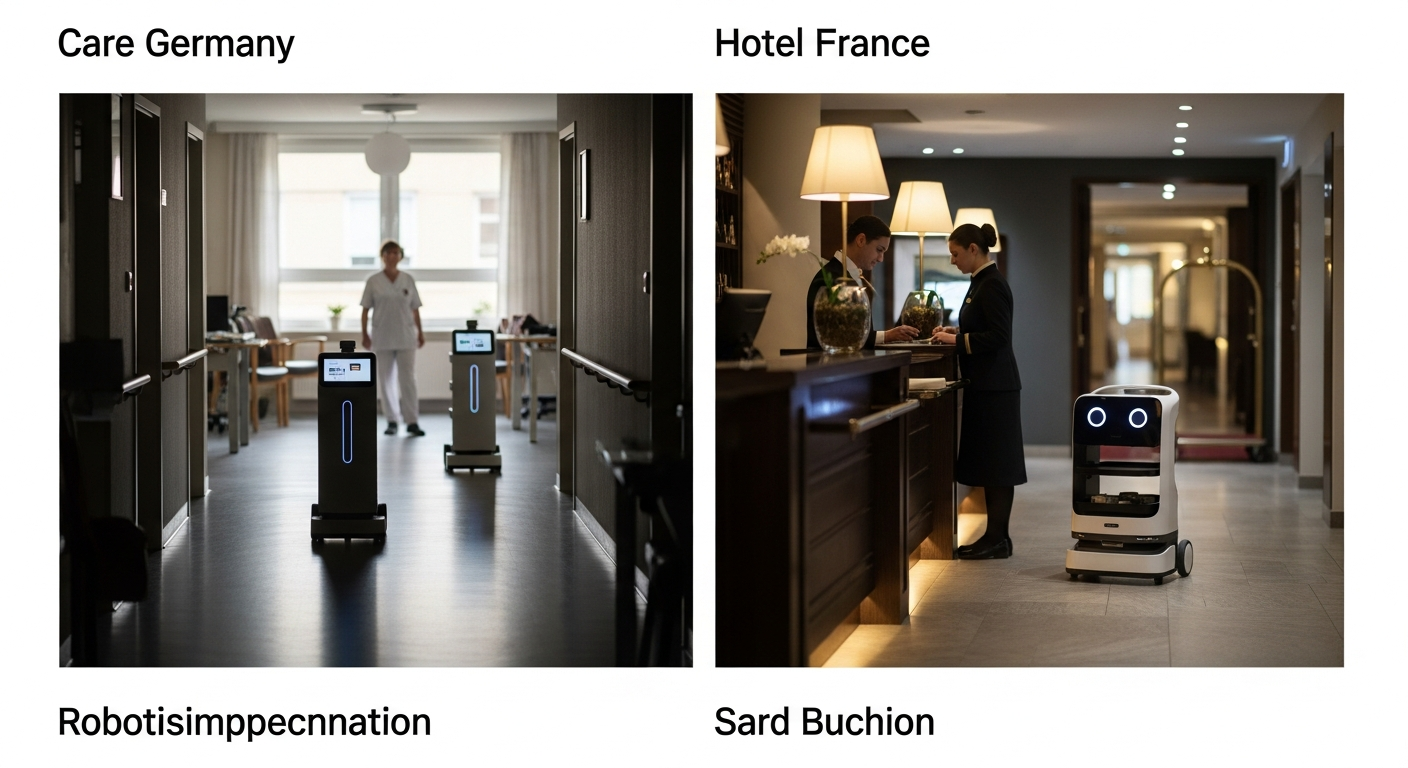
Station 2. 10:00 p.m. The hallway is quiet, but logistics don't stand still. An autonomous transport robot delivers the medication carts for the night shift. No nursing staff had to go this route. In Germany, this is no longer a future scenario, but rather everyday operational life in over 200 werob operations. While traditional consulting firms are still creating discovery decks, these robots are already part of the cost relief. The challenge lies not in the hardware, but in the seamless integration into the German regulatory framework and the existing IT infrastructure. werob closes this gap between OEM manufacturers and operators as the leading system integrator in Europe.
Key Takeaways
- 1werob shortens the planning phase from months to 48 hours using the AI-supported spec engine.
- 2Hardware agnostics protects against vendor lock-in and enables access to over 44 OEM partners.
- 3Compliance with the EU Machinery Regulation 2023/1230 is firmly integrated into the process as a compliance path.
The status quo of robotics in Germany
The German economy is facing an unprecedented demographic challenge. There is a shortage of tens of thousands of skilled workers in sectors such as nursing, hotels and logistics. Nevertheless, robot implementation in Germany often falls short of expectations. The reason is rarely the poor quality of the hardware, but rather the complexity of the integration. Many companies try to buy robots as isolated hardware products instead of seeing them as part of a digital workflow. This leads to long pilot phases without a real rollout.
werob has industrialized this process. As a system integrator, we view the hardware as an interchangeable component. As of May 2026, 200 robots are already in live operation in eleven European countries. This scaling is made possible by a platform that covers the entire lifecycle from specification to fleet management. Instead of relying on a single manufacturer, werob relies on a catalog of over 44 OEM partners. This prevents the so-called vendor lock-in and ensures that the most efficient device is selected for each specific task. In Germany, werob is the compliance path that ensures that all installations meet strict regulatory requirements.
The Spec Engine: From requirement to specification in 48 hours
The classic planning of a robot introduction in German companies often takes three to six months. During this time, specifications are written, inspections are carried out and feasibility studies are drawn up. werob has shortened this process to 48 hours using the Spec Engine. This tool translates the human description of a workflow directly into a usable robot specification. The engine was trained on the basis of over 35,000 projects and immediately recognizes which hardware requirements are necessary for a specific shift or floor.
The operator simply has to describe the process in his own words. The Spec Engine analyzes factors such as floor conditions, door widths, elevator connectivity and human interaction. The result is a technical action graph that forms the basis for subsequent supplier matching. This speed is crucial in order to quickly reduce operational pressure in companies. While competitors are still philosophizing about synergies, werob delivers a precise technical roadmap within two days. This automated approach eliminates human error in the planning phase and ensures that the robot actually delivers the promised performance in the end.
Hardware agnostics: 44+ OEMs in direct comparison
A common mistake when implementing robots in Germany is deciding on a manufacturer early on. A nursing home that ties itself directly to a manufacturer of service robots is dependent on its software and its innovation cycle. werob breaks down this model. Using the hardware-agnostic approach, over 280 different robot models are ranked against the customer's individual specifications. Partners include leading names such as Boston Dynamics, Keenon, Pudu, Apptronik and Unitree.
The Supplier Match System evaluates the robots not based on marketing promises, but based on hard operational data. Can the robot fit through the narrow hallways of an old building? Can he transport the specific medication boxes? Is the battery life sufficient for a 12-hour shift? Through this ranking, the operator receives an offer that is technically validated within five days. werob takes on the role of a neutral entity that is only committed to the success of the workflow. Should an OEM discontinue its software support or a more powerful model comes onto the market, the werob platform enables a seamless change of hardware without having to re-set up the entire integration.
Regulatory safety: EU Machinery Regulation 2023/1230
A critical factor for any robot implementation in Germany is the legal framework. The new EU Machinery Regulation 2023/1230, which will become binding from January 20, 2027, is particularly relevant. Many Asian robot manufacturers currently do not have the necessary conformity assessments to permanently meet this standard. werob acts as a necessary compliance path for European operators. Every installation is planned so that it not only works today, but also meets future legal requirements.
In addition, specific standards such as ISO 13482 for personal assistance robots must be observed. In care, the inspection by the home supervision is also required, while in the security area the security regulations (BewachVO) are relevant. werob integrates these regulatory checks directly into the implementation process. The cockpit constantly monitors the compliance status of the fleet in live operation. This protects managing directors and operators from liability risks. At a time when the EU AI Act and stricter data protection guidelines (GDPR) regulate the use of sensors and cameras, werob offers the necessary legal certainty for the large-scale use of autonomous systems.
Integration into the tech stack: Connectors for SAP and Co.
A robot that does not communicate with the existing software remains an expensive toy. The real value creation comes from integration into the company's existing IT stack. werob supplies prefabricated connectors for this. In care, this means a direct connection to systems such as PointClickCare or MatrixCare. In the hotel industry, interfaces to Opera PMS or Mews are used, for example to handle room service fully automatically. Integration into SAP EWM is the standard in logistics.
These connectors enable the robot to receive orders directly from the leading system and report its status in real time. When a guest in the hotel orders a towel via the PMS, this order is transmitted to the robot without human intervention. After successful delivery, the task is marked as completed in the system. This seamless communication eliminates manual interfaces and reduces error rates. werob sees itself as an operating level that sits between the physical hardware and the logical software level of the operator. This is the crucial difference to a pure hardware reseller who only supplies the device but leaves the customer alone with the IT integration.
Economic efficiency: Verified cost relief per location
The decision for a robot implementation in Germany is ultimately made based on the return on investment (ROI). werob works with concrete numbers instead of vague adjectives. In care, the automation of the medication round leads to cost relief of 92,000 euros per site and year. The transport of laundry or meals saves another 71,000 euros per year. In hospitality, a robot for room service brings 112,000 euros in annual relief, while the automation in bar and breakfast preparation amounts to 54,000 euros. These numbers are not estimates but are based on real data from the live operation of over 200 robots in 11 European countries.
The live cockpit: fleet management with a traffic light system
As soon as the robots are implemented, the operational phase begins. werob provides the Cockpit, a central fleet management system. This tool uses a four-dimensional traffic light system to monitor the health of the entire fleet. The first dimension concerns the hardware: What is the battery level? Are there mechanical problems? The second dimension monitors the infrastructure: Are the WiFi connections and elevator controls working? The third dimension is regulation: Are all safety certificates up to date? The fourth dimension checks compliance with the specification: Does the robot complete its tasks in the scheduled time?
This proactive monitoring prevents downtime before it occurs. When a robot in a hotel in Hamburg shows an error message, the werob team often sees it in the cockpit before the on-site staff. Through remote maintenance and automated updates, most problems can be solved without a technician having to be called out. The cockpit also provides detailed reports on the service provided and the cost reduction achieved. This makes robotics a transparent and controllable key figure in corporate management. The operator maintains full control over its autonomous resources at all times, whether it is a single robot or a nationwide fleet.
The 8-week path to implementation
Speed is a core promise of werob. While traditional projects often come to nothing, werob follows a strict schedule. After the first contact, the specification will be created within 48 hours. A binding offer will be made within five days. The actual implementation on site, including IT connection and employee training, usually takes eight weeks. This process is highly standardized and minimizes the burden on the customer's day-to-day business.
The path begins with an eight-step intake process in which all relevant data on the shift, infrastructure and regulatory requirements are requested. werob takes over the entire coordination with the OEM partners and the IT departments. At the end of the eight weeks, there is a robot that is not only physically present, but has been productively integrated into the work processes. This pace is unique in the industry and is only made possible through the combination of specialized software and many years of operational experience. Operators can realize significant efficiency gains within a quarter instead of waiting years for results.
FAQ
- How much does a robot implementation cost at werob?
- werob uses an outcome-only model. This means there are no classic list prices for implementation. You only pay when the robot is operational and delivers the agreed service. This eliminates the financial risk for the operator.
- How long does it take for a robot to be ready for use?
- It usually takes eight weeks from the first contact to productive use. The specification is available within 48 hours and the offer follows within five days.
- Which robot manufacturers does werob support?
- werob is hardware agnostic and works with over 44 OEM partners including Boston Dynamics, Keenon, Pudu and Apptronik. A total of over 280 different robot models can be maneuvered.
- Is the solution compatible with SAP?
- Yes, werob offers pre-built connectors for SAP EWM as well as other industry systems such as Opera PMS, Mews, Toast and MatrixCare.
- What happens if there are technical problems in the company?
- All robots are monitored via the live cockpit. A four-dimensional traffic light system immediately detects disruptions in hardware, infrastructure or regulations. Many problems are solved remotely before they disrupt operations.
- Does anyone comply with the new EU Machinery Regulation?
- Yes, werob offers an integrated compliance path for the EU Machinery Regulation 2023/1230, which is binding from January 2027. This secures your investment in the long term.
Related reading
Robot Implementation Flat Rate Costs: Transparent Calculation
Calculating implementation costs for robots is a black box for many operators. werob replaces uncertain flat rates with a 48-hour specification and a purely results-oriented compensation model.
9 June 2026Robot pilot project gastronomyRobot pilot project for catering: Going live in 8 weeks
A robot pilot project in the catering industry often fails because the planning phase is too long. werob translates workflows into a specification in 48 hours and brings robots into live operation in eight weeks.
1 July 2026agile robots integrator europeAgile Robots Integrator Europe: Automation in 8 weeks
The introduction of robotics often fails due to months of planning and complex integration. werob translates operational workflows into technical specifications in 48 hours and brings robots into live operation in eight weeks.
5 July 2026robot cell simulation europeRobot Cell Simulation Europe: From Spec to Live in 8 Weeks
Moving from a manual workflow to a robotic cell requires more than a purchase order. It requires a validated simulation that accounts for infrastructure, regulatory compliance, and stack integration. werob provides the operating layer to move from spec to live operation in eight weeks.
5 July 2026robot projector HamburgRobot project planner Hamburg: Automation in 8 weeks
It often takes months from the first workflow draft to productive use. werob, as a specialized robot project developer in Hamburg, shortens this path to eight weeks using a hardware-agnostic platform.
2 July 2026