Humanoid Robots in Europe: Integration and Compliance
Humanoid robots are leaving the test labs and taking on real tasks in the European economy. Learn how werob, as a systems integrator, bridges the gap between complex hardware and operational everyday life.
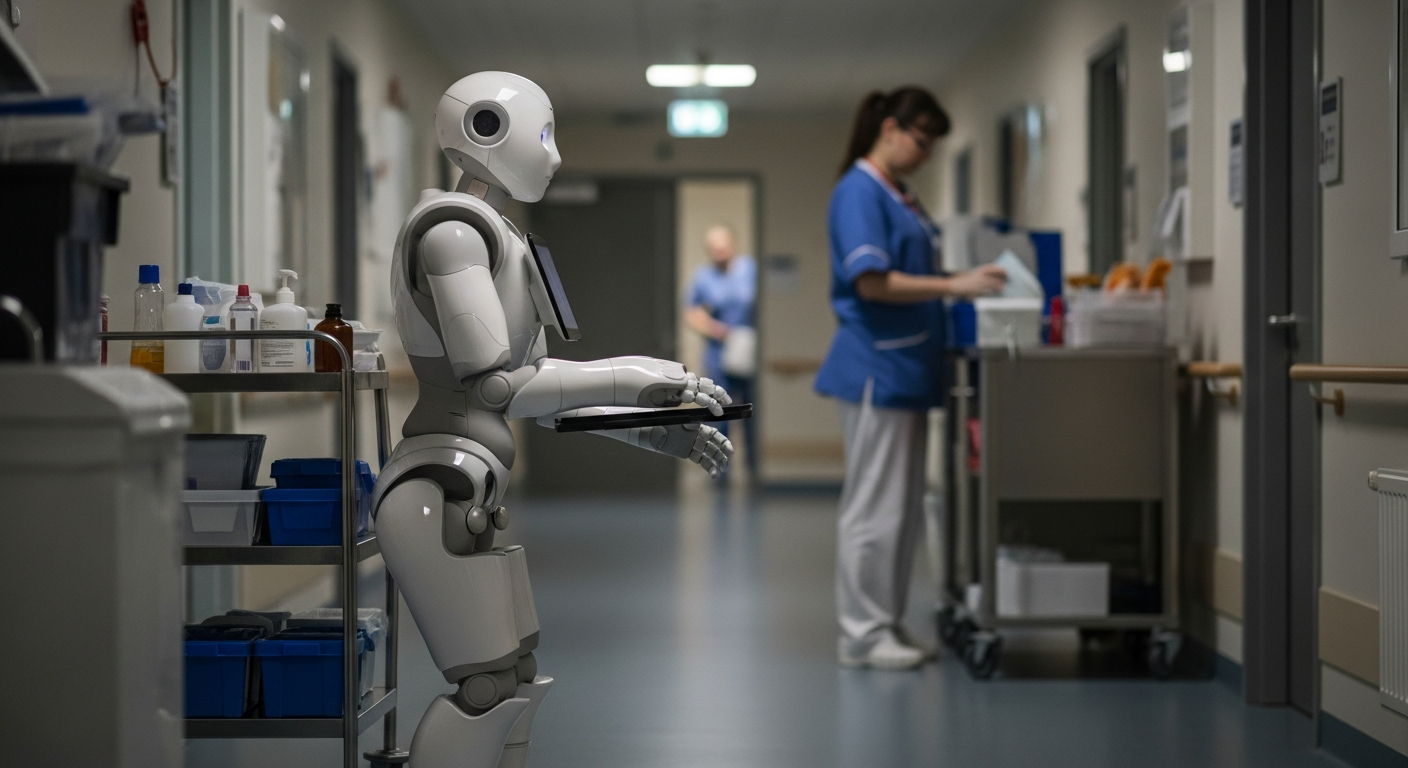
Hamburg-Eppendorf. 22:00. The night shift in the care facility has begun. A humanoid robot of the Apollo type autonomously completes the medication round on floor 3. It navigates safely through the corridors, detects obstacles in real time, and relieves the specialist staff of routine logistical tasks. This is not a pilot project in a laboratory, but week 12 of live operation in a Hamburg facility. While others discuss potentials, werob already delivers measurable results today through the integration of humanoid systems into the European market.
Key Takeaways
- 1werob delivers humanoid robots to live operation in 8 weeks.
- 2The EU Machinery Regulation 2023/1230 is mandatory from January 2027.
- 3Annual cost relief of up to EUR 112,000 per location is achievable.
The Evolution of Humanoid Robotics in Europe
The European market for humanoid robotics is at a turning point. While the technology was considered a future vision for years, current installations show that operational maturity has been reached. werob already operates over 200 robots in live operation in eleven European countries today. The decisive difference compared to earlier approaches lies in the shift of focus: away from pure hardware development, toward systemic integration into existing workflows. For operators in care, logistics, or facility management, this means that humanoid systems must no longer be regarded as isolated experiments, but as part of the workforce. The ability of these robots to move in human environments and perform tasks with a kinematic similar to that of humans opens up completely new possibilities for automation. werob acts here as the central translator, transferring operator requirements into technical specifications and selecting the appropriate OEM partners from a catalog of over 44 providers.
Hardware Agnosticism: Why the Choice of Manufacturer Is Secondary
A common error in introducing robotics is the premature focus on a specific hardware model. werob pursues a hardware-agnostic approach. With the Supplier Match Engine, over 280 different robot models are evaluated against the customer's specific requirements. Whether a system from Apptronik, Figure AI, 1X, or Unitree is used is decided solely by its suitability for the defined workflow. In Europe, this flexibility is decisive, as the requirements for safety and interaction vary greatly depending on the country and industry. A humanoid robot that performs well in a logistics hall in Poland is not necessarily the best choice for a care home in Sweden. By ranking 44+ OEM partners, werob ensures that no vendor lock-in arises. Operators benefit from an objective evaluation that takes into account factors such as range, payload, battery life, and above all conformity with local regulations. This process shortens the selection phase from the industry-standard three to six months to just 48 hours.
The EU Machinery Regulation 2023/1230 as a Regulatory Anchor
For companies in Europe, regulatory compliance is the most important gatekeeper. The new EU Machinery Regulation 2023/1230 will be binding from 20 January 2027. It places particularly high requirements on the safety of machines that work closely with people. Humanoid robots fall into particularly critical categories due to their freedom of movement and ability to interact. werob offers the necessary compliance path here. Many manufacturers, especially from the Asian region, often do not have the necessary conformity assessments for the European market. werob closes this gap as a systems integrator. We ensure that every deployed system not only works technically, but is also legally secured. This includes, in addition to the Machinery Regulation, compliance with ISO 13482 for personal assistance robots and GDPR-compliant processing of sensor data. Without this protection, operators risk costly shutdowns by supervisory authorities. The werob Cockpit continuously monitors this status via a four-dimensional traffic light system that depicts hardware, infrastructure, regulation, and specification in real time.
Economics and Measurable Cost Relief
Investments in humanoid robotics must justify themselves through clear numbers. werob relies on an outcome-only model: customers only pay when the robot is productively in use. The savings potentials are considerable and based on real operating data. In care, the automation of the medication round leads to annual cost relief of EUR 92,000 per location. The mere transport of materials within a facility saves another EUR 71,000 per year. In logistics, a yard patrol amortizes with relief of EUR 68,000, while in the hotel sector, room service through robots can generate savings of EUR 112,000. These figures are not theoretical projections, but the result of optimized shift schedules and the reduction of unproductive walking times of specialist personnel. Through integration into systems such as SAP EWM or PointClickCare, these processes are seamlessly documented, which increases transparency and acceptance within the organization. The focus is always on relieving staff of repetitive tasks in order to create capacity for value-adding activities.
Seamless Integration into the Operator Stack
A robot is only as efficient as its connection to the existing IT infrastructure. werob provides pre-built connectors that enable integration into the operator stack in the shortest time. Verified integrations include PointClickCare and MatrixCare for the care sector, Opera PMS and Mews for the hotel industry, as well as SAP EWM for logistics. These connectors ensure that the humanoid robot receives orders directly from the leading system and returns status reports in real time. An example: as soon as a transport order is generated in SAP EWM, the werob platform translates it into an Action Graph for the robot. The operator does not have to learn new software, but controls the fleet via the familiar interfaces. The werob Cockpit serves as a superordinate monitoring layer that ensures the health of the fleet and adherence to specifications. This deep integration is the key to transforming humanoid robots from expensive gimmicks into productive tools.
The werob Spec Engine: From Vision to Specification
The path to productive robot deployment often starts with a vague idea. The werob Spec Engine transforms these descriptions into a ready-to-deploy specification within 48 hours. The system has been trained on the basis of over 35,000 projects and understands the operational nuances of different industries. An operator simply describes the workflow of a shift, the spatial conditions, and the type of task. The Spec Engine generates a precise requirements catalog from this, which serves as the basis for the Supplier Matching. This process eliminates lengthy discovery phases and ensures that expectations of the hardware are realistically defined from the start. Within five days, the customer receives a concrete offer, and usually only eight weeks pass until the robot is first productively deployed on site. This speed is unique in the market and enables companies to react agilely to skill shortages or changing market requirements.
Comparison of Leading Humanoid Systems for the European Market
The following table provides an overview of some of the leading humanoid systems that werob integrates into projects as a systems integrator. Selection always takes place on the basis of individual specifications.
| Manufacturer | Model | Origin | Focus | Compliance Status (EU) |
|---|---|---|---|---|
| Apptronik | Apollo | USA | General Purpose / Logistics | Under review for 2023/1230 |
| 1X | Eve / Neo | Norway | Care / Service | EU-compliant |
| NEURA Robotics | 4NE-1 | Germany | Industry / Service | EU-compliant |
| Unitree | H1 / G1 | China | Research / Low-Cost | Adaptation by werob required |
| Figure AI | Figure 02 | USA | Production / Logistics | In preparation |
This comparison shows the diversity of the market. While European manufacturers such as NEURA Robotics or 1X have an advantage in immediate compliance with local standards, US American systems often offer high technological maturity in specific AI applications. werob evaluates these factors neutrally and takes over the necessary adaptations to safely integrate even international systems into European operations.
Operational Excellence through the werob Cockpit
After successful implementation, the phase of live management begins. The werob Cockpit offers a central interface for monitoring the entire robot fleet, regardless of the manufacturer. The system uses a four-dimensional traffic light system to visualize the status of each robot. The Hardware dimension monitors the physical condition and maintenance intervals. The Infrastructure layer checks connectivity and charging status within the building. The regulatory layer ensures that all certificates are current and operation takes place within legal limits. The fourth layer, the Specification, reconciles the real performance of the robot with the originally defined targets. If performance deviates, the system delivers proactive suggestions for optimization. This data-driven approach enables operators to continuously increase the efficiency of their fleet and minimize downtime. werob plays the role of the operating partner that guarantees smooth operation, while the customer can focus on their core business.
Conclusion: The Strategic Path to Humanoid Automation
Humanoid robots are no longer a thing of the future in Europe, but an available solution for pressing operational challenges. Success, however, does not depend on choosing the most spectacular hardware, but on solid integration and adherence to regulatory standards. werob offers companies the safest and fastest path into this new era. Through the combination of hardware-agnostic consulting, deep software integrations, and a clear focus on the EU Machinery Regulation 2023/1230, we minimize the risk for operators. The outcome-only model ensures that the economic interests of the integrator and the customer are perfectly aligned. With an implementation time of only eight weeks from the initial idea to the robot on the floor, werob sets the standard for modern systems integration in Europe. Companies that take the first step today secure not only a lead in the competition for efficiency, but also sustainably solve their personnel problems in critical areas.
FAQ
- What does a humanoid robot cost at werob?
- werob works on an outcome-only model. There are no classic list prices. You only pay when the robot is productively running in your operation and delivering the defined added value.
- How long does the implementation of a humanoid robot take?
- From first intake to productive deployment usually takes eight weeks. The specification is available after 48 hours, the offer after five days.
- Which industries benefit most from humanoid systems?
- Particularly high savings are achieved by care (EUR 92,000/year), the hotel industry (EUR 112,000/year), and logistics (EUR 68,000/year) through the takeover of repetitive transport and service tasks.
- Is the hardware safe for contact with people?
- Yes, werob ensures that all deployed systems comply with ISO 13482 for personal assistance robots and meet the path to the EU Machinery Regulation 2023/1230.
- Who is liable in case of accidents with humanoid robots?
- Through werob's regulatory compliance path, it is ensured that all liability questions are clarified in advance and the systems are certified in accordance with European safety standards.
- Can a humanoid robot climb stairs?
- This depends on the chosen OEM model. The werob Spec Engine examines your structural conditions and selects hardware specifically that can handle your specific infrastructure.
Related reading
Humanoid Robots in Operational Use: Integration and ROI
Humanoid robots are leaving the labs and taking on real tasks in care and logistics. Learn how werob, as a systems integrator, integrates this technology hardware-agnostically into your operations.
8 June 2026humanoid robotHumanoid Robot in Operational Use: Integration and ROI
Humanoid robots are leaving the labs and taking on real tasks in care and logistics. werob integrates these systems hardware-agnostically into existing workflows.
8 June 2026figure robot germany providerFigure Robot Germany Provider: Integration and Operation
The search for a Figure robot provider in Germany inevitably leads to the question of systems integration. werob delivers not only hardware but the complete operational stack including compliance and connection to existing systems.
6 June 2026humanoid integrator europe comparisonHumanoid Integrator Europe Comparison: Scaling General Purpose Robots
Humanoid robotics in Europe is shifting from laboratory demos to floor-ready operations. This guide compares the integration pathways for general-purpose robots across senior living, hospitality, and logistics.
2 July 2026humanoid robot price per month europeHumanoid Robot Price Per Month Europe: The Integrator Guide
Understanding the monthly cost of humanoid robotics in Europe requires looking beyond hardware list prices. This guide analyzes the shift toward outcome-only commercial models and the operational offsets that drive ROI.
2 July 2026