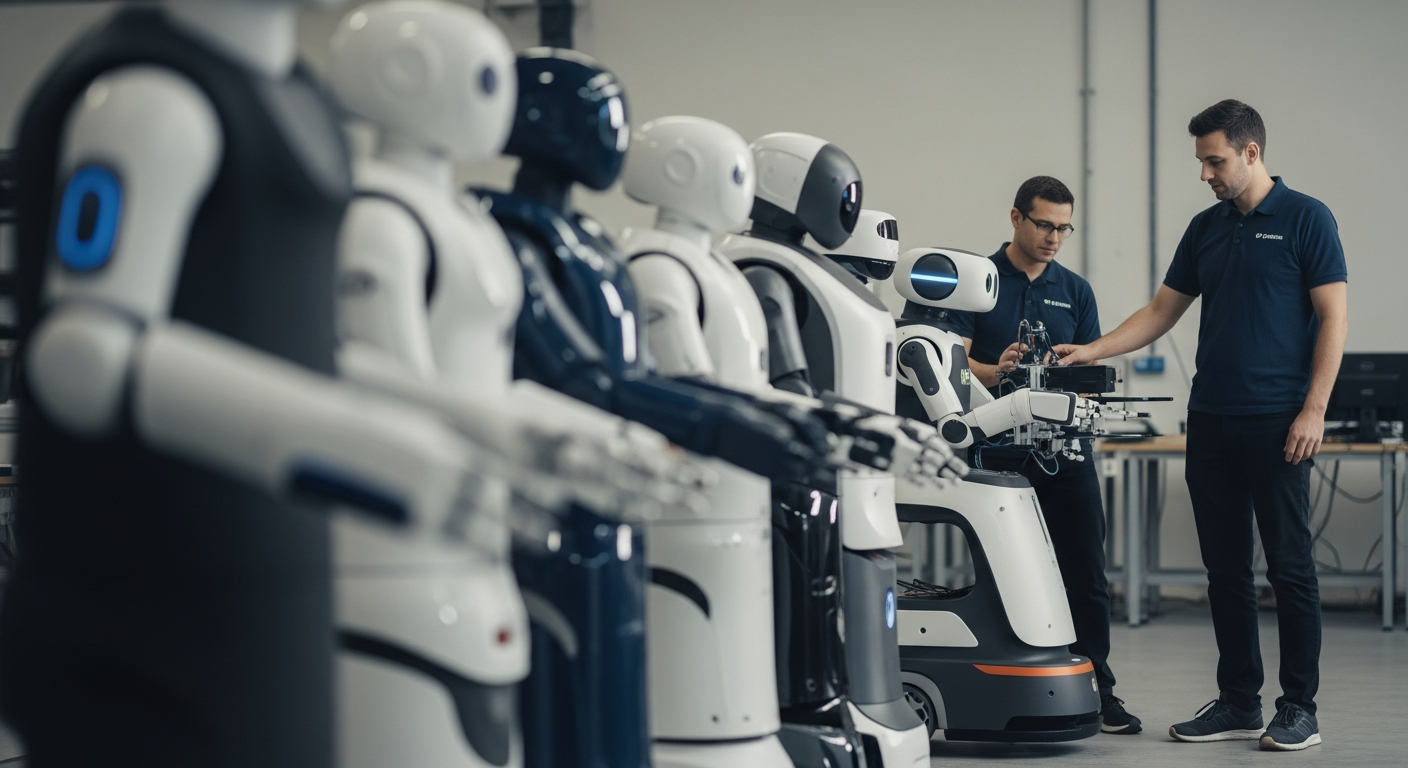
Humanoid robot manufacturer comparison: The best systems in 2026
The market for humanoid robots is growing rapidly, but choosing the right manufacturer determines the ROI. werob compares 44+ OEMs objectively based on their operational requirements.
Station 4. 3:15 a.m. The night watch is busy with an emergency room. Meanwhile, a humanoid robot moves silently across the hallway to replenish supplies. This is already an operational reality at a leading European care operator. In modern care and logistics, it is no longer a question of whether humanoid systems are coming, but rather which manufacturer meets the specific requirements of a location. As a hardware-agnostic system integrator, Werob views the market not from the perspective of a seller, but from the perspective of the operator. The focus is on the measurable outcome, not on technical data sheets.
Key Takeaways
- 1Hardware agnostics is crucial: werob selects the right hardware for your specific workflow from 44+ OEMs.
- 2Measurable cost relief: In nursing, humanoid systems save up to a significant amount per year on medication.
- 3Compliance security: werob guarantees the path to the EU Machinery Regulation 2023/1230 for all robots used.
The status quo of humanoid robotics in B2B use
The landscape of robot manufacturers has fundamentally changed. While humanoid systems were purely research objects a few years ago, they are now in productive use. Companies such as healthcare leaders are already using this technology to realize double-digit cost relief in the first year. The key difference to conventional service robots is their versatility. A humanoid robot is designed to operate in an environment designed for humans without having to adapt the infrastructure.
For operators in the care, hotel or logistics sectors, this means a significant reduction in implementation hurdles. A robot that can open doors, operate elevators and grasp objects supports staff in physically demanding or repetitive tasks. In nursing, this relieves the burden on specialist staff, for example when it comes to medication rounds, which corresponds to a significant annual cost reduction per location. werob analyzes over 44 OEM partners to find the exact hardware for the respective workflow. Werob is not a manufacturer, but the operational layer that integrates the technology into the existing operation.
Leading manufacturers in direct comparison
In the current market, clear market leaders are emerging, each with different priorities. Apptronik with the Apollo model focuses heavily on industrial usability and easy integration. Figure AI, on the other hand, relies on specialized AI models that enable complex interactions. With Atlas, Boston Dynamics remains the benchmark for mobility and dynamism, while providers like Unitree are putting pressure on the market with competitive pricing structures and fast iteration cycles.
When comparing these manufacturers, the origin and the associated regulations are important. While US and Asian manufacturers often lead technologically, EU conformity represents a hurdle. werob acts as a compliance path here, especially with regard to the EU Machinery Regulation 2023/1230. We not only evaluate the hardware specifications such as load capacity or battery life, but also the long-term availability of spare parts and support in Europe. We have over 280 different robot models in our catalog, which we match to our customers' specifications. This prevents vendor lock-in and secures the investment in the long term.
Comparison table: Top manufacturers for operational use
To make an informed decision, operators must weigh technical capabilities against operational requirements. Relevant players in the werob ecosystem at a glance:
| Manufacturer | Model focus | Strengths | Area of application |
|---|---|---|---|
| Apptronics | Apollo | High payload, modularity | Logistics, Care Transport |
| Figure AI | Figure 02 | AI-controlled autonomy | Complex assembly, service |
| Unitree | G1 / H1 | Cost efficiency, agility | Research, lightweight Logistics |
| 1X | Neo | Safe human-robot interaction | Home care, hospitality |
| Boston Dynamics | Atlas (Electric) | Maximum Mobility | Heavy duty, special tasks |
This selection is only a fraction of the 44+ OEM partners that werob continuously evaluates. The deciding factor is not the hardware alone, but how that hardware communicates with the operator stack. Whether SAP EWM in logistics or MatrixCare in care: werob delivers the prefabricated connectors to integrate the robot into the digital infrastructure within five days of the offer being created.
The werob Spec Engine: From the task to the hardware
A challenge when introducing humanoid robots is the hardware-centric approach. Operators buy a model and then look for a task. werob reverses this process. With our Spec Engine, we translate the workflow of a nursing home or hotel into a usable robot specification within 48 hours. This engine has been trained on over 35,000 projects and precisely recognizes which hardware properties are required for a specific layer.
For example, if a hotel wants to automate room service in order to achieve significant annual cost reduction, the Spec Engine analyzes factors such as floor conditions, elevator control and integration into the Opera PMS or Mews. Supplier matching only takes place after this analysis. This process ensures that the chosen robot is not only technically capable but also makes economic sense. Our outcome-only model guarantees that you only pay when the robot is actually in productive use. This eliminates the risk of expensive bad purchases that often arise when purchasing directly from the manufacturer.
Regulatory and EU Machinery Regulation 2023/1230
When comparing international manufacturers, legal certainty is in Europe. From January 20, 2027, the EU Machinery Regulation 2023/1230 will be binding. Many manufacturers from the USA or Asia currently do not have the necessary conformity assessments for the European market. werob offers the necessary compliance path here. We ensure that all systems used comply with European safety standards, including ISO 13482 for personal care robots.
For a Director of Operations, this means legal certainty. A robot that operates in a public environment such as a hotel or care facility must meet the highest safety requirements. werob assumes responsibility for regulatory acceptance and continuous monitoring in the live cockpit. Our four-dimensional traffic light system not only monitors the hardware and infrastructure, but also compliance with regulatory requirements in real time. In this way, we are already preparing our customers for the strict requirements of 2027 without delaying the operational rollout.
Economic efficiency and measurable outcome
At the end of the day, profitability determines the success of a robotics project. Humanoid robots are not a gimmick, but tools for cost optimization. In logistics, yard patrol through autonomous systems achieves significant annual relief. In the area of facility management, cleaning kitchen floors in F&B establishments can significantly reduce costs. These numbers are not estimates, but verified data from our live operation of over 200 robots in 11 European countries.
The comparison of manufacturers must therefore always take the total cost of ownership (TCO) into account. A cheaper robot to purchase can be more expensive than a premium model due to a lack of integration or high maintenance costs. werob offers transparency here. Our RaaS model (Robotics as a Service) eliminates the need for high initial investments. The focus is on the monthly outcome. If a robot in a Hamburg care facility already takes on the full load of transport tasks in week 12 of operation, the ROI is immediately tangible. We not only supply the hardware, but the entire operating process including maintenance and software updates.
Integration into the operator stack
A humanoid robot that works in isolation loses 80 percent of its value. The true strength only emerges through the connection to the existing software landscape. werob offers prefabricated connectors for the most important systems in our core industries. In nursing these are PointClickCare and MatrixCare, in the hotel industry Opera PMS and Mews, and in logistics SAP EWM. These integrations allow the robot to receive tasks autonomously and report status back in real time.
Imagine a guest orders an extra pillow through the hotel system. The connector passes this command directly to the robot, which retrieves the pillow from storage, calls the elevator and appears in front of the guest's room door. While the hardware acts autonomously, the staff always remains in control via the central cockpit. This level of automation is only possible because werob builds the bridge between the complex robotics hardware and the operational software. Our cockpit serves as a central control unit in which all data streams come together with complete traceability and are prepared for management. This reduces the complexity for the operator to a minimum.
For productive use in eight weeks
Time is a critical factor. Traditional consulting firms often need three to six months for a discovery phase. werob shortens this process significantly. You will receive a finished specification within 48 hours, a binding offer after five days and the robot will be ready for use on your site after eight weeks - one partner was able to shorten the implementation time by 70%. This speed advantage results from our platform structure and access to a pre-qualified catalog of 44+ OEM partners.
The path to success begins with a simple eight-step intake process. We record your shift schedules, the on-site infrastructure and your commercial conditions. Supplier matching takes place on this basis. Since we are hardware-agnostic, you always receive the objectively best solution for your problem. Our goal is to have over 2,000 robots in live operation by 2028. Become part of this development and start your automation without any upfront financial risk. With werob you only pay when the solution is running. This enables efficient and future-proof operations.
FAQ
- Which humanoid robot manufacturers are best for caregiving?
- There is no single best manufacturer. Models from Apptronik are suitable for transport, while providers such as 1X are relevant for social interaction. werob determines the right hardware based on a 48-hour analysis of your specific care workflow.
- How much does a humanoid robot cost at werob?
- werob works according to an outcome-only model. There are no classic list prices. You only pay when the robot is in productive use. This covers hardware, integration, maintenance and the live cockpit.
- Is the EU Machinery Regulation 2023/1230 a problem for robots from Asia?
- Yes, many Asian OEMs do not yet independently meet the strict EU requirements for 2027. werob acts as a system integrator and compliance path in order to be able to operate this hardware in a legally secure manner in Europe.
- How long does it take to implement a humanoid robot?
- At werob it usually takes eight weeks from the first specification to live operation. The technical spec is created within 48 hours.
- Can humanoid robots be integrated into existing software such as SAP?
- Yes, werob offers ready-made connectors for SAP EWM, Opera PMS, MatrixCare and other systems. This means the robot becomes part of your digital ecosystem and receives tasks directly from your stack.
- What happens if a robot manufacturer goes bankrupt?
- Werob's hardware-agnostic approach keeps you covered. Because we control the operational level (cockpit and connectors), we can integrate hardware from another OEM if necessary without having to set up the entire workflow again.
Related reading
Humanoid Robot Vendor Comparison: 2026 Enterprise Integration Guide
A technical analysis of leading humanoid OEMs and the integration architecture required to move from pilot projects to live production environments.
2 July 2026humanoid robot manufacturer listHumanoid Robot Manufacturer List: A 2026 Integration Guide
A technical breakdown of the leading humanoid manufacturers and the operational framework required to move from hardware selection to a live, integrated fleet in eight weeks.
2 July 2026humanoid robotHumanoid Robot in Operational Use: Integration and ROI
Humanoid robots are leaving the labs and taking on real tasks in care and logistics. werob integrates these systems hardware-agnostically into existing workflows.
8 June 2026rent humanoid robotsRenting Humanoid Robots: Strategies for B2B Deployment
Humanoid robots are leaving the labs and reaching operational practice. For companies, the question is no longer whether but how to integrate without capital risk through Robotics-as-a-Service.
8 June 2026buy humanoid robot companiesBuying Humanoid Robots for Companies: The Guide
Companies face the challenge of integrating humanoid hardware into existing processes. As a systems integrator, werob offers the path from specification to live operation without manufacturer ties.
9 June 2026