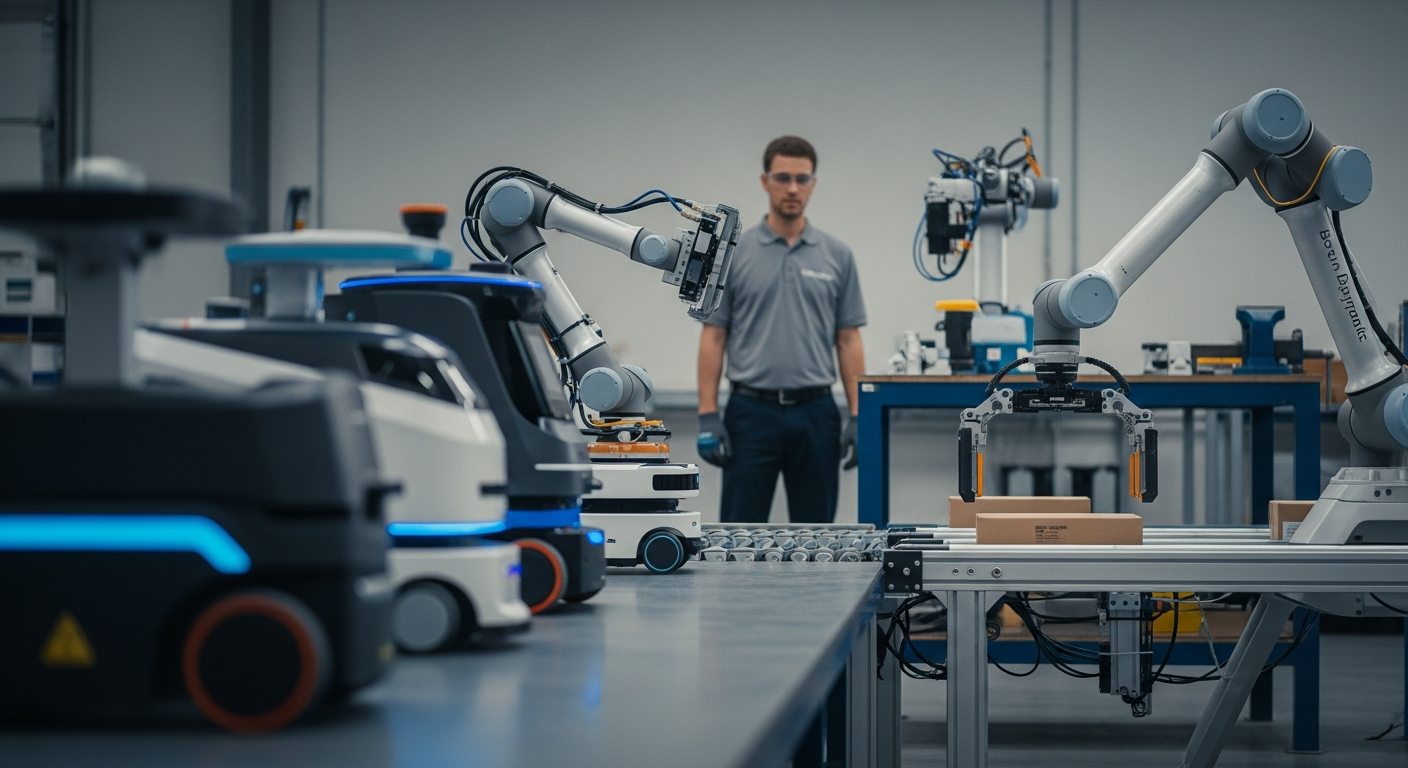
Boston Dynamics Stretch Logistics Partner: Integration in 8 weeks
Boston Dynamics Stretch automates truck unloading at the ramp. werob is the system integrator that translates this hardware into your operational workflow, connects it to SAP EWM and ensures compliance.
Logistics center, ramp 4. 5:30 a.m. The first container is docked. Instead of two employees manually unloading heavy boxes at high temperatures, Stretch rolls into the loading area. The robot grips precisely, recognizes stacking patterns in real time and places the goods on the conveyor belt. werob ensures that this process does not end up as an isolated pilot project, but rather communicates directly with the warehouse management system. As a system integrator, we translate this physical process into a digital specification and bring the robot into live operation within eight weeks. werob acts hardware-agnostic and tests Stretch against 44 other OEM partners in order to find the optimal solution for your location.
Key Takeaways
- 1Integration of Boston Dynamics Stretch in just 8 weeks through standardized processes
- 2Prefabricated connectors for SAP EWM enable seamless data flow without individual programming
- 3Full compliance with the EU Machinery Regulation 2023/1230 already integrated into the system
werob's role as an integrator for Boston Dynamics Stretch
Boston Dynamics is a leading manufacturer of robotics hardware, but the physical machine is only part of the solution. In a complex logistics environment, the operator needs an integration level that connects the robot to the existing infrastructure. werob is not a reseller of individual brands, but rather the system integrator that closes the gap between OEM hardware and operations. We view the robot as a tool within a larger workflow.
For logistics managers, this means they don't have to deal with the technical details of API programming or gripper configuration. werob takes responsibility for the result. Our model is designed for measurable results to ensure the robot is working productively on the ramp. With over 200 robots in live operation and a presence in 11 European countries werob has the necessary experience to integrate Stretch into existing fleets or establish it as the first autonomous unit.
Working with a specialized partner like werob significantly reduces the deployment risk. While traditional consulting firms take months to analyze, our Spec Engine delivers a ready-to-use specification within 48 hours. Not only do we evaluate Boston Dynamics' hardware, we compare it to 280 different robot models from our catalog to ensure that Stretch is actually the most economical choice for your specific unloading situation.
Workflow translation by the Spec Engine
The success of a robotics deployment is decided in the planning phase. The werob Spec Engine uses data from over 35,000 projects to translate your requirements into a precise action graph. In logistics this means: How many boxes have to be moved per hour? What are the dimensions and weights of the units? What is the condition of the ground on the ramp? These questions are answered in a standardized process that takes just 48 hours.
Instead of conducting lengthy discovery workshops, werob uses an AI-powered platform to capture the operational reality of your site. The result is a technical specification that serves as a direct basis for supplier matching. Stretch from Boston Dynamics is tested against the requirements for range, load capacity and speed. The recommendation for use is only made if the hardware meets the specification 100 percent.
This structured approach prevents expensive bad purchases and ensures transparency towards management. In logistics, efficiency when unloading containers is a crucial lever for overall profitability. The Spec Engine ensures that the selected robot not only functions technically, but also achieves the desired economic goals. We define success by the output on the ramp, not by the number of sensors installed.
Integration into the logistics stack via SAP EWM
An autonomous robot like Stretch is only valuable if it knows what it is unloading and where the goods should go. werob offers ready-made connectors in the operator stack, especially for SAP EWM and other warehouse management systems. This integration ensures that inventory data is updated in real time as Stretch places a box from the truck onto the conveyor belt. Manual booking steps are no longer necessary, which reduces the error rate to zero.
Werob's connectors are not individual tinkering solutions, but rather standardized interfaces that enable rapid scaling. Once you have successfully integrated Stretch at one location, the rollout to additional logistics centers can take place within a few days. The communication between the robot and the WMS is bidirectional. The system can assign priorities to the robot, while the robot returns status reports about the progress of the unloading.
In addition to pure data integration, werob also takes care of the infrastructural connection. This includes WiFi coverage on the ramp, integration into safety control systems such as Genetec and coordination with the conveyor technology. The goal is a closed loop in which Boston Dynamics hardware acts as an integrated part of the automated logistics chain. Using our platform eliminates the need to have new interfaces programmed for every robotics project.
Economic efficiency and cost reduction in logistics
The investment in robotics must be justified by clear key figures. In the logistics industry, we see significant savings potential through the use of autonomous systems. The potential in truck unloading through systems like Stretch is significant and often surpasses simple automation solutions. The relief not only results from the reduction in manual working hours, but also from the avoidance of health-related absences in an extremely physically demanding work area.
werob relies on a results-oriented model. We guarantee that the specified service will be provided. This approach shifts risk from the user to the integrator. We guarantee that the specified service will be provided. If Stretch does not move the promised number of boxes per hour on your ramp, we have not achieved our goal.
In addition to the direct cost savings, automation offers greater planning security. Robots are not aware of shift change delays or heat-related breaks. In times of a massive shortage of skilled workers in logistics, the ability to unload containers autonomously around the clock is a decisive competitive advantage. werob helps you realize these advantages within just eight weeks, from the first contact to the productive use of the robot. For example, a partner at a Big Four consultancy reported that throughput times were massively shortened by using specialized analysis workflows.
Regulatory information: EU Machinery Regulation 2023/1230
A critical aspect when introducing robotics from the USA or Asia is compliance with European safety standards. From January 20, 2027, the new EU Machinery Regulation 2023/1230 will be binding. This places stricter requirements on conformity assessment, especially for machines with AI components or autonomous functions. werob offers the necessary compliance path here.
As a European system integrator, we ensure that the use of Boston Dynamics Stretch meets all regulatory requirements. This includes not only the CE marking, but also the specific risk assessments for operation in an environment where humans and machines interact. We integrate the necessary security concepts directly into the specification and monitor compliance via our live cockpit.
Regulatory protection is an essential part of our service promise. Operators in Germany must also observe local regulations such as the security regulations or specific occupational safety guidelines. werob takes care of the documentation and ensures that your automation solution is audit-proof. Without a partner that covers this regulatory depth, companies risk costly shutdowns from regulators. With werob, the compliance path is already built into the platform, with each finding linked directly to the underlying documents and regulatory sources.
Comparison: Stretch vs. conventional logistics automation
To make the right decision, operators need to understand where Stretch excels and where other systems are preferable. werob carries out this comparison objectively based on the Spec Engine. Here is an overview of the criteria:
| Criteria | Boston Dynamics Stretch | Conventional AMRs | Stationary unloading systems |
|---|---|---|---|
| Flexibility | Very high (mobile, no rails) | High (transport only) | Low (fixed installed) |
| Integration | Via werob Connectors (SAP) | Standard interfaces | Often proprietary |
| Area of application | Truck unloading, depalletizing | Horizontal transport | Specialized Conveyor technology |
| Compliance | EU 2023/1230 via werob | Standard CE | Plant certification |
| Amortization | Result-oriented model | Often CAPEX-based | High Initial costs |
While classic AMRs (Autonomous Mobile Robots) are primarily designed for transport from A to B, Stretch addresses the complex task of gripping and moving variable goods. In each project, werob checks whether the mobility of Stretch on various ramps justifies the added value compared to a stationary solution. Since we are hardware-agnostic, you will always receive the recommendation that best suits your workflow technically and economically.
The Cockpit: Live monitoring of the unloading fleet
As soon as the robots are in use, the werob cockpit takes over central control and monitoring. It is a 4-dimensional traffic light system that displays the status of hardware, infrastructure, regulatory and specification in real time. For a logistics manager, this means full transparency across the entire fleet, regardless of whether there is one or ten stretch robots in use.
The cockpit detects irregularities before they lead to a standstill. For example, if Wi-Fi latency increases at a certain ramp or a sensor is dirty, the system proactively issues alerts. This data also flows back into optimizing workflows. We see exactly how efficient each unloading process is and where there is potential for further increases in speed.
Another advantage of the cockpit is the complete documentation for audits. Since all movement data and security events are logged, proof of compliance to insurance companies or authorities is possible at any time. werob operates this live cockpit as part of the platform, so you don't have to build your own software infrastructure for fleet management. You get a fully operational system that makes operation as easy as possible.
The way to use: A productive ramp in 8 weeks
Speed is a crucial factor in modern logistics. werob has radically shortened the robotics deployment process. While traditional projects often take six to twelve months, we get the robot on site in eight weeks. This process begins with a 48-hour intake, during which we record your workflow and translate it into a specification.
You will receive a binding offer based on your requirements within five days. As soon as the decision has been made, the integration and configuration phase begins. Thanks to our prefabricated connectors in systems such as SAP EWM, time-consuming individual programming is no longer necessary. We prepare the environment, ensure compliance and train your staff on site.
In week eight, the first robot rolls onto the ramp and begins work. This quick rollout is possible because werob takes on the entire complexity of the system integration. We are your single point of contact for hardware, software, regulations and operations. Start your Spec in 48 hours and transform your truck unloading with a partner focused on results.
FAQ
- Is werob an official Boston Dynamics dealer?
- werob is a hardware-agnostic system integrator. We work with over 44 OEM partners, including Boston Dynamics, to integrate the hardware into the customer's operational stack. We do not sell off-the-shelf robots, but rather deliver usable complete solutions.
- What requirements does my warehouse have to meet for Stretch?
- Infrastructure requirements are analyzed in our Spec Engine within 48 hours. What is essential is stable WiFi coverage, suitable ground conditions on the ramp and the connection to your warehouse management system via werob connectors.
- How much does an integration cost?
- werob's cost structure is geared towards the measurable success of your project. We focus on the output achieved and the long-term increase in efficiency at your location.
- Can Stretch also work in extreme temperatures?
- Yes, Stretch is designed for use in demanding logistics environments. The exact operational parameters are checked in the Spec Engine against your site conditions to ensure long-term availability.
- What happens if the robot has a malfunction?
- The werob cockpit monitors the fleet live. In the event of disruptions, our support system intervenes. Since we are responsible for the entire operational level, we take care of troubleshooting so that your operations at the ramp are not interrupted.
- Does werob also support other logistics robots?
- Yes, our catalog includes over 280 different robots from 44+ OEMs. For each project, we check whether Stretch or another robot (e.g. from Agility Robotics or Unitree) is the best solution for your specific task.
Related reading
Boston Dynamics Spot Integrator Germany: Operational scaling
If you want to use the Boston Dynamics spot productively in Germany, you need more than just the hardware. werob translates your operational requirements into a usable specification in 48 hours and integrates the robot directly into your existing software stack.
6 July 2026ek robotics integration partnerek robotics Integration Partner: Efficiency in logistics
The implementation of ek robotics systems often fails due to the IT interface or lengthy planning phases. werob translates your logistics workflows into a technical specification in 48 hours and ensures productive live operations.
7 July 2026abb gofa integrator europeABB GoFa Integrator Europe: Cobot solutions for operations
Find out how werob, as a hardware-agnostic system integrator, integrates the ABB GoFa into your operation. We do not deliver hardware catalogs, but rather ready-to-use solutions including software connectors and full regulatory compliance.
5 July 2026boston dynamics spot securityBoston Dynamics Spot Security: Integration and ROI Guide
Deploying Boston Dynamics Spot for security requires more than just hardware. This guide explores how integrating Spot into existing security stacks yields a €68,000 annual cost offset while ensuring compliance with upcoming EU regulations.
4 August 2026logistics robotsLogistics Robots: Scalable Automation for Mid-Sized Businesses
Logistics robots are no longer a vision of the future, but operational reality. Learn how you can achieve measurable cost relief through hardware-agnostic integration and automated workflows.
11 June 2026