Room service automation: increasing efficiency in hotel operations
Automating room service significantly reduces personnel costs per location per year. By integrating into PMS systems such as Opera or Mews, robots become a seamless part of the hotel infrastructure.
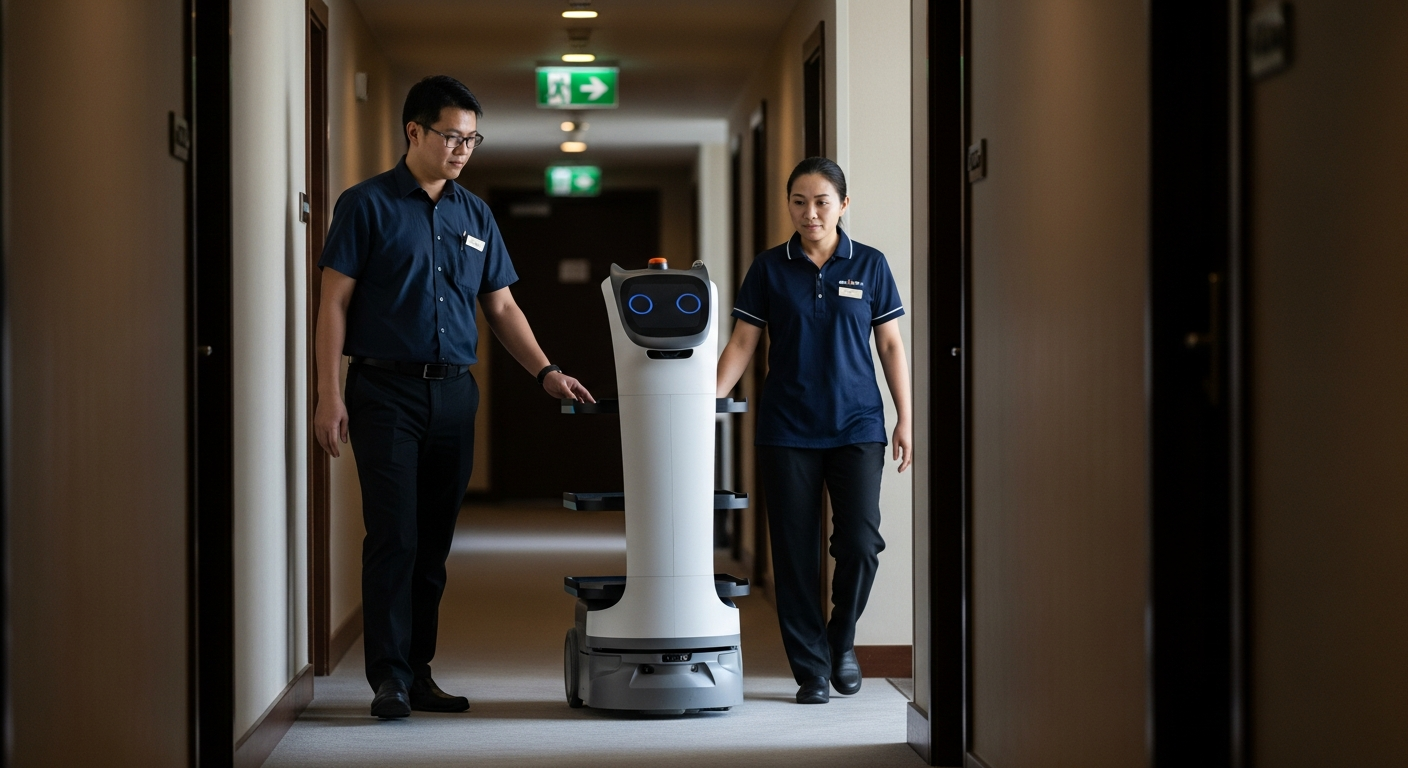
Friday evening, 11:30 p.m. On the fourth floor, a guest requests additional towels and bottled water. The reception staff is busy checking in a tour group. Instead of taking an employee away from reception for ten minutes, the robot takes over the task. It navigates autonomously to the elevator, calls it digitally and delivers the order to the room door. Room service automation addresses the shortage of skilled workers and secures the operating margin. werob translates these workflows into precise technical specifications and brings the solution into live operation within eight weeks.
Key Takeaways
- 1Room service automation enables annual cost savings by reducing unproductive walking distances.
- 2Integration into PMS systems such as Opera and Mews is essential for an automated workflow that relieves staff of routine tasks.
- 3werob offers a compliance path for the EU Machinery Regulation 2023/1230, which will be binding for all operators from January 2027.
The economic reality in hotel room service
In many hotels, classic room service is considered to be loss-making or at least operationally burdensome. The personnel costs for simple errands are often disproportionate to the sales achieved per order. Room service automation addresses this inefficiency. By using autonomous robots, hotel businesses achieve significant, verified cost savings. This number is based on the savings in man-hours that were previously spent on pure transport routes.
Instead of using qualified staff to bring toothbrushes, pillows or snacks, robots take over these repetitive tasks. Meanwhile, the staff can concentrate on check-in or providing personal care to guests. werob acts as a system integrator that not only supplies the hardware, but also digitizes the entire workflow. The goal is not to exchange people, but to eliminate unproductive walking routes, which can amount to several kilometers per shift in large hotel complexes.
Integration instead of isolated solution: Opera PMS and Mews
A robot that operates in isolation from the rest of the IT infrastructure creates more work than it saves. The efficiency of room service automation comes from integration into the property management system (PMS). werob provides pre-built connectors for market-leading systems such as Opera PMS and Mews. This integration enables an order in the PMS to directly trigger a movement command to the robot.
As soon as an order is booked in the system, the robot receives information about the target room number and the contents. It positions itself at the charging station or the distribution point. After loading by the staff, confirmation is given and the robot sets off. Thanks to the connection to the elevator control and the in-house WiFi, the system navigates safely through all floors. Without this deep integration, robotics would remain a toy. werob ensures that the hardware becomes a fully-fledged part of the digital hotel stack.
Hardware agnostics: The right robot for every floor
The market for concierge robots is confusing. Manufacturers such as Keenon with the T9 or M2 models, Pudu, Bear Robotics or TOSY offer different strengths in terms of loading capacity, speed and sensors. werob is not a manufacturer and not a single OEM reseller. We are hardware-agnostic and select exactly the hardware that fits the specific architecture of your hotel from a catalog of over 44 OEM partners.
In a supplier match, over 280 different robot models are tested against your requirements. Factors such as carpet texture, door widths and elevator types play a crucial role. A boutique hotel in a historic building has different navigation requirements than a modern hotel complex with wide hallways. Through this ranking process, hotel operators avoid vendor lock-in and receive the best technical solution for their specific application. The decision for hardware is only made after the operational specification has been determined.
The Spec Engine: From workflow to solution in 48 hours
Traditional consulting projects to introduce robotics often take three to six months. werob shortens this process radically. With the Spec Engine, your workflow is translated into a ready-to-use robot specification within 48 hours. This engine was trained on the basis of over 35,000 projects and understands the special features of the hotel industry. You don't have to define any technical parameters, just describe your shifts, floors and tasks.
From this information, we generate an action graph that determines exactly how the robot should behave in which situation. This speed is crucial in responding to acute staff shortages. After the spec has been created, a concrete offer will follow within five days. In eight weeks the robot will be in live use on your floor. This structured process minimizes project risk and ensures a quick amortization of the investment.
Regulatory and safety: EU Machinery Regulation 2023/1230
An often underestimated aspect of room service automation is legal security. From January 20, 2027, the new EU Machinery Regulation 2023/1230 will be binding. Many robots on the market today do not meet these strict requirements without additional customization. werob offers the necessary compliance path here. As a system integrator, we take responsibility for conformity assessment and ensure that the systems used meet all European security standards.
This includes not only physical security when dealing with guests, but also cybersecurity in accordance with IEC 62443 and data protection in accordance with GDPR. Since robots are equipped with cameras and sensors to avoid obstacles, legally compliant data management is essential. werob integrates these regulatory requirements as early as the planning phase, so that hotel operators are protected from liability risks. This is a significant advantage over purchasing directly from foreign manufacturers, who often do not offer local compliance support.
Operational excellence through the live cockpit
As soon as the robot fleet is in use, the management phase begins. The werob Cockpit offers a central control unit for all active units. A four-dimensional traffic light system constantly monitors the status of the hardware, infrastructure, regulations and compliance with the specification. For example, if a robot stops due to a blocked WiFi connection, this is immediately signaled in the cockpit.
This transparency allows hotel management to objectively evaluate the performance of the automation. How many deliveries were made? How much time did the staff save? The cockpit provides the data for continuous optimization of processes, whereby every step and every system decision remains completely traceable. By connecting to the cockpit, werob is able to solve problems proactively, often before the hotel staff on site notices a problem. This ensures high availability of the systems, which is crucial for acceptance by guests and employees.
Outcome-Only: werob’s commercial model
A major obstacle to the introduction of new technologies is high initial investment and the risk of failure. werob eliminates these hurdles with an outcome-only model. This means: You only pay when the robot actually runs and completes the defined tasks. There are no hidden costs for lengthy discovery phases or advisory decks. The focus is purely on the operating result.
This model underlines the trust in your own platform and the selection of OEM partners. If the integration with Opera PMS or Mews does not work or the robot does not reach the floors reliably, the risk is borne by the user. For hotel operators, this means planning security. The monthly costs are more than compensated for by the realized cost relief, which leads to a positive cash flow from the first month of live operation.
Implementation in eight weeks: The path to live operation
The path to room service automation at werob follows a strict eight-step plan. The process begins with the intake, where you describe your requirements in your own words. This is followed by the creation of the spec within 48 hours and the matching of the appropriate hardware. Once the decision is made, the connectors are deployed into your IT stack. The physical installation and mapping of the premises take place parallel to the regulatory acceptance.
The system is ready for productive use within eight weeks. This schedule is unique in the industry and is made possible by the high standardization of the werob platform. While others are still discussing concepts, we are already delivering measurable results. The rapid rollout is particularly attractive for hotel chains that aim to quickly scale across multiple locations. With werob you have a partner who takes on the complexity of robotics so you can concentrate on your guests.
FAQ
- How much are room service robots actually saving?
- In the hotel industry, the verified cost relief amounts to significant sums. This sum results from saving working time for errands and room service deliveries.
- Which PMS systems are supported by werob?
- werob offers pre-built connectors for market-leading systems such as Opera PMS and Mews. Further integrations can be implemented via the connector level of the platform.
- How long does it take to implement a robot?
- At werob, it usually takes eight weeks from the first specification to live operation. The technical specification is available after just 48 hours.
- Can the robots drive elevators independently?
- Yes, by integrating into the building's elevator control system, the robots can move autonomously between floors and thus serve the entire hotel.
- What happens in the event of technical disruptions?
- All robots are monitored via the werob live cockpit. A 4-dimensional traffic light system immediately detects malfunctions in hardware or infrastructure, so that proactive intervention can often be carried out.
- Is it safe for guests to use the robots?
- Yes, the robots used have the latest sensors to avoid obstacles. werob also ensures compliance with the EU Machinery Regulation 2023/1230.
Related reading
Robot as a Service Germany: Efficiency without investment risk
Robot as a Service (RaaS) is transforming the way German companies scale automation. As a hardware-agnostic system integrator, werob offers the direct path from workflow analysis to a productive fleet in eight weeks.
27 June 2026service robot hotelService robots in hotels: operational excellence through integration
The implementation of service robots in the hotel industry often fails due to isolated isolated solutions. As a system integrator, werob offers the direct path to an automated fleet through seamless PMS connection and manufacturer-independent specifications.
19 June 2026hotel coo automationHotel COO Automation: Strategies for Operational Excellence
Automation in the hotel industry is no longer an option, but an operational necessity to secure margins. Learn how COOs achieve annual savings of over 112,000 euros per location through precise specifications and seamless system integration.
24 June 2026service robot funding Germany 2026€12,000 once, €30,000 in Bavaria, 30 percent in year one: what actually pays towards a service robot in Germany in 2026
Germany has no funding programme for service robots. It has three instruments a robot fits into, and each has an amount, an end date and one condition most applications fail on. Plus a loan that is not a grant.
14 September 2026automation partner service provider medium-sized businessesAutomation partner service provider medium-sized companies: werob Guide
Medium-sized companies don't need months-long discovery phases, but rather measurable operational results. Find out how werob, as a hardware-agnostic system integrator, radically shortens the path from specification to live operation.
21 June 2026