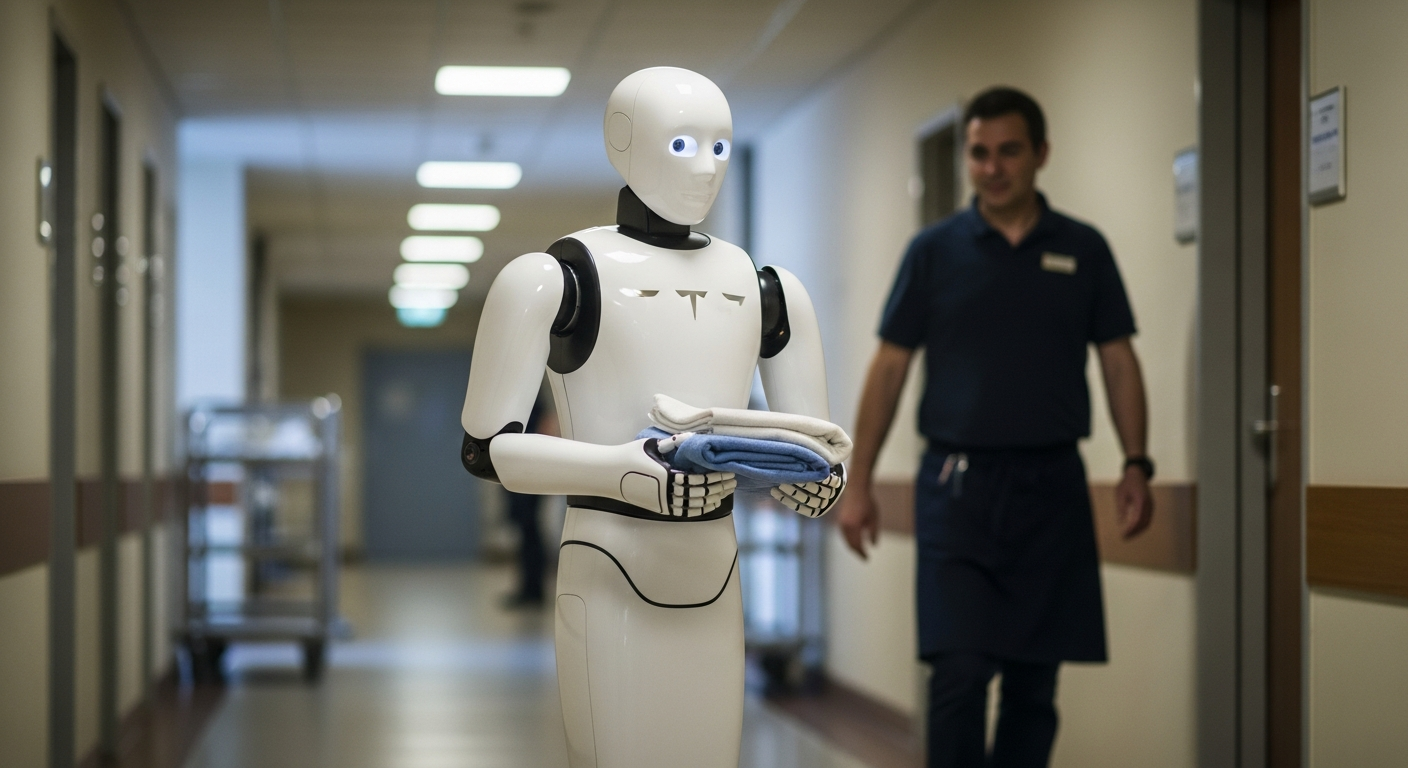
Tesla Optimus Integrator Europe: Humanoid robots in operation
The Tesla Optimus promises a revolution in manual work. However, the path to productive use is complex for European companies. werob acts as a system integrator that integrates humanoid hardware into existing IT stacks and ensures compliance with strict EU regulations.
Hamburg-Eppendorf. 3:15 a.m. The night shift in the logistics hall has been running for four hours. A humanoid robot moves autonomously between the shelves, picks up unsorted small parts and feeds them to the packaging process. What seems like a scene from the distant future is the target image for the Tesla Optimus in Europe. But the hardware alone does not solve operational problems. Without being embedded in the local infrastructure and complying with European safety standards, the robot remains an isolated experiment. werob closes this gap as a system integrator, paving the way from the first specification to live operation in eight weeks.
Key Takeaways
- 1werob is the key system integrator for the use of the Tesla Optimus in Europe and ensures compliance with the EU Machinery Regulation 2023/1230.
- 2The Spec Engine shortens the planning phase from months to 48 hours and delivers a precise, executable specification.
- 3Using prefabricated connectors, the robot is seamlessly integrated into systems such as SAP EWM, Opera PMS or PointClickCare.
The role of system integrator for Tesla Optimus in Europe
Tesla is developing an impressive hardware platform with the Optimus. But for an operations director in Europe, the robot is only part of the equation. A systems integrator like werob is needed to translate the physical capabilities of the machine into measurable economic results. werob is not a robot manufacturer or a simple reseller, but rather the operational level that sits between the OEM and the operator. While Tesla provides the body, Werob provides the integration into the operational process.
In Europe, companies face the challenge that hardware from the USA or Asia cannot be easily integrated into German or French operations. This is where the werob model of hardware agnostics comes into play. werob evaluates over 44 OEM partners, including humanoid systems such as Apptronik Apollo or NEURA Robotics, and compares them with the Tesla Optimus. The goal is not to use a specific model, but to meet the customer's specification. By ranking over 280 different robots, werob ensures that the selected hardware fits the workflow exactly, be it in logistics, care or facility management.
Spec Engine: From workflow to specification in 48 hours
The biggest bottleneck when introducing humanoid robot like the Tesla Optimus is the planning phase. Traditional consulting firms often take three to six months to create discovery decks. werob shortens this process to 48 hours using the proprietary Spec Engine. Trained on over 35,000 projects, this engine translates the natural language of an operations manager into an executable robot action graph. When you describe how a shift works in your warehouse, the Spec Engine immediately generates the technical requirements for the robot.
This automated process eliminates the risk of planning errors. Instead of relying on vague promises from hardware manufacturers, operators receive a precise specification that takes all variables into account: from ground conditions to the cycle time of the transfer stations. After the spec has been created, the Supplier Match follows, in which the Tesla Optimus is ranked against other humanoid and specialized robots. You will find out within a few days whether the Optimus is the most economical choice for your specific task or whether a specialized transport robot offers greater cost relief.
EU Machinery Regulation 2023/1230: The mandatory compliance path
A critical factor for the use of the Tesla Optimus in Europe is the regulatory landscape. From January 20, 2027, the new EU Machinery Regulation 2023/1230 will be binding. This regulation places high demands on the safety and conformity of autonomous systems, especially when they operate in close proximity to people. This represents a hurdle for US manufacturers such as Tesla, as conformity assessment procedures are specific and strict for the European market. werob acts as the necessary compliance path here.
As a system integrator, werob assumes responsibility for compliance with these standards. This includes not only the Machinery Regulation, but also ISO 13482 for personal care robots and the upcoming EU AI Act. Without certified integration, operators risk having their fleets decommissioned by market regulators. werob integrates these regulatory requirements as early as the planning phase. The live cockpit continuously monitors the status of compliance during ongoing operations, so that companies remain auditable at all times. This is particularly essential in highly regulated areas such as care or critical infrastructure.
Seamless integration into the operator stack
A humanoid robot that does not communicate with the Warehouse Management System (WMS) or the Property Management System (PMS) is worthless. werob offers prefabricated connectors that integrate the Tesla Optimus directly into the operator's existing IT stack. These include integrations in SAP EWM for logistics, Opera PMS or Mews for the hotel industry, and PointClickCare and MatrixCare for the care sector. This connectivity ensures that the robot carries out its tasks based on real-time data.
When an order is received in SAP EWM, the robot immediately receives the command to pick via the werob platform. No individual programming is required on site, which massively reduces implementation time. werob promises to have the robot in use within eight weeks of placing the order. This speed is only possible because the interfaces already exist and do not have to be developed anew for each project. In the werob cockpit, the operator sees the status of each robot, the utilization and possible error messages in a four-dimensional traffic light system that includes hardware, infrastructure, regulations and compliance with the specification.
Economic efficiency and cost relief through humanoids
The use of humanoid robots such as the Tesla Optimus must be economically viable. werob relies on an outcome-only model here: customers only pay when the robot is running productively. The potential savings are significant and based on verified data from live operations of over 200 robots in 11 European countries. In logistics, for example, an automated yard patrol reduces costs by 68,000 euros per location and year. In retail, a patrol reduces costs by 58,000 euros annually.
The effects are even clearer in personnel-intensive industries such as nursing or the hotel industry. An automated medication round in a care facility results in a relief of 92,000 euros per year, while the transport of laundry or waste saves a further 71,000 euros. In the hotel industry, a room service robot can save the budget by 112,000 euros per year. These numbers are not theoretical estimates, but operational reality for customers like Korian Germany. werob enables companies to leverage this potential without getting lost in lengthy pilot projects.
Comparison: Tesla Optimus in a competitive environment
Although the Tesla Optimus has a strong media presence, there are already established alternatives in the field of humanoid robotics that werob includes in its ranking. A comparison of the systems is essential in order to find the right hardware for the respective application. While Tesla relies on a high level of generalization, other systems are already more optimized for specific industry requirements. werob evaluates these systems neutrally and hardware-agnostic.
| System | Origin | Focus | Integration via werob |
|---|---|---|---|
| Tesla Optimus | USA | General Purpose | In preparation |
| Apptronics Apollo | USA | Logistics & Service | Available |
| NEURA Robotics | Germany | Cognitive Assistance | Available |
| Figure AI | USA | Industrial manufacturing | Under review |
| Unitree H1/G1 | China | Cost efficiency | Available |
This comparison shows that systems with a local presence or specialized security features are often advantageous for European companies. werob helps to weigh up the advantages and disadvantages, especially with regard to maintenance and support in live operation.
The werob cockpit: live fleet management
As soon as the Tesla Optimus or a comparable system is in operation, the werob cockpit takes over the monitoring. A humanoid robot is a complex system that requires continuous attention. The cockpit offers a four-dimensional traffic light system that goes far beyond simple status reports. The first level monitors the hardware itself: battery level, joint temperatures and sensors. The second level checks the infrastructure, such as WiFi coverage and the accessibility of charging stations.
The third level is regulation. This ensures that the robot operates within the certified parameters and that no safety standards are violated. The fourth level monitors compliance with the original specification. Does the robot achieve the planned cycle times? Are the tasks performed as defined in the Spec Engine? This transparency allows operations managers to manage the fleet efficiently and intervene immediately in the event of deviations. werob operates this cockpit as a central service, so that the customer does not have to set up their own complex IT infrastructure for robot management.
For productive use in eight weeks
The path to automation with werob follows a clear eight-step process. First, the identity and operational goals of the company are recorded. In the second step, the specific shift is described in your own words. The Spec Engine creates the task from this and checks the location infrastructure in the fourth step. After the hardware preference and the clarification of the regulatory requirements, the commercial framework is set. The last step is to contact us directly to finalize the offer.
This structured approach guarantees that projects do not come to nothing. While others are still discussing the possibilities of Tesla Optimus, werob customers are already implementing it. The goal for 2028 is to operate 2,000 robots across Europe. With currently 200 robots in live use and a presence in 11 countries, werob has the necessary experience to safely and economically introduce even complex humanoid systems into the European market. Start your specification today and get clarity on your project in 48 hours.
Users also ask: Tesla Optimus in Europe
When will the Tesla Optimus be available in Germany? Tesla has not yet given an exact date for the commercial rollout in Europe. However, werob is already preparing the integration paths to enable immediate implementation upon availability in compliance with EU standards.
How much does a Tesla Optimus cost to operate? werob works with an outcome-only model. Instead of high acquisition costs, operators pay for the service provided. The costs are based on the relief achieved, which can be 68,000 euros per year in logistics, for example.
Is the Tesla Optimus safe for use next to people? Safety depends on certification according to ISO 13482 and compliance with the EU Machinery Regulation. werob ensures that all robots used meet these strict European safety standards.
What alternatives are there to the Tesla Optimus? There are already available humanoid systems such as Apptronik Apollo or NEURA Robotics 4NE-1. werob ranks over 44 OEM partners to find the best hardware for your specific workflow.
FAQ
- What does werob do as an integrator for Tesla Optimus?
- werob translates the hardware capabilities of the Tesla Optimus into operational workflows, ensures IT integration and guarantees compliance with European security laws.
- How long does it take to implement a humanoid robot?
- With werob it takes 48 hours to get the specification, five days to get the offer and eight weeks to have the robot in production on site.
- Which industries benefit most from Tesla Optimus?
- Particularly high cost reductions can be seen in logistics (€68,000), care (€92,000) and the hotel industry (€112,000) per location and year.
- Do I have to buy the robot or are there rental models?
- werob offers an outcome-only model. This means that you pay for the result and ongoing operation, not for the pure hardware purchase.
- Does werob also support other humanoid robots?
- Yes, werob is hardware agnostic and ranks over 44 OEM partners including Apptronik, NEURA Robotics, Figure AI and Unitree.
- How is the safety of robots in public spaces guaranteed?
- Compliance with the EU Machinery Regulation 2023/1230 and continuous monitoring in the werob cockpit ensure safe operation.
Related reading
Optimus Tesla Germany Deployment: Strategy for Operators
Tesla Optimus marks the transition from research to operational application. For German companies, however, success is determined not by the hardware itself, but by integration into existing processes and compliance with EU Machinery Regulation.
13 June 2026humanoid integrator europe comparisonHumanoid Integrator Europe Comparison: Scaling General Purpose Robots
Humanoid robotics in Europe is shifting from laboratory demos to floor-ready operations. This guide compares the integration pathways for general-purpose robots across senior living, hospitality, and logistics.
2 July 2026robotics integrator europeRobotics Integrator Europe: Scaling Fleet Operations in 8 Weeks
Moving from a single-robot pilot to a multi-OEM fleet requires more than a reseller. It requires an operating layer that handles specification, compliance, and stack integration.
7 July 2026abb gofa integrator europeABB GoFa Integrator Europe: Cobot solutions for operations
Find out how werob, as a hardware-agnostic system integrator, integrates the ABB GoFa into your operation. We do not deliver hardware catalogs, but rather ready-to-use solutions including software connectors and full regulatory compliance.
5 July 2026agile robots integrator europeAgile Robots Integrator Europe: Automation in 8 weeks
The introduction of robotics often fails due to months of planning and complex integration. werob translates operational workflows into technical specifications in 48 hours and brings robots into live operation in eight weeks.
5 July 2026