Security robots: Autonomous monitoring and cost reduction
Security robots close the gap between personnel monitoring and seamless presence. As a system integrator, werob makes autonomous fleets operational in eight weeks and significantly reduces the costs per location.
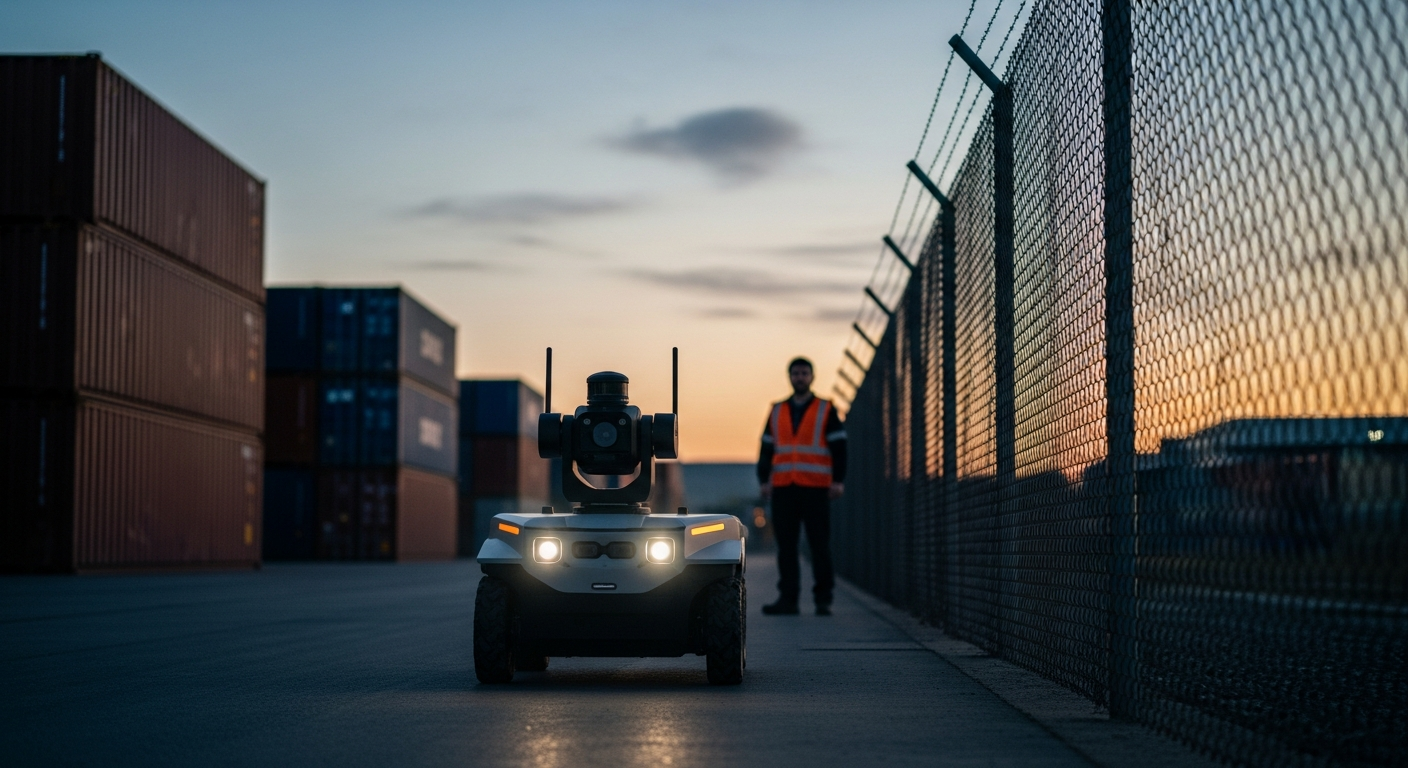
Tuesday, 02:15. Subcamp Hamburg-South. The patrol has been running autonomously for four hours and documents every corner directly in Genetec. While the control center only intervenes when alarms are verified, a single security robot covers areas that previously required several tours on foot. A security guard now controls the security of three locations simultaneously from the control center. This operational reality is not a pilot project, but rather standard in the properties managed by werob. As a system integrator, werob translates such work processes into a usable specification in 48 hours and brings the appropriate robot to the site in eight weeks.
Key Takeaways
- 1Significant annual cost reduction for yard and retail patrols.
- 2Fast implementation in eight weeks from specification to live operation.
- 3Full compliance with EU Machinery Regulation 2023/1230 and IEC 62443.
The status quo of location security in Europe
Over 180,000 locations in Europe are faced with the challenge of finding qualified security personnel for monotonous and sometimes dangerous patrol services. The Guarding Ordinance (BewachVO) places high demands on on-site presence, while the shortage of skilled workers is driving up the costs of personnel guarding. A security robot does not act as a complete replacement for humans, but as a decisive force multiplier. It takes over the complete monitoring of logistics yards, external warehouses or retail areas, while the specialist staff concentrates on intervention and analysis.
werob has recognized this need and created a platform that shortens the process from the initial idea to live operation to eight weeks. Instead of dealing with the technical details of individual manufacturers, operators define their requirements for the shift schedule and the environment. werob's Spec Engine uses data from over 35,000 projects to create a technical specification within 48 hours. This eliminates the usual three to six month discovery phases of traditional consulting firms.
Economic efficiency: Significant cost reduction per year
The decision for robotics in security is primarily made based on the economic outcome. werob works according to an outcome-only model, in which customers only pay when the robot is working productively. The verified figures from live operation show clear savings potential. An automated yard patrol in logistics leads to a significant annual cost reduction per location. In retail, the savings from retail patrol are well into the five-digit range per year.
For larger logistics areas that require a fleet of robots, this effect scales significantly. With optimized use, a logistics yard in the network can achieve a significant six-figure reduction in workload per year. These numbers are based on reducing nighttime surcharges, avoiding false alarms through precise sensor technology and increasing monitoring frequency without additional staff. werob ensures that these savings are not offset by hidden integration costs, as all connectors are already pre-built into the operator stack.
Integration into the security stack: Genetec and SAP EWM
A security robot only realizes its full value when it communicates seamlessly with the existing infrastructure. werob supplies ready-to-use connectors for market-leading systems. The integration into Genetec allows video streams and sensor data from the robot to be treated like any other stationary camera. Alarms that are triggered by the robot's on-board AI (e.g. person detection in restricted zones or heat sources) appear immediately in the control center's usual dashboard.
The connection to SAP EWM (Extended Warehouse Management) is also crucial for logistics companies. Here we synchronize the patrol routes with the dynamic movements of goods in the warehouse or on the farm. The robot knows which gates are currently active and where increased vigilance is required. This deep integration prevents data silos and ensures that the robotics fleet becomes an integral part of the company's IT landscape rather than acting as an isolated isolated solution.
Regulatory and Compliance: The Path to the EU Machinery Regulation
The regulatory landscape for autonomous systems is becoming more complex. The EU Machinery Regulation 2023/1230 will be binding from January 20, 2027. Many robot manufacturers, especially from outside Europe, do not yet have the necessary conformity assessments for the European market. werob acts as a compliance path here. We ensure that every hardware used meets the strict requirements of the regulation as well as the specific German requirements of the BewachVO.
In addition, cybersecurity plays a central role. Integration into corporate networks requires compliance with IEC 62443 for industrial communication networks. werob continuously monitors this compliance level via the live cockpit. The four-dimensional traffic light system in the cockpit shows the status of the hardware, infrastructure, regulatory compliance and adherence to the original specification at all times. This means operators can always stay on the safe side, even in the event of changes to the law or new security standards.
Hardware agnostics: 44+ OEM partners compared
werob is not a manufacturer and is not tied to individual brands. The company ranks over 44 OEM partners and more than 280 different robot models against customer specifications. In the field of security robotics, this includes leading systems such as ANYbotics for demanding terrain, Boston Dynamics (Spot) for agile inspections or specialized platforms from Robotnik and Taurob. The Supplier Match process ensures that customers receive the system that best suits their specific application, both technically and economically.
This independence protects operators from vendor lock-in. If a manufacturer no longer meets the requirements or a more powerful model comes onto the market, the werob platform enables the fleet to be easily changed or expanded. The connectors to the operator stack remain identical, which increases the company's technological agility. werob takes responsibility for the selection and validation of the hardware, allowing the customer to focus on their operational goals.
From concept to live operation in eight weeks
Speed is a core promise of werob. While classic automation projects often take years, the process at werob is optimized to eight weeks. After the initial work processes have been recorded, the Spec Engine delivers the technical framework within 48 hours. The customer receives a binding offer within five days. The remaining time until the eighth week will be used for configuring the connectors, regulatory acceptance and physical deployment at the site.
This rapid rollout is made possible by the standardization of the interfaces. Since werob already operates 200 robots in 11 European countries, most of the challenges in integrating them into systems such as Genetec or SAP EWM have already been solved. The customer does not have to build up their own expertise in robotics, but rather uses werob's ready-made operating level. The goal is clearly defined: 2,000 robots should be controlled via the platform by 2028, which underlines the scalability of the model.
The live cockpit: fleet management in real time
As soon as the security robots are in use, the werob cockpit takes over central control and monitoring. It is the nerve center of the fleet and offers much more than a simple status display. The system monitors hardware health, Wi-Fi or 5G infrastructure stability, and security zone compliance. Particularly critical for security services is the complete documentation of patrols, which is stored in the cockpit in an audit-proof manner, whereby every finding can be traced directly back to the original sensor data source.
The four-dimensional traffic light system proactively warns before problems disrupt operations. For example, if a regulatory change requires an action graph to be adjusted, this will be signaled in the cockpit. This transparency is the basis for the outcome-only model. Since the customer only pays for the successful service, werob has a direct interest in keeping the availability of the fleet at almost 100 percent. This approach creates a true partnership at eye level between integrator and operator.
Conclusion: The future of security is integrated
Automating site security is not a question of 'if', but of 'how'. Security robots offer an answer to rising costs and staff shortages, provided they are correctly integrated into existing processes. werob offers the necessary operating level for this, which combines hardware, software and regulation. With a significant cost reduction per year and a rollout in just eight weeks, getting started with autonomous surveillance is now easier than ever before.
Companies that invest now in scalable robot fleets not only secure an economic advantage, but also meet the upcoming requirements of the EU Machinery Regulation at an early stage. The path leads away from isolated hardware purchases towards an integrated system solution where experts remain in control and AI only automates operational analysis. werob accompanies this path as a hardware-agnostic partner with a deep understanding of operational processes.
FAQ
- How much does a security robot cost at werob?
- werob uses an outcome-only model. There are no classic list prices for the hardware. You only pay when the robot works productively on your area and delivers the defined output.
- Which systems can be connected to the robot?
- werob offers ready-made connectors for security stacks such as Genetec as well as for logistics systems such as SAP EWM. Further integrations are possible via the connector layer of the platform.
- How secure is the robot’s data?
- Safety is the highest priority. werob meets the IEC 62443 standards for industrial cybersecurity and ensures GDPR-compliant processing of all sensor data.
- Will a security robot replace my security guards?
- No, it acts as a force multiplier. The robot takes over monotonous tours, so that an employee has to monitor several locations at the same time and only intervene in the event of real alarms.
- What happens in the event of technical disruptions?
- The werob cockpit monitors the fleet in real time with a 4-dimensional traffic light system. Hardware or infrastructure disruptions are identified and resolved immediately, often before they impact operations.
- Is my terrain suitable for a robot?
- The werob Spec Engine sorts this out in 48 hours. We analyze the surface, slopes and radio coverage to find the right model from over 280 available robots.
Related reading
Guard Robots: Autonomous Security and Operational Integration
Guard robots close the gap between selective monitoring and seamless sensor technology. Learn how werob, as a systems integrator, integrates autonomous patrols into existing security stacks like Genetec.
20 June 2026guard robot monthly rentSecurity robot monthly rental: costs and ROI for security services
Financing security robotics often fails due to non-transparent leasing models. Find out how werob creates calculable cost advantages through hardware agnostics and direct system integration.
20 June 2026security robotSecurity Robot: Deploying Autonomous Patrols in Eight Weeks
Autonomous security robots are no longer experimental. By integrating hardware-agnostic platforms with existing VMS like Genetec, operators are achieving annual cost offsets of 68,000 Euro per site while ensuring compliance with the EU Machinery Regulation 2023/1230.
6 August 2026unitree b2 securityUnitree B2 Security: Integrating Quadruped Robotics into Operations
The Unitree B2 represents a shift in industrial security from static cameras to mobile, autonomous sensing. As a systems integrator, werob translates this hardware capability into a compliant, integrated security workflow.
7 August 2026ciborius alternative robotics securityCiborius Alternative: Scaling Robotics Security with werob
Plant security and property protection face structural change. While classic security service providers often rely on personnel, werob, as a hardware-agnostic systems integrator, offers a scalable alternative through autonomous robot fleets.
4 June 2026