Monthly Costs of Care Robots: ROI and Operational Relief
The calculation of care robots is often based on incomplete assumptions about hardware leasing. Learn how to achieve annual cost relief of up to 92,000 euros per site through deep integration into the operator stack.
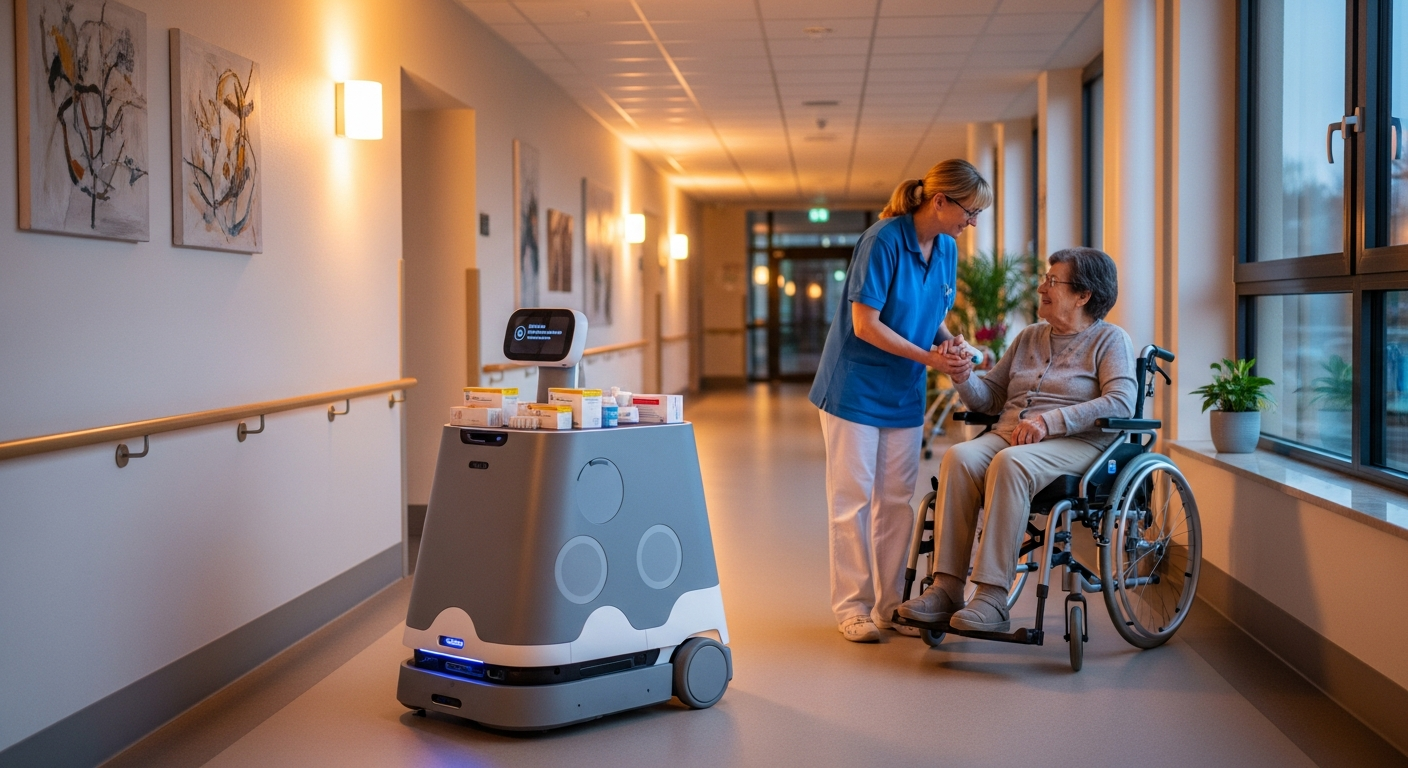
Ward 4. 9:45 PM. The night shift at a Hamburg care facility begins. While a nurse prepares the handover for the remaining colleagues, the robot is already setting off on the first logistics round. It autonomously transports dirty laundry and consumables through the corridors so that staff can remain at the residents' bedside. At this moment, what counts is not the purchase price of the hardware, but the operational availability and the relief of the specialist staff. At werob, we view robotics not as a capital investment, but as a measurable outcome that goes productive within eight weeks. Anyone looking only at the monthly leasing rate overlooks the leverage of system integration.
Key Takeaways
- 1True cost relief is created by workflow automation, not by pure hardware rental.
- 2Medication rounds offer savings potential of 92,000 euros per year and site.
- 3The EU Machinery Regulation 2023/1230 makes a certified compliance pathway mandatory from 2027 onwards.
The Cost Structure Beyond Hardware Rental
In the current debate about the automation of care, many operators mistakenly focus on the list price of a single robot. However, a care robot is not a vacuum cleaner that you unpack and switch on. The monthly costs consist of four levels: hardware provision, software licenses for fleet management, maintenance contracts, and, above all, the costs of integration into existing systems. Anyone who merely leases a robot from a reseller often receives an isolated solution that causes more work in everyday operations than it relieves.
werob breaks open this model. As a systems integrator, we rank over 44 OEM partners against your specific requirements. Our Spec Engine translates your workflows into a deployable specification in 48 hours. The goal is not to own a robot, but to automate a workflow. If a robot costs 2,000 euros per month but is only productive 50 percent of its time due to a lack of integration with elevator management or the care documentation system (EHR), the effective costs per working hour rise massively. A professional calculation must therefore always consider the integration capability with the operator stack such as PointClickCare or MatrixCare.
Verified Cost Relief: 92,000 Euros per Year
The profitability of robotics in care can be measured by concrete numbers. In projects with partners such as Korian Germany, we were able to realize double-digit cost relief in the first year. The leverage is created where highly qualified staff are freed from routine logistical tasks. A central example is the medication round. By deploying specialized transport robots that deliver medications safely from the pharmacy to the wards, care facilities achieve annual cost relief of 92,000 euros per site.
Another area is the general transport of laundry, meals, or waste. Here, the verified relief is 71,000 euros per site and year. These sums far exceed the monthly operating costs of the robot fleet. At werob, we use an outcome-only model. For you as the operator, this means: you only pay when the robot is actually running and fulfilling the defined workflow. This model eliminates the investment risk and shifts the focus from acquisition costs to operational savings. At a Hamburg care facility, the first humanoid has been in twelve-week live operation since May 2026, underscoring the scalability of this technology.
Integration with PointClickCare and MatrixCare
A robot that does not speak with your software is a burden on the IT infrastructure. werob delivers pre-built connectors into the operator stack, including PointClickCare and MatrixCare. This integration is decisive for the monthly cost-benefit calculation. Without these interfaces, nursing staff would have to manually acknowledge tasks in the system or control the robot by hand. Through our connectors, the robot becomes a native part of the digital infrastructure. It receives orders directly from the care management system and reports the status back in real time.
This seamless connection reduces the error rate and increases acceptance among staff. When the nursing management sees in the werob cockpit that hardware, infrastructure, and regulatory requirements are all green, operational security is assured. The cockpit uses a four-dimensional traffic light system to monitor the live operation of the fleet. This minimizes downtime and ensures that the calculated savings actually materialize. Manual monitoring by your own staff is eliminated, further lowering the indirect monthly costs.
Regulation as a Cost Driver: EU Machinery Regulation 2023/1230
An often overlooked factor in the monthly costs is compliance. From January 20, 2027, the EU Machinery Regulation 2023/1230 becomes mandatory. Many Asian OEMs currently do not have the necessary conformity assessments for the European market. Anyone who leases cheap hardware today without a clear compliance pathway risks the shutdown of the fleet or expensive retrofitting from 2027 onwards. werob acts as your shield here. We ensure that all deployed robots comply with European standards, including ISO 13482 for personal care robots.
Compliance with these standards is not only a legal necessity but also secures insurance coverage and acceptance by the care home supervisory authority. In Germany, coordination with the care home supervisory authority is a critical step for every rollout. werob has integrated this process into the Spec Engine. We provide the necessary documentation and regulatory protection as part of our platform service. This way, you avoid unforeseen costs from legal consulting or fines and secure the long-term stability of your investment in automation.
Comparison: Single-OEM vs. werob System Integration
To properly classify the monthly costs, a direct comparison between purchasing from a single manufacturer and using the werob platform helps. A manufacturer will always only sell you its own hardware, regardless of whether it is optimally suited for your specific floor plan or your elevator control. werob, on the other hand, is hardware-agnostic and selects the best solution from over 280 deployable robots.
| Criterion | Single-OEM Reseller | werob Systems Integrator |
|---|---|---|
| Hardware selection | Limited to one brand | 44+ OEMs (agnostic) |
| Integration | Mostly isolated (stand-alone) | PointClickCare, MatrixCare, SAP |
| Compliance | Operator bears risk | EU 2023/1230 pathway integrated |
| Cost model | List price / leasing | Outcome-only (payment upon operation) |
| Speed | 3-6 months planning | 8 weeks until live operation |
This comparison shows that the seemingly lower monthly rates of a single OEM are bought at the price of higher integration costs and regulatory risks. werob offers planning security through a model in which you only pay when the robot is productive.
The Path to Robot Deployment in Eight Weeks
Time is money, especially in the care industry, which suffers from acute staff shortages. Traditional consulting firms often need three to six months for a discovery phase before the first robot is even ordered. werob has radically accelerated this process. Our Spec Engine only requires 48 hours to create a technical specification from your operational descriptions. Within five days, you receive a binding offer, and after eight weeks, the robot is deployed on your ward.
This speed reduces the opportunity cost of waiting. Every month in which your specialists take on logistical tasks that a robot could perform costs you real money. With the outcome-only model, the lengthy budget approval for high investment sums (CAPEX) is also eliminated. The costs are booked as operating expenses (OPEX), which are directly covered by the achieved savings. With 200 robots in live operation in eleven European countries, werob has the necessary experience to efficiently implement even complex multi-site rollouts. Start your specification today and secure the operational relief for your team.
FAQ
- What does a care robot cost monthly at werob?
- werob works with an outcome-only model. There are no rigid list prices. You only pay when the robot is running in your operation and fulfilling the defined workflow. This protects you from investment ruins.
- How much can be saved by using care robots?
- In care, we realize verified relief of 92,000 euros for medication rounds and 71,000 euros for transport tasks per site and year.
- Which software systems can werob connect to?
- We offer pre-built connectors for PointClickCare, MatrixCare, SAP EWM, and many other systems to ensure seamless integration into your stack.
- How long does it take until the first deployment?
- From the first conversation to the finished specification takes 48 hours. A binding offer is available after 5 days, and the robot is usually ready for deployment after 8 weeks.
- Is werob a robot manufacturer?
- No, werob is a hardware-agnostic systems integrator. We select the best hardware for your specific requirements from over 44 OEM partners.
- What happens in case of technical problems?
- We monitor your fleet live via the werob cockpit. Our 4-dimensional traffic light system immediately detects faults in hardware, infrastructure, or regulation and enables rapid remediation.
Related reading
Renting Care Robots: Costs, Benefits, and System Integration
The decision to rent care robots is often the first step toward relieving specialist staff. But without the right software connection and regulatory protection, the hardware remains ineffective.
14 June 2026amortization robot carePayback of robots in care: ROI analysis for operators
The payback of robots in care does not depend on the hardware, but on the integration into the workflow. Find out how you can save up to 92,000 euros per year through automated medication rounds and transport routes.
21 June 2026rent robots monthlyRenting robots monthly: costs and models for operators
Monthly rental of robots offers operators financial flexibility without high investment risk. As a system integrator, werob enables deployment within eight weeks through manufacturer-independent integration and a purely results-oriented model.
1 July 2026guard robot monthly rentSecurity robot monthly rental: costs and ROI for security services
Financing security robotics often fails due to non-transparent leasing models. Find out how werob creates calculable cost advantages through hardware agnostics and direct system integration.
20 June 2026staff shortage care robot solutionShortage of staff care robot solution: Efficiency through integration
The shortage of personnel in nursing requires immediate operational relief instead of lengthy consultation cycles. werob translates care workflows into usable robot specifications in 48 hours and integrates them directly into the existing IT stack.
26 June 2026