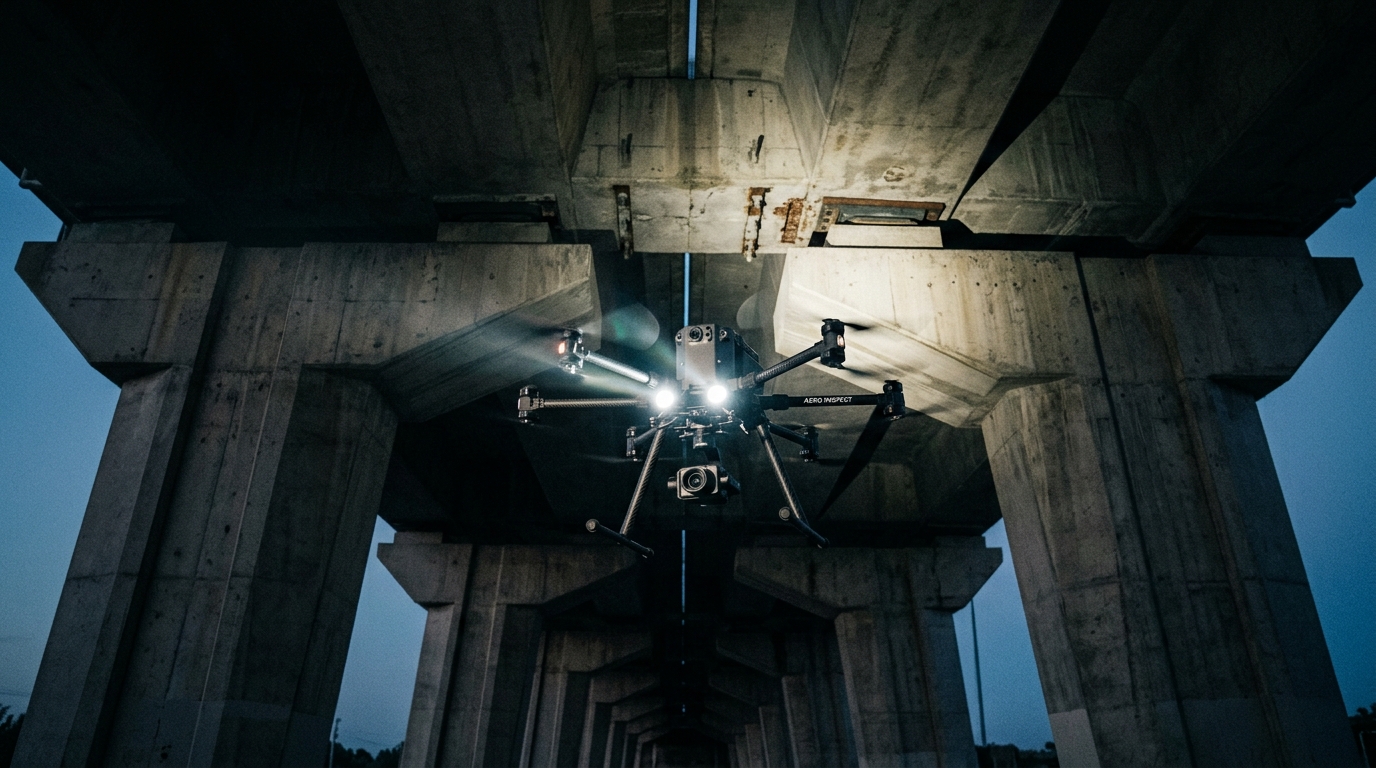
Drone-based bridge inspection: reaching the soffit without a closure
Learn how drone bridge inspection accesses soffits and bearings under DIN 1076 without closures, helping overcome construction skilled worker shortages.
Conducting drone-based inspection of bridge soffits, bearings, and piers eliminates lane closures and rope access. While flights do not replace a DIN 1076 inspection, they dramatically shorten the gap between mandatory audits.
Key Takeaways
- 1Drone flights inspect bridge soffits and bearings safely, avoiding traffic closures on Germany's federal trunk road bridges.
- 2Aerial surveys do not replace a DIN 1076 inspection but provide a critical intermediate step to shorten the safety gap between audits.
- 3Using drones addresses labor issues as the German construction sector faces a forecast shortage of skilled workers.
- 4The werob Platform acts as a manufacturer-independent integrator, helping construction companies deploy optimized hardware.
The infrastructure crisis: Germany's aging bridge network
Germany is facing a massive logistical challenge across its transport corridors. The vast network of aging bridges on federal trunk roads requires constant monitoring. Today, many of these structures are subject to heavy traffic volumes far exceeding their original design parameters. Visual inspection is critical to identify defects early, yet traditional monitoring methods struggle to keep pace with the degradation of these concrete assets.
For professional craftsmen and construction supervisors, the physical realities of conventional inspections represent a persistent headache. Assessing critical areas like the bridge soffit, piers, and bearings typically requires specialized rope access teams or under-bridge inspection units. These methods inevitably lead to lane closures, major traffic disruptions, and high operational costs. To address this bottleneck, a new approach is emerging: using autonomous aerial systems via a manufacturer-independent robot integrator to capture highly detailed visual data without disrupting traffic.
- Accelerated assessment cycles that shorten the critical gap between mandatory DIN 1076 main inspections.
- Complete physical coverage of hard-to-reach areas including the bridge soffit, bearings, and piers.
- Eliminating the need for active road closures, keeping traffic flowing and protecting inspectors from roadside hazards.
By deploying advanced drone systems integrated through the werob Platform, operators do not seek to replace official DIN 1076 structural tests. Instead, they establish a reliable intermediate monitoring routine. This seamless integration ensures continuous digital documentation of concrete cracks and structural fatigue, empowering decision-makers with real-time data from the field.
Traditional bridge inspection: The cost of rope access and closures
For the 40,264 bridges on German federal trunk roads (BASt, March 2026), maintaining structural integrity is a continuous challenge. Under DIN 1076, regular structural inspections are legally mandated, requiring a simple check every three years and a comprehensive evaluation every six years. Inspecting hard-to-reach components like the bridge soffit, bearings, and piers traditionally relies on industrial rope access climbers, cherry pickers, or under-bridge units. However, these manual methods require extensive lane closures, which heavily drain public budgets and cause severe traffic congestion.
This operational burden is compounded by severe skilled labor shortages in the construction sector. The German Construction Industry Association (HDB) forecasts a shortage of over 100,000 skilled workers in the construction industry by 2030 (HDB forecast 2022). With 81,890 construction companies (HDB, June 2025) already competing for limited human resources, relying purely on manual industrial climbers for routine visual checks is increasingly unsustainable. This labor bottleneck restricts the capacity of public authorities to maintain strict inspection schedules.
- Safety Hazards: Climbers face severe occupational risks working at heights under bridge decks.
- Bureaucratic Delays: Coordinating road closures and hiring cherry pickers require weeks of administrative approval.
- High Costs: Setting up scaffolding or under-bridge platforms drains municipal budgets rapidly.
Drone-based aerial inspections offer a safer, faster alternative to evaluate bridge soffits, bearings, and piers without requiring lane closures or rope access climbers. While an aerial flight does not replace a formal DIN 1076 engineering inspection, it efficiently shortens the safety gap between these mandated evaluations. As a manufacturer-independent robot integrator, werob utilizes the werob Platform to help operators design and deploy optimized drone inspection workflows, matching the best aerial systems to specific structural needs and ensuring seamless data collection without traffic disruption.
Drone-based aerial inspections: Precision beneath the deck
Traditional bridge maintenance places immense strain on craftsmen and construction supervisors. In Germany alone, there are 40,264 bridges on federal trunk roads according to the Federal Highway Research Institute (BASt) as of March 2026, many of which require close monitoring. While full-scale hands-on inspections under DIN 1076 are legally mandated every six years, utilizing autonomous drone-based aerial inspections is an efficient way to shorten the gap between these cycles. As a manufacturer-independent robot integrator, werob enables operators to deploy multi-sensor drone technology to capture high-resolution imagery of critical structural elements without interrupting traffic or initiating costly lane closures.
Instead of setting up massive under-bridge inspection units, erecting complex scaffolding, or relying on high-risk rope access, drones fly directly beneath the deck. These specialized aerial systems are equipped with millimeter-level cameras and thermal sensors to safely inspect the bridge soffit, piers, and bearings. By navigating difficult, enclosed spaces beneath the bridge deck, they allow supervisors to visually track concrete fatigue, hairline cracks, and structural wear with absolute precision.
- Bridge soffit capture: Multi-sensor drones fly directly underneath the deck, capturing clear vertical imagery of the concrete ceiling.
- Pier and bearing visualization: Millimeter-level optical sensors document the exact condition of bearings and tall supporting columns.
- Non-disruptive deployment: No under-bridge work platforms or lane closures are required, keeping traffic flowing freely above.
- Continuous monitoring: Repeated flights allow teams to track the progression of cracks and concrete spalling between mandatory DIN 1076 schedules.
By coordinating these drone operations through the unified werob Platform, supervisors gain access to centralized data. While drone flights do not replace a DIN 1076 hands-on inspection, they act as an invaluable diagnostic tool, ensuring minor defects are caught before they turn into major structural failures.
DIN 1076 compliance: Bridging the gap between manual inspections
In Germany, structural integrity is governed by strict regulatory frameworks. Under the DIN 1076 standard, bridge owners must adhere to a rigid dual-structure: a simple inspection (Einfache Prüfung) occurs every three years, while an intensive, hands-on main inspection (Hauptprüfung) is mandated every six years. For construction supervisors and maintenance engineers, managing this schedule across Germany's vast network (which includes 40,264 bridges on federal trunk roads as of March 2026 according to BASt data) is a major logistical challenge. Drone-based surveys do not replace these legally mandated physical assessments. Instead, they serve as a powerful intermediate monitoring layer that significantly shortens the safety gap between formal inspections.
Why drones complement tactile testing
The six-year Hauptprüfung requires close-up, tactile methods such as hammer-tapping to locate concrete delamination or internal structural decay. While aerial inspections cannot replicate these physical, hands-on tests, they provide unparalleled high-resolution imagery of hard-to-reach areas like the bridge soffit, bearings, and piers without requiring road closures. This continuous oversight is vital. It is especially critical given that the German construction sector is facing an acute skilled-worker shortage forecast by the HDB in 2022 to exceed 100,000 workers by 2030, which severely limits the availability of specialized physical inspection crews. As a manufacturer-independent robot integrator, werob helps engineering teams implement drone flights to spot cracks or moisture penetration early.
- Early anomaly detection: Catching hairline cracks and concrete spalling before they compromise structural safety.
- Targeted maintenance: Creating precise visual maps to help manual crews focus their physical testing exactly where defects are suspected.
- Risk mitigation: Minimizing the need for dangerous rope-access operations or costly lane closures during routine interim checks.
Integrating drone technology with the werob Platform
Public authorities and the 81,890 construction companies operating as of June 2025 face mounting pressure to maintain aging infrastructure. On the 40,264 bridges on federal trunk roads, traditional structural inspections demand complex rope access and expensive lane closures. While a drone flight does not replace a formal DIN 1076 inspection, deploying autonomous aerial systems on the wedrone side significantly shortens the gap between these mandatory regulatory intervals. By capturing detailed visual evidence of the bridge soffit, bearings, and piers without closing traffic, operators keep transport networks moving. As a manufacturer-independent robot integrator, werob provides the precise software tools required to plan, source, and execute these aerial missions.
Sourcing and workflow standardization
Integrating drone technology through the werob Platform begins with selecting the optimal hardware without vendor lock-in. Using the Supplier Match database, operators can screen and rank specialized aerial systems based on payload capacity, regulatory readiness, and technical specs. Once matched, the Spec Engine translates natural-language flight and inspection parameters into formally verified, ROS-compatible action plans within 48 hours. This software-driven approach standardizes aerial workflows, ensuring that every flight path under a bridge soffit is pre-verified, repeatable, and highly precise. The resulting inspection reports are consolidated in a unified dashboard, enabling technical teams to monitor structural health proactively.
- Unbiased sourcing: Selection via Supplier Match ensures the best hardware for specific bridge geometries without manufacturer lock-in.
- Standardized flights: The Spec Engine generates ROS-compatible action plans to automate precise flight paths around complex piers and bearings.
- Optimized scheduling: Safe, regular drone surveys maintain high-quality data in the years between formal DIN 1076 structural inspections.
Real-time monitoring and data management with Cockpit and Connectors
Capturing bridge soffits, bearings, and piers by drone using the wedrone aerial side approach eliminates the immediate need for lane closures and rope access. However, the raw visual data collected from Germany's 40,264 bridges on federal trunk roads (BASt, March 2026) must be processed and actioned quickly. As a manufacturer-independent robot integrator, werob does not build hardware but seamlessly deploys it. By managing drone inspection logs, supervisors can systematically shorten the gap between mandatory DIN 1076 inspections.
This is where Cockpit and Connectors become essential. Visual inspection imagery and flight logs are aggregated directly into the Cockpit dashboard. Instead of wading through hundreds of loose image files, construction supervisors monitor structural metrics using real-time traffic lights across hardware, infrastructure, regulatory, and specification dimensions. If a drone captures a critical structural anomaly, the platform manages escalating alerts. This ensures severe concrete cracking or bearing damage is immediately flagged and routed to the correct repair teams before a minor issue escalates.
- Continuous Data Flow: Pre-built Connectors link drone telemetry and visual logs directly into central maintenance databases, eliminating manual file uploads.
- Structured Health Audits: The Cockpit dashboard displays real-time operational metrics, simplifying tracking for ongoing maintenance tasks.
- Targeted Labor Allocation: With a projected skilled-worker shortage of over 100,000 specialists by 2030 (HDB forecast 2022), automated alerts optimize field crew deployment across Germany's 81,890 construction companies (HDB, June 2025).
Future-proofing structural monitoring across German infrastructure
The challenge of maintaining Germany's massive transport and utility networks is scaling rapidly. Manual structural monitoring of these dispersed assets places an unsustainable demand on available labor. Integrating aerial drone workflows allows operators to capture bridge soffits, bearings, and piers safely without requiring lane closures or risky rope access. While this agile approach does not replace a formal DIN 1076 inspection, it significantly shortens the critical inspection gaps between them, ensuring structural defects are caught early.
- The 40,264 bridges on federal trunk roads overseen by the Bundesanstalt für Straßenwesen (BASt) as of March 2026
- The 37,900 km extra-high-voltage grid regulated by the Bundesnetzagentur (BNetzA) as of the end of 2024
- The nation's 30,906 wind turbines operating as of the end of 2025
For the 81,890 construction companies active in Germany as of June 2025, transition to automated workflows is no longer optional. The Hauptverband der Deutschen Bauindustrie (HDB) forecast from 2022 predicted a skilled-worker shortage of over 100,000 workers by 2030, a gap that directly threatens maintenance schedules. To bridge this divide, werob acts as a manufacturer-independent systems integrator rather than a hardware producer. Through the werob Platform, construction supervisors and craftsmen can deploy tailored robotic and aerial workflows to mitigate severe labor shortages while keeping critical infrastructure safe and continuously monitored.
FAQ
- Does a drone flight replace a DIN 1076 bridge inspection?
- No, a drone flight does not replace a DIN 1076 inspection. Instead, it acts as an intermediate tool that shortens the gap between mandatory audits. Under DIN 1076, a comprehensive hands-on Hauptprüfung must occur every six years, requiring close tactile contact to assess structural integrity. Drones serve as a powerful supplementary tool, providing visual monitoring for difficult areas like deck soffits and bearings during simple inspections or routine monitoring between major audits.
- How do drones access bridge soffits without lane closures?
- Drones can fly directly beneath the bridge deck to capture high-resolution images of soffits, piers, and bearings. By operating from adjacent safe areas or under-bridge zones, they eliminate the need for industrial rope access or heavy under-bridge inspection vehicles. This prevents costly lane closures and traffic jams on key transport routes, ensuring that highway operations continue smoothly while engineers collect precise visual data.
- How many bridges are monitored on Germany's federal road network?
- According to the Federal Highway Research Institute (BASt), there are 40,264 bridges on federal trunk roads as of March 2026. This vast network requires constant, highly structured monitoring to manage aging concrete structures and maintain national transport safety.
- Can drones help solve the skilled worker shortage in German construction?
- Yes, by automating visual inspection workflows, drones help mitigate severe labor constraints. The Hauptverband der Deutschen Bauindustrie (HDB) forecast in 2022 a shortage of 100,000+ skilled workers in the construction sector by 2030. Drones allow small engineering teams to cover more structures in less time without requiring extensive physical climbing crews.
- What role does werob play in drone-based bridge inspections?
- As a manufacturer-independent robot integrator, werob does not manufacture drone hardware. Instead, the company helps public authorities and some of Germany's 81,890 construction companies integrate the best drone technology. Through the werob Platform, organizations can plan missions, source ideal hardware via Supplier Match, and track inspections using Cockpit.
- What other German infrastructure can be monitored using werob integrations?
- Beyond Germany's 40,264 federal road bridges, the robotic integrations coordinated by werob can monitor other major utility and energy networks. This includes the 37,900 km extra-high-voltage power grid recorded by BNetzA at the end of 2024, as well as Germany's 30,906 wind turbines operating at the end of 2025.
Related reading
Drone dike inspection: from the single flight to a programme
Coverage, repeatability and an evidence trail — not sharper eyes. What operators must set up to turn drone flights over flood defences into a running inspection programme.
28 August 2026onboard drone autonomyOnboard Drone Autonomy: What Changes for Operators
The question is not whether the aircraft can fly itself. It is what you have to be able to show once it does — indoors, on containment, on link loss, and in procurement.
31 August 2026offshore drone inspection wind turbineOffshore drone inspection: wind farms, platforms and the limits of flying over water
What drone inspection actually delivers offshore: the German wind stock in numbers, the regulatory frame after SORA 2.5, and the operational limits of flying without a landing option.
24 July 2026drone dam inspectionMonitoring dams and reservoirs from the air: deformation and seepage over time
Learn how the wedrone platform standardizes multi-pass aerial monitoring to detect structural deformation and dam seepage over time with millimeter precision.
17 July 2026subsea robotics rov auv inspectionSubsea robotics: what ROV and AUV inspection delivers today
German offshore wind sits in 31 m of water on average. That single figure decides which underwater vehicle, which vessel and which approval an inspection campaign really needs.
22 July 2026