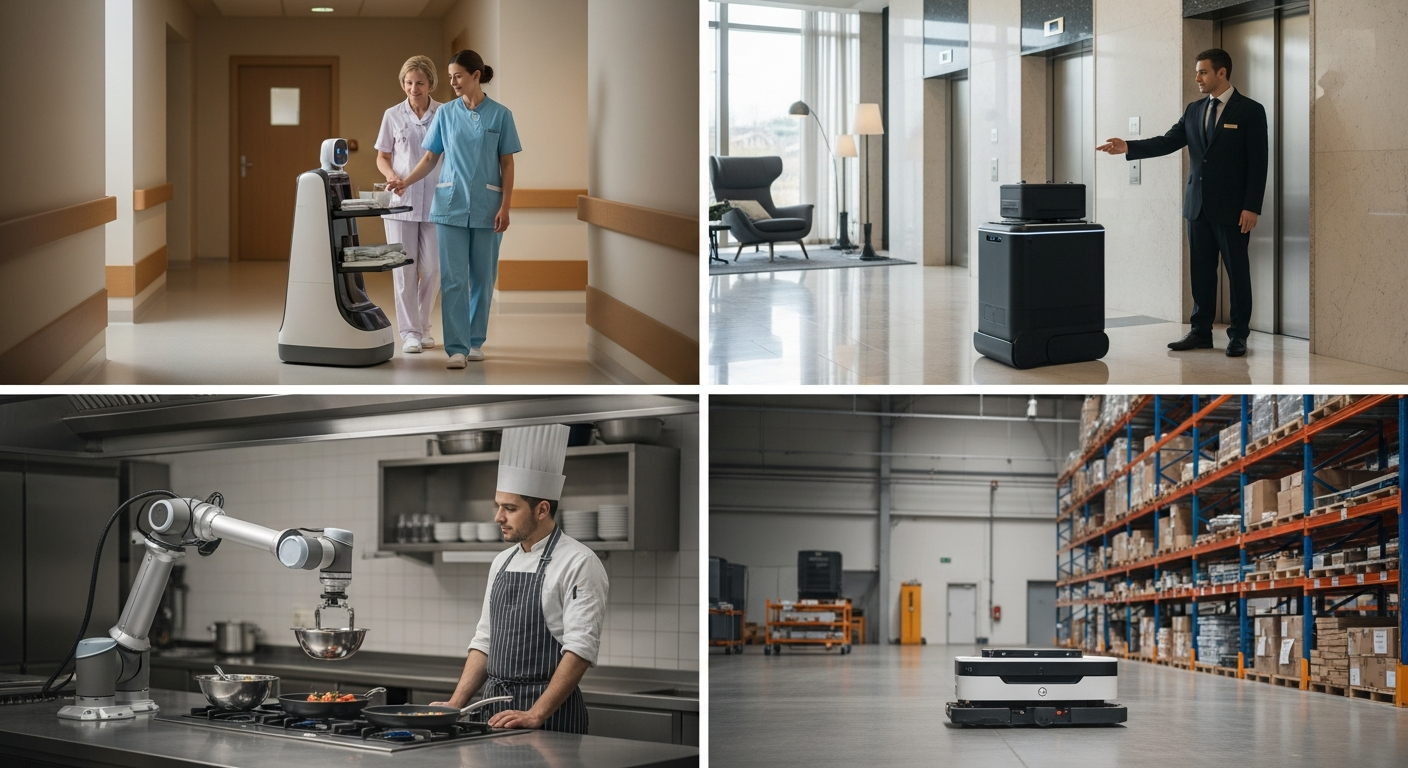
Robot Cell Simulation Europe: From Spec to Live in 8 Weeks
Moving from a manual workflow to a robotic cell requires more than a purchase order. It requires a validated simulation that accounts for infrastructure, regulatory compliance, and stack integration. werob provides the operating layer to move from spec to live operation in eight weeks.
Floor 4. 03:00. A logistics yard in Hamburg. The autonomous patrol robot pauses at a gate that was not in the original CAD drawing. In a traditional deployment, this discrepancy would lead to weeks of troubleshooting and downtime. In a werob-integrated environment, this scenario was solved three weeks before the hardware arrived on site. Robot cell simulation is no longer a luxury for automotive giants; it is the mandatory first step for any operator in senior living, hospitality, or logistics looking to offset labor costs without risking operational failure. By simulating the robot action graph against the physical environment and the software stack, operators move from uncertainty to a live, revenue-positive fleet in exactly eight weeks.
Key Takeaways
- 1Robot cell simulation is mandatory for compliance with EU Machinery Regulation 2023/1230 by January 2027.
- 2werob's Spec Engine reduces the discovery phase from months to 48 hours using a fine-tuned model of 35,000+ projects.
- 3A hardware-agnostic approach allows for ranking 44+ OEMs to find the best fit for specific vertical cost offsets like the €112k hotel room service offset.
The Shift from Discovery Decks to Digital Twins
For years, the robotics industry has been plagued by the discovery deck. Consultants spend months mapping workflows and creating slide decks that fail to account for the reality of the floor. werob replaces this cycle with the Spec Engine. This platform layer converts an operator's words regarding shifts, floors, and tasks into a deployable robot action graph within 48 hours. The simulation is not just a visual representation; it is a technical validation of the workflow against 35,000+ previously analyzed projects.
When a senior living facility identifies a medication round as a candidate for automation, the simulation must account for elevator wait times, hallway widths, and human interaction. In this vertical, the cost offset for a medication round is €92k per site per year. A simulation that fails to account for a 30-second elevator delay can erode 15% of that margin. werob's hardware-agnostic approach means the simulation ranks 44+ OEM partners against the specific spec, ensuring the chosen hardware-whether from Keenon, Pudu, or a humanoid provider like Apptronik-is physically capable of the task before a single euro is spent on shipping.
Regulatory Forcing Functions: EU Machinery Regulation 2023/1230
The regulatory landscape in Europe is shifting. The EU Machinery Regulation 2023/1230 becomes mandatory on January 20, 2027. This is the primary forcing function for robot cell simulation today. Any operator deploying autonomous systems must ensure that their fleet meets these new safety and conformity standards. werob acts as the compliance pathway, building these regulatory requirements directly into the simulation phase.
Simulation allows for the testing of safety zones, emergency stop triggers, and human-robot collaboration protocols in a risk-free digital environment. For a logistics yard patrol, where the cost offset is €68k per year, compliance with BewachVO and IEC 62443 is non-negotiable. The simulation validates that the robot's sensor suite and software logic adhere to these standards. By the time the robot reaches the floor, the conformity assessment is already supported by simulation data, reducing the legal risk for the Director of Operations and the Compliance Lead.
Hardware-Agnostic Matching and OEM Ranking
A common mistake in robotics procurement is starting with the hardware. An operator sees a robot at a trade show and tries to force it into their workflow. werob reverses this. The Supplier Match layer of the platform ranks 280 different robots from 44+ OEMs against the validated spec. The simulation determines which hardware platform actually delivers the highest uptime and efficiency for the specific site.
In a hotel room service use case, where the cost offset is €112k per year, the simulation might show that a specific service robot from Keenon outperforms a competitor due to its superior navigation in narrow corridors. Because werob is not a manufacturer and not a single-OEM reseller, the simulation is unbiased. It is a performance-driven ranking. This hardware-agnosticism prevents vendor lock-in and ensures that as new models from partners like Boston Dynamics or Unitree enter the market, the operator can swap or scale their fleet based on simulated performance data rather than marketing claims.
Integration into the Operator Stack
A robot that cannot talk to the building or the business software is a liability. Robot cell simulation must include the digital interface. werob provides pre-built Connectors into major operator stacks, including SAP EWM, Mews, Opera PMS, Toast, and PointClickCare. The simulation validates the data handshake between the robot and these systems.
For example, in a hospitality setting using Mews or Opera PMS, the simulation tests the trigger: a guest orders room service, the PMS notifies the robot, the robot calls the elevator, and the delivery is logged. If the latency in the API connection exceeds three seconds, the simulation flags it. This prevents the 'silo effect' where robots operate in isolation from the rest of the business. By the time the deployment goes live in week eight, the software integrations are already stress-tested. This level of technical precision is why werob currently manages 200 robots live across 11 European countries, with a target of 2,000 robots by 2028.
The 8-Week Deployment Timeline
Speed is a competitive advantage. The industry norm for robotics deployment is three to six months of discovery followed by a pilot. werob delivers a live robot on the floor in eight weeks. This is made possible by the front-loading of work in the simulation phase. The 48-hour spec and five-day quote process mean that by the end of week one, the technical and commercial frames are set.
Weeks two through six are focused on digital validation and connector configuration. While the hardware is in transit, the digital twin is already running the workflow. This allows the operator to train staff on the virtual model before the physical robot arrives. In a senior living transport use case, which offers a €71k annual cost offset, this eight-week timeline means the facility starts capturing ROI months earlier than with traditional integrators. The simulation ensures that day one of live operation is a full production day, not a testing day.
Outcome-Only Commercials and ROI
werob operates on an outcome-only commercial model. Operators pay nothing until the robot is running on the floor. This shifts the risk from the buyer to the integrator and necessitates a high-fidelity simulation. If the simulation is inaccurate, the deployment fails, and werob does not get paid. This alignment of interests is unique in the European market.
| Vertical | Use Case | Annual Cost Offset |
|---|---|---|
| Senior Living | Medication Round | €92,000 |
| Hospitality | Room Service | €112,000 |
| F&B Chains | Tray-Bot (Dishroom) | €76,000 |
| Logistics | Yard Patrol | €68,000 |
| Golf Clubs | Ball Collection | €38,000 |
These numbers are not theoretical. They are verified outcomes from live sites, such as Korian Deutschland, where robots have delivered double-digit cost offsets in year one. The simulation phase is where these savings are locked in by optimizing the robot's pathing and task frequency to maximize displacement of manual labor hours.
The Live Cockpit: Beyond Simulation
Once the eight-week deployment is complete, the simulation data transitions into the Cockpit. This is the live fleet management layer that provides 4-dimensional traffic lights for every robot: hardware health, infrastructure status, regulatory compliance, and spec adherence. The Cockpit allows the Director of Operations to monitor the entire fleet across multiple sites from a single interface.
If a robot's performance deviates from the simulated baseline, the Cockpit alerts the operator immediately. This proactive supervision is critical for maintaining the high uptime required to achieve the stated cost offsets. Whether it is a humanoid pilot in a Hamburg senior living facility or a fleet of tray-bots in a QSR chain, the Cockpit ensures that the digital twin and the physical reality remain in sync. This continuous feedback loop informs future simulations, making the Spec Engine smarter with every hour of live operation.
Starting the Simulation Process
The path to a simulated and validated robotic cell begins with an eight-step intake process. This intake captures the essential data: the shift details, the shape of the task, site infrastructure, and regulatory requirements. Unlike consulting firms that require weeks of meetings to gather this information, werob's intake is designed for speed and operational specificity.
Within 48 hours of completing the intake, the operator receives a deployable spec. This spec is the foundation for the simulation and the eventual deployment. For any facility manager or operations director currently struggling with labor shortages or rising costs, the message is clear: the technology is ready, the regulatory pathway is defined, and the commercial risk has been removed. The transition to robotics is no longer a question of 'if' but a question of how quickly the simulation can be validated.
FAQ
- What is the primary benefit of robot cell simulation?
- The primary benefit is the digital validation of a workflow before physical deployment. This reduces operational risk, ensures compatibility with existing software stacks like SAP or Mews, and confirms compliance with EU safety regulations, leading to a guaranteed eight-week path to live operation.
- How does werob handle different robot manufacturers in one simulation?
- werob is hardware-agnostic. The platform ranks 44+ OEM partners and 280 different robots against the operator's specific spec. The simulation tests these different hardware options digitally to determine which one provides the highest efficiency and ROI for the specific task.
- Is simulation required for EU Machinery Regulation 2023/1230?
- While the regulation does not explicitly mandate simulation, it requires rigorous safety and conformity assessments. Simulation is the most efficient and reliable way to document and validate these safety protocols, making it the standard compliance pathway for European operators.
- Can simulation predict the exact cost savings of a robot?
- Yes. By simulating the exact shift and task, werob can predict cost offsets with high precision. For example, senior living medication rounds typically see a €92k annual offset, while hotel room service can reach €112k. Simulation confirms these figures against site-specific variables.
- How long does it take to get a simulation and quote?
- werob provides a deployable spec within 48 hours of the initial intake and a firm quote within five days. The entire process from spec to a live robot on the floor takes eight weeks.
- What software integrations are tested during simulation?
- werob tests pre-built connectors into the operator's stack, including PointClickCare, MatrixCare, Opera PMS, Mews, Toast, Lightspeed, GolfNow, Genetec, and SAP EWM. This ensures the robot can communicate with the building and business systems from day one.