AI Robot Specification Platform: From Workflow to Floor in 8 Weeks
Traditional robotics procurement is broken by three-month discovery cycles and vendor lock-in. werob replaces consulting decks with an AI-driven Spec Engine that translates operational workflows into technical requirements within 48 hours.
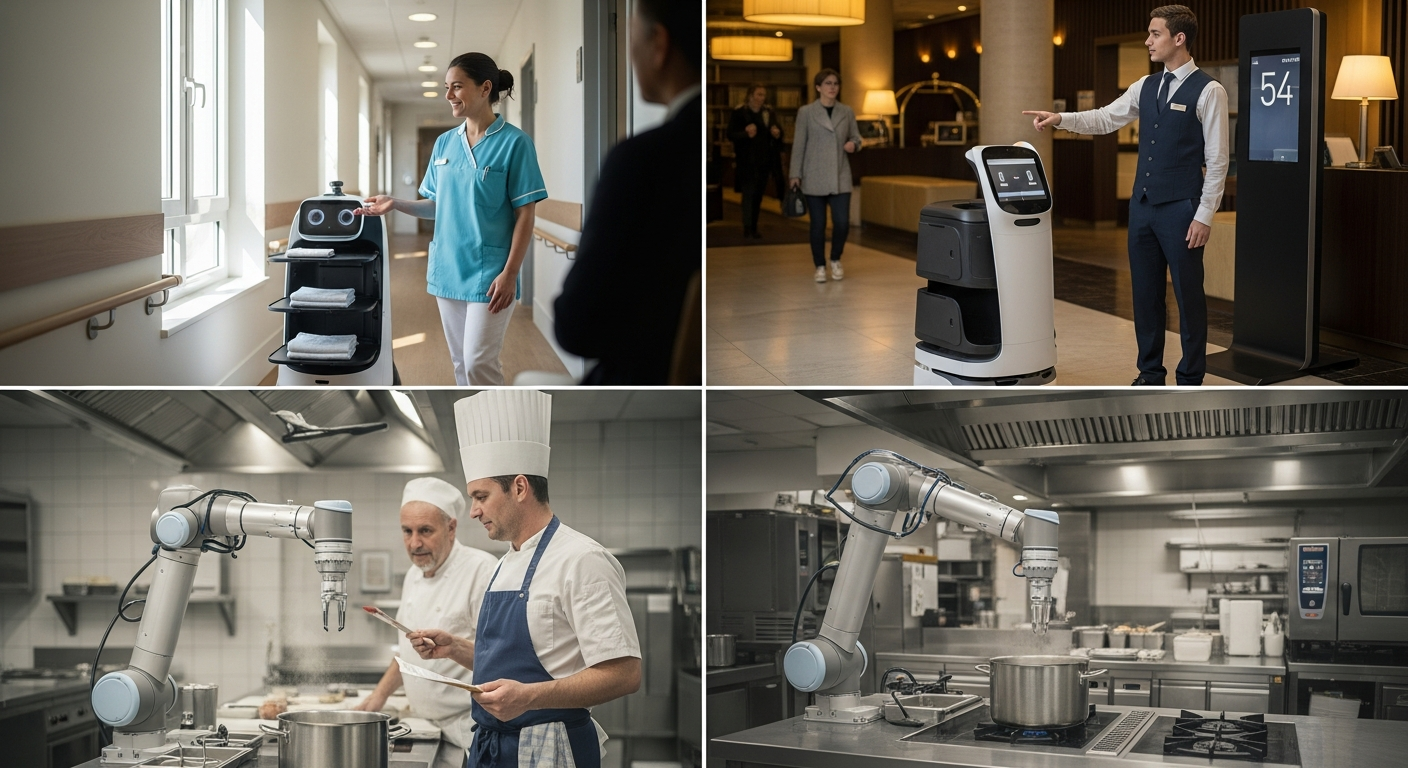
Floor 4. 03:00. The night shift supervisor at a Korian Deutschland senior living facility is managing the medication round. Instead of manual transport, a robot handles the heavy lifting between the pharmacy and the ward. This deployment did not begin with a three-month discovery phase or a stack of consulting slides. It started with a workflow-to-spec translation that took exactly 48 hours. In high-stakes environments like healthcare, hospitality, and logistics, the bottleneck is no longer the hardware. The bottleneck is the specification. werob operates as the systems integrator that removes this friction, moving from a verbal description of a shift to a live robot on the floor in eight weeks.
Key Takeaways
- 1The Spec Engine reduces the time from workflow description to technical specification from months to 48 hours.
- 2Hardware agnosticism allows operators to rank 44+ OEMs and 280 robots to find the best fit without vendor lock-in.
- 3EU Machinery Regulation 2023/1230 compliance is built into the platform, mitigating legal risks for deployments after January 2027.
The Failure of Traditional Robotics Procurement
For most enterprise operators, the path to robotics is stalled by the discovery trap. Traditional integrators often require three to six months of site visits, workshops, and feasibility studies before a single quote is issued. This delay is usually caused by the lack of a standardized language between operational needs and technical hardware capabilities. A Director of Operations describes a shift in human terms, while a robot manufacturer speaks in degrees of freedom and payload capacity. This translation gap leads to misaligned expectations and failed pilots.
werob solves this by acting as the operating layer between the operator and the manufacturer. As a hardware-agnostic systems integrator, werob does not sell a specific brand of robot. Instead, it provides a platform that ranks 44+ OEM partners against a specific operational requirement. This approach eliminates vendor lock-in and ensures that the hardware selected is the best fit for the task, whether that task is a medication round in a care home or yard patrol in a logistics hub. By shifting the focus from the machine to the workflow, the platform reduces the time to spec from months to 48 hours.
The Spec Engine: Translating Words into Action Graphs
The core of the werob platform is the Spec Engine. This AI-driven tool is fine-tuned on data from over 35,000 projects, allowing it to convert a simple description of a shift into a deployable robot action graph. When an operator defines a task-such as 'collecting used trays from the dining room and delivering them to the dishroom'-the Spec Engine breaks this down into technical parameters: navigation requirements, battery duty cycles, payload weight, and sensor density.
This process removes the subjectivity of manual consulting. The resulting specification is a technical blueprint that can be understood by any of the 280+ robots in the werob catalogue. This speed promise is central to the platform's value proposition: 48 hours to a full specification and five days to a firm quote. For organizations managing multiple sites, this allows for rapid horizontal scaling. Once a workflow is specified for one location, the Spec Engine can adapt it for dozens of others, accounting for local infrastructure variations while maintaining the core operational logic.
Supplier Match: Ranking 44+ OEMs Against the Spec
Once the specification is finalized, the platform moves to the Supplier Match layer. Unlike a reseller who is incentivized to push a specific brand, werob ranks 44+ OEM partners based on their ability to meet the spec. This includes established names like Boston Dynamics, Keenon, and Pudu, as well as emerging humanoid manufacturers like Apptronik and Unitree. The ranking is based on four dimensions: hardware capability, infrastructure compatibility, regulatory compliance, and commercial fit.
This hardware-agnostic approach is critical for long-term fleet resilience. If a specific manufacturer faces supply chain issues or fails to update their software, the operator is not stranded. The Spec Engine allows the operator to swap hardware providers without redesigning the entire workflow. As of May 2026, werob has 200 robots live in operation across 11 European countries, proving that the ability to match the right robot to the right task is more valuable than the hardware itself. The platform considers 280 different robots, ensuring that the selection is driven by data rather than marketing brochures.
The Regulatory Forcing Function: EU Machinery Regulation 2023/1230
Compliance is often an afterthought in robotics pilots, but it is the primary reason many projects fail to move to full production. The regulatory landscape in Europe is tightening, with the EU Machinery Regulation 2023/1230 becoming mandatory on January 20, 2027. This regulation places significant responsibility on the entity that integrates the robot into a workspace. For operators using robots from non-EU manufacturers, the burden of conformity assessment can be overwhelming.
werob provides a built-in compliance pathway for this regulation. By acting as the systems integrator, werob handles the mandatory conformity assessments and ensures that every deployment meets ISO 13482 standards for personal-care robots and local requirements like the German Heimaufsicht for senior living. This regulatory cover is essential for Directors of Operations who need to ensure that their fleet is not only productive but also legally compliant. The platform's Cockpit provides a live audit trail, monitoring the fleet's regulatory status alongside its technical health, ensuring that the operation remains compliant as standards evolve.
Integration Architecture: The Connector Layer
A robot that operates in isolation is a liability. To provide real value, robotics must be integrated into the existing software stack of the business. werob's Connector layer provides pre-built integrations into the most common enterprise platforms. For senior living, this includes PointClickCare and MatrixCare. For hospitality, the platform connects directly to Opera PMS and Mews. In logistics and F&B, integrations with SAP EWM, Toast, and Lightspeed are standard.
These connectors allow the robot to become a functional part of the digital workflow. For example, a room service robot in a hotel receives its mission directly from the PMS when a guest places an order. In a logistics yard, a patrol robot can log security incidents directly into Genetec. This eliminates the need for manual intervention and ensures that the data generated by the robot is captured in the system of record. By providing these 'off-the-shelf' connectors, werob reduces the integration phase from months of custom development to a few days of configuration.
Economic Outcomes and Cost Offsets
The ultimate metric for any robotics deployment is the cost offset. werob focuses on high-impact use cases where the economic return is clear and measurable. In senior living, a robot-assisted medication round provides a €92k annualized cost offset per site. General transport tasks in the same sector yield €71k. These are not theoretical projections; they are based on live operations like those at Korian Deutschland.
In the hospitality sector, the numbers are even more pronounced. A hotel room service robot can generate a €112k cost offset per year, while automating bar and breakfast prep saves €54k. In F&B environments, kitchen floor cleaning robots offset €44k, and tray-bots in the dishroom provide €76k in savings. These offsets allow operators to reallocate human staff to higher-value tasks, addressing the chronic labor shortages across these industries. werob's commercial model is outcome-only, meaning the operator pays nothing until the robot is running on the floor and delivering these results.
The Live Cockpit: 4-Dimensional Fleet Management
Once the robots are live, management shifts to the werob Cockpit. This is not just a teleoperation tool; it is a comprehensive fleet management system that uses a four-dimensional traffic light system to monitor hardware, infrastructure, regulatory status, and spec adherence. If a robot deviates from its specified action graph or if a sensor shows signs of wear, the Cockpit alerts the operator before a failure occurs.
This level of visibility is crucial for managing fleets across multiple countries. With 200 robots live in 11 countries, werob provides a single pane of glass for the entire operation. The Cockpit also manages the cybersecurity posture of the fleet, adhering to IEC 62443 standards. This ensures that the networked robots do not become a vulnerability in the operator's IT infrastructure. For the Head of Facility or the CTO, this means that robotics can be managed with the same rigor and security as any other enterprise IT asset.
The 8-Week Deployment Timeline
The speed of deployment is a core differentiator for werob. The process begins with an eight-step intake that captures the shift, the task, and the site infrastructure. Within 48 hours, the Spec Engine produces a technical specification. Within five days, the operator receives a firm quote based on the Supplier Match ranking. From that point, the goal is to have a live robot on the floor within eight weeks.
This timeline is possible because werob has standardized the most difficult parts of the process: the specification, the matching, and the integration. By using pre-built connectors and a hardware-agnostic catalogue, the platform bypasses the traditional delays of custom engineering. For an organization looking to deploy 2,000 robots by 2028, this repeatable, high-speed process is the only viable path to scale. The focus remains on the outcome: a functional, integrated, and compliant robotics fleet that delivers measurable economic value from day one.
Future-Proofing with Humanoid Integration
While service robots currently handle the majority of tasks, the platform is already prepared for the next generation of hardware: humanoids. werob has already conducted humanoid pilots, such as the 12-week operation in a Hamburg senior living facility. The Spec Engine and Supplier Match layers are designed to incorporate humanoids from partners like Apptronik, Figure AI, and Tesla as they become commercially viable.
Because the platform is hardware-agnostic, operators can integrate humanoids into their existing workflows without changing their underlying software stack. The same connectors that link a tray-bot to Toast will link a humanoid to the kitchen's management system. This future-proofing ensures that an investment in the werob platform today will remain relevant as the robotics industry evolves. The platform provides the operating layer that makes any form factor-whether a wheeled delivery bot or a bipedal humanoid-a productive part of the enterprise workforce.
FAQ
- How does an AI robot specification platform save money?
- It eliminates expensive consulting phases and prevents the purchase of incompatible hardware. By matching the exact workflow to the right OEM, it ensures cost offsets such as €92k for medication rounds or €112k for hotel room service.
- What is the difference between werob and a robot manufacturer?
- werob is a systems integrator, not a manufacturer. While manufacturers like Keenon or Pudu build the hardware, werob provides the operating layer that specifies, matches, integrates, and manages the fleet across multiple brands.
- Which software integrations are available?
- werob provides pre-built connectors for PointClickCare, MatrixCare, Opera PMS, Mews, Toast, Lightspeed, GolfNow, Genetec, and SAP EWM.
- Is the platform compliant with European regulations?
- Yes, werob provides a compliance pathway for the EU Machinery Regulation 2023/1230, ISO 13482, and local requirements like the German Heimaufsicht.
- How long does it take to see a robot on the floor?
- The werob promise is 48 hours to a spec, five days to a quote, and eight weeks to a live robot in operation.
- What is the commercial model for werob?
- werob uses an outcome-only commercial model. Operators pay nothing until the robot is running and delivering the specified operational results.