Fleet Sizing Humanoid Robots: Operational Planning Guide
Scaling from a single humanoid pilot to a live fleet requires precise unit density calculations. This guide details how to size humanoid fleets for senior living, hospitality, and logistics using the werob Spec Engine.
Floor 3. 03:15. The night shift lead is managing three wings alone. A humanoid unit completes a perimeter check while another prepares the morning medication trays in the pharmacy hub. This is not a pilot. It is a sized fleet. Moving from a single robot to a scaled operation requires more than just purchasing hardware. It requires a systems integration approach that maps every second of a shift to a specific unit capacity. At werob, we translate these workflows into deployable specs within 48 hours, ensuring that the fleet size matches the operational reality of the floor.
Key Takeaways
- 1Fleet sizing must be based on peak-load action graphs rather than average daily throughput to ensure staff displacement is permanent.
- 2The EU Machinery Regulation 2023/1230 is a mandatory forcing function that dictates safety buffers and unit speeds in all EU deployments by 2027.
- 3Direct stack integration with PMS or EHR systems reduces wasted robot movement and allows for a smaller, more efficient fleet size.
The Unit Density Problem in Humanoid Robotics
Most robotics projects fail during the transition from a single-unit pilot to a multi-unit fleet. The primary reason is a lack of understanding of unit density. Unit density is the number of robots required to cover a specific workload without creating bottlenecks or idle time. In a senior living facility, for example, sizing a fleet for medication rounds requires calculating the travel time between rooms, the time spent at the bedside, and the recharge intervals. If the fleet is undersized, the staff must intervene, negating the cost offset. If it is oversized, the capital efficiency drops.
werob addresses this through the Spec Engine. By analyzing 35,000+ project data points, the engine converts an operator's workflow into a deployable robot action graph. This process takes 48 hours and provides a clear unit count based on the actual shift requirements. For a senior living medication round, the target is often a €92k annual cost offset. Achieving this requires a fleet that can operate autonomously through the peak demand periods of the morning and evening shifts. The sizing must also account for the physical constraints of the facility, such as elevator wait times and hallway width, which dictate how many units can move simultaneously without congestion.
Battery Duty Cycles and Infrastructure Requirements
Humanoid robots are energy-intensive machines. Unlike smaller service bots, humanoids often have shorter operational windows between charges due to the power required for bipedal balance and complex manipulation. Fleet sizing must account for the 'effective uptime' of each unit. If a robot requires two hours of charging for every four hours of work, the fleet size must be increased by 33 percent to maintain continuous coverage. This is where the werob Supplier Match layer becomes critical. We rank 44+ OEM partners, including Apptronik, Figure AI, and Unitree, against your specific duty cycle requirements.
Infrastructure density is the second half of the equation. A fleet of ten humanoids requires a charging strategy that does not overwhelm the local power grid or consume excessive floor space. Operators must decide between centralized charging hubs or distributed swap stations. In logistics environments, where a yard patrol robot might offset €68k in annual costs, the charging infrastructure must be integrated into the patrol route to minimize deadhead travel. werob provides the technical specification for these power requirements as part of the five-day quoting process, ensuring the facility is ready before the robots arrive on site.
Vertical Specifics: Senior Living and Care
In the senior living sector, fleet sizing is driven by the strict schedules of care. A facility like the Hamburg senior living facility, which saw its first humanoid pilot reach Week 12 of operation, requires robots that can handle both scheduled tasks and ad-hoc requests. For medication rounds, the fleet must be sized to handle the peak volume between 07:00 and 09:00. Outside of these hours, the same units can be repurposed for transport tasks, which offer a €71k annual cost offset. This multi-tasking capability is what makes humanoids more efficient than single-purpose robots, provided the fleet is sized correctly.
Integration into the care stack is mandatory for accurate sizing. werob provides direct connectors into PointClickCare and MatrixCare. These integrations allow the robot fleet to receive real-time updates on resident needs. If a resident is moved or a medication is changed, the fleet re-allocates tasks automatically through the werob Cockpit. This prevents 'ghost runs' where a robot travels to a room for a task that is no longer required. By reducing wasted movement, operators can often achieve the same outcomes with a smaller, more efficient fleet, maximizing the return on investment.
Vertical Specifics: Hospitality and F&B
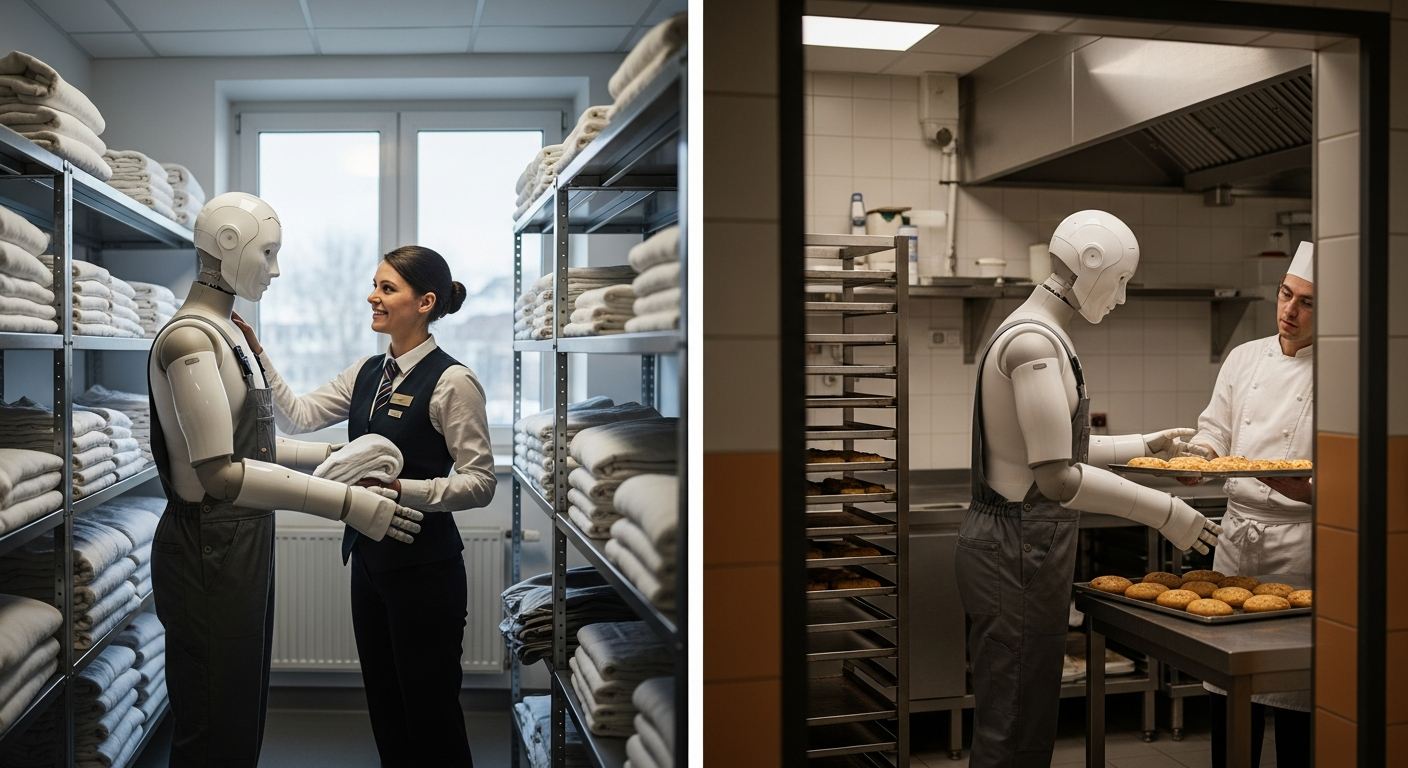
Hospitality environments present a different sizing challenge. Room service demand is highly variable, peaking in the late evening and early morning. To achieve a €112k annual cost offset for room service, the fleet must be sized to handle the 90th percentile of demand, not just the average. During off-peak hours, these units transition to bar and breakfast prep, which provides an additional €54k in annual savings. The ability to shift roles across different departments is a core advantage of the humanoid form factor.
The integration with Property Management Systems (PMS) like Opera or Mews is what enables this flexibility. When a guest places an order through the hotel app, the werob platform matches the task to the nearest available unit with the correct attachments. In F&B chains, similar logic applies to tray-bots in the dishroom, which can offset €76k per year. Because werob is hardware-agnostic, we can mix and match OEMs within the same fleet. You might use a high-dexterity humanoid for kitchen prep and a simpler, more robust unit for floor cleaning, all managed through a single cockpit interface.
The Regulatory Forcing Function: EU Machinery Regulation 2023/1230
Fleet sizing is not just about throughput; it is about compliance. The EU Machinery Regulation 2023/1230 becomes mandatory on January 20, 2027. This regulation changes how autonomous mobile robots and humanoids are certified for use in shared spaces. For operators in the 11 European countries where werob operates, including Germany, France, and the UK, compliance is a non-negotiable part of the deployment. A sized fleet must include a safety buffer that accounts for the 'safe speed' limits imposed by the regulation in high-traffic areas.
werob acts as the compliance pathway for Asian and North American OEMs entering the European market. We ensure that every unit in the fleet meets the necessary standards, such as ISO 13482 for personal care robots. In a security context, where a retail patrol robot might offset €58k annually, the fleet must also comply with BewachVO and DSGVO for data privacy. The werob Cockpit provides the necessary audit logs and 4-dimensional traffic lights to monitor regulatory status in real-time. This ensures that as the fleet grows, the compliance burden does not grow with it.
Comparison of Humanoid Fleet Sizing Models
When determining the correct fleet size, operators must choose between a peak-load model and a base-load model. The following table compares these approaches based on typical werob deployment data.
| Metric | Base-Load Model | Peak-Load Model | Hybrid (werob Recommended) |
|---|---|---|---|
| Unit Density | Low (1 unit per 60 residents) | High (1 unit per 25 residents) | Optimized (1 unit per 40 residents) |
| Cost Offset Focus | Steady-state tasks (Transport) | High-intensity tasks (Medication) | Cross-departmental utility |
| Staff Intervention | Frequent during peaks | Minimal | Managed via Cockpit |
| ROI Timeline | 12-18 months | 18-24 months | 14-16 months |
The hybrid model is typically the most effective for senior living and hospitality. It uses the Spec Engine to identify tasks that can be shifted to off-peak times, allowing for a smaller fleet that still achieves high cost offsets. This approach reduces the initial capital requirement while maintaining the outcome-only commercial promise: you pay nothing until the robots are running on your floor.
Live Fleet Management via the werob Cockpit
Once the fleet is sized and deployed, the focus shifts to live management. The werob Cockpit provides a unified view of the entire operation across 11 countries. It uses a 4-dimensional traffic light system to monitor hardware health, infrastructure status, regulatory compliance, and task performance. If a unit in a logistics yard patrol (offsetting €68k/year) experiences a sensor failure, the Cockpit automatically re-routes the remaining fleet to cover the high-priority zones. This dynamic re-allocation is essential for maintaining the promised cost offsets.
The Cockpit also handles the integration with the operator's existing stack, such as SAP EWM for logistics or Genetec for security. This ensures that the robot fleet is not a siloed technology but a functional part of the facility's operations. For large-scale operators, such as a senior living group with 20 robots across four sites, the Cockpit provides the centralized oversight needed to manage a €1.8M annual cost offset. This level of visibility is what allows werob to scale toward the target of 2,000 robots by 2028.
The Outcome-Only Commercial Path to Scale
The final hurdle in fleet sizing is the commercial model. Traditional robotics procurement requires significant upfront capital, which often kills the project before it reaches scale. werob operates on an outcome-only model. This means the operator pays nothing until the robot is live and performing the specified task on the floor. This model aligns the interests of the integrator with the operator. We are incentivized to size the fleet correctly because our revenue depends on the robots actually working.
This approach removes the risk of 'shelfware'-robots that are purchased but never used because they were poorly specified or integrated. With a speed promise of eight weeks to a live robot, werob provides the fastest path to operational cost offsets in the industry. Whether it is a golf club looking for a €38k saving on ball collection or a hotel group targeting a €2.7M offset across multiple properties, the process starts with a 48-hour spec. By removing the financial and technical barriers to entry, we enable operators to focus on what matters: the performance of their facility.
FAQ
- How long does it take to determine the correct fleet size for my facility?
- Using the werob Spec Engine, we can translate your workflow into a full robot specification, including unit count and density, within 48 hours of the initial intake.
- Which humanoid OEMs are currently supported for fleet deployments?
- werob is hardware-agnostic and ranks 44+ OEM partners, including Apptronik, Figure AI, Unitree, and Boston Dynamics, to find the best match for your specific task.
- What is the typical cost offset for a humanoid fleet in senior living?
- A correctly sized fleet can achieve a €92k annual cost offset for medication rounds and a €71k offset for internal transport tasks per site.
- Does the fleet size include backup units for maintenance?
- Our sizing models include redundancy and maintenance cycles to ensure continuous operation, managed through the live fleet Cockpit.
- How does the EU Machinery Regulation 2023/1230 affect my existing robots?
- By January 20, 2027, all robots in operation must comply with the new regulation. werob provides the compliance pathway to ensure your fleet remains operational.
- Can I mix different types of robots in the same fleet?
- Yes. The werob platform is designed for multi-OEM fleets, allowing you to use humanoids, service bots, and industrial cobots under a single management layer.