Hotel Cost Reduction Robotics: Operationalizing ROI in 8 Weeks
Move from discovery decks to live operations. werob delivers a deployable robot specification in 48 hours and a live fleet in eight weeks, offsetting up to €112,000 in annual room service costs.
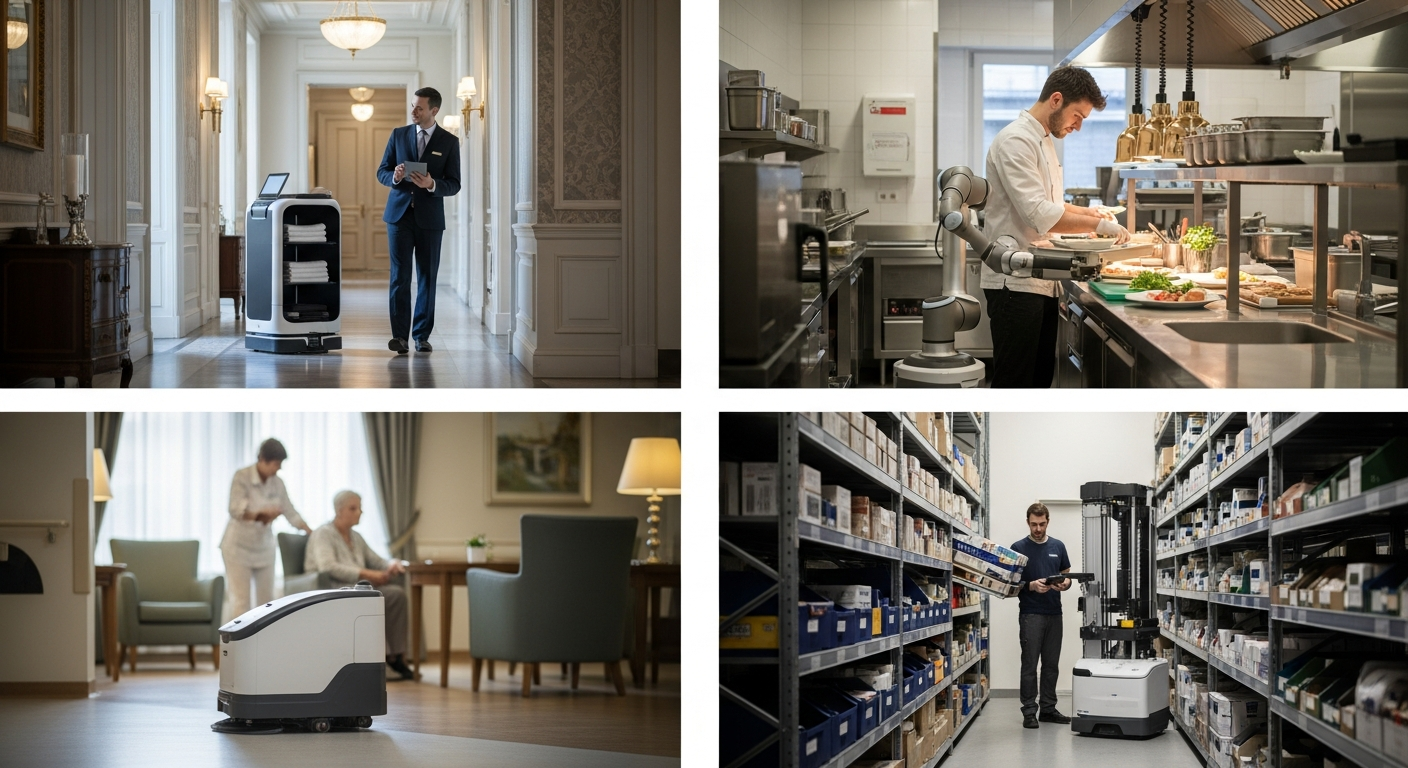
Floor 4. 23:15. A guest in room 412 requests additional towels and a club sandwich. In a traditional setup, the night auditor leaves the front desk unattended for 12 minutes to fulfill the request. Tonight, the task is handled by an autonomous unit. The robot calls the elevator, navigates the corridor, and notifies the guest upon arrival. This is one of 200 robots currently live in European operations. For the operator, the focus is not the machine but the €112,000 annual cost offset per site. werob translates these workflows into deployable specifications in 48 hours, moving hotels from pilot projects to industrial-scale fleet management.
Key Takeaways
- 1Robotics in hospitality can offset €112k in room service and €54k in bar prep costs per site annually.
- 2Integration into PMS stacks like Opera and Mews is mandatory for achieving labor-saving ROI.
- 3The EU Machinery Regulation 2023/1230 makes professional systems integration a legal necessity by 2027.
The Economics of Hospitality Robotics: Beyond the Pilot Phase
The hospitality industry has moved past the era of 'novelty' robotics. For a Director of Operations, a robot is no longer a marketing gimmick but a tool for structural cost offset. In the current labor market, the primary challenge is not just the cost of staff, but the availability of personnel for low-value, high-frequency tasks. werob focuses on the verified cost offsets that drive bottom-line performance. Specifically, hotel room service automation provides a €112,000 cost offset per site per year. Similarly, automating bar and breakfast prep logistics yields a €54,000 annual saving.
Unlike traditional procurement models that involve heavy CAPEX and long discovery phases, werob operates on an outcome-only commercial model. Operators pay nothing until the robot is running on the floor. This shifts the risk from the hotel group to the systems integrator. By focusing on the workflow rather than the hardware, werob ensures that the chosen solution matches the specific architectural and operational constraints of the property. With 200 robots live across 11 European countries, the data confirms that the economic value lies in the operating layer-the software and integration stack-rather than the individual OEM unit.
The Integration Gap: Connecting Robotics to Opera PMS and Mews
A robot that operates in a vacuum is a liability. To achieve true cost reduction, the robotics fleet must be a native part of the hotel's digital ecosystem. werob provides pre-built connectors into the industry's leading Property Management Systems (PMS), including Opera PMS and Mews. These integrations allow the robot to receive tasks directly from guest orders without manual intervention from the front desk or kitchen staff. When a guest places an order via a tablet or mobile app, the werob Connector layer translates that request into a robot mission.
This seamless data flow is critical for maintaining operational speed. Without a direct connector, staff must manually input room numbers and delivery details into a separate robot interface, which negates the labor-saving benefits. werob’s platform ensures that the robot can navigate elevators, pass through secure doors, and communicate with guests via their preferred channels. This level of integration is what allows a single operator to manage a fleet of robots across multiple properties through the werob Cockpit, providing a four-dimensional view of hardware, infrastructure, regulatory status, and task performance.
The Four-Layer Platform: From Spec to Live Fleet
werob is not a manufacturer; it is the operating layer that makes robotics deployable. The platform consists of four distinct layers designed to eliminate the typical 3-6 month discovery period. First, the Spec Engine converts an operator's workflow-defined by shifts, floors, and tasks-into a deployable robot action graph within 48 hours. This engine is trained on over 35,000 projects, ensuring that the specification is grounded in real-world operational data. Second, the Supplier Match engine ranks 44+ OEM partners and over 280 different robots against that specific spec. This hardware-agnostic approach prevents vendor lock-in and ensures the best machine for the task is selected.
The third layer consists of the Connectors mentioned previously, which link the robots to the existing hotel stack. Finally, the Cockpit provides live fleet management. This is not just a dashboard; it is a regulatory and operational oversight tool. It uses a traffic-light system to monitor hardware health, infrastructure connectivity, and compliance with safety standards. For a hotel group, this means a standardized way to manage robotics across different brands and geographies, all while maintaining a single point of truth for performance and ROI metrics.
Room Service Automation: The €112k Opportunity
Room service is one of the most labor-intensive departments in any hotel. The 'last mile' delivery from the kitchen to the guest room involves significant transit time, elevator waits, and return trips. By automating this process, hotels can reallocate staff to guest-facing roles that require human empathy and complex problem-solving. The verified cost offset of €112,000 per year is based on the displacement of these repetitive transit tasks, particularly during night shifts when staffing levels are at their lowest.
The deployment of room service robots also improves guest privacy and security. Guests often prefer the contactless nature of robotic delivery for late-night orders. From an operational standpoint, the robot provides a perfect audit trail. Every delivery is logged, including the exact time of arrival and the duration of the guest interaction. This data is fed back into the werob Cockpit, allowing management to identify bottlenecks in kitchen prep or elevator response times. By optimizing these micro-logistics, hotels can increase the volume of room service orders they can handle without increasing headcount.
Breakfast and Bar Prep: Streamlining Back-of-House Logistics
While room service is the most visible application, the back-of-house logistics for breakfast and bar service offer significant efficiency gains. Automating the transport of heavy trays, restocking of buffet stations, and the movement of glassware between the bar and the dishroom results in a €54,000 annual cost offset. These tasks are physically demanding and contribute to high staff turnover rates. By deploying robots for these 'heavy lifting' roles, hotels can improve the working environment for their culinary and service teams.
In the F&B vertical, compliance with HACCP (Hazard Analysis and Critical Control Points) is non-negotiable. werob ensures that any robot selected for food-zone operations meets the necessary hygiene and safety standards. The Supplier Match engine filters for OEMs that provide food-grade materials and easy-to-clean surfaces. Furthermore, the integration with POS systems like Toast or Lightspeed ensures that the kitchen staff can call for a robot as soon as an order is ready, reducing the time food spends under heat lamps and improving the overall guest experience.
Regulatory Compliance: EU Machinery Regulation 2023/1230
The regulatory landscape for robotics is changing rapidly. The EU Machinery Regulation 2023/1230 becomes mandatory on January 20, 2027. This regulation places significant responsibility on the operator to ensure that autonomous systems are safe and compliant. For hotels, this means that simply buying a robot from an Asian OEM is no longer sufficient. There must be a clear compliance pathway that includes conformity assessments and risk management. werob provides this pathway as a built-in feature of the platform.
Beyond the Machinery Regulation, hospitality robots must often comply with ISO 13482 for personal care robots, especially when operating in close proximity to guests. werob’s Cockpit monitors the regulatory status of every robot in the fleet, ensuring that all software updates and safety patches are applied in real-time. This level of oversight is essential for protecting the hotel from liability and ensuring that the robotics deployment remains compliant with local and European laws. By acting as the systems integrator, werob takes on the burden of regulatory monitoring, allowing hotel managers to focus on their core business.
Hardware Agnosticism: Why 44+ OEMs Matter
The robotics market is highly fragmented. New OEMs emerge every month, while others pivot or exit the market. For a hotel operator, committing to a single manufacturer is a significant risk. If that manufacturer fails or stops supporting their software, the hotel is left with expensive 'bricks'. werob’s hardware-agnostic model mitigates this risk. By ranking 44+ OEM partners-including Keenon, Pudu, Bear Robotics, and various humanoid developers-werob ensures that the operator always has access to the best available technology.
This approach also allows for a multi-OEM fleet. A hotel might use one type of robot for room service and a different, more robust model for heavy-duty laundry transport. The werob platform unifies these different machines under a single operating layer. The guest and the staff see a consistent interface, and the management sees a unified data set in the Cockpit. This flexibility is what enables werob to promise a live robot on the floor in just eight weeks, as the platform can quickly pivot between suppliers based on availability and specific site requirements.
The 8-Week Path to Live Operations
Speed is a critical differentiator for werob. While traditional consulting firms might spend months on discovery decks and 'transformation journeys', werob moves from intake to live deployment in eight weeks. The process begins with an 8-step onboarding intake that captures the essential details of the hotel's workflow, infrastructure, and commercial goals. Within 48 hours, the Spec Engine produces a detailed specification. Within five days, the operator receives a firm quote based on the outcome-only model.
The final phase is the deployment itself. Because werob uses pre-built connectors and a standardized integration stack, the time spent on-site is minimized. The robots are configured, mapped, and integrated into the PMS and elevator systems with surgical precision. By week eight, the fleet is live and generating cost offsets. This rapid deployment cycle is essential for hotels looking to address immediate labor shortages or seasonal demand spikes. The goal is not just to install a robot, but to establish a permanent, scalable operational layer that grows with the property.
Comparison: Traditional Procurement vs. werob Integration
| Feature | Traditional OEM Reseller | werob Systems Integrator |
|---|---|---|
| Hardware Choice | Single Brand (Lock-in) | Hardware-Agnostic (44+ OEMs) |
| Integration | Bespoke / Manual | Pre-built (Opera, Mews, Toast) |
| Time to Spec | 3-6 Months | 48 Hours |
| Commercial Model | CAPEX / Lease | Outcome-only (Pay when running) |
| Compliance | Operator's Responsibility | Built-in (EU Reg 2023/1230) |
| Fleet Management | Fragmented Apps | Unified Cockpit |
FAQ
- What is the typical cost offset for a hotel using robotics?
- Based on live operations, hotels see a cost offset of €112,000 for room service and €54,000 for bar and breakfast prep per site per year.
- Which PMS systems does werob integrate with?
- werob provides direct, pre-built connectors for Opera PMS and Mews, ensuring seamless task automation from guest orders.
- How long does it take to deploy a robot in a hotel?
- werob delivers a spec in 48 hours, a quote in 5 days, and a live, integrated robot on the floor within 8 weeks.
- Is werob a robot manufacturer?
- No. werob is a hardware-agnostic systems integrator. We rank 44+ OEM partners to find the best robot for your specific workflow.
- What is the outcome-only commercial model?
- It means you pay nothing until the robot is live and running in your facility. There are no upfront list prices for hardware.
- How does werob handle the new EU Machinery Regulation?
- werob provides a built-in compliance pathway for EU Machinery Regulation 2023/1230, which becomes mandatory on January 20, 2027.