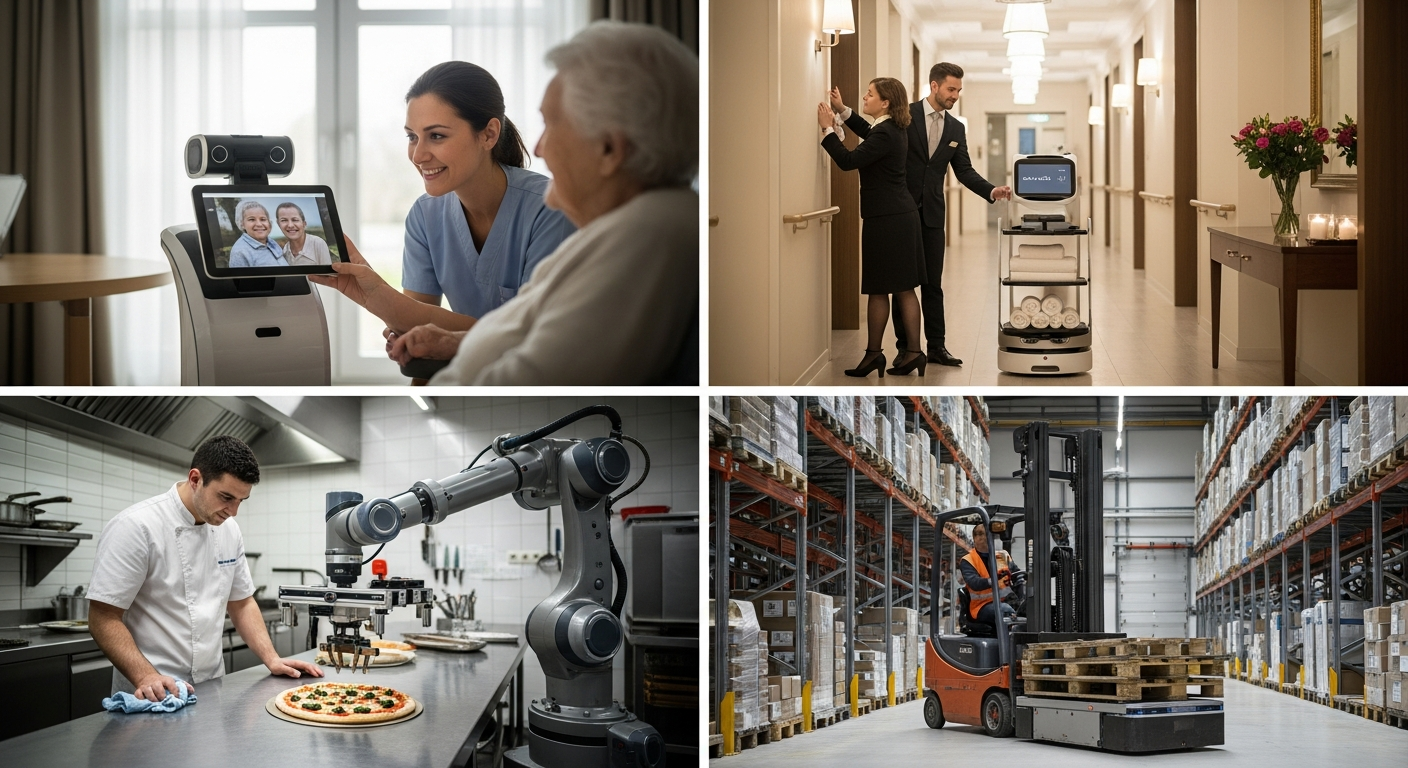
Opera PMS Robot Integration API: Automating Hotel Operations
Integrating your robotics fleet with the Opera PMS API is the difference between a standalone gadget and a functional operational system. This guide explains how werob connects 44+ OEMs to your existing hotel stack in eight weeks.
23:15. Floor 4. A guest in room 412 requests extra towels via the hotel app. In a traditional setup, the night auditor must leave the front desk or wait for a runner to become available. With a functional Opera PMS robot integration, the request triggers an immediate task in the robot's queue. The robot navigates the elevator, reaches the room, and completes the delivery without human intervention. These workflows are active today. It is the current operational standard for hotels across the 11 European countries where werob manages live fleets. The success of this workflow depends entirely on the data handshake between the Property Management System and the autonomous hardware.
Key Takeaways
- 1Opera PMS integration is essential for achieving the verified significant annual cost offset in hotel room service.
- 2The EU Machinery Regulation 2023/1230 makes compliance a mandatory requirement for all hotel robots by January 2027.
- 3werob's hardware-agnostic approach allows operators to choose from 280+ robots without being locked into a single OEM.
The Operational Reality of Hotel Robotics
Many hotel operators view robotics as a standalone hardware purchase. Viewing robotics as a standalone hardware purchase is a mistake that leads to underutilized equipment and frustrated staff. A robot that is not integrated into the Opera PMS remains a silo. It requires manual programming for every delivery, which often takes more time than simply walking the item to the room. To achieve a true return on investment, the robot must be an extension of the hotel's digital nervous system.
The integration allows for the automation of high-frequency, low-complexity tasks. When a guest orders room service, the transaction in the PMS should automatically dispatch the robot. This level of automation is what drives the significant annual cost offset for room service. By removing the need for staff to act as couriers, the hotel can maintain service levels even during peak hours or staffing shortages. werob acts as the systems integrator that makes this connection possible, moving from workflow intake to a deployable spec in just 48 hours.
Technical Architecture of the Opera PMS API
The technical foundation for this integration is the Oracle Hospitality Integration Platform (OHIP) or the older OXI (Opera Exchange Interface). These APIs provide the endpoints necessary for a robot to understand the hotel's environment. Key data points include room status, guest names for personalized greetings, and service request logs. However, the API alone is not enough. The robot needs to know more than just the room number; it needs to understand the building's infrastructure, such as elevator protocols and Wi-Fi dead zones.
werob Connectors serve as the bridge between the Opera API and the robot's navigation system. We map the PMS data fields to the robot's action graph. For example, when a room is marked as 'Dirty' in Opera, the system can automatically dispatch a floor-cleaning robot to that specific corridor. Bidirectional communication ensures that the PMS is updated in real-time when a task is completed. This level of technical depth is why werob is not a simple reseller but a full-stack systems integrator. We handle the complexity of the API so the operator can focus on high-value guest strategy and deal outcomes.
Economic Impact: €112k and €54k Cost Offsets
The primary driver for robotics in hospitality is the measurable cost offset. Adopting an integrated robotics strategy is not about replacing staff but about optimizing their output. In the hospitality sector, werob has verified two major cost-offset categories. Room service automation yields a significant annual offset per site. This is achieved by automating the delivery of food, beverages, and amenities, which typically consume significant portions of a runner's shift.
hotel bar and breakfast preparation automation provides an substantial annual cost offset. By using robots for heavy lifting, tray transport, and restocking, the morning shift can focus on food quality and guest interaction. These numbers are not theoretical. They are based on live operations across our 200-robot fleet. Because werob uses an outcome-only commercial model, operators pay nothing until the system is running and these offsets are being realized. This removes the financial risk associated with traditional technology deployments.
Hardware Agnosticism and Supplier Matching
A common pitfall in hotel robotics is vendor lock-in. An operator might buy a fleet of robots from a single manufacturer, only to find that those robots cannot handle a specific floor type or elevator system. werob solves this through hardware agnosticism. Our Supplier Match engine ranks 44+ OEM partners and over 280 different robots against your specific site requirements. Whether the best fit is a Keenon T9 for room service or a Pudu robot for the lobby, our platform ensures the hardware matches the task.
This agnostic approach is critical when integrating with Opera PMS. The integration layer we build is independent of the robot brand. If a more efficient robot model is released next year, it can be swapped into the existing workflow without rewriting the API connection to your PMS. This future-proofs the hotel's investment. We manage the relationship with the OEMs, ensuring that the hardware is maintained and the firmware is compatible with the latest Opera updates. This allows the operator to scale their fleet across multiple properties regardless of the specific robot brand used at each site.
Regulatory Compliance and the EU Machinery Regulation
Compliance is often overlooked until it halts a project. For any hotel operating in Europe, the EU Machinery Regulation 2023/1230 is a critical deadline. Starting January 20, 2027, this regulation becomes mandatory for all autonomous mobile robots. Many robots manufactured outside the EU do not currently meet these stringent safety and conformity standards. Operating non-compliant hardware in a public hotel lobby creates significant liability for the owner.
werob provides a built-in compliance pathway. We ensure that every robot integrated into your Opera PMS stack is assessed against the latest regulatory requirements, including ISO 13482 for personal care robots. Our platform handles the documentation and safety audits required by European law. This is a core part of our four-layer platform. The Cockpit provides a live regulatory traffic light, alerting you if a robot's compliance status changes, ensuring human experts remain in control of the final safety audit. By choosing an integrator like werob, you are not just getting a robot; you are getting a legally protected operational environment.
The 8-Week Deployment Timeline
Speed is a competitive advantage in the hospitality industry. Traditional robotics projects often languish in 'discovery phases' for three to six months. werob has compressed this timeline through our AI-driven Spec Engine. We translate your hotel's workflow into a deployable robot specification within 48 hours. Once the spec is approved, we provide a firm quote within five days. The final step is the deployment, which takes eight weeks from the initial intake to the robot being live on the floor.
This rapid deployment is possible because our connectors for Opera PMS and Mews are pre-built. We do not need to start from scratch for every hotel. We simply configure the existing integration to match your property's specific room layout and service protocols. This pre-configured capability for complex enterprise software is what sets werob apart from consulting firms. We are focused on the outcome: a working robot that delivers outcomes—a Big Four Advisory partner reported cutting similar operational assessments from weeks to days using our deployment framework.
Live Fleet Management via the werob Cockpit
Once the robots are live and integrated with Opera PMS, the focus shifts to long-term reliability. The werob Cockpit is the central hub for managing your fleet across one or one hundred properties. It provides real-time visibility into every robot's performance. The Cockpit uses a four-dimensional traffic light system to monitor hardware health, infrastructure connectivity, regulatory compliance, and adherence to the original spec.
If a robot fails to deliver a room service order because an elevator is out of service, the Cockpit logs the event and notifies the relevant team. This data is also fed back into the Opera PMS, ensuring that the guest's order status is updated. Real-time transparency is essential for maintaining high service standards. The Cockpit also generates the audit logs required for compliance with the EU AI Act and GDPR, ensuring that all sensor data and guest interactions are handled according to European privacy laws. This oversight, backed by SOC 2 Type II and ISO 27001 standards, is why operators trust werob to run their robotics programs.
Starting Your Robotics Integration
The transition to an automated hotel begins with a clear understanding of your current workflows and source traceability. werob's eight-step onboarding process is designed to capture these details quickly. We ask about your shifts, the shape of the tasks you want to automate, and your existing infrastructure. This information allows our Spec Engine to create a precise roadmap for your Opera PMS integration. You do not need to be a robotics expert to start; you only need to know your business.
Because our model is outcome-only, the initial consultation and specification phase carry no financial risk. We are incentivized to find the most efficient and cost-effective solution for your property. With 200 robots already live across 11 countries, we have the data to prove what works. Whether you are a single boutique hotel or a large resort group, the path to a significant annual cost offset starts with a 48-hour spec. The future of hospitality is integrated, compliant, and autonomous.
FAQ
- How does the robot know which room to go to in Opera PMS?
- The robot receives the room number directly from the Opera PMS API via werob Connectors. When a service request is logged in the PMS, it is translated into a coordinate-based task for the robot's navigation system.
- What is the cost of integrating Opera PMS with werob?
- werob operates on an outcome-only commercial model. You pay nothing until the robot is live and running on your floor. Contact our team for a demo to discuss how our outcome-based model fits your portfolio.
- Can the robot use the hotel elevators?
- Yes. werob integrates the robot fleet with your elevator control system. The robot communicates with the elevator via Wi-Fi or LTE to call the lift and select the correct floor automatically.
- Is the integration compliant with GDPR?
- Yes. All werob integrations are designed to meet GDPR standards. Robots process only the data necessary for the task, and any camera or sensor data is handled according to strict privacy protocols.
- How long does it take to set up the Opera API connection?
- The technical connection is part of our 8-week deployment promise. Because we have pre-built connectors for Opera PMS, the configuration happens rapidly during the implementation phase.
- What happens if the Opera PMS goes offline?
- The werob Cockpit monitors the connection status. If the PMS goes offline, the robots can still be operated manually or through local task queues until the connection is restored, ensuring no service interruption.