Robot Deployment Partner France: Scaling Operations in 8 Weeks
Deploying robotics in France requires more than just purchasing hardware. It demands a systems integrator that can navigate the EU Machinery Regulation 2023/1230 while integrating directly into existing tech stacks like Mews and Opera PMS.
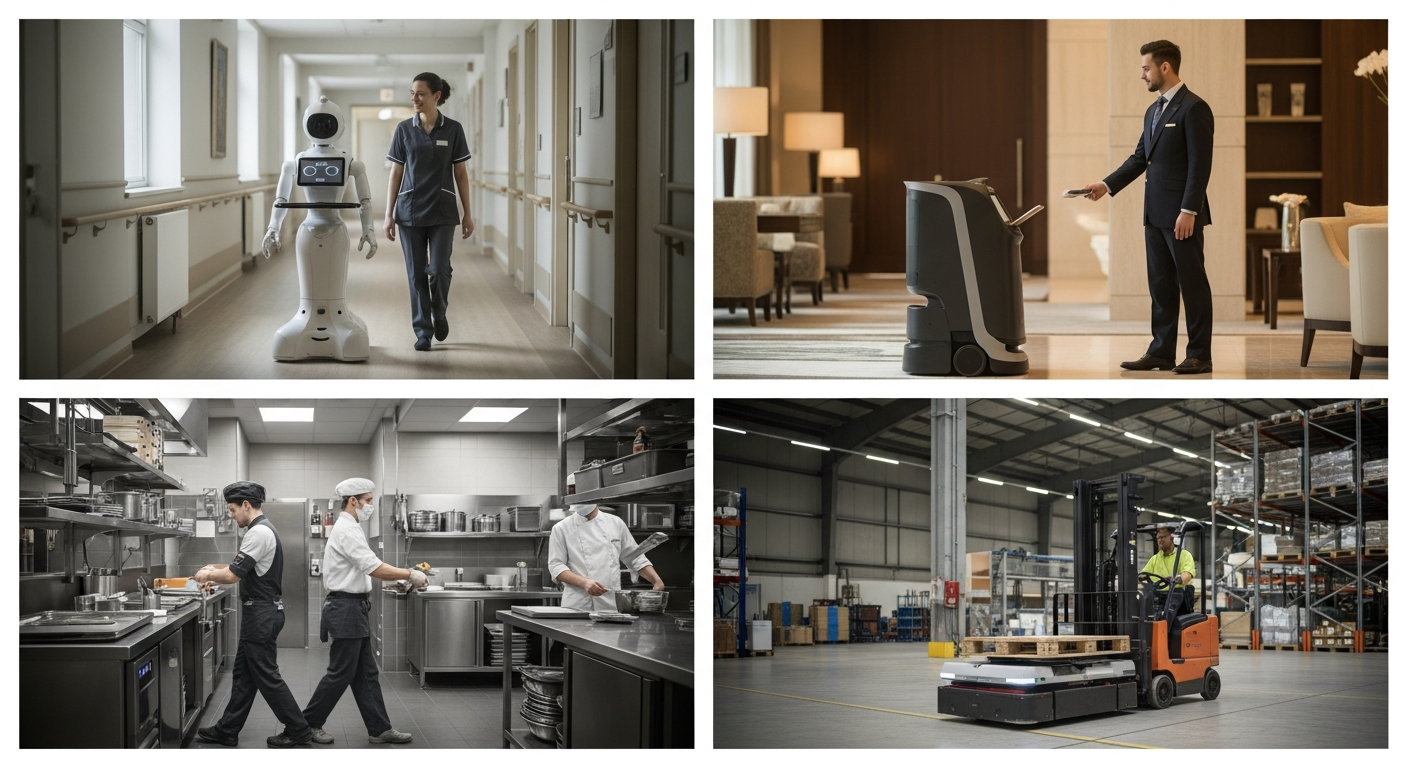
Paris, 03:30. The night shift at a 200-room hotel in the 8th Arrondissement is at its peak. A single night auditor manages the front desk while three separate room service requests arrive simultaneously. On the sixth floor, a guest requires extra towels. In the kitchen, a tray of breakfast prep needs to be moved to the staging area. This is the operational bottleneck where human labor is stretched too thin and where robotics shifts from a futuristic concept to a functional necessity. For French operators in hospitality, senior living, and logistics, the challenge is no longer whether to use robots, but how to deploy them without disrupting the existing workflow or failing local compliance audits.
Key Takeaways
- 1A systems integrator is essential for navigating the EU Machinery Regulation 2023/1230 which becomes mandatory on January 20, 2027.
- 2werob delivers a deployable robot specification in 48 hours and a live fleet in eight weeks, significantly faster than the 3-6 month industry average.
- 3Direct connectors into tech stacks like Mews, Opera PMS, and SAP EWM are required to turn robots into functional operational tools.
The Role of a Systems Integrator in the French Market
The French robotics landscape is often misunderstood as a choice between different hardware manufacturers. However, the hardware is only one component of a successful deployment. A true robot deployment partner in France acts as a systems integrator, bridging the gap between the robot manufacturer (OEM) and the operator's daily workflow. werob does not manufacture robots. Instead, it operates as the intelligence layer that translates a specific task-such as a medication round in a senior living facility or room service in a Parisian hotel-into a deployable technical specification.
Operating across 11 European countries, including France, werob provides the infrastructure to manage multi-OEM fleets. This is critical because no single manufacturer offers the best solution for every task. A hotel might require a Keenon bot for room service but a different platform for floor cleaning. Without an integrator, the operator is forced to manage multiple disparate systems, leading to fragmented data and operational silos. werob eliminates this by providing a single operating layer that ranks 44+ OEM partners against the operator's specific needs, ensuring the hardware fits the floor, not the other way around.
The Spec Engine: From Workflow to Blueprint in 48 Hours
Traditional robotics procurement in France often involves three to six months of discovery decks and consulting meetings. This delay is unacceptable in high-pressure environments like F&B or healthcare. werob replaces this lengthy process with the Spec Engine. This tool converts the operator's description of a shift, a floor, and a task into a deployable robot action graph within 48 hours. The engine is trained on over 35,000 projects, allowing it to predict operational hurdles before the first robot arrives on site.
The Spec Engine considers variables that are often overlooked during standard procurement. It analyzes site infrastructure, regulatory requirements, and the specific shape of the task. For a French logistics yard, this might mean accounting for specific security protocols under BewachVO. For a senior living facility, it means ensuring the robot can navigate the tight corridors typical of European architecture. By delivering a spec in 48 hours, werob allows operators to move from identification to implementation at a pace that matches the urgency of their labor shortages.
Hardware-Agnostic Matching: Ranking 44+ OEMs
Vendor lock-in is a significant risk for French operators. If a facility commits to a single manufacturer, they are tied to that OEM's software, update cycle, and hardware limitations. werob maintains a hardware-agnostic stance, ranking 44+ OEM partners and over 280 different robots against the operator's spec. This catalogue includes everything from service bots like Pudu and Bear Robotics to advanced humanoids from companies like Apptronik or Unitree. The goal is to find the best tool for the job based on performance data, not brand loyalty.
This matching process is data-driven. The Supplier Match layer of the werob platform scores each robot based on its ability to meet the specific requirements of the French site. If a hotel in Nice requires a robot that can interface with specific elevator systems or navigate high-pile carpets, the system filters the catalogue to show only the top-performing candidates. This ensures that the operator receives a solution that is technically viable and commercially sound, rather than whatever a single-brand reseller happens to have in stock.
Integration into the French Tech Stack
A robot that cannot communicate with the existing property management system (PMS) or warehouse management system (WMS) is a liability. In the French hospitality sector, integration with platforms like Mews and Opera PMS is non-negotiable. werob provides pre-built connectors that allow robots to receive tasks directly from the software the staff already uses. When a guest requests an item via the hotel app, the request flows through the PMS and triggers the robot without human intervention.
The same principle applies to other verticals. In logistics, werob connects into SAP EWM to coordinate autonomous yard patrols or transport bots. In senior living, integrations with PointClickCare or MatrixCare ensure that medication rounds are logged and audited in real-time. These connectors turn the robot into a functional extension of the existing digital infrastructure. This reduces the training burden on staff and ensures that the data generated by the robot fleet is captured within the operator's primary system of record.
Regulatory Compliance: EU Machinery Regulation 2023/1230
The regulatory environment for robotics in Europe is changing rapidly. The most critical forcing function for French operators is the EU Machinery Regulation 2023/1230, which becomes mandatory on January 20, 2027. This regulation places significant responsibility on the entity that integrates and deploys the machinery. Many Asian-made robots do not currently meet the full conformity assessment requirements for the European market. werob acts as the compliance pathway, ensuring that every deployment meets these mandatory standards.
Beyond the Machinery Regulation, French operators must also navigate GDPR for camera data, ISO 13482 for personal-care robots, and local standards like the Heimaufsicht in senior living. werob builds these compliance requirements into the deployment from day one. The Cockpit, werob's live fleet management tool, includes a regulatory traffic light system that monitors the fleet's compliance status in real-time. This provides the Director of Operations and the Compliance Lead with the necessary audit trails to satisfy regulators and insurance providers.
Economic Impact: Cost Offsets in French Verticals
The primary driver for robotics in France is the measurable cost offset. In the hospitality sector, a robot dedicated to room service can generate a cost offset of €112,000 per site per year. This is achieved by allowing night staff to remain at the front desk while the robot handles deliveries, reducing the need for additional headcount during low-occupancy hours. In senior living facilities, the impact is equally significant. A robot assisting with medication rounds can offset €92,000 in annual costs, while transport bots for laundry or meals can save an additional €71,000 per year.
These numbers are not theoretical. They are based on live operations across 200 robots in 11 countries. In F&B chains, tray-bots in the dishroom can offset €76,000 annually, while kitchen floor cleaning robots contribute another €44,000 in savings. By focusing on these high-impact tasks, French operators can achieve a double-digit cost offset within the first year of operation. werob's outcome-only commercial model means the operator pays nothing until the robot is live on the floor, aligning the investment directly with the realized savings.
The 8-Week Deployment Timeline
Speed is a competitive advantage. While traditional integrators might take months to move from a pilot to a full rollout, werob has standardized the deployment process into an eight-week cycle. This begins with the 48-hour spec and a quote delivered within five days. Once the hardware is selected and the connectors are configured, the robot is shipped and deployed on-site. This rapid timeline is possible because werob uses pre-built integration modules and a standardized onboarding intake.
The eight-step intake process covers everything from the shape of the task to the site's infrastructure and regulatory needs. By front-loading this information, werob avoids the common delays associated with bespoke engineering. For a French facility manager, this means a robot can be operational and contributing to cost offsets in less than two months. This speed allows organizations to respond quickly to sudden labor shortages or operational changes without the risk of a multi-year project failure.
Live Fleet Management: The Cockpit
Once the robots are live, the focus shifts to supervision and optimization. The werob Cockpit provides a live view of the entire fleet across multiple sites. This is not just a basic telemetry dashboard; it is a four-dimensional management tool that monitors hardware health, infrastructure connectivity, regulatory compliance, and performance against the original spec. If a robot in a Lyon warehouse deviates from its patrol path or a bot in a Paris hotel loses its connection to the elevator system, the Cockpit alerts the operator immediately.
This level of visibility is essential for scaling. A Director of Operations managing twenty sites across France cannot be on the floor at every location. The Cockpit centralizes the management of the fleet, providing high-level traffic lights for the executive team and granular data for the facility managers. It also serves as the central repository for audit logs, which are critical for maintaining compliance with the EU AI Act and other emerging regulations. By providing a single pane of glass for the entire robotics operation, werob ensures that the fleet remains an asset rather than a management burden.
Outcome-Only Commercials: Zero Risk for Operators
The traditional model of purchasing robots as a capital expenditure (CAPEX) is often a barrier to entry for French businesses. werob removes this barrier by utilizing an outcome-only commercial model. This means the operator does not pay for the technology until it is running on the floor and delivering the specified workflow. This shifts the risk from the operator to the integrator, ensuring that werob is incentivized to deliver a functional, high-performing system as quickly as possible.
This model is particularly attractive for senior living groups and hotel chains looking to scale across multiple properties. It allows for a predictable operational expenditure (OPEX) that is directly offset by the labor savings the robots provide. For example, a senior living group like Korian Deutschland has seen double-digit cost offsets in year one by utilizing this approach. For French operators, this commercial structure provides the financial flexibility to modernize their operations without the upfront cost and risk associated with traditional robotics procurement.
FAQ
- Does werob manufacture its own robots?
- No, werob is a hardware-agnostic systems integrator. We rank 44+ OEM partners and over 280 different robots to find the best match for your specific workflow and site requirements.
- How long does it take to get a robot on the floor in France?
- werob provides a spec within 48 hours, a quote within five days, and a live robot on your floor within eight weeks.
- What are the typical cost savings for a hotel in France?
- A robot dedicated to room service can provide a cost offset of €112,000 per site per year, while bar and breakfast prep bots can offset €54,000 annually.
- Is the EU Machinery Regulation 2023/1230 mandatory for French operators?
- Yes, it becomes mandatory on January 20, 2027. werob provides the built-in compliance pathway to ensure your robot fleet meets these standards.
- Can werob robots integrate with Mews or Opera PMS?
- Yes, werob has pre-built connectors for Mews, Opera PMS, Toast, SAP EWM, and other major operator stacks to ensure seamless workflow integration.
- What is the commercial model for werob deployments?
- werob uses an outcome-only commercial model. You pay nothing until the robot is running on your floor and performing the specified tasks.