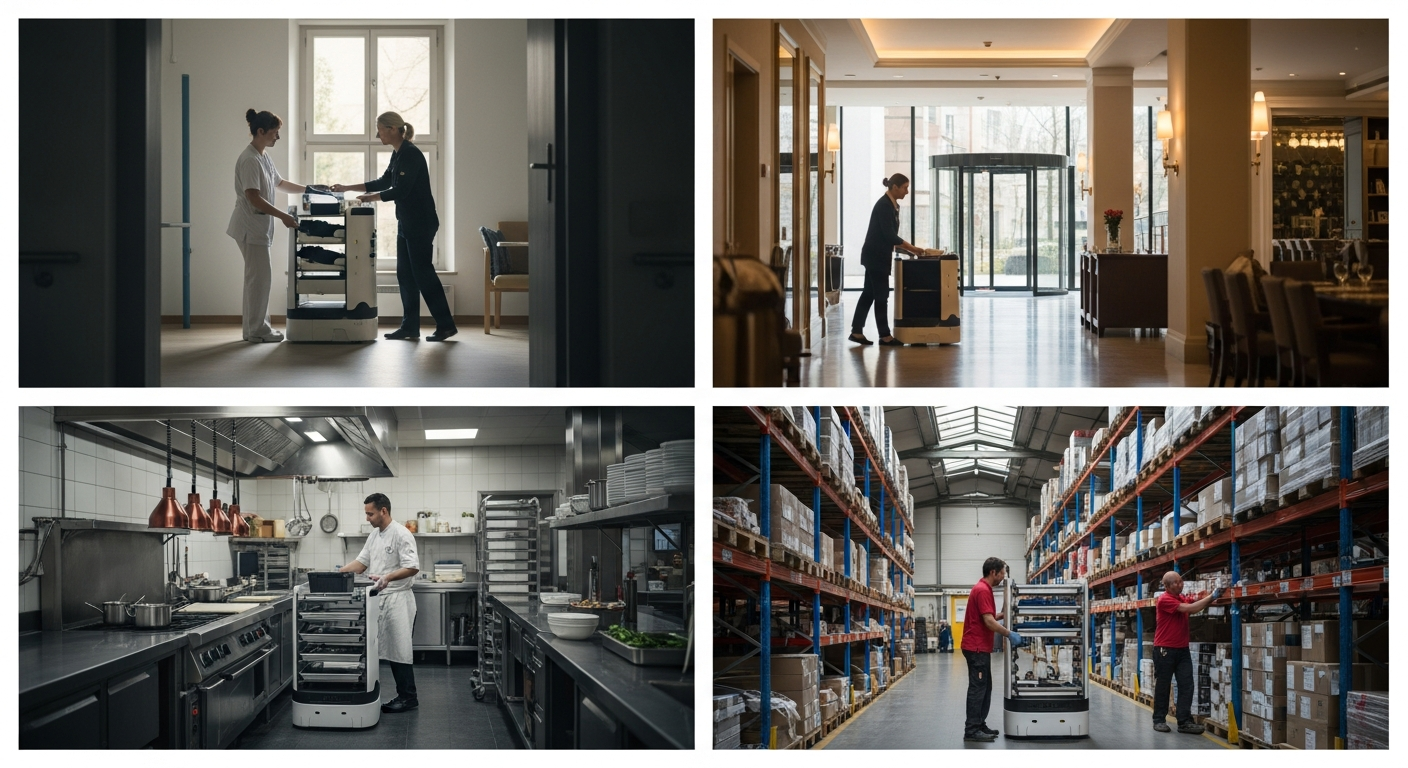
Plain Language Robot Deployment AI for Operational Scale
Traditional robotics procurement is stalled by months of discovery and vendor lock-in. werob uses plain language AI to convert operational workflows into deployable specifications within 48 hours.
Floor 3. 22:00. The night shift supervisor at a senior living facility describes the medication round. There is no technical blueprint or discovery deck. Instead, the supervisor speaks in plain language about the route, the weight of the trolley, and the frequency of the task. In a traditional setting, this conversation would trigger six months of consulting. At werob, this input enters the Spec Engine. Within 48 hours, the workflow is a technical action graph. Within eight weeks, a robot is on the floor. This is the shift from experimental robotics to industrial-scale systems integration.
Key Takeaways
- 1The Spec Engine converts plain language workflows into technical specs in 48 hours, bypassing months of discovery.
- 2werob is hardware-agnostic, ranking 44+ OEMs and 280 robots to find the best match for the operator's specific task.
- 3Verified cost offsets include €92k for senior living medication rounds and €112k for hotel room service per year.
The Failure of Traditional Robotics Procurement
For most operators in senior living, hospitality, and logistics, the barrier to robotics is not the hardware. It is the gap between a human workflow and a technical specification. Traditional procurement involves months of discovery, expensive consulting decks, and a high risk of vendor lock-in. When an operator chooses a single OEM manufacturer, they are betting their entire infrastructure on one piece of hardware that may not adapt to changing site requirements.
werob operates as a hardware-agnostic systems integrator to solve this specific friction. By using a Spec Engine trained on over 35,000 projects, werob translates the operator's words into a deployable robot action graph in 48 hours. This removes the need for three-month discovery phases. The focus shifts from 'what can this robot do' to 'what does the workflow require'. This distinction is critical for maintaining operational uptime and ensuring that the technology serves the staff rather than creating new maintenance burdens.
Translating Human Workflow to Robot Action Graphs
The core of the werob platform is the Spec Engine. It is designed for the person on the floor, not the robotics engineer. When a Head of Care or a Director of Operations describes a shift, the AI identifies the physical constraints, the regulatory requirements, and the necessary software integrations. This process generates a multi-dimensional specification that covers hardware capabilities, infrastructure needs, and compliance pathways.
Once the spec is finalized, the Supplier Match layer ranks 44+ OEM partners and 280 different robots against the requirements. This ensures the operator receives the best possible hardware for the specific task, whether it is a tray-bot for a dishroom or a humanoid for complex logistics. Because werob is not a manufacturer, the ranking is objective and performance-driven. The goal is a live robot on the floor in eight weeks, supported by a commercial model where the operator pays nothing until the system is operational.
Economic Impact and Verified Cost Offsets
Robotics deployment must be justified by concrete cost offsets rather than vague innovation goals. werob tracks performance metrics across 200 live robots in 11 European countries. The data shows that specific workflows yield predictable annual savings. In senior living, a robot-assisted medication round generates a €92,000 cost offset per site per year. General transport tasks in the same sector provide a €71,000 offset.
In the hospitality sector, the numbers are even more pronounced. A hotel room service robot can offset €112,000 annually, while automation in bar and breakfast preparation saves €54,000. For F&B chains, a tray-bot in the dishroom provides a €76,000 offset. These figures are not projections but results from live operations like those at Korian Deutschland. By integrating robots directly into the operator stack via connectors like Opera PMS, Mews, or PointClickCare, these savings are realized through immediate staff displacement from repetitive, low-value tasks.
Regulatory Compliance and EU Machinery Regulation 2023/1230
The regulatory landscape is the primary forcing function for robotics in Europe. The EU Machinery Regulation 2023/1230 becomes mandatory on January 20, 2027. This regulation places significant responsibility on the operator to ensure that autonomous systems are compliant with new safety and cybersecurity standards. Many Asian OEMs do not provide the necessary conformity assessments for the European market, leaving the operator at risk.
werob acts as the compliance pathway. The platform builds regulatory checks into the specification phase, ensuring that every deployment meets ISO 13482 for personal care robots or BewachVO for security patrol robots. This includes managing the audit trails required by the EU AI Act and ensuring that data handling complies with GDPR. For a Compliance Lead or a Data Protection Officer, werob provides a single point of accountability for the entire fleet, regardless of how many different manufacturers are represented in the cockpit.
Integration into the Operator Stack
A robot that operates in a silo is a liability. To achieve maximum cost offset, the robot must be a first-class citizen in the operator's existing software stack. werob provides pre-built connectors into major industry platforms. In senior living, this means direct integration with PointClickCare and MatrixCare. In hospitality, werob connects to Opera PMS and Mews. For logistics and F&B, integrations with SAP EWM, Toast, and Lightspeed are standard.
These connectors allow the robot to receive tasks directly from the system of record. When a guest orders room service via the hotel PMS, the robot is dispatched automatically. When a medication round is logged in the care management system, the robot prepares the transport route. This level of integration removes the need for manual intervention and ensures that the fleet is managed through the werob Cockpit, which provides live traffic lights for hardware health, infrastructure status, and regulatory compliance.
The Eight-Week Deployment Timeline
Speed is a core differentiator of the werob platform. The industry norm for robotics deployment is measured in quarters or years. werob operates on a compressed timeline: 48 hours to a specification, five days to a quote, and eight weeks to a live robot on the floor. This is made possible by the Spec Engine and the pre-configured connector architecture. The onboarding process is a structured eight-step intake that captures everything from the shape of the task to the site infrastructure.
This speed does not come at the expense of precision. Because the Spec Engine is fine-tuned on 35,000 projects, it anticipates common failure points such as elevator integration, Wi-Fi dead zones, and floor transitions. By the time the hardware arrives on site, the digital environment is already prepared. This operational readiness is why werob has successfully scaled to 200 robots across 11 countries, with a target of 2,000 robots by 2028.
Outcome-Only Commercial Model
The traditional CAPEX-heavy model of purchasing robots is a barrier to entry for many operators. werob utilizes an outcome-only commercial model. This means the operator pays nothing until the robot is running and delivering the specified workflow. This aligns the interests of the integrator with the interests of the operator. If the robot does not perform the task as specified in the action graph, the operator is not billed.
This model removes the financial risk of exploring new robotics categories, such as humanoids. werob is currently running the first humanoid pilot in a Hamburg senior living facility, which reached its 12th week of operation in May 2026. By focusing on outcomes rather than hardware sales, werob ensures that every deployment is optimized for the highest possible cost offset. The operator benefits from a hardware-agnostic fleet that can be updated or swapped as better technology becomes available from the 44+ OEM partners.
Future-Proofing with the werob Cockpit
Managing a multi-OEM fleet requires a centralized operating layer. The werob Cockpit provides this visibility, offering a 4-dimensional view of the fleet. It monitors hardware health, infrastructure connectivity, regulatory status, and adherence to the original specification. If a robot deviates from its assigned action graph or if a new firmware update impacts compliance with the EU Machinery Regulation, the Cockpit alerts the operator immediately.
This centralized management is essential for scaling from a single pilot to a multi-site deployment. For example, a senior living group can manage 20 robots across four sites through a single interface, seeing an annualized cost offset of approximately €1.8M. The Cockpit ensures that the robotics strategy remains data-driven and transparent, providing the audit logs necessary for insurance and regulatory reviews. As the catalogue of 280+ robots continues to grow, the Cockpit remains the stable layer that allows operators to adopt new technology without rebuilding their entire integration stack.
FAQ
- What is plain language robot deployment AI?
- It is an AI-driven system, like the werob Spec Engine, that translates natural language descriptions of work shifts and tasks into technical robot specifications and action graphs.
- How long does it take to deploy a robot with werob?
- werob delivers a specification in 48 hours, a quote in five days, and a live, integrated robot on the floor within eight weeks.
- Does werob manufacture its own robots?
- No, werob is a systems integrator. It is hardware-agnostic and partners with 44+ OEMs to provide the best robot for each specific workflow.
- Which software systems does werob integrate with?
- werob has pre-built connectors for PointClickCare, MatrixCare, Opera PMS, Mews, Toast, Lightspeed, GolfNow, Genetec, and SAP EWM.
- What is the EU Machinery Regulation 2023/1230?
- It is a mandatory regulation effective January 20, 2027, that sets new safety and cybersecurity standards for autonomous machinery in the EU. werob ensures all deployments are compliant.
- How does the outcome-only commercial model work?
- Operators pay nothing upfront. Billing only begins once the robot is fully integrated and successfully performing the specified tasks on-site.