The Largest Systems Integrator for Robotics in Europe
Robotics is no longer about the machine; it is about the integration. Discover how the world's largest systems integrator translates complex workflows into live robot fleets across 11 countries.
Floor 4. 03:00. The night shift lead at a senior living facility in Hamburg monitors the medication round. A robot navigates the corridor autonomously, integrated directly into the PointClickCare stack. This is not a pilot project or a manufacturer's demo. It is a live deployment managed by werob, where the complexity of hardware, software, and EU regulation has been abstracted into a single operating layer. As of May 2026, werob manages 200 robots in live operation across 11 European countries, including Germany, France, and the UK. The focus is not on selling a specific brand of hardware, but on delivering a verified cost offset through a seamless systems integration.
Key Takeaways
- 1werob is a hardware-agnostic systems integrator, not a manufacturer, ranking 44+ OEMs to find the best fit for specific workflows.
- 2The platform delivers an 8-week deployment cycle, significantly faster than the industry standard of 3-6 months.
- 3Verified cost offsets range from €31k for grounds mowing to €112k for hotel room service per site per year.
The Shift from Robot Manufacturer to Systems Integrator
The robotics industry has reached a tipping point where the hardware itself is becoming a commodity. For an operator in senior living, hospitality, or logistics, the challenge is no longer finding a robot that can move. The challenge is finding a robot that works within their specific workflow, complies with local regulations, and communicates with their existing software stack. This is why the role of the systems integrator has become the most critical component of the robotics value chain. werob does not manufacture robots. Instead, it functions as the operating layer that sits between the operator and the 44+ original equipment manufacturers (OEMs) in the global market.
Traditional procurement models often lead to 'robot graveyards' because single-OEM resellers are incentivized to sell their specific hardware regardless of the fit. werob reverses this model by being hardware-agnostic. By ranking over 280 different robots against a specific operator spec, werob ensures that the hardware is the best possible match for the task. This approach has allowed werob to scale to 200 live robots across 11 countries, with a target of 2,000 robots by 2028. The value is not in the machine, but in the integration that makes the machine productive from day one.
The Four-Layer Platform Architecture
To achieve a deployment speed of eight weeks, werob utilizes a proprietary four-layer platform. The first layer is the Spec Engine. While traditional consulting firms take three to six months to produce a discovery deck, werob's Spec Engine converts an operator's words-describing shifts, floors, and tasks-into a deployable robot action graph within 48 hours. This engine is trained on over 35,000 projects, allowing it to predict operational bottlenecks before a robot ever touches the floor.
The second layer is the Supplier Match. This system ranks 44+ OEM partners, including leaders like Boston Dynamics, Keenon, Pudu, and Apptronik, against the generated spec. The third layer consists of Connectors. These are pre-built integrations into the operator's existing software stack, such as PointClickCare, MatrixCare, Opera PMS, Mews, Toast, and SAP EWM. Finally, the Cockpit provides live fleet management with four-dimensional traffic lights monitoring hardware health, infrastructure status, regulatory compliance, and spec adherence. This end-to-end architecture is what defines werob as the largest systems integrator for robotics in the European market.
Hardware Agnosticism vs. Vendor Lock-in
One of the primary risks for any Director of Operations is vendor lock-in. If a facility commits to a single manufacturer and that manufacturer fails to update its software or goes out of business, the entire investment is at risk. werob eliminates this risk by maintaining a catalogue of 44+ OEMs and 280 different robot models. Whether the task requires a humanoid from Apptronik or a service robot from Keenon, the selection is based on performance data rather than sales quotas.
| Feature | Single-OEM Reseller | werob (Systems Integrator) |
|---|---|---|
| Hardware Selection | Limited to one brand | 44+ OEMs (Hardware-agnostic) |
| Integration Depth | Surface-level or bespoke | Pre-built stack connectors |
| Compliance Path | Operator's responsibility | Built-in (EU 2023/1230) |
| Commercial Model | Upfront purchase/Lease | Outcome-only (Pay for performance) |
This comparison highlights why the integrator model is superior for large-scale deployments. By decoupling the software and integration layer from the physical hardware, operators gain the flexibility to swap out robots as technology evolves without needing to rebuild their entire operational workflow or software integrations.
Verified Cost Offsets and Vertical Performance
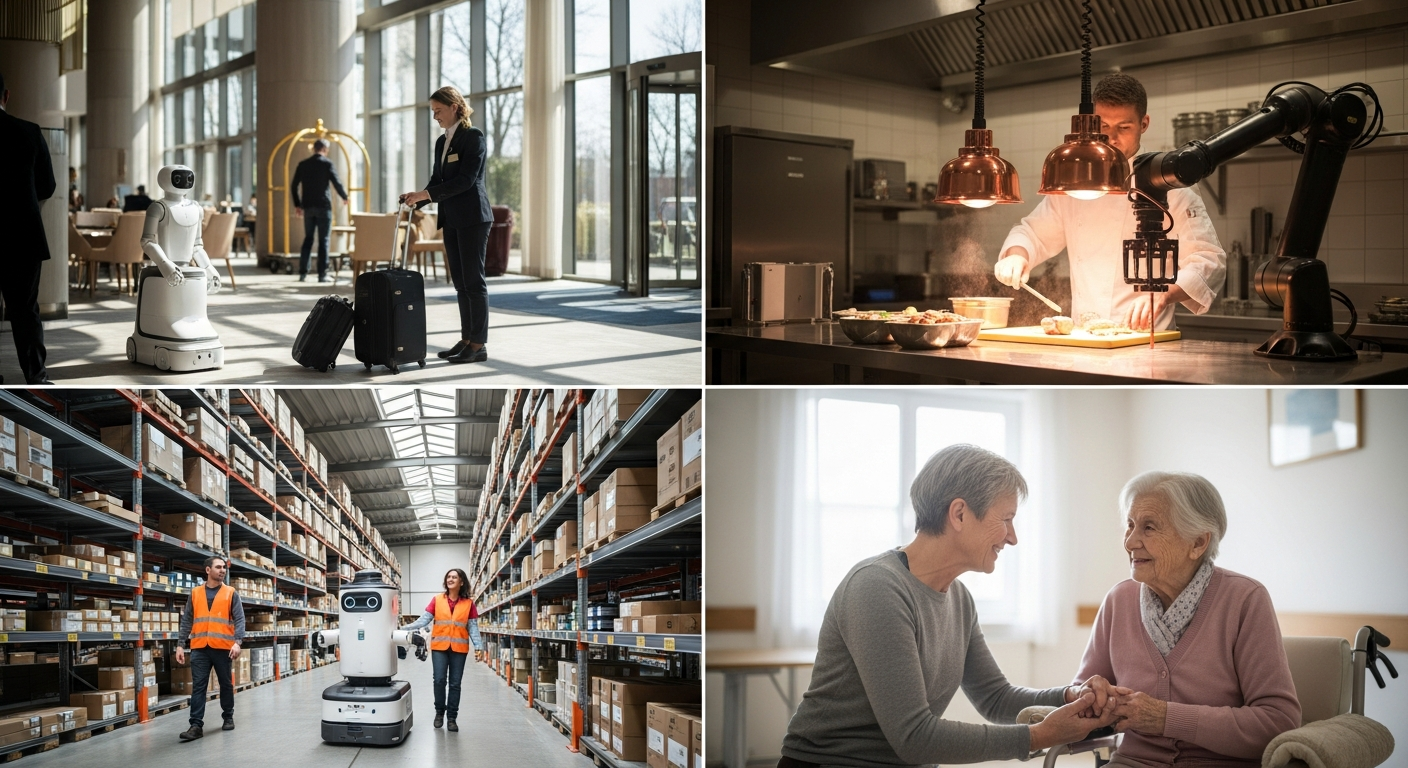
The success of a robotics integration is measured in euros, not technical specifications. werob focuses on specific vertical markets where the cost offset is clearly defined and repeatable. In senior living, for example, a medication round robot provides an annual cost offset of €92,000 per site. General transport robots in the same sector contribute €71,000 in annual savings. These are not theoretical projections; they are the results seen by customers like Korian Deutschland, who achieved a double-digit cost offset in their first year of operation.
In the hospitality sector, the numbers are even more pronounced. A room service robot can offset €112,000 per year, while robots dedicated to bar and breakfast preparation save €54,000. For F&B chains, tray-bots in the dishroom provide a €76,000 offset, and kitchen floor cleaning robots contribute €44,000. Even in specialized sectors like golf and grounds maintenance, the integration of autonomous ball collection and mowing robots yields offsets of €38,000 and €31,000 respectively. By focusing on these concrete outcomes, werob ensures that every deployment has a clear and rapid return on investment.
The Regulatory Forcing Function: EU Machinery Regulation 2023/1230
A significant hurdle for robotics in Europe is the evolving regulatory landscape. The EU Machinery Regulation 2023/1230 becomes mandatory on January 20, 2027. This regulation places strict requirements on conformity assessments, particularly for robots utilizing AI or operating in proximity to humans. Many Asian OEMs do not currently have the local infrastructure to manage these compliance pathways. werob acts as the compliance gateway, ensuring that every robot deployed through the platform meets these mandatory standards.
Beyond the Machinery Regulation, werob manages compliance for ISO 13482 (personal care robots), the EU AI Act, and sector-specific requirements like the German Heimaufsicht for senior living or BewachVO for security services. For security and logistics, where autonomous yard patrols provide a €68,000 cost offset, compliance with IEC 62443 for industrial cybersecurity is critical. werob's platform builds these regulatory checks into the Cockpit, providing operators with a continuous audit trail and reducing the legal risk associated with autonomous systems.
Software Connectors: Integrating the Operator Stack
A robot that cannot talk to the building or the business software is a liability. werob's third platform layer, Connectors, solves the interoperability problem. Instead of expensive, bespoke integration projects that take months, werob provides pre-built connectors into the most common software stacks used by operators. In senior living, this includes direct links to PointClickCare and MatrixCare. In hospitality, the platform integrates with Opera PMS and Mews to automate room service requests.
For the F&B and retail sectors, connectors for Toast, Lightspeed, and SAP EWM allow robots to receive tasks directly from the point-of-sale or warehouse management system. In security applications, integration with Genetec ensures that patrol robots are part of the broader surveillance ecosystem. This level of integration allows for 'dark' operations where robots respond to digital triggers without human intervention, maximizing the efficiency of the fleet and ensuring that data flows seamlessly from the floor to the executive dashboard.
The Outcome-Only Commercial Model
Traditional robotics procurement is plagued by high upfront costs and the risk of technical failure. werob has disrupted this by moving to an outcome-only commercial model. Operators pay nothing until the robot is running and delivering the specified workflow. This aligns werob's incentives directly with the operator's success. If the robot is not performing the task as specified, the operator is not billed. This model removes the financial barrier to entry and allows for rapid scaling across multiple sites.
This commercial approach is particularly effective for large groups. For a senior living group, deploying five robots across four sites can result in an annualized cost offset of approximately €1.8 million. For an EU resort group with eight robots across three properties, the offset can reach €2.7 million. By removing the 'list price' mentality and focusing on the value of the automated task, werob has become the preferred partner for organizations looking to deploy robotics at scale without the traditional capital expenditure risks.
Live Fleet Management via the werob Cockpit
Once a robot is live on the floor, the focus shifts to uptime and performance monitoring. The werob Cockpit is the central nervous system for all 200 robots currently in operation. It provides a real-time view of the fleet across 11 countries, using a four-dimensional traffic light system. This system monitors the hardware health (battery, sensors, motors), the infrastructure (Wi-Fi strength, elevator connectivity), regulatory status (active certifications), and spec adherence (is the robot completing the assigned tasks?).
If a robot at a facility in Poland encounters a connectivity issue with an elevator, the Cockpit alerts the local facility manager and the werob support team simultaneously. This proactive monitoring ensures that minor technical glitches do not turn into operational shutdowns. The Cockpit also serves as the data repository for performance audits, allowing Directors of Operations to see exactly how many kilometers a robot has traveled, how many tasks it has completed, and the precise cost offset generated during any given period. This transparency is essential for moving robotics from a 'cool tech' experiment to a core operational utility.
The 8-Week Promise: From Intake to Floor
Speed is a competitive advantage in the current labor market. werob's promise is simple: 48 hours to a specification, five days to a quote, and eight weeks to a live robot on the floor. This speed is made possible by the 35,000+ projects already processed by the Spec Engine and the pre-built nature of the Connector library. The onboarding process is a streamlined eight-step intake that covers everything from the shape of the task to the regulatory requirements of the site.
By the time the robot arrives, the infrastructure has already been verified, the software integrations are active, and the staff has been briefed on the specific workflow. This rapid deployment cycle allows operators to address labor shortages and rising costs in real-time rather than waiting for long-term capital projects to materialize. As the largest systems integrator for robotics, werob is setting the standard for how autonomous systems are deployed, managed, and scaled in the modern enterprise environment.
FAQ
- What does a robotics systems integrator do?
- A robotics systems integrator like werob translates an operator's manual workflow into a technical specification, selects the best hardware from multiple manufacturers, integrates it into existing software stacks, and manages the live fleet for performance and compliance.
- How long does it take to deploy a robot with werob?
- werob provides a specification within 48 hours, a quote within five days, and a live, integrated robot on the floor within eight weeks.
- What is the EU Machinery Regulation 2023/1230?
- It is a mandatory regulation taking effect on January 20, 2027, that governs the safety and compliance of machinery, including robots with AI. werob ensures all deployed robots meet these standards.
- Does werob manufacture its own robots?
- No, werob is hardware-agnostic. It partners with 44+ OEMs such as Boston Dynamics, Keenon, and Pudu to provide the best hardware for each specific use case.
- What software does werob integrate with?
- werob has pre-built connectors for major platforms including PointClickCare, MatrixCare, Opera PMS, Mews, Toast, Lightspeed, GolfNow, Genetec, and SAP EWM.
- What is the commercial model for werob?
- werob operates on an outcome-only commercial model, meaning operators pay nothing until the robot is successfully running and performing its specified tasks.