Labor Cost Reduction Robotics Europe: Integration Strategies
European operators face rising labor costs and structural shortages. werob provides a systems integration platform that deploys robots in eight weeks to achieve six-figure annual cost offsets.
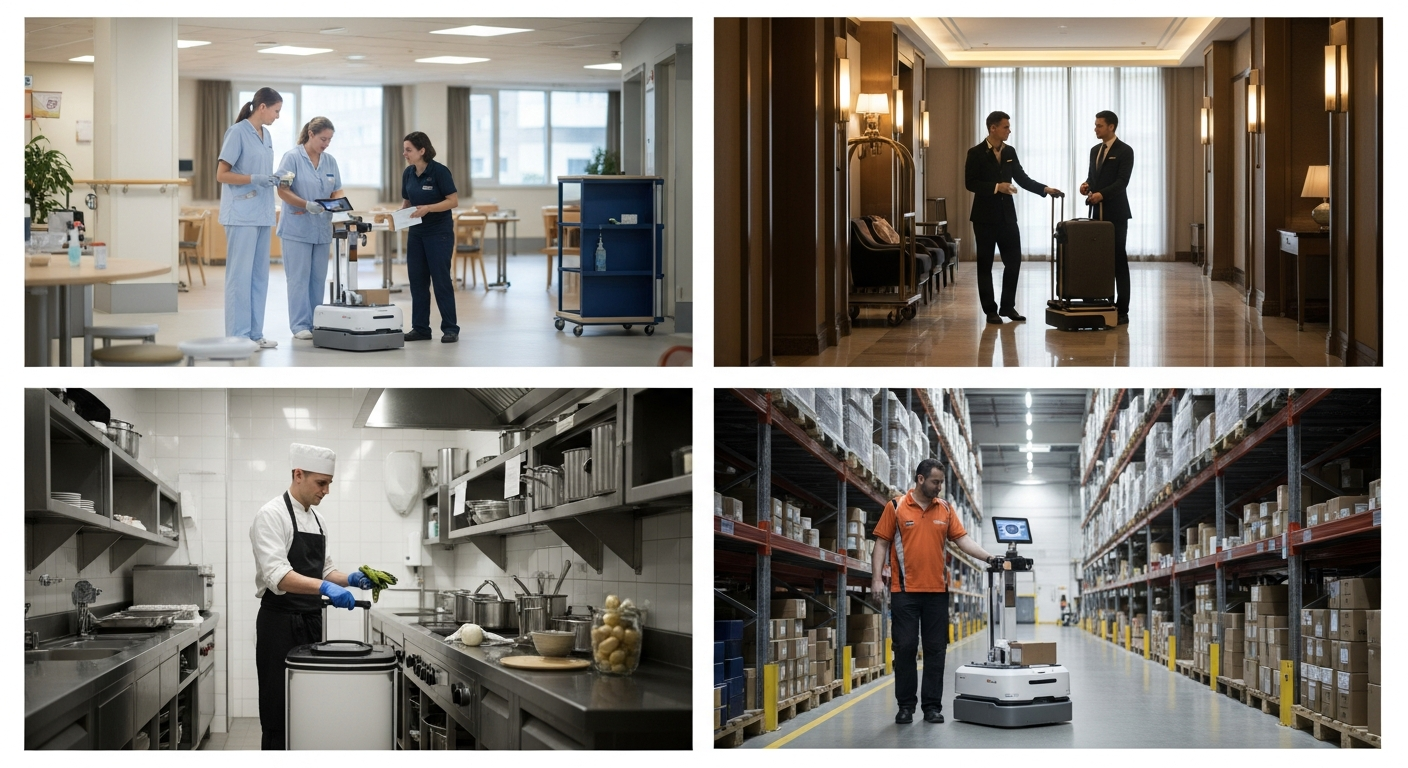
Floor 3. 03:00. The night shift supervisor is managing 40 residents alone. Instead of walking 4 kilometers to deliver supplies, a robot handles the transport. This is not a pilot project; it is a live deployment in a Hamburg senior living facility. In this environment, the robot is not a novelty but a critical component of the labor strategy. European operators are currently facing a dual pressure: rising minimum wages and a structural shortage of qualified personnel. werob addresses this by acting as the systems integrator that translates complex workflows into operational robot fleets. With 200 robots live across 11 European countries, the focus is on measurable cost offsets rather than technology for its own sake.
Key Takeaways
- 1Systems integration is the only way to achieve measurable labor cost offsets in Europe.
- 2The EU Machinery Regulation 2023/1230 makes compliance a mandatory requirement by January 2027.
- 3werob provides a hardware-agnostic platform that ranks 44+ OEMs to find the best fit for any workflow.
The Shift from Hardware to Systems Integration
The European robotics market is saturated with hardware manufacturers, yet the failure rate of independent pilot projects remains high. This is because the value of robotics does not reside in the machine itself, but in the integration of that machine into an existing operational workflow. werob is not a robot manufacturer. It is the operating layer that sits between the operator and the OEM. By ranking 44+ OEM partners against a specific workflow, werob ensures that the hardware selected is the most efficient tool for the task.
Traditional procurement cycles for robotics often involve three to six months of discovery decks and consulting. werob replaces this with a Spec Engine that converts an operator's words into a deployable action graph within 48 hours. This engine is trained on over 35,000 projects, allowing for a level of precision that manual consulting cannot match. Whether the task is medication delivery in senior living or tray transport in a restaurant, the goal is the same: reducing the labor burden on human staff to offset costs. As of May 2026, werob manages 200 live robots, proving that the systems integrator model is the only scalable path for European enterprises.
Verified Labor Cost Offsets by Vertical
Operational leaders require concrete numbers to justify the deployment of autonomous systems. Adjectives like significant or substantial are insufficient for a balance sheet. werob tracks real-world performance data to provide verified cost offsets across various sectors. In senior living, a medication round robot provides an annual cost offset of €92,000 per site. This is achieved by reclaiming nursing hours that were previously spent on simple transport tasks. Similarly, general transport robots in care facilities offset €71,000 per year.
The hospitality sector shows even higher potential for labor reclamation. A hotel room service robot can offset €112,000 per site annually, while automation in bar and breakfast preparation accounts for €54,000. In the food and beverage industry, kitchen floor cleaning robots offset €44,000, and dishroom tray-bots provide a €76,000 offset. Logistics and security also benefit from this model, with yard patrols offsetting €68,000 and retail security patrols saving €58,000 per year. These figures are not theoretical; they are the result of live operations where robots handle the repetitive, low-value movements that drive up labor costs.
The Four-Layer Platform for Rapid Deployment
To achieve these cost offsets, werob utilizes a four-layer platform designed for speed and reliability. The first layer is the Spec Engine. It takes the operator's description of a shift and a task and generates a technical specification in 48 hours. This eliminates the need for lengthy discovery phases. The second layer is the Supplier Match. werob maintains a catalogue of 44+ OEM partners and 280 different robots. The platform ranks these robots against the spec to find the optimal hardware, ensuring the operator is never locked into a single vendor.
The third layer consists of Connectors. A robot that cannot talk to the building or the software stack is a liability. werob provides pre-built integrations into industry-standard systems such as PointClickCare, MatrixCare, Opera PMS, Mews, Toast, and SAP EWM. This allows the robot to receive tasks directly from the existing management software. The final layer is the Cockpit. This live fleet management tool uses four-dimensional traffic lights to monitor hardware, infrastructure, regulatory status, and spec compliance. This comprehensive stack is what allows werob to move from a quote to a live robot on the floor in just eight weeks.
EU Machinery Regulation 2023/1230 Compliance
Regulatory compliance is the primary forcing function for robotics in Europe. The EU Machinery Regulation 2023/1230 becomes mandatory on January 20, 2027. This regulation introduces strict requirements for conformity assessments, particularly for robots originating from non-EU manufacturers. Many operators who purchase robots directly from OEMs find themselves non-compliant because they lack the necessary documentation and safety certifications required by European law.
werob acts as the compliance pathway for its partners. The platform is built to ensure that every deployment meets the standards of the new Machinery Regulation, as well as ISO 13482 for personal care robots and the EU AI Act. For senior living facilities in Germany, werob also manages the requirements of the Heimaufsicht. By handling the regulatory burden, werob allows operators to focus on their core business while maintaining a high safety and cyber posture. This includes compliance with IEC 62443 for industrial cybersecurity and GDPR for sensor data management. Failure to prepare for the 2027 deadline could result in the immediate grounding of non-compliant robot fleets across the EU.
Hardware-Agnosticism and the OEM Landscape
The robotics industry is evolving rapidly, with new hardware entering the market every month. An operator who commits to a single manufacturer risks being stuck with obsolete technology within two years. werob’s hardware-agnostic approach mitigates this risk. The platform ranks 44+ OEMs, including leaders in humanoids like Boston Dynamics, Apptronik, and Unitree, as well as service robot specialists like Keenon and Pudu. This ensures that the operator always has access to the best-in-class hardware for their specific use case.
Because werob is an integrator and not a manufacturer, its loyalty lies with the operator's workflow. If a new robot enters the market that offers a better cost-to-performance ratio, the werob platform can integrate it into the existing fleet. This flexibility is critical for large-scale deployments, such as those seen with Korian Deutschland. By maintaining a diverse catalogue of 280 robots, werob provides a level of future-proofing that single-OEM resellers cannot offer. The goal is to solve the operational problem, regardless of which brand of robot is doing the work.
Integration with Existing Software Stacks
A robot operating in isolation is an island of automation that often creates more work for staff than it saves. To truly reduce labor costs, the robot must be a native part of the digital ecosystem. werob’s Connectors layer provides direct, pre-built integrations into the most common software stacks used in Europe. In the hospitality sector, this includes Opera PMS and Mews, allowing robots to handle room service requests automatically when a guest places an order. In the F&B sector, integrations with Toast and Lightspeed ensure that tray-bots are dispatched as soon as an order is ready in the kitchen.
For the healthcare and senior living sectors, werob integrates with PointClickCare and MatrixCare. This allows for seamless task management where nursing staff can trigger robot movements within the software they already use daily. In logistics, the connection to SAP EWM ensures that autonomous mobile robots are synchronized with the warehouse management system. These integrations are not bespoke body-shop projects; they are standardized connectors that are part of the werob platform. This standardization is what enables the eight-week deployment timeline and ensures that the data from the robots is captured in the operator's existing audit logs.
The Outcome-Only Commercial Model
One of the biggest barriers to robotics adoption is the high upfront capital expenditure and the risk of the technology not delivering the promised results. werob eliminates this barrier through an outcome-only commercial model. Operators do not pay for the hardware or the implementation until the system is running and delivering the specified workflow. This shifts the risk from the operator to the integrator, ensuring that werob is fully aligned with the customer's success.
There are no hidden list prices or complex licensing fees. The commercial frame is built around the value delivered to the operation. This model is particularly attractive for large groups, such as the senior living group that achieved a €1.8M annualized cost offset across four sites. By focusing on outcomes, werob ensures that every robot on the floor is contributing to the bottom line. This approach has allowed werob to scale to 11 European countries, providing a clear and predictable path to ROI for operations directors and CFOs who are wary of traditional technology pilots.
Implementation Timeline: From Intake to Live Floor
Speed is a critical differentiator in a market where labor shortages are an immediate problem. werob’s onboarding process is designed to move from initial contact to a live robot in eight weeks. The process begins with an eight-step intake that covers the user's identity, the specific shift and task, site infrastructure, hardware preferences, and regulatory requirements. Within 48 hours of this intake, werob provides a detailed technical specification. A formal quote follows within five days.
The remaining weeks are spent on configuration, integration, and compliance checks. Because the connectors are pre-built and the OEM relationships are already established, the deployment phase is streamlined. This is a stark contrast to the industry norm of multi-month discovery phases. By the eighth week, the robot is on the floor, integrated into the software stack, and fully compliant with EU regulations. This rapid deployment capability is what allows operators to address labor costs in real-time, rather than waiting for a long-term transformation project to bear fruit.
FAQ
- How much can robotics reduce labor costs in senior living?
- In senior living facilities, robotics can offset approximately €92,000 per site per year for medication rounds and €71,000 for general transport tasks.
- What is the EU Machinery Regulation 2023/1230?
- It is a mandatory regulation taking effect on January 20, 2027, that requires strict conformity assessments and safety standards for all machinery, including robots, in the EU.
- How long does it take to deploy a robot with werob?
- werob delivers a technical spec in 48 hours, a quote in five days, and a live robot on the floor within eight weeks.
- Which software systems does werob integrate with?
- werob has pre-built connectors for PointClickCare, MatrixCare, Opera PMS, Mews, Toast, Lightspeed, GolfNow, Genetec, and SAP EWM.
- Is werob a robot manufacturer?
- No, werob is a hardware-agnostic systems integrator that matches an operator's workflow to the best available robots from 44+ OEM partners.
- What is the commercial model for werob?
- werob uses an outcome-only commercial model where the operator pays nothing until the system is operational and running.