Robot commissioning partner: efficiency in eight weeks
Choosing the right partner for robot commissioning determines the long-term ROI of your automation strategy. As a hardware-agnostic system integrator, werob delivers ready-to-use solutions including software integration and compliance path.
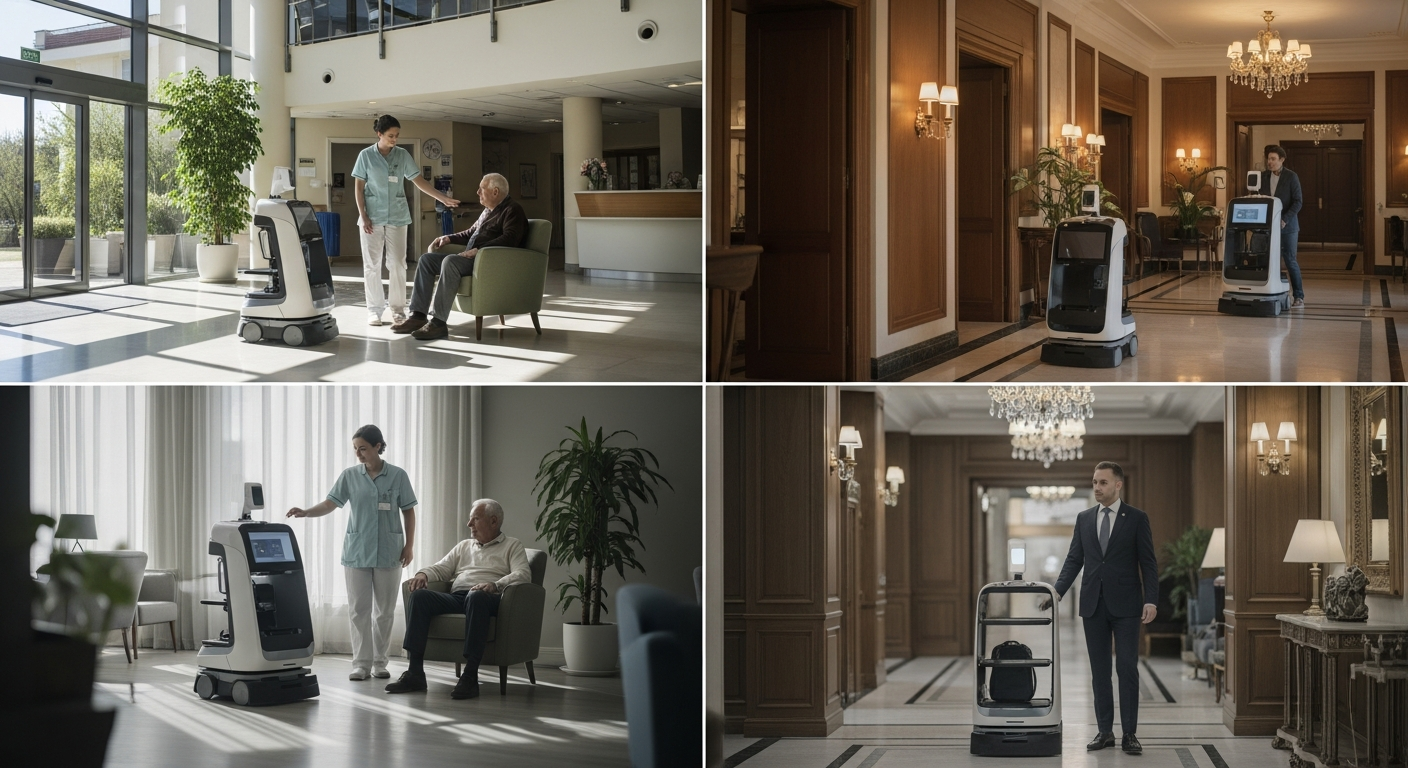
Station 2. 10:00 p.m. The night watch begins its tour while the medication cart is already passing autonomously through the hallway. In this operational reality, it is not the theory of a Discovery deck that counts, but rather the reliability of the technology. Many companies fail when introducing robotics due to the complexity of the interfaces or rigid manufacturer solutions. A competent partner for robot commissioning must speak the language of the company today and translate this into a technical specification in 48 hours. werob acts as a central operating level that synchronizes hardware, software and regulations so that the staff's focus is back on the core task.
Key Takeaways
- 1Hardware agnostics by a system integrator prevents expensive wrong decisions and vendor lock-in when commissioning the robot.
- 2Integration into existing systems such as SAP or Opera PMS is the prerequisite for measurable cost savings of up to 112,000 euros per year.
- 3Compliance with the EU Machinery Regulation 2023/1230 by January 2027 must already be part of every commissioning strategy.
The system integrator as a decisive success factor
The classic procurement of robotics often follows an outdated pattern: a company chooses a specific manufacturer and then tries to squeeze their hardware into its own processes. A modern partner for robot commissioning turns this process around. werob is not a robot manufacturer and not a simple reseller. As a system integrator, the focus is on the operator's operational requirements. This means that it is not the hardware that dictates the workflow, but rather that the workflow determines the hardware.
With access to over 44 OEM partners and more than 280 different robot models, werob offers a hardware-agnostic platform. This prevents vendor lock-in and ensures that the most technically and economically most suitable system is chosen for each specific task, be it in care, hotels or logistics. A commissioning partner takes full responsibility for the interaction between mechanics, sensors and the customer's existing IT infrastructure. At a time when talent shortages limit operational capacity, this speed and precision of implementation is a critical competitive advantage.
The Spec Engine: Ready for use in 48 hours
Time is the most expensive resource in operational environments. While traditional consulting firms need three to six months to create requirements catalogs, werob uses the so-called Spec Engine. This tool translates the human description of a workflow, such as a medication round or room service process, into an accurate, usable robotic specification in just 48 hours. The Spec Engine was trained on the basis of over 35,000 projects and eliminates the typical sources of error in manual planning.
This automated approach ensures that all relevant parameters are taken into account, from floor conditions to elevator control to the radius of interaction with people. A partner for robot commissioning who can access such amounts of data massively reduces the risk of bad investments. The operator does not receive a vague concept, but rather a validated action graph that describes exactly what the robot has to do, when and where. This clarity is the prerequisite for the subsequent supplier matching, in which the hardware is checked against this specification.
Supplier Match: Objective ranking instead of manufacturer marketing
The market for robotics is confusing and characterized by rapid innovation cycles. It is almost impossible for an operator to keep track of the technical details and compliance standards of all available models from manufacturers such as Keenon, Pudu, Boston Dynamics or Apptronik. Here the commissioning partner takes on the role of curator. Through the Supplier Match process, the 44+ OEM partners in the werob catalog are objectively ranked against the previously created specification.
This ranking takes into account not only the acquisition costs, but also the ease of maintenance, the availability of spare parts in Europe and conformity with local standards. A robot commissioning partner ensures that only hardware that can withstand the tough demands of 24/7 operation is used. Since Werob acts hardware-agnostic, objectivity is maintained. The goal is not to sell a specific model, but to achieve the defined operational outcome. This approach protects the operator from technological dead ends and ensures that the fleet will still be state-of-the-art in five years.
Seamless integration through pre-built connectors
A robot that acts as an isolated unit often creates more work than it saves. The true value of automation comes from its deep integration into the company's existing software stack. A professional partner for robot commissioning therefore not only supplies the hardware, but also the necessary interfaces. werob offers ready-made connectors for market-leading systems such as SAP EWM, Opera PMS, Mews, Toast or PointClickCare.
In a hotel, for example, this integration enables an order in the point-of-sale system to automatically trigger a delivery order to the robot, which in turn calls the elevator and informs the guest upon arrival via the room telephone. In nursing, the connection to MatrixCare or PointClickCare means that transport tasks can be controlled directly from the nursing documentation. This connectivity reduces manual interaction to a minimum and ensures seamless data transfer to the central management system. Without this integration, robotics remains a toy; it becomes an integral part of the company's value chain.
Regulatory and Compliance: The Path to the EU Machinery Regulation
An often underestimated aspect when commissioning robots is legal protection. From January 20, 2027, the new EU Machinery Regulation 2023/1230 will be binding. This places significantly higher demands on conformity assessment, especially for systems that work with artificial intelligence or operate in close proximity to people. A commissioning partner must integrate this compliance path into the implementation process today.
werob ensures that all systems used comply with applicable standards such as ISO 13482 for personal assistance robots. This also includes compliance with the GDPR when processing sensor data as well as industry-specific requirements such as the Guarding Ordinance (BewachVO) in the security sector or HACCP standards in the catering industry. In care, coordination with home supervision is also crucial. A partner who takes on this regulatory burden protects the management from liability risks and ensures legally compliant operation of the robot fleet over its entire service life.
Economic efficiency and measurable cost relief
Automation has to pay off. An experienced partner for robot commissioning provides clear figures instead of vague promises. Based on data from 200 robots in live operation (as of May 2026), werob enables significant savings in various verticals. In care, the automation of the medication round leads to a cost reduction of 92,000 euros per location and year. Simply transporting laundry or meals saves a further 71,000 euros annually.
In the hotel industry, the potential for room service is 112,000 euros, while preparing the bar and breakfast costs 54,000 euros. In the area of logistics and security, an autonomous farm patrol relieves the budget by 68,000 euros per year. These numbers are not estimates, but operational reality for customers like Korian Germany. A partner for commissioning helps to identify this potential through a precise workflow analysis and to realize it without any upfront financial risk through the right commercial model, such as werob's outcome-only approach.
The live cockpit: transparency during ongoing operations
After physical commissioning, the fleet management phase begins. A robot commissioning partner must not leave the customer alone after installation. The werob Cockpit serves as the central control unit for live operation. It uses a four-dimensional traffic light system to monitor the status of the hardware, infrastructure, regulations and compliance with the original specification in real time.
If a deviation occurs, for example because a WLAN access point fails or a robot cannot follow a planned route, this is signaled immediately. This transparency is crucial for acceptance among staff. Only if the technology works reliably and problems are solved proactively will the robot be perceived as a real relief. The cockpit also provides valuable data for the continuous optimization of processes. In this way, bottlenecks can be identified and fleet utilization can be steadily increased. A partner that offers this level of operational monitoring guarantees the long-term stability of the automation solution.
Outcome-only: A fair commercial model
Confidence in new technologies increases with the security of the investment. werob therefore follows a consistently results-oriented model: outcome-only. This means that the operator does not incur any costs until the robot is actually in productive use and fulfills the defined workflow. This model differs massively from classic consulting firms or hardware sellers who invoice for the planning or the pure delivery.
A partner for the robot commissioning who bears this financial risk underlines his competence and his interest in a functioning solution. There are no hidden list prices, but rather a clear calculation based on the service provided. This approach enables companies to start even complex projects such as the use of humanoids, as is currently being piloted in a Hamburg care facility, with calculable risk. The speed of eight weeks to live operation becomes the common goal of partner and operator.
Comparison of the commissioning models
There are various approaches available when choosing a partner for robot commissioning. The following table illustrates the differences between the werob system integrator model and conventional paths.
| Criteria | Individual OEM / Reseller | Consulting company | werob System integrator |
|---|---|---|---|
| Hardware selection | Private brand only | Theoretical recommendation | 44+ OEMs (agnostic) |
| Planning duration | Weeks | 3-6 months | 48 hours (Spec Engine) |
| IT integration | Often superficial | Requires third party providers | Pre-built connectors |
| Compliance path | Manufacturer dependent | Documentation only | Integrated EU path |
| Cost model | Purchase / leasing | Daily rates | Outcome-only |
The comparison shows that werob's integrated approach closes the gap between technical feasibility and operational benefit. While resellers are often tied to their hardware and consultants remain stuck in theory, the system integrator delivers a turnkey solution that generates immediate added value.
FAQ
- What distinguishes werob from a robot manufacturer?
- werob is a hardware-agnostic system integrator. We do not produce our own hardware, but select the best solution for your specific workflow from over 44 OEM partners and integrate it into your IT infrastructure.
- How long does it take to commission a robot?
- At werob, the process from the initial specification to productive use usually takes eight weeks. The technical specification is available after just 48 hours.
- Which software systems can be connected?
- We offer pre-built connectors for systems such as SAP EWM, Opera PMS, Mews, Toast, MatrixCare and PointClickCare to ensure seamless data transfer.
- What does the outcome-only commercial model mean?
- With werob, you only pay when the robot is running in your company as specified. There are no upfront payments for hardware or advice without a working result.
- Is the solution compliant with the new EU machinery regulation?
- Yes, werob offers an integrated compliance path for the EU Machinery Regulation 2023/1230, which is binding from January 20, 2027, as well as for other standards such as ISO 13482.
- In which countries is werob active?
- werob is currently operational in 11 European countries, including Germany, Austria, Switzerland, France, Italy, Spain and the Benelux countries.
Related reading
Robot Integrator: To an operational fleet in eight weeks
A robot integrator closes the gap between hardware manufacturers and everyday operations. Find out how werob specifies workflows in 48 hours and brings productive units to the floor within eight weeks.
30 June 2026eu robotics compliance partnerEU Robotics Compliance Partner: Security from 2027
The new EU machinery regulation will set strict limits for the operation of autonomous systems from January 2027. werob acts as your compliance partner, combining hardware agnostics with regulatory security.
7 July 2026robotics boutique integrator partnerRobotics boutique integrator partner for your business
A specialized robotics integrator closes the gap between complex hardware and everyday operational life. Find out how werob, as a hardware-agnostic partner, translates your workflows into a usable specification in 48 hours.
3 July 2026robot deployment partner germanyChoosing a Robot Deployment Partner in Germany
Navigating the German robotics landscape requires more than hardware selection. It demands a systems integrator capable of bridging the gap between operational workflows and strict EU regulatory compliance.
5 July 2026robot deployment partner ukRobot Deployment Partner UK: The Systems Integration Guide
Stop evaluating individual robots and start deploying operational outcomes. This guide outlines how a hardware-agnostic systems integrator translates UK workflows into live, integrated robot fleets using a 48-hour specification engine.
5 July 2026