Robots in nursing homes: efficiency and compliance
The use of robotics in care is no longer a vision of the future, but rather an economic necessity to relieve the burden on specialist staff. Find out how werob, as a system integrator, deploys ready-to-use solutions within eight weeks that achieve significant cost savings.
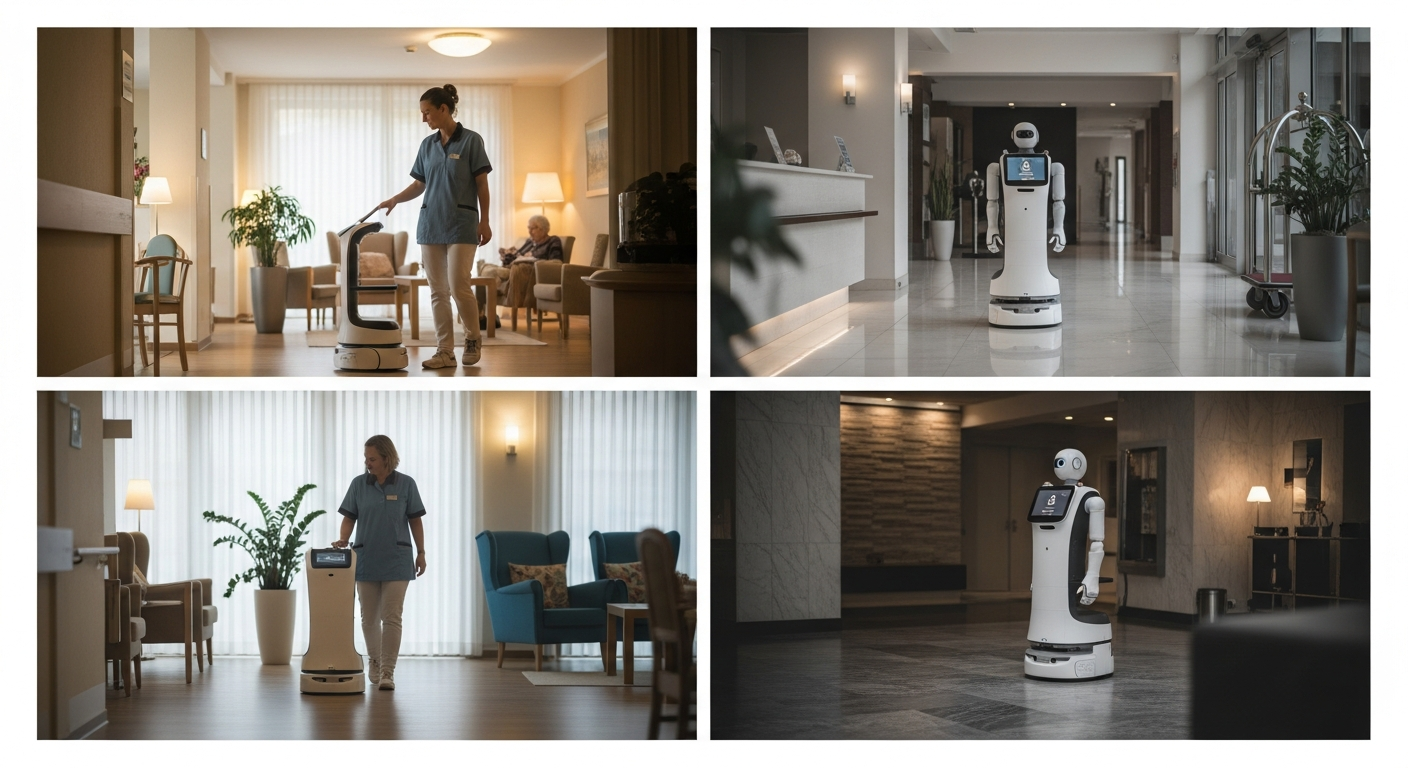
Station 3. 9:45 p.m. The handover is complete. While the nursing staff updates the documentation in the PointClickCare system, the transport robot starts moving. He brings the heavy laundry containers to the central logistics station. No staff has to leave the station. The specialist stays with the residents. This is not a pilot project in a test environment, but rather everyday operations in modern care facilities. werob translates these workflows into precise robot specifications and brings the hardware into live operation. The focus is not on the technology itself, but on the measurable relief of staff and compliance with strict regulatory requirements.
Key Takeaways
- 1Measurable relief: Significant annual savings in medication rounds and transportation per location.
- 2Fast implementation: From the first specification in 48 hours to live operation in just eight weeks.
- 3Legal certainty: werob offers a compliance path for the upcoming EU Machinery Regulation 2023/1230.
The status quo of care robotics: integration instead of isolated solutions
The debate about the use of robots in nursing homes is often dominated by futuristic visions that ignore everyday operational life. It's not about replacing human attention - experts always maintain control over the processes - but about automating unproductive walking routes and heavy lifting tasks. An average nursing home loses valuable specialist hours every day due to logistical tasks that have no direct therapeutic benefit. This is where werob comes in as a system integrator. In contrast to pure hardware manufacturers, werob looks at the operator's entire workflow. The goal is to seamlessly embed robotics into the existing operational stack.
Many institutions make the mistake of purchasing individual robots without an overarching integration strategy. Such isolated solutions often fail due to a lack of acceptance or a lack of interfaces to the care software. werob acts as an operational level that mediates between the requirements of the nursing service management and the technical possibilities of over 44 OEM partners. With over 200 robots in live operation in eleven European countries, werob has the necessary experience not only to plan projects but also to put them into long-term productive use. Over 280 different robot models are tested against the specific requirements of the facility in order to guarantee the optimal hardware choice.
Measurable cost relief: operational efficiency figures
Care operators calculate profitability precisely. The use of robotics must lead to direct or indirect cost reductions in order to survive in the competitive environment. werob uses verified data from existing installations to predict ROI for new customers. The medication round is one of the most time-consuming processes on any shift. By using specialized transport robots that bring the material to the station autonomously, significant annual cost reductions are achieved per location. The staff saves time traveling between the pharmacy, warehouse and ward and can use this time to provide direct care to residents.
Another area with high savings potential is the general transport of laundry, food and waste. Here, the verified cost relief amounts to a significant amount per year and location. These numbers are not theoretical estimates, but are based on reducing overtime and optimizing shift schedules. In times of a shortage of skilled workers, this relief is also a crucial factor for employee retention. When hard physical work and monotonous walking are eliminated, job satisfaction increases measurably. werob's commercial model is consistently geared towards success: the outcome-only model means that operators only pay when the robot is actually in productive use.
The werob Spec Engine: To the specification in 48 hours
Traditional robotics consulting projects often last three to six months before the first hardware is ordered. The care industry requires higher speeds. werob has radically shortened this process with the Spec Engine. This platform layer translates a facility's verbal descriptions of workflows into an operational robot specification within 48 hours. The Spec Engine has been trained on over 35,000 projects and immediately recognizes which hardware requirements are necessary for certain floor coverings, door systems or elevator controls.
After the specification has been created, the supplier match takes place. werob is hardware-agnostic and not tied to a single manufacturer. The robots that achieve the best ranking for the specific task are selected from a catalog of over 44 OEM partners. Whether it is a humanoid robot for complex interactions or a specialized transport robot depends solely on the operator's requirements. This process guarantees that customers do not get into a vendor lock-in, but always receive the most technologically and economically sensible solution. A binding offer is usually available within just five days of the first inquiry.
Integration into the operator stack: PointClickCare and MatrixCare
A robot that does not communicate with the existing software remains a foreign object in operation. werob solves this problem with prefabricated connectors. These enable the robot fleet to be directly integrated into leading systems such as PointClickCare or MatrixCare. When a caregiver documents or requests a task in the usual system, this command is automatically transferred to the werob Cockpit and assigned to the corresponding robot. This deep integration ensures that there are no duplicate data maintenance paths and that acceptance among staff remains high.
The werob Cockpit serves as a central control unit for live fleet management. It provides a four-dimensional traffic light system that monitors the status of hardware, infrastructure, regulatory and specification compliance in real time. If a robot is unable to fulfill its task due to an obstacle or a technical defect, this is immediately signaled in the cockpit. This transparency is essential for safe operations in sensitive environments such as nursing homes. The connectors also ensure that all of the robot's activities are completely documented and stored with complete source traceability, which is essential for compliance with quality standards and legal documentation requirements.
Regulatory safety: EU Machinery Regulation 2023/1230
The use of robotics in care is subject to strict legal requirements. The new EU Machinery Regulation 2023/1230, which will become binding from January 20, 2027, is particularly critical. Many robot manufacturers, especially from Asia, do not currently fully meet these requirements for the European market. werob offers the necessary compliance path here. As a system integrator werob takes responsibility for conformity assessment and ensures that all systems used comply with European safety standards. This also includes compliance with ISO 13482 for personal care robots.
In addition, country-specific requirements such as the requirements of home supervision in Germany must be taken into account. werob integrates these regulatory checks in the planning phase via the Spec Engine. Operators therefore receive not only a technical solution, but also a legally secure overall solution. This protects management from liability risks and ensures a smooth audit process by the supervisory authorities. In an industry where security and privacy are top priorities, this integrated compliance approach is an essential part of any robotics strategy. werob ensures that the robots used not only operate efficiently, but also fully comply with the law. The highest security standards such as SOC 2 Type II and ISO 27001 are adhered to.
Hardware agnostics: The best robots for care
The market for robotics is developing rapidly. New models from manufacturers such as Keenon, Pudu and Unitree are constantly entering the market. It is almost impossible for a nursing home operator to keep track of the technological performance and reliability of these systems. werob solves this problem through a hardware-agnostic approach. Since werob is not a manufacturer, there is no interest in selling a specific model. Instead, the hardware that best suits the customer's specification is selected. These can be specialized service robots for in-house catering or humanoid robots for versatile assistance tasks.
An example of this approach is the use of the first humanoid robot in a Hamburg care facility, which is already in its twelfth week of operation. The search was not for the best-known name, but for the machine that can best handle the building's specific thresholds and narrow hallways. By ranking over 280 types of robots, werob ensures that future technological leaps can be made immediately usable for customers. Should a new manufacturer bring a superior model onto the market, it can be immediately integrated into existing fleets via the werob platform without having to rebuild the entire infrastructure.
Outcome-only: A commercial model without risk
High investment costs and uncertain payback periods are often the biggest hurdles to the introduction of robotics in care. werob breaks with traditional pricing models and offers an outcome-only approach. This means: The customer only pays when the robot is in use as specified and delivers the promised added value. There are no hidden costs for lengthy discovery phases or consulting services that do not result in a productive solution. This model forces werob to focus on the highest quality and quick implementation right from the start.
The commercial structure is designed to make the cost reductions immediately visible in the facility's budget. For example, if a robot takes over the medication round and thereby saves significant amounts of money per year, the fee for operating the robot is calculated in such a way that there is a positive cash flow for the operator from day one. This model also enables smaller providers to benefit from the latest technology without burdening their liquidity with high one-off investments. werob assumes the technological risk and responsibility for long-term operation, while the operator can concentrate on its core competency: caring for people.
Going live in eight weeks: The implementation process
werob relies on speed. While conventional projects often take years, werob puts robots into productive use within eight weeks. This process follows a clear eight-step onboarding intake. First, it is defined who the operator is and which specific layers should be automated. The description of the tasks is done in the customer's own words, which are then processed by the Spec Engine. Infrastructure data such as floor plans and existing IT systems are recorded to ensure connectivity.
After the hardware has been selected through the supplier match and the regulatory requirements have been clarified, the physical installation and connection to the operator stack takes place. The werob team accompanies this process on site to ensure that the integration into daily processes works smoothly. The goal is not to hand over a technical device, but rather to establish a new, more efficient workflow. After eight weeks, the robot is an integral part of the team and is monitored via the live cockpit. This structured approach minimizes downtime and ensures that the planned cost reductions are realized quickly. A partner at a Big Four consultancy, for example, reported a reduction in analysis times from three weeks to five days.
Future security through the werob cockpit
Operating a robot fleet does not end with installation. Continuous monitoring and optimization are necessary to ensure long-term success. The werob Cockpit offers all the necessary tools for this. It not only monitors the technical availability of the hardware, but also compliance with the defined service level agreements. For example, if a robot slows down or Wi-Fi coverage is weak in certain areas of the facility, the cockpit immediately provides the appropriate troubleshooting data. This proactive maintenance prevents downtimes and secures the operator's investment.
In addition, the cockpit enables data-based optimization of workflows. By analyzing movement data and task distribution, bottlenecks can be identified and processes can be further refined. In combination with the regular updates of the connectors, the robotics solution always remains at the cutting edge of technology and regulatory requirements. werob plans to operate over 2,000 robots in Europe by 2028. Customers who join today will become part of this growing ecosystem and benefit from the platform's economies of scale and continuous improvements. The future of care is digital and automated, and WHO provides the operating system for it.
FAQ
- What are the costs for the first analysis?
- At werob there are no upfront costs for the analysis. With the outcome-only model, you only pay when the robot is running productively in your facility.
- Can the robots communicate with elevators?
- Yes, integration into building technology, including elevator controls and automatic doors, is part of the werob specification.
- Which nursing software is supported?
- werob offers pre-built connectors for leading systems such as PointClickCare and MatrixCare.
- How do residents react to the robots?
- Experience with leading operators shows a high level of acceptance because the robots primarily take on logistical tasks in the background and the staff are more present for the residents.
- What happens in the event of technical disruptions?
- The werob cockpit monitors the fleet in real time. Malfunctions are reported immediately and resolved by our support or local partners.
- Is werob a robot manufacturer?
- No, werob is a hardware-agnostic system integrator. We select the best solution for your specific needs from over 44 OEM partners.
Related reading
Robots in nursing homes: cost relief and operational safety
The use of robotics in inpatient care is no longer a vision of the future, but rather an economic necessity to relieve the burden on specialist staff. Find out how werob, as a system integrator, paves the way from workflow analysis to live operation in eight weeks.
17 June 2026system integrator roboticsSystem integrator robotics: Scaling in eight weeks
A robotics systems integrator bridges the gap between OEM hardware and operational reality. werob translates workflows into usable specifications in 48 hours and integrates fleets into existing IT stacks.
5 July 2026Robots for rent nursing homeRenting robots in nursing homes: costs and integration
Renting robots in care is not just a procurement process, but rather a procedural decision. werob delivers ready-to-use solutions within eight weeks that are directly integrated into the care stack.
1 July 2026nursing home director roboticsNursing home director robotics: operational relief and ROI
The introduction of robotics in care often fails due to complex selection processes. werob shortens the path from requirements analysis to live operation to eight weeks and guarantees measurable cost reductions.
26 June 2026Robot commissioning partnerRobot commissioning partner: efficiency in eight weeks
Choosing the right partner for robot commissioning determines the long-term ROI of your automation strategy. As a hardware-agnostic system integrator, werob delivers ready-to-use solutions including software integration and compliance path.
29 June 2026