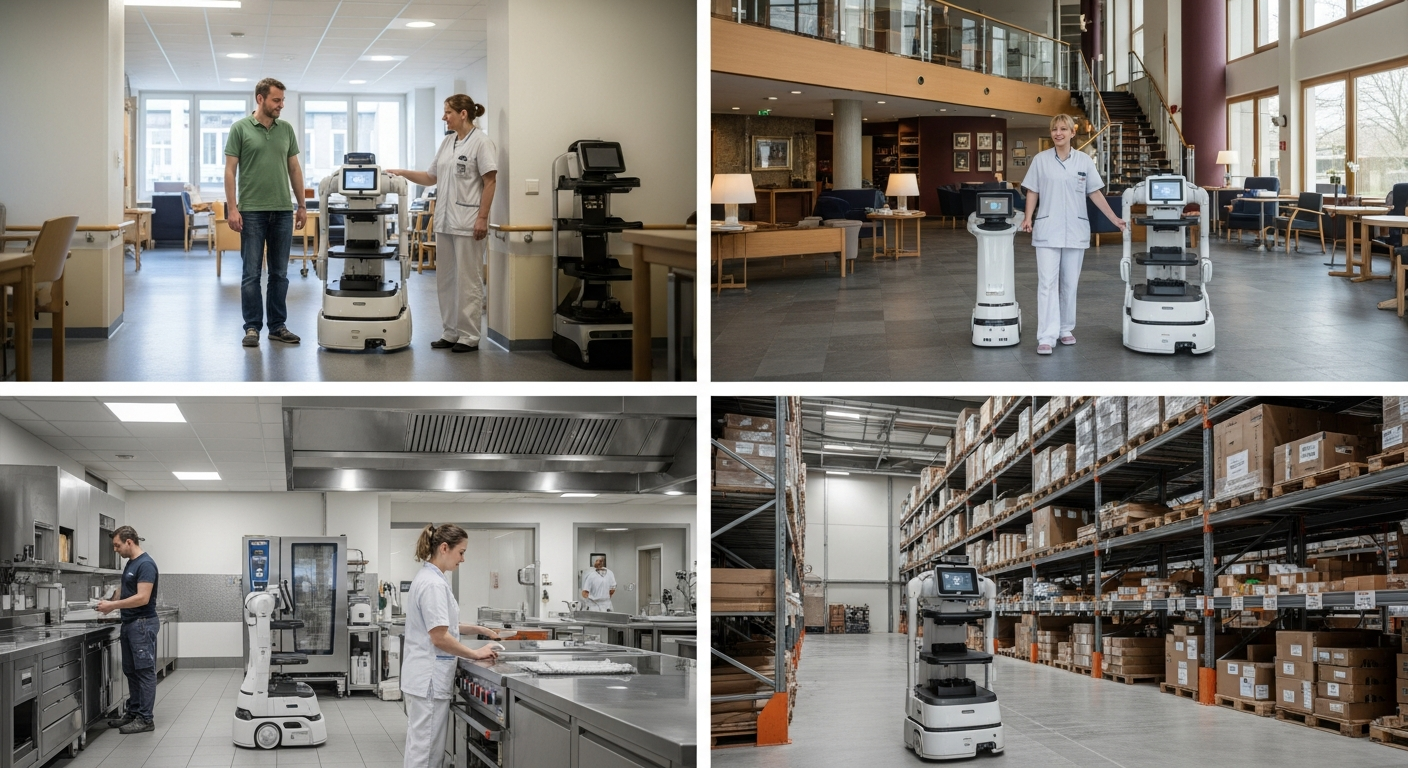
RaaS care robots: Efficiency through system integration
Robotics as a Service (RaaS) transforms care from an investment-intensive hurdle into a scalable operating model. As a system integrator, werob provides the necessary infrastructure to productively integrate robots into everyday station life within eight weeks.
Station 3. 3:15 a.m. The night watch is responsible for 40 residents alone. While the nursing staff is completing documentation at the terminal, an autonomous transport robot is already delivering the prepared laundry packages for the early shift. This is not a vision of the future, but rather everyday operational life in facilities that rely on Robotics as a Service. werob acts as the decisive operational level that translates the care workflow into a usable robot specification. Within eight weeks, a personnel shortage situation becomes a technological relief, saving up to 92,000 euros per location and year on medication. werob is not a manufacturer, but the integrator who ensures that the technology works in the existing system.
Key Takeaways
- 1RaaS in care enables immediate cost reductions of up to 92,000 euros per year without CAPEX hurdles.
- 2As a hardware-agnostic integrator, werob delivers a ready-to-use solution including IT integration within eight weeks.
- 3Compliance with the EU Machinery Regulation 2023/1230 will be mandatory from 2027 and will be ensured by werob as a compliance path.
The RaaS model in care: More than just rent
Robotics as a Service (RaaS) is often mistakenly equated with a simple rental or leasing model for hardware. However, in the highly regulated environment of residential care, this definition falls short. A true RaaS approach, like the one we are pursuing, encompasses the entire operational level. It's not about the robot itself, but about the successful execution of a workflow. For operators, this means that they do not have to bear high investment costs (CAPEX), but can view robotics as an operational outcome. You only pay when the robot actually runs and provides added value.
werob differentiates itself here as a hardware-agnostic system integrator. While a single manufacturer (OEM) always only wants to sell its own hardware, werob analyzes the specific needs of the facility. With over 44 OEM partners in the catalog and the ability to range 280 different robot types, werob will find the solution that exactly fits the floor plan, floor conditions and IT interfaces of the company. The aim is to relieve specialist staff of routine logistical tasks so that the time for direct resident care is maximized. The commercial model is consistently geared towards success: Outcome-only means that the economic burden of implementation lies with the integrator until operational readiness is achieved.
Economic efficiency: 92,000 euros in cost relief per year
The introduction of robotics in care must be measured against hard business metrics. Adjectives such as clear or noticeable are not enough in the budget planning of care companies. werob provides concrete data from the live operation of over 200 robots in eleven European countries. An automated medication round leads to an annual cost reduction of 92,000 euros per location. This sum results from the savings in travel time that the highly qualified staff previously had to spend on purely logistical activities.
Another example is the internal transport of laundry, meals or consumables. Here, operators realize a relief of 71,000 euros per location and year. These figures are not theoretical projections, but are based on projects such as Korian Germany, where double-digit cost reductions were achieved in the first year. With the RaaS model, these savings become effective immediately, as there is no need to wait for a payback period for expensive hardware purchases. The monthly service fee is calculated directly against the personnel cost hours saved, resulting in an immediate improvement in the operating margin. In times of rising wage costs and an acute shortage of skilled workers, this form of automation is the only way to keep the quality of care stable.
The four levels of the werob platform
To guarantee the speed of eight weeks until live use, werob uses a four-tier platform architecture. It starts with the Spec Engine. In just 48 hours, this system translates the human description of a workflow into a technical specification. The engine was trained on the basis of over 35,000 projects and immediately recognizes the requirements for sensors, load capacity and navigation. In contrast to classic consulting firms, which require months-long discovery phases, werob immediately provides usable specifications.
The second level is the supplier match. Here the requirements are checked against the catalog of over 44 OEMs. Whether a robot from Keenon, Pudu or a specialized humanoid like from Apptronik is used depends solely on the suitability for the specific case. The third level is the connectors. A robot is only as good as its integration into the existing software stack. werob offers ready-made interfaces to industry solutions such as PointClickCare and MatrixCare. This means that data on medication dispensing or transport orders flow seamlessly between the care system and the robot fleet. The fourth level is the cockpit. This live fleet management monitors the hardware, infrastructure, regulations and compliance with the specification via a four-dimensional traffic light system. This means operators have full control over their automated workforce at all times.
Regulatory information: The EU Machinery Regulation 2023/1230
A critical aspect when using RaaS in care is legal security. Many Asian OEMs do not meet strict European safety standards without additional adjustments. From January 20, 2027, the EU Machinery Regulation 2023/1230 will be binding. This regulation places high demands on conformity assessment, especially when AI-supported systems are used near vulnerable people such as nursing home residents. werob acts as the necessary compliance path for operators here.
As a system integrator, werob takes responsibility for compliance with standards, including ISO 13482 for personal care robots. This includes not only the hardware, but also the protection of data paths in accordance with GDPR and cybersecurity in accordance with IEC 62443. For a nursing service management, this means that they do not have to deal with the technical details of CE certification. werob ensures that every robot used meets the local requirements of home supervision. Without such an integration partner, operators face a significant liability risk if incidents occur in the public space of the facility. werob offers a legally secure framework here that goes far beyond merely providing technology.
Integration into the care stack: PointClickCare and MatrixCare
The biggest hurdle for robotics in care is often the lack of communication with existing IT systems. A robot that has to be loaded manually and controlled by pressing a button on the device creates new workload instead of relief. werob solves this problem through direct connectors into the operator stack. Through integration into systems such as PointClickCare or MatrixCare, transport orders are generated automatically as soon as an action is documented in the care system. For example, when medication delivery for a living area is completed, the robot receives the command to deliver the boxes to the appropriate station.
This seamless integration ensures that the robot becomes an integral part of the team. The staff does not have to learn new apps or operate complex controls. The robot acts in the background as an autonomous service provider. This connectivity also enables seamless reporting in the werob cockpit. Operators can see in real time how many kilometers the fleet has traveled, how many hours of staff time have been saved and whether maintenance intervals are due. This transparency is the basis for scaling robotics solutions across multiple locations. werob has already proven that these integrations work stably in eleven European countries, making the platform the preferred choice for international care groups.
Hardware agnostics as a strategic advantage
The robotics market is extremely dynamic. New manufacturers enter the market every month, while established models become obsolete due to technological leaps. An operator who is firmly tied to a single manufacturer today risks vendor lock-in. werob therefore follows a strictly hardware-agnostic approach. This means that werob is not tied to the sale of a specific brand. If a new robot comes onto the market that is more efficient or cost-effective, it can be immediately integrated via the werob platform.
werob currently offers over 280 different types of robots, from simple service robots to state-of-the-art humanoids. In the Hamburg pilot project for a nursing facility, for example, the operation of a humanoid was successfully tested in week 12. This flexibility allows werob to select the best hardware for each specific task. Whether it's cleaning hallways, accompanying residents or heavy transport in logistics: the supplier match process ensures that the hardware follows the specification and not the other way around. For the customer, RaaS at werob means future security. The technological evolution of robotics is managed by the integrator, while the operator can concentrate on operational use.
The path to live operation in eight weeks
Speed is a crucial factor for ROI. While traditional consulting projects often remain in the analysis phase for months, werob has radically accelerated the process. After the first contact, an eight-step intake process takes place. This involves collecting information about the shifts, the task, the on-site infrastructure and regulatory requirements. The Spec Engine then delivers a finished specification within 48 hours. Just five days later, the operator receives a concrete offer based on the outcome-only model.
As soon as the decision has been made, the eight-week implementation phase begins. During this time, the connectors for the IT stack are configured, the robots are trained on site and the staff is trained. Since werob already has over 200 robots in live operation, most of the infrastructure challenges, such as elevator control or automatic doors, have already been solved. At the end of the eight weeks, you have a fully functional system that reduces costs from day one. This standardized process minimizes risk for the operator and enables rapid scaling across a care group's entire portfolio. werob's goal is to bring a total of 2,000 robots into operation by 2028.
Case studies and operational reality
The effectiveness of the werob approach is most clearly demonstrated in practice. At Korian Germany, double-digit cost savings were achieved in the first year through the use of robotics. The focus here was on relieving the nursing staff of logistical tasks, which led to a measurable increase in employee satisfaction. Another example is a nursing facility in Hamburg, where werob implemented the first humanoid pilot in Germany. Already in the twelfth week of operation, it became clear that humanoid robots can take on complex tasks that go beyond simple transportation.
These successes are the result of precise coordination between humans, machines and software. werob sees itself as a translator who brings the language of care into the language of robotics. The cockpit provides the necessary data to continuously optimize the operation. For example, if a robot detects that a particular hallway is blocked during peak hours, the route or scheduling can be immediately adjusted via the cockpit. This operational agility is what turns RaaS in care from an experiment into a stable pillar of the facility organization. werob not only delivers technology, but also a turnkey process that addresses the challenges of the modern care market.
Conclusion: The future of care is automated
The shortage of skilled workers in nursing cannot be solved through personnel acquisition alone. Automating routine tasks is an imperative to keep the system collapse-free. Robotics as a Service offers the most economically sensible way to do this, as it minimizes financial risk and guarantees technological flexibility. As a system integrator, werob ensures that this technology does not arrive as a foreign body, but as a useful tool in care. With the Spec Engine, the Supplier Match, the Connectors and the Cockpit, werob offers a complete operating level for the robotics of the future.
Operators should no longer wait until the regulatory pressure from the EU Machinery Regulation 2027 increases or the cost pressure becomes unbearable. Getting started with robotics is now possible in eight weeks, without any upfront investment and with a guaranteed cost reduction of up to 92,000 euros per year. werob is ready to take this path together with the operators and to sustainably strengthen care through intelligent system integration. The focus always remains on the result: a smooth process, relieved staff and optimal care for the residents.
FAQ
- How much does Robotics as a Service cost in nursing?
- werob uses an outcome-only model. This means that operators do not pay list prices for hardware, but rather a fee that is only due when the robot is running productively. The costs are directly offset by the savings in staff hours (e.g. €92,000 for medication rounds).
- How long does it take to implement a care robot?
- With the werob platform, it takes 48 hours to get the finished specification, five days to get the quote, and eight weeks to have the robot live in the facility.
- Which IT systems can be connected?
- werob offers pre-built connectors for market-leading systems such as PointClickCare and MatrixCare to ensure seamless data transfer between care planning and robotics.
- Is werob a robot manufacturer?
- No, werob is a system integrator. The company is hardware-agnostic and selects the best solution for the customer's specific workflow from over 44 OEM partners.
- What happens if there are technical problems with the robot?
- The fleet is monitored live via the werob cockpit. A four-dimensional traffic light system immediately detects faults in hardware, infrastructure or regulations, so that anyone can intervene proactively.
- Do the robots meet German safety standards?
- Yes, werob ensures compliance with all relevant standards, including ISO 13482 and the upcoming EU Machinery Regulation 2023/1230, which will be mandatory from January 2027.
Related reading
Care Automation: Efficiency Gains Through System Integration
Automation in care is no longer a future vision but an operational reality. Learn how werob as a systems integrator paves the way from specification to live operation in eight weeks.
13 June 2026care robotsCare Robots in Practice: Operational Efficiency for Operators
The introduction of care robots often fails because of months-long discovery phases. werob shortens the path from workflow analysis to a ready-to-deploy fleet to eight weeks and secures regulatory compliance.
1 June 2026raas roboticsRaaS Robotics: Scalable Automation Without Investment Risk
RaaS robotics enables companies access to state-of-the-art automation without high upfront investments. Through a usage-based model, hardware, software, and maintenance are bundled into a monthly rate, which maximizes operational flexibility.
15 June 2026amortization robot carePayback of robots in care: ROI analysis for operators
The payback of robots in care does not depend on the hardware, but on the integration into the workflow. Find out how you can save up to 92,000 euros per year through automated medication rounds and transport routes.
21 June 2026raas provider germanyRaaS Provider Germany: Robotics Integration Without Investment Risk
Robotics as a Service (RaaS) enables companies access to state-of-the-art automation without high upfront investments. werob acts as a systems integrator that combines hardware, software, and compliance in a scalable model.
15 June 2026