The Role of a Robotics Integrator in Scalable Operations
Robot hardware has become a commodity. The real value lies in the integration layer that connects 44+ OEMs to your specific facility workflow and software stack.
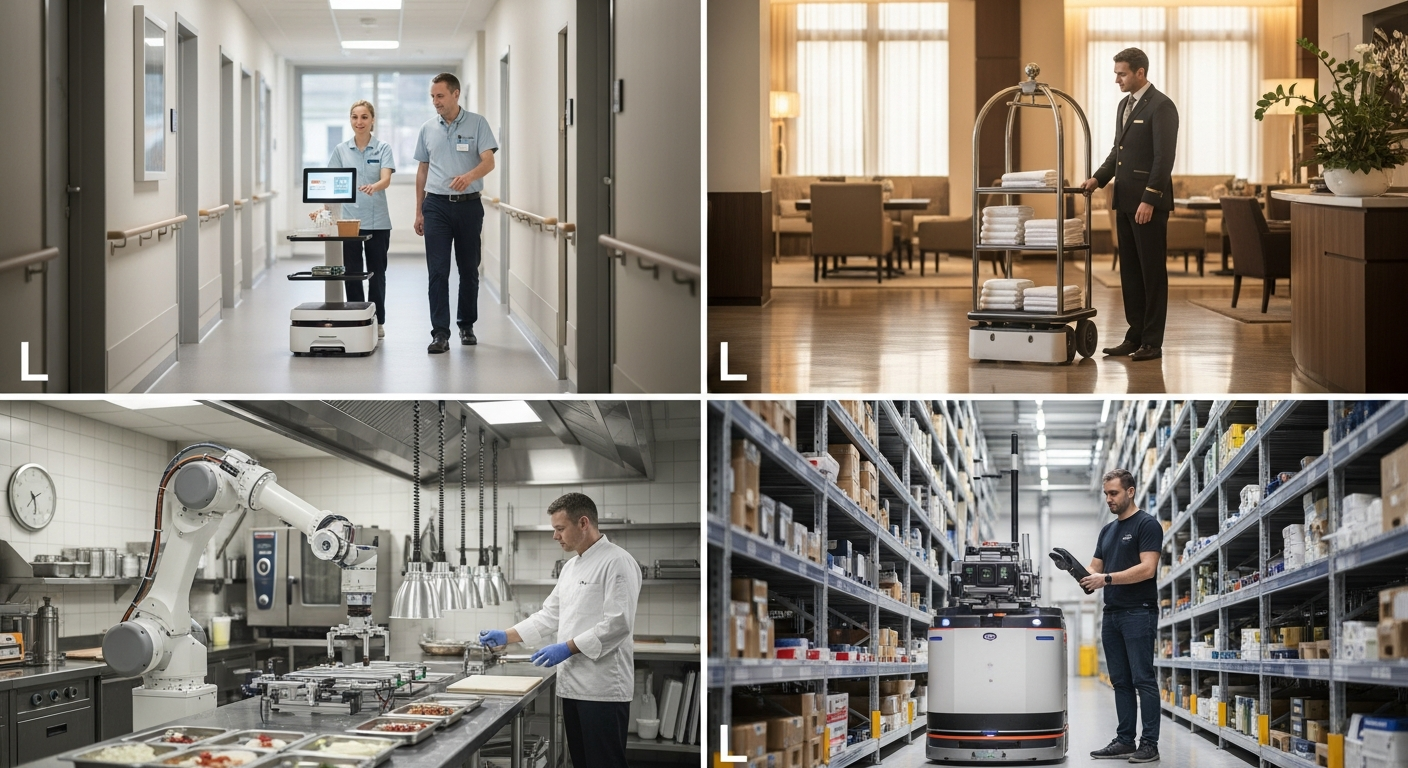
Floor 4. 22:00. The medication round is already underway. In a senior living facility in Hamburg, a robot navigates the corridor autonomously, carrying supplies to the night shift lead. This is not a discovery deck or a slide presentation. It is week 12 of a live operation where the robot is integrated into the facility workflow. For the Director of Operations, the focus is not on the sensors or the battery life of the machine, but on the €92,000 annual cost offset achieved by automating this specific task. This shift from buying a robot to integrating an outcome defines the role of a modern robotics integrator. werob operates as this critical layer, managing 200 robots live across 11 European countries as of May 2026.
Key Takeaways
- 1A robotics integrator provides the operating layer between 44+ OEMs and the operator's specific workflow.
- 2The 48-hour spec engine and 8-week deployment timeline significantly reduce time-to-value compared to traditional consulting.
- 3Compliance with the EU Machinery Regulation 2023/1230 is a mandatory requirement that integrators handle for operators.
The Difference Between an OEM and a Robotics Integrator
In the current robotics market, many operators confuse robot manufacturers (Original Equipment Manufacturers or OEMs) with integrators. An OEM like Boston Dynamics, Keenon, or Pudu focuses on the physical hardware and the base navigation stack. They build the machine. However, a robot in a box is not a solution for a senior living group or a logistics provider. It is a piece of equipment that lacks context. A robotics integrator like werob provides that context. werob is not a manufacturer and is not a single-OEM reseller. Instead, werob is a systems integrator that ranks 44+ OEM partners against a specific operator workflow.
The integrator's job is to ensure the robot works within the existing infrastructure. This includes navigating elevators, opening automatic doors, and, most importantly, communicating with the software the staff already uses. While an OEM wants to sell a specific model, an integrator is hardware-agnostic. If a different robot performs better for a specific task, the integrator switches the recommendation. This removes vendor lock-in and ensures the operator is always using the most efficient tool for the job. As of May 2026, werob tracks 280 different robots in its catalogue to ensure the match is data-driven rather than sales-driven.
The Four-Layer Platform Architecture
To move from a manual workflow to a live robot in eight weeks, werob utilizes a four-layer platform. The first layer is the Spec Engine. This tool converts an operator's plain-language description of a shift into a deployable robot action graph. Trained on over 35,000 projects, the Spec Engine produces a technical specification within 48 hours. This replaces the traditional three to six months of discovery meetings and consulting decks that typically stall automation projects.
The second layer is the Supplier Match. Once the spec is defined, werob ranks 44+ OEMs to find the best hardware. The third layer consists of Connectors. These are pre-built integrations into the operator's existing stack, such as PointClickCare, MatrixCare, Opera PMS, Mews, Toast, or SAP EWM. Without these connectors, a robot remains an isolated island of automation. The fourth layer is the Cockpit. This is the live fleet management interface that uses four-dimensional traffic lights to monitor hardware health, infrastructure connectivity, regulatory status, and task performance. This architecture allows werob to scale toward its target of 2,000 robots by 2028.
Operational Speed: From Spec to Floor in Eight Weeks
Time-to-value is the primary metric for any Director of Operations. Traditional robotics deployments often fail because the implementation cycle is too long, leading to lost interest or changing requirements. werob has standardized the deployment process to meet a strict timeline: 48 hours to produce a spec, five days to provide a quote, and eight weeks to have a live robot on the floor. This speed is possible because the platform treats hardware as a commodity and focuses on the integration logic.
By the time the robot arrives at the site, the digital environment is already prepared. The connectors are active, the regulatory assessments are complete, and the staff has been briefed on the specific tasks the robot will handle. This rapid deployment model is currently operational in 11 countries, including Germany, France, the UK, and Poland. For a facility manager, this means the staffing gap is addressed in two months rather than two years. The goal is not to experiment with technology but to solve a labor shortage with a reliable, integrated tool.
Quantifiable Cost Offsets Across Verticals
A robotics integrator must justify the deployment through concrete financial outcomes. werob uses verified cost offset figures based on live operations. In senior living, automating the medication round results in a €92,000 annual cost offset per site. Automating internal transport tasks in the same vertical saves €71,000 per year. These are not theoretical projections; they are the results seen by customers like Korian Deutschland. In the hospitality sector, room service robots provide a €112,000 offset, while automating bar and breakfast prep contributes €54,000 annually.
Other sectors see similar results. F&B kitchen floor cleaning robots offset €44,000, and tray-bots in dishrooms save €76,000 per year. In logistics and security, yard patrols provide a €68,000 offset, while retail security patrols save €58,000. Even in specialized areas like golf clubs, ball collection robots offset €38,000 and autonomous mowing saves €31,000. By focusing on these specific numbers, the integrator moves the conversation away from the novelty of the robot and toward the bottom-line impact for the business.
The Regulatory Forcing Function: EU Machinery Regulation 2023/1230
Compliance is often the biggest hurdle for robotics in Europe. A critical role of the integrator is providing a compliance pathway for the EU Machinery Regulation 2023/1230, which becomes mandatory on January 20, 2027. This regulation requires rigorous conformity assessments, particularly for robots manufactured outside the EU. werob acts as the local integrator positioned to handle these assessments, ensuring that the fleet remains legal and insurable. This is a mandatory requirement that many single-OEM resellers are not equipped to handle.
Beyond the Machinery Regulation, the integrator manages compliance with ISO 13482 for personal-care robots, which is essential for senior living and hospitality environments. They also ensure adherence to the EU AI Act, DSGVO (GDPR) for camera data, and IEC 62443 for industrial cybersecurity. In Germany, specific regulations like the BewachVO for security or Heimaufsicht for care facilities must be met. werob builds these regulatory checks into the Cockpit, providing a real-time compliance status for every robot in the fleet. This protects the operator from legal risks and operational shutdowns.
Software Integration and the Connector Stack
A robot that cannot talk to the building's software is a liability. A robotics integrator builds the bridges between the robot's operating system (often ROS-2) and the enterprise software stack. werob provides direct connectors into industry-standard platforms. In senior living, this includes PointClickCare and MatrixCare. In hospitality, integrations with Opera PMS and Mews allow robots to handle room service and guest requests autonomously. In the F&B sector, connectors for Toast and Lightspeed ensure that kitchen robots respond to real-time order flows.
For logistics and facility management, werob integrates with SAP EWM and Genetec. These connections allow the robot to be triggered by specific events, such as a pallet being ready for transport or a security sensor being tripped. This level of integration ensures that the robot is a seamless part of the workflow. The staff does not need to learn a new robot interface; they continue to work within the software they already know, while the robot executes the physical tasks in the background. This approach minimizes training time and maximizes adoption across the organization.
Outcome-Only Commercial Model
The traditional model of buying robots involves high upfront capital expenditure (CAPEX) and significant risk if the technology fails to deliver. werob eliminates this barrier through an outcome-only commercial model. Operators pay nothing until the robot is live and running on the floor. This aligns the integrator's incentives with the operator's success. If the robot does not perform the specified task or fails to integrate with the stack, the operator is not financially committed.
This model treats robotics as a service (RaaS) but with a focus on the integrated outcome rather than just the hardware rental. It allows companies to scale their automation efforts without the risk of stranded assets. Because werob is hardware-agnostic, they can optimize the cost by selecting the most cost-effective OEM that meets the technical spec. This transparency in pricing and the focus on realized savings make robotics accessible to a wider range of industries, from small golf clubs to large senior living groups.
The Future of Humanoids in the Workforce
While service and industrial robots are the current workhorses, the role of the integrator is expanding into the humanoid category. werob is already running humanoid pilots, such as the deployment in a Hamburg senior living facility which is now in its 12th week of operation. Humanoid robots from partners like Apptronik, Figure AI, 1X, and Unitree offer the potential to handle tasks designed for human form factors, such as navigating tight spaces or using tools.
The integrator's role here is even more vital. Humanoids are complex machines that require sophisticated action graphs to be useful. werob uses its Spec Engine to define exactly what these humanoids should do, ensuring they are not just walking around but performing value-add tasks. As the technology matures, the integrator will be the one to determine when a humanoid is a better fit than a specialized service robot. With 44+ OEM partners, werob is positioned to lead this transition, moving toward the 2028 goal of 2,000 robots in live operation.
Why Hardware-Agnosticism is the Only Path to Scale
The robotics market is fragmented. New OEMs emerge every month, and existing ones frequently update their hardware. An operator who commits to a single manufacturer risks being stuck with obsolete technology or a vendor that cannot support their growing needs. A robotics integrator provides a buffer against this volatility. By remaining hardware-agnostic, werob ensures that the operator's investment is in the workflow and the integration, not in a specific piece of plastic and metal.
If a manufacturer goes out of business or a better robot is released, the integrator can swap the hardware while keeping the software connectors and the workflow logic intact. This flexibility is essential for long-term operational stability. It allows companies to start with one type of robot for floor cleaning and expand to another for security or transport, all managed through a single Cockpit. This unified approach is the only way to manage a diverse fleet of 200+ robots across multiple sites and countries effectively.
FAQ
- What is the difference between a robot manufacturer and an integrator?
- A manufacturer (OEM) builds the robot hardware. An integrator like werob connects that hardware to your specific tasks, software stack, and regulatory requirements, ensuring the robot actually performs useful work in your facility.
- How long does it take to deploy a robot with werob?
- werob provides a technical spec within 48 hours, a quote within five days, and a live, integrated robot on your floor within eight weeks.
- Which software systems can werob integrate with?
- werob has pre-built connectors for PointClickCare, MatrixCare, Opera PMS, Mews, Toast, Lightspeed, GolfNow, Genetec, and SAP EWM.
- What are the typical cost savings for a robotics deployment?
- Verified annual cost offsets include €92,000 for senior living medication rounds, €112,000 for hotel room service, and €76,000 for F&B dishroom tray-bots.
- Is werob hardware-agnostic?
- Yes. werob ranks 44+ different OEM partners and over 280 robot models to find the best fit for your specific spec, avoiding vendor lock-in.
- How does werob handle EU robotics regulations?
- werob provides a built-in compliance pathway for the EU Machinery Regulation 2023/1230, ISO 13482, and the EU AI Act, ensuring your fleet is legal and safe.