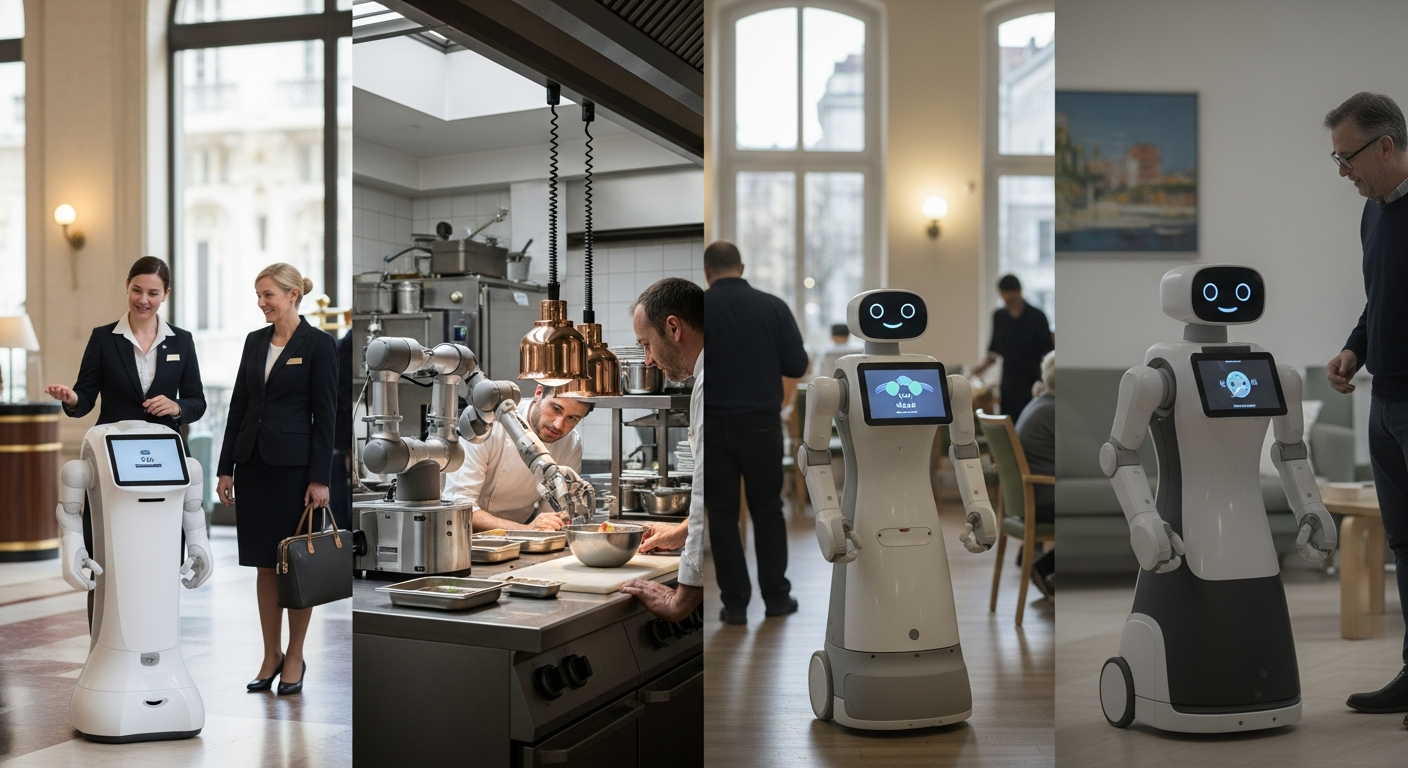
Robot Fleet Management: Scaling Operations Beyond the Pilot
Moving from a single robot to a fleet requires more than hardware. It demands a centralized operating layer that connects workflows, compliance, and real-time performance data.
Floor 2. 22:00. The medication round is already underway. In a senior living facility, a single nurse is responsible for forty residents. In the hallway, a transport robot moves linens while a medication-support unit follows the nurse from room to room. This is not a trial. It is a live deployment where the robot is a standard tool, much like a service elevator or a Wi-Fi network. However, the nurse never looks at a robot dashboard. The facility manager does not check battery levels. The fleet is managed by an underlying operating layer that ensures every unit is where it needs to be, compliant with local regulations, and fully integrated into the facility management software. This is the reality of professional robot fleet management.
Key Takeaways
- 1Hardware is a commodity; the real value lies in the operating layer that manages orchestration and integration.
- 2The EU Machinery Regulation 2023/1230 is a critical deadline for fleet compliance by January 2027.
- 3Direct connectors into stacks like PointClickCare and SAP EWM are essential for moving beyond isolated pilots.
The Shift from Hardware to Orchestration
In the early stages of robotics adoption, many operators focus on the physical machine. They compare battery life, payload capacity, and sensor range. However, for a Director of Operations, the hardware is increasingly a commodity. The true challenge lies in orchestration. Managing a single robot is a project; managing twenty robots across eleven sites is an operational discipline. Professional robot fleet management moves the focus away from the individual unit and toward the workflow it supports. This requires a systems integrator approach rather than a manufacturer-specific solution.
When robots are deployed at scale, the primary concern is uptime and task completion. If a robot stops in a corridor, it is not just a technical failure; it is a break in the service chain. A centralized fleet management system provides a 4-dimensional traffic light view: hardware health, infrastructure connectivity, regulatory compliance, and specification adherence. This level of oversight ensures that the robot remains an asset rather than a maintenance burden. By decoupling the hardware from the management layer, operators can mix and match different OEMs to suit specific tasks while maintaining a single point of control through the werob Cockpit.
The Four-Layer Platform for Fleet Success
werob operates as the systems integrator that bridges the gap between robot manufacturers and facility operators. This is achieved through a four-layer platform designed for speed and reliability. The first layer is the Spec Engine. It translates an operator's workflow into a deployable robot specification within 48 hours. This engine is trained on over 35,000 projects, allowing it to convert plain-language descriptions of shifts and tasks into a technical action graph. This accelerates the discovery phase while allowing experts to validate the technical action graph.
The second layer is the Supplier Match. werob ranks more than 44 OEM partners and 280 different robots against the generated spec. This hardware-agnostic approach prevents vendor lock-in and ensures the best tool is chosen for the specific environment. The third layer consists of Connectors. These are pre-built integrations into the operator's existing stack, such as PointClickCare for senior living, Mews for hospitality, or SAP EWM for logistics. Finally, the Cockpit provides the live fleet management interface, offering real-time supervision and reporting across all deployed units, regardless of their manufacturer.
Direct Connectors into the Operator Stack
A robot that operates in a vacuum is a liability. To provide real value, the fleet must communicate with the software the staff already uses. werob provides direct connectors into industry-standard platforms. In the senior living sector, integrations with PointClickCare and MatrixCare allow robots to receive task assignments directly from the care plan. In hospitality, connectors for Opera PMS and Mews enable room service robots to be dispatched automatically when a guest places an order. This automation removes the need for manual intervention, allowing staff to focus on high-value interactions.
For food and beverage chains, integrations with Toast and Lightspeed ensure that tray-bots are synchronized with the kitchen's output. In the logistics and security sectors, connectors for SAP EWM and Genetec allow autonomous patrol units to report incidents directly into the security operations center. This integrated data flow is what transforms a robot from a novelty into a functional part of the workforce. By using pre-built connectors, werob reduces the time to live deployment to just eight weeks, compared to the months required for bespoke integration projects.
Economic Impact and Cost Offsets
The decision to deploy a robot fleet is driven by economic necessity. Staffing shortages in Europe have made manual labor for repetitive tasks unsustainable. werob focuses on concrete cost offsets rather than vague productivity gains. In senior living, a robot-assisted medication round can generate a significant annual cost offset per site. General transport tasks in the same environment offer a measurable offset. These figures are not theoretical; they are based on live operations across 200 robots currently in the field.
In the hospitality sector, the numbers are even more pronounced. A hotel room service robot can offset substantial in annual costs, while automation in bar and breakfast preparation saves notable. F&B chains see a direct offset from dishroom tray-bots and clear from automated kitchen floor cleaning. Logistics yard patrols and retail security units provide offsets of proven and verified respectively. Even in niche markets like golf clubs, ball collection robots save demonstrated annually. These offsets allow operators to achieve a double-digit cost reduction in the first year of operation, as seen with customers like a major European care provider.
The Regulatory Forcing Function: EU 2023/1230
Compliance is often an afterthought in robotics pilots, but it is the most critical factor for scaling a fleet. The EU Machinery Regulation 2023/1230 becomes mandatory on January 20, 2027. This regulation introduces strict requirements for digital documentation, cybersecurity, and conformity assessments, particularly for robots using AI. Many Asian-made robots currently on the market do not yet meet these standards. As a systems integrator, werob provides the compliance pathway for these OEMs, ensuring that every robot in the fleet is ready for the 2027 deadline.
Beyond the Machinery Regulation, operators must navigate ISO 13482 for personal care robots and the EU AI Act. In Germany, the Heimaufsicht regulates robot use in care facilities, while the BewachVO applies to security patrols. werob builds these regulatory requirements into the Spec Engine from day one. This means that when a robot is matched to a task, it is already vetted for the specific legal framework of the country and vertical. This built-in compliance reduces the legal risk for Directors of Operations and ensures that the fleet can remain in operation long-term without facing sudden regulatory shutdowns.
Hardware-Agnostic Fleet Management
A significant risk in robotics is vendor lock-in. If an operator relies on a single manufacturer's software to manage their fleet, they are limited to that manufacturer's hardware roadmap. werob's hardware-agnostic model breaks this dependency. By ranking 44+ OEMs, werob allows operators to deploy a Keenon robot for food delivery, a Unitree humanoid for complex tasks, and a Pudu robot for cleaning, all managed through the same Cockpit. This flexibility is required as the robotics market evolves rapidly.
The ability to compare 280 different robots against a single specification ensures that the operator always has the most efficient tool for the job. If a new, more efficient model is released by a different manufacturer, the werob platform can integrate it into the existing fleet without requiring a complete overhaul of the software stack. This approach protects the operator's investment and ensures that the fleet can grow and adapt as technology improves. It also allows for regional variations, where different OEMs might have better support infrastructure in specific European countries.
Operational Uptime and the Cockpit
The werob Cockpit is the operational heart of the fleet. It provides real-time visibility into every robot's status across 11 European countries. The system uses a 4-dimensional traffic light approach to monitor performance. The first dimension is hardware health, tracking battery cycles, motor temperature, and sensor calibration. The second is infrastructure, ensuring the robot has a stable connection to the facility's Wi-Fi and the necessary IoT triggers for elevators or automatic doors. The third dimension is regulatory, flagging any upcoming maintenance or certification requirements.
The fourth and most important dimension is specification adherence. The Cockpit monitors whether the robot is actually performing the tasks defined in the original Spec Engine output. If a robot is assigned to a medication round but is consistently delayed by floor plan obstacles, the Cockpit alerts the operator to the discrepancy. This data-driven oversight allows for continuous optimization of the fleet. Instead of waiting for a staff member to report a problem, the system identifies bottlenecks and suggests adjustments to the robot's action graph, ensuring maximum ROI.
Case Study: Humanoid Integration in Hamburg
While service robots are the current standard, humanoid robotics are rapidly entering the operational phase. In a senior living facility in Hamburg, werob has overseen the first humanoid pilot, which is now in its twelfth week of operation. Unlike specialized service robots, humanoids are designed to operate in environments built for humans, using the same tools and pathways as the staff. This pilot focuses on tasks that require higher dexterity and adaptability than a standard AMR can provide.
The integration of humanoids into a fleet management system presents unique challenges in terms of safety and task complexity. However, by using the same Spec Engine and Cockpit architecture, the Hamburg facility can manage the humanoid alongside its existing service robots. This pilot demonstrates that the werob platform is future-proof. Whether the hardware is a simple tray-bot or a complex humanoid from partners like Apptronik or Neura Robotics, the management layer remains consistent. This allows operators to experiment with advanced technology without disrupting their core operational workflows.
The Outcome-Only Commercial Model
Traditional robotics procurement involves high capital expenditure and significant risk. werob eliminates this barrier through an outcome-only commercial model. Operators pay nothing until the robot is live on the floor and performing the specified tasks. This aligns the interests of the integrator with those of the operator. Because werob is not a manufacturer, there is no incentive to push a specific piece of hardware. The only goal is to deliver the operational outcome defined in the initial 48-hour spec.
This model is particularly attractive for large-scale groups in senior living or hospitality. For example, a senior living group deploying five robots across four sites can see an annualized cost offset of approximately significant. A resort group with eight robots across three properties can reach substantial in offsets. By removing the upfront financial risk, werob allows these organizations to scale their robotics programs quickly. The focus shifts from 'can we afford this' to 'how fast can we deploy across all sites.' This speed is reflected in the 2028 target of 2,000 robots live in operation.
FAQ
- How long does it take to deploy a robot fleet?
- werob delivers a technical specification within 48 hours, a quote within five days, and a live robot on the floor within eight weeks.
- Is werob a robot manufacturer?
- No, werob is a hardware-agnostic systems integrator. We rank 44+ OEM partners to find the best robot for your specific workflow.
- What is the outcome-only commercial model?
- You pay nothing until the robot is live and performing the tasks defined in your specification.
- Which software systems can werob integrate with?
- We have pre-built connectors for PointClickCare, MatrixCare, Opera PMS, Mews, Toast, Lightspeed, GolfNow, Genetec, and SAP EWM.
- How does werob handle the 2027 EU Machinery Regulation?
- We provide the compliance pathway for all our OEM partners, ensuring that every robot in your fleet meets the mandatory standards by January 20, 2027.
- Can I manage different robot brands in one system?
- Yes, the werob Cockpit is designed to manage multi-OEM fleets, providing a single interface for hardware, infrastructure, and regulatory monitoring.